 Botmonster Tech
Setup a Private WireGuard VPN for Secure Remote Access
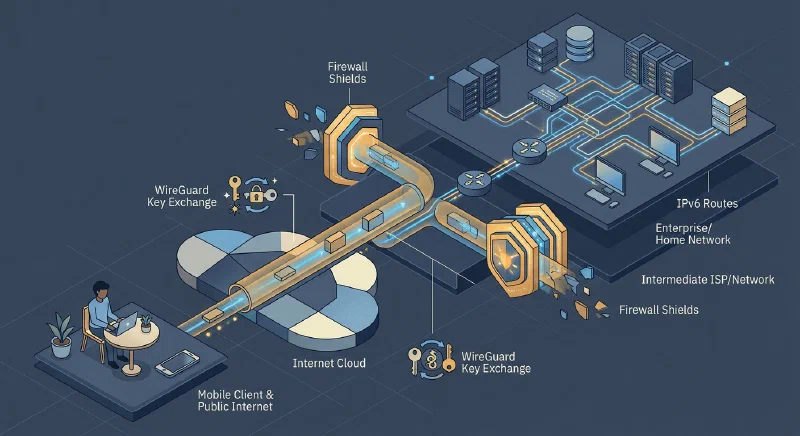
A private WireGuard VPN is the most practical way to reach your home lab, self-hosted apps, and development machines from anywhere without exposing services directly to the internet. Instead of opening many inbound ports, you publish one UDP endpoint and move trusted traffic through an encrypted tunnel. In 2026, that still gives you the best balance of speed, security, and operational simplicity.
This guide builds a production-ready setup from scratch on Ubuntu
or Debian
, then hardens it for real-world conditions: dynamic home IPs, IPv6, mobile clients behind carrier NAT, and restrictive networks that try to block VPN traffic. You will also see a GUI path (wg-easy
) for teams that prefer visual peer management over manual config files.
Why WireGuard in 2026? (And Why Not OpenVPN or Tailscale )
Before touching configuration files, it is worth understanding why WireGuard has become the default recommendation for private remote access.
WireGuard’s design is intentionally small and focused. The protocol and implementation are tiny compared with legacy VPN stacks, which means less code to audit and less room for accidental complexity. OpenVPN is still dependable and very flexible, but that flexibility often means more knobs, more historical compatibility baggage, and generally more CPU overhead on commodity hardware.
On modern x86 and ARM systems, WireGuard routinely delivers multi-gigabit throughput when both ends are capable, while still keeping handshake and reconnection behavior fast enough that mobile roaming feels seamless. You notice this in real workflows: SSH sessions recover quickly on network changes, file syncs saturate your uplink sooner, and latency-sensitive tools (remote IDEs, admin dashboards) feel less “tunneled.”
Tailscale is excellent and deserves honest mention. It uses WireGuard underneath but adds a managed control plane for identity, key orchestration, NAT traversal help, and relay fallback. If you want the least operational burden and are comfortable with a third-party coordination layer, Tailscale is often the fastest path to “it just works.”
This article takes the opposite design goal: zero external control-plane dependency. You own key material, peer metadata, routing policy, and logs on your infrastructure.
If you want Tailscale-like UX while keeping coordination self-hosted, look at Headscale . It lets you keep familiar client ergonomics but run your own control server.
| Option | Core Model | Typical Performance | Operational Complexity | Third-Party Dependency |
|---|---|---|---|---|
| WireGuard (manual) | Direct peer config | Excellent | Medium | None |
| OpenVPN | TLS-based VPN | Moderate | Medium-High | None |
| Tailscale | WireGuard + cloud control plane | Excellent | Low | Yes |
| Headscale + Tailscale clients | WireGuard + self-hosted coordination | Excellent | Medium | No cloud control plane |
The key takeaway: choose private WireGuard when control and independence matter most, and you are comfortable managing peer definitions directly.
Prerequisites and Architecture Planning
Good VPN deployments are won in planning, not in troubleshooting. Decide your topology, address space, and DNS behavior before you generate keys.
For the server, you need one reachable endpoint with a public IP or resolvable DNS name. That can be:
- A VPS in a provider region near your users.
- A home server behind port forwarding with either static IP or DDNS .
- A small cloud VM acting as a hub while your home network joins as a peer.
A practical baseline is Debian 12 or Ubuntu 22.04+ with root access and an uncomplicated firewall policy. Keep kernel and security patches current.
Topology choice comes next:
- Road warrior hub-and-spoke: phones/laptops connect to one central server. This is easiest to operate and ideal for “access my home/dev network from anywhere.”
- Full mesh peer-to-peer: every node may route to every other node directly. This reduces hub bottlenecks but adds route management complexity.
For most people, start with hub-and-spoke. You can evolve later.
Now choose a WireGuard subnet that does not collide with your LANs or office networks. If your home LAN is 192.168.1.0/24 and work LAN often uses 10.0.0.0/24, pick something less common like 10.44.0.0/24 for VPN addresses.
DNS planning is the next irreversible decision:
- Full-tunnel DNS: all queries go through VPN resolvers. Best privacy and consistent split-horizon internal names.
- Split DNS: only internal domains resolve via VPN, public DNS stays local. Better performance and fewer surprises on bandwidth-limited links.
Also plan address families from day one. In 2026, many networks are dual-stack, so include IPv6 in your design rather than bolting it on later. Example internal ranges:
- IPv4 VPN:
10.44.0.0/24 - IPv6 VPN ULA:
fd42:42:42::/64
| Planning Item | Recommended Default | Why |
|---|---|---|
| Topology | Hub-and-spoke | Easiest to reason about and debug |
| Listen Port | UDP 51820 (or 443 if needed) | Standard default, easy docs; 443 can evade restrictive firewalls |
| VPN Subnet | 10.44.0.0/24 | Avoids common home/office collisions |
| IPv6 Subnet | fd42:42:42::/64 | Enables dual-stack from start |
| DNS Strategy | Full-tunnel for privacy, split DNS for speed | Explicit trade-off you can revisit |
Server Installation and Key Generation
Assume a fresh Debian/Ubuntu server with sudo privileges.
Install packages:
sudo apt update
sudo apt install -y wireguard wireguard-tools qrencode nftables
Verify the kernel module is available:
modinfo wireguard | headGenerate key material and lock down permissions:
sudo mkdir -p /etc/wireguard/keys
cd /etc/wireguard/keys
wg genkey | sudo tee server_private.key | wg pubkey | sudo tee server_public.key
sudo chmod 600 server_private.key
sudo chmod 644 server_public.key
Create /etc/wireguard/wg0.conf:
[Interface]
Address = 10.44.0.1/24, fd42:42:42::1/64
ListenPort = 51820
PrivateKey = <SERVER_PRIVATE_KEY>

# NAT for IPv4 and IPv6 egress via this host
PostUp = nft add table inet wgtable; nft 'add chain inet wgtable postrouting { type nat hook postrouting priority 100; }'; nft add rule inet wgtable postrouting ip saddr 10.44.0.0/24 oifname "eth0" masquerade; nft add rule inet wgtable postrouting ip6 saddr fd42:42:42::/64 oifname "eth0" masquerade
PostDown = nft delete table inet wgtable
Replace <SERVER_PRIVATE_KEY> with:
sudo cat /etc/wireguard/keys/server_private.keyEnable forwarding permanently:
cat <<'EOF' | sudo tee /etc/sysctl.d/99-wireguard.conf
net.ipv4.ip_forward=1
net.ipv6.conf.all.forwarding=1
EOF
sudo sysctl --system
Open the UDP listen port in your firewall. With UFW :
sudo ufw allow 51820/udp
sudo ufw reload
sudo ufw status verbose
Bring up the tunnel and enable it at boot:
sudo systemctl enable --now wg-quick@wg0
sudo wg show
If your interface does not come up, run:
sudo journalctl -u wg-quick@wg0 -n 100 --no-pagerThat log is usually enough to spot typos in keys, interface names, or malformed post-up rules.
Adding Client Peers
Most setup failures happen in peer definitions, especially AllowedIPs and endpoint mistakes. Be explicit and consistent.
On each client, generate keys:
wg genkey | tee client1_private.key | wg pubkey > client1_public.key
wg genpsk > client1_psk.key
chmod 600 client1_private.key client1_psk.key
Add the client peer to server config (/etc/wireguard/wg0.conf):
[Peer]
PublicKey = <CLIENT1_PUBLIC_KEY>
PresharedKey = <CLIENT1_PSK>
AllowedIPs = 10.44.0.2/32, fd42:42:42::2/128
Then reload cleanly:
sudo wg syncconf wg0 <(sudo wg-quick strip wg0)
sudo wg show
Create client config (Linux/macOS/Windows via respective tools):
[Interface]
PrivateKey = <CLIENT1_PRIVATE_KEY>
Address = 10.44.0.2/24, fd42:42:42::2/64
DNS = 10.44.0.1

[Peer]
PublicKey = <SERVER_PUBLIC_KEY>
PresharedKey = <CLIENT1_PSK>
Endpoint = vpn.example.net:51820
AllowedIPs = 0.0.0.0/0, ::/0
PersistentKeepalive = 25
Important AllowedIPs patterns:
- Full tunnel:
0.0.0.0/0, ::/0routes all traffic through VPN. - Split tunnel to VPN subnet only:
10.44.0.0/24, fd42:42:42::/64. - Split tunnel to home LAN too: add
192.168.1.0/24(or your LAN).
Start a Linux client:
sudo wg-quick up wg0
wg show
ip route
ip -6 route
For mobile clients, generate a QR code from a finalized config:
qrencode -t ansiutf8 < client1.confOn iOS/Android WireGuard app, import by scanning. For recurring team onboarding, keep a secure process for handing out one-time configs and immediately archiving them.
Security Best Practices
A functioning tunnel is not automatically a hardened one. Treat your WireGuard host like a bastion.
Rotate keys periodically, especially after team changes, device loss, or role changes. WireGuard’s static key model is simple, but operational discipline matters more than protocol choice.
Use a PSK (wg genpsk) on each peer relationship. This adds a symmetric layer atop the normal key exchange and is a pragmatic defense-in-depth move against future cryptanalytic advances.
Use strict firewall rules, not broad allowlists. With nftables
, allow only established traffic and your WireGuard UDP port inbound. Drop invalid state aggressively.
Example minimal concept:
sudo nft add table inet filter
sudo nft 'add chain inet filter input { type filter hook input priority 0; policy drop; }'
sudo nft add rule inet filter input ct state established,related accept
sudo nft add rule inet filter input iif lo accept
sudo nft add rule inet filter input udp dport 51820 accept
sudo nft add rule inet filter input ct state invalid drop
About hiding ports: some restrictive networks heavily filter UDP except common ports. Running WireGuard on UDP 443 can increase success rates because many networks permit that path. This is not true protocol camouflage, but it can be enough for practical connectivity.
PersistentKeepalive is useful for clients behind NATs that aggressively expire UDP mappings. A value like 25 seconds keeps the path alive. Do not set it blindly on all peers forever; unnecessary keepalives create identifiable traffic patterns and drain mobile batteries.
Monitor with wg show and system logs. WireGuard itself does not include password-auth attempts like SSH, so classic fail2ban patterns do not map directly. Instead, watch for repeated handshake anomalies and unusual endpoint churn, then alert on that behavior from journald metrics or your log pipeline.
Operational hardening checklist:
- Patch OS and kernel on a predictable schedule.
- Use unique keypairs per device; never share client keys.
- Revoke peers immediately when devices are retired.
- Keep server private keys readable only by root.
- Backup configs and keys securely (encrypted backup vault).
Dynamic DNS (DDNS) for Home Servers Without Static IP
Many home ISPs rotate public IPs. Without DDNS, your clients eventually fail because Endpoint points to an old address.
The fix is simple: publish a stable hostname and update its DNS record whenever your IP changes.
Typical flow:
- Register
vpn.yourdomain.tldwith your DNS provider. - Create an API token scoped to DNS record updates.
- Run a lightweight DDNS updater on your router or server.
- Point all clients to the hostname, never raw IP.
A common Linux approach is ddclient
:
sudo apt install -y ddclient
sudo dpkg-reconfigure ddclient
Or use provider-native scripts (Cloudflare , Route 53 , DuckDNS ) via cron/systemd timers. The key is idempotent updates and alerting when updates fail.
If your ISP uses CGNAT and blocks inbound forwarding, direct home hosting may be impossible. In that case:
- Put your WireGuard hub on a low-cost VPS.
- Connect home server as a peer to that VPS.
- Route your clients through the VPS to reach home resources.
This architecture is often more reliable than fighting consumer ISP constraints.
A GUI Alternative: wg-easy with Docker
Not everyone wants to hand-edit peer blocks. wg-easy provides a web UI for creating peers, QR codes, and quick visibility.
Example docker-compose.yml:
services:
  wg-easy:
    image: ghcr.io/wg-easy/wg-easy:latest
    container_name: wg-easy
    environment:
      - WG_HOST=vpn.example.net
      - PASSWORD_HASH=<bcrypt-hash>
      - WG_DEFAULT_ADDRESS=10.44.0.x
      - WG_DEFAULT_DNS=10.44.0.1
      - WG_ALLOWED_IPS=0.0.0.0/0,::/0
      - WG_MTU=1420
      - WG_PERSISTENT_KEEPALIVE=25
    volumes:
      - ./wg-easy-data:/etc/wireguard
    ports:
      - "51820:51820/udp"
      - "51821:51821/tcp"
    cap_add:
      - NET_ADMIN
      - SYS_MODULE
    sysctls:
      - net.ipv4.ip_forward=1
      - net.ipv6.conf.all.forwarding=1
    restart: unless-stopped
Bring it up:
docker compose up -dThen browse to your server on port 51821 (e.g., https://192.168.1.100:51821). Use strong UI credentials, enforce TLS in front of the panel, and restrict management UI exposure with firewall rules or an internal-only route.
wg-easy is excellent for small teams, homelabs, and rapid onboarding. Manual config remains better if you need strict config review workflows and infrastructure-as-code pipelines.
IPv6 Dual-Stack WireGuard Configuration
IPv6 is no longer optional in many networks. Dual-stack WireGuard avoids breakage on IPv6-preferred clients and future-proofs your setup.
Server interface example already included IPv6:
Address = 10.44.0.1/24, fd42:42:42::1/64Client interface should also include both families:
Address = 10.44.0.2/24, fd42:42:42::2/64
AllowedIPs = 0.0.0.0/0, ::/0
Three practical notes:
- Enable IPv6 forwarding (
net.ipv6.conf.all.forwarding=1). - Add IPv6 NAT or routing policy matching your upstream network model.
- Test with IPv6-specific commands, not only IPv4 pings.
Validation commands:
ping -6 fd42:42:42::1
curl -6 ifconfig.co
dig AAAA example.com
If IPv6 handshakes succeed but traffic fails, inspect firewall family-specific rules. It is common to secure IPv4 correctly and accidentally leave IPv6 either too open or too restricted.
Multi-Hop and Obfuscation for Censored or Restricted Networks
In some environments, direct WireGuard UDP is throttled or blocked. Two patterns help: multi-hop routing and obfuscation wrappers.
Multi-hop means clients enter one VPN node, then route onward through a second egress node. Benefits include:
- Isolating entry and exit trust boundaries.
- Region-shifting egress for policy compliance or access needs.
- Limiting blast radius if one node is compromised.
Trade-off: more latency and more routing complexity.
Obfuscation is different from encryption. WireGuard is encrypted already, but traffic shape can still be identifiable. Tools such as AmneziaWG style packet shaping can reduce protocol fingerprinting in hostile networks.
A practical approach:
- Keep standard WireGuard profile for normal networks.
- Maintain a separate “restricted network” profile on alternate port/path.
- Use a relay VPS in a permissive region.
- Monitor reliability and fail back automatically when normal profile works.
Be clear on legal and policy boundaries wherever you operate. Technical capability does not remove compliance obligations.
Troubleshooting Common Issues
When WireGuard fails, debugging is straightforward if you separate handshake, routing, and DNS.
Start with handshake state:
sudo wg showIf there is no recent handshake:
- Check server UDP port exposure (
ufw statusornft list ruleset). - Verify
Endpointhostname resolves correctly. - Confirm DDNS record points to current public IP.
- Check router port forwarding for home-hosted servers.
If handshake exists but traffic does not flow:
- Confirm IP forwarding is enabled (
sysctl net.ipv4.ip_forward). - Verify NAT/postrouting rules were applied.
- Check client and server
AllowedIPsfor overlap mistakes.
If DNS leaks or DNS does not resolve:
- Confirm client
DNS =points to intended resolver. - Test resolver path with
dig whoami.akamai.netand compare expected egress. - If using split DNS, ensure domain-specific resolver rules are actually applied by your client OS.
If some sites work and others stall:
- Suspect MTU and fragmentation.
- Set
MTU = 1420on both ends, then retest. - On nested tunnels or mobile carrier paths, lower values like
1380may be necessary.
If mobile clients connect intermittently:
- Enable
PersistentKeepalive = 25on mobile peer. - Confirm device battery optimization is not suspending the WireGuard app.
A fast incident playbook:
| Symptom | Likely Cause | First Check |
|---|---|---|
| No handshake | Blocked UDP/incorrect endpoint | Firewall + DNS + port forward |
| Handshake, no packets | Routing/NAT/forwarding issue | sysctl, postrouting rules |
| Connected, name resolution fails | DNS config mismatch | Client DNS and resolver reachability |
| Random stalls | MTU mismatch | Set MTU=1420, retest |
| Works on Wi-Fi, fails on mobile | NAT timeout/policy filtering | PersistentKeepalive, port strategy |
Final Deployment Checklist
Before you call the deployment done, verify each of these items once:
- Server reachable by stable DNS name (DDNS if needed).
- IPv4 and IPv6 forwarding enabled.
- One unique keypair and PSK per client.
- Explicit firewall policy and only required inbound UDP exposed.
AllowedIPsreviewed for least-privilege routing.- DNS behavior matches your privacy/performance goal.
- MTU tuned for your real network path.
- Revocation process documented for lost devices.
- Optional GUI (
wg-easy) secured or disabled when not needed. - Optional restricted-network profile tested (multi-hop/obfuscation path).
A private WireGuard deployment pays off because it reduces your public attack surface while improving day-to-day remote access speed. Start with a simple hub-and-spoke setup, validate each layer methodically, and add advanced features only after baseline reliability is proven. That sequence gives you a VPN that is not just working, but dependable enough for daily development and home infrastructure operations.