 Botmonster Tech
Keycap materials compared: PBT, ABS, PC, and POM sound and feel
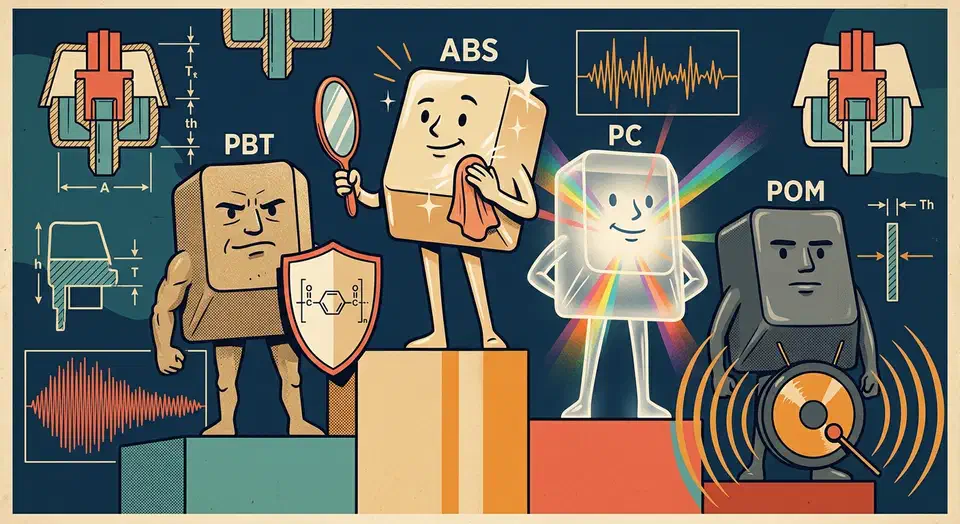
Asked as PBT vs PC keycaps, this has a clean answer: the two plastics solve different problems. PBT is the surface that still looks new in two years. PC is the one that lets your RGB through. For most typists, thick 1.5mm doubleshot PBT in Cherry or MT3 profile is the best all-around pick, because it resists shine for years and holds crisp legends through daily abuse. RGB builders should choose polycarbonate for maximum backlight bleed. ABS sets like GMK win on slickness, and POM sets like Keyreative POM sit at the premium end for the deepest sound.
Key Takeaways
- PBT is built for typing. PC is built for RGB light.
- Nobody has ever measured keycap sound, so ignore any hertz number.
- Polycarbonate is the toughest of these four plastics by a wide margin.
- Unprotected PC yellows in sunlight. Stabilized grades stay clear for years.
- Hybrid caps combine PBT feel on top with RGB glow below.
Each plastic trades sound, feel, durability, and legend quality differently. None wins on every axis, which is why enthusiasts end up owning three or four sets. Below: the PBT and PC head-to-head first, then each plastic in detail, then what nobody has measured about keycap sound, and a decision framework for 2026.
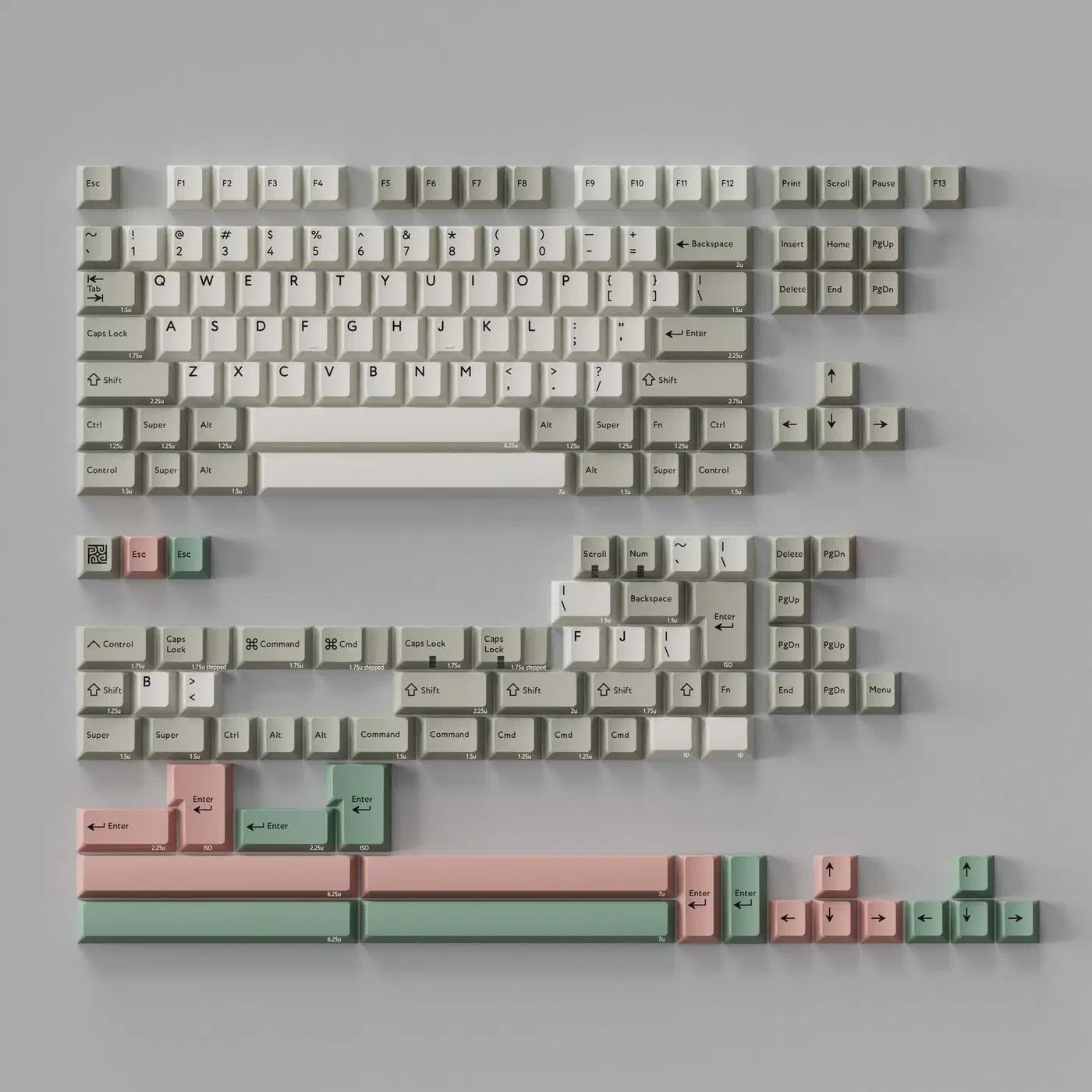
PBT vs PC keycaps: the direct comparison
Most people arrive here with the build already half decided. They want RGB, or they want caps that stay matte for years, and they suspect they cannot have both. The short version: PBT is the everyday typing surface, and PC is a lighting part shaped like a keycap. They are built for different jobs.
| PBT | PC (polycarbonate) | |
|---|---|---|
| Look | Opaque, matte, deep colors | Transparent or translucent |
| Feel | Slightly textured, grippy | Smooth, glassy |
| Sound | Lower, fuller | Brighter, glassy top end |
| RGB shine-through | No | Yes, 87 to 88% transmission |
| Impact toughness | Lowest of the four (1.38 J/cm) | Highest of the four (6.71 J/cm) |
| Shine resistance | Excellent | Good, but scratches show |
| UV yellowing | Not an issue | Yes if unstabilized |
| Typical wall | 1.45 to 1.55mm | 1.2 to 1.4mm |
| Price, base kit | $40 to $140 | $35 to $140 |
| Best for | Typists, daily drivers | RGB showcase builds |
Two rows usually decide it. If backlighting is the point of the build, PBT cannot do the job at any price, so the choice is made for you. If you type for a living and never look at the lights, PBT’s texture and shine resistance win and the decision is equally easy.
The contested middle is people who want both. That case has an answer most guides skip, covered further down: hybrid caps that use PBT on top and PC on the sides.
PBT keycaps: the durable workhorse
PBT (polybutylene terephthalate) is the default premium plastic for typists. It has a textured matte finish, strong shine resistance, and thick walls. It is also harder than ABS, so it shrugs off the finger oils that turn ABS glossy within months.
Wall thickness does more work than the material label. EnjoyPBT blanks and KBDfans sets run 1.45 to 1.55mm walls. That sounds deeper than the thin 1.0mm caps bundled with pre-built boards. Put a thick PBT set on a linear switch in an aluminum board and it reads lower and fuller than ABS. That is what people call thocky.
There are two main legending routes on PBT. Doubleshot (two-shot molding) gives legends that physically cannot fade, but PBT warps slightly at thin walls and long keys like spacebars are notoriously hard to get right. Dye-sublimation prints sink about 0.1mm into the cap surface and are permanent. The limit is direction: you can only print a darker legend onto a lighter base. Light legends on dark caps need the reverse dye-sub workaround.
Real sets worth considering:
- KAT Milkshake (1.5mm, spherical top, creamy thock)
- EnjoyPBT Cyan on White (doubleshot, 1.5mm)
- DCS-profile sets from Signature Plastics
- Cherry-profile ePBT runs sold through KBDfans
Long-term wear is where PBT justifies its price. A 1.5mm doubleshot set shows no visible shine after two to three years of daily 8-hour typing. GMK ABS starts to gloss on WASD and the space bar in four to eight months under the same load.
The downsides are real but manageable. Long keys can warp. Thin-wall sets sometimes crack at the stem. And the chalky texture feels alien if you are coming off ABS.
One caveat, and it is the loudest reply in every thread on this. Plenty of experienced typists say they cannot feel the difference between PBT and ABS at all, and that what people read as “PBT texture” comes mostly from the mold finish plus the wall thickness. They have a point. A slick PBT set and a textured ABS set will cross over, and cap weight changes the feel more than the material name does. Judge a specific set rather than a category.
ABS keycaps: smooth, loud, and shiny
ABS (acrylonitrile butadiene styrene) is what GMK and other Western premium vendors use. It molds to tighter tolerances, holds vibrant legends, and feels slick under the finger. It also shines, and the two facts are linked.
ABS is the softest of these four plastics. It averages 107 on the Rockwell R scale, against 117 for PBT and 120 for PC, per MatWeb datasheets. Softer surfaces wear faster. Daily rubbing buffs the matte texture into a glossy patch within four to eight months of heavy use.
Tolerances explain the premium. GMK’s Berlin factory turns out crisp 1.5mm doubleshot legends without the warping PBT suffers. That is why group-buy ABS sets still fetch $140 to $220 for a base kit through Divinikey and Cannonkeys.
Surface feel keeps people coming back. Untextured ABS is much slicker than PBT, so fingers move across it faster. FPS and rhythm game players tend to prefer that, and the caps feel cooler over long sessions.
The downside is the same slickness. Finger oils work the surface until it turns glossy and uneven, and the worn spots always land on WASD and the space bar first.
ABS reads brighter than PBT. On the same switches where PBT sounds thocky, ABS lands clacky and poppy.
MT3 is the exception worth knowing. The profile uses thick 1.5mm ABS with a deep scoop and a 16.5mm height. That extra mass pushes the sound closer to PBT. MT3 Susuwatari and MT3 Godspeed are the usual picks for the sculpted retro feel without GMK pricing.
Notable ABS sets in 2026:
- GMK Bento (Cherry profile, 1.5mm doubleshot, $165+)
- GMK Olivia++
- GMK Striker
- Signature Plastics SA “Retro” thick doubleshot
- MT3 Susuwatari from Drop
Avoid pad-printed ABS entirely. It is the cheapest legending method, ships on OEM stock caps, and wears off in weeks. The legend will smudge under rubbing alcohol and that is the easiest way to identify it before you buy.
Polycarbonate keycaps: built for RGB
Polycarbonate (PC) keycaps exist to serve RGB builds. The resin is clear. Covestro’s Makrolon datasheet puts light transmission at 87 to 88 percent at 4mm under ISO 13468-2, rising to 90 percent for its best grade.
PBT cannot match that at any wall thickness. It is a semi-crystalline polymer, and those crystal regions scatter light. That is the whole reason PBT is opaque and PC is not. So if you want shine-through legends, PC is the only real choice.
Typical PC wall thickness runs 1.2 to 1.4mm, a touch thinner than premium PBT, because thinner walls pass more light.
Worth correcting a common claim here. PC is the toughest of these four plastics by a wide margin, despite its reputation for cracking. Notched Izod impact strength runs about 6.71 J/cm for PC, against 2.22 for ABS and 1.38 for PBT, per MatWeb. It is the same plastic used for safety glazing.
PC caps do sometimes crack at the stem on stabilized keys, and threads on r/MechanicalKeyboards report it on left shift and spacebars. But the cause is stem geometry, molding stress and thin walls. Buy PC at the thicker end and the problem largely goes away.
Sound sits between ABS and PBT, with a glassy top end. Some listeners dislike it on linears. It suits tactiles like the Glorious Panda or Holy Panda X. The extra ring comes from the stiffness and thin walls, so a foam-dampened board is the easiest fix.
Do polycarbonate keycaps turn yellow?
Yes, if the plastic is unprotected. This gets muddled online, with vendors claiming PC is UV resistant and never yellows while other guides say it goes yellow in months of sun.
The resin maker settles it. Covestro names yellowing as the main effect of UV on polycarbonate and tracks it as Yellowness Index under ASTM E313 across a decade of outdoor weathering. It states flatly that “UV stabilization is essential” for parts facing heavy UV. The chemistry is well studied: UV breaks carbonate bonds, and the compounds left behind are what you see as yellow.
The limit on that is stabilized grades. UV-absorbing additives and coatings are standard practice, which is why plenty of PC parts never yellow in service. So both camps are half right. Unprotected PC will yellow near a sunny window. A stabilized grade will not. Vendors rarely say which they used, so treat a blanket “does not yellow” claim as unverified rather than false.
PBT and PC hybrid caps
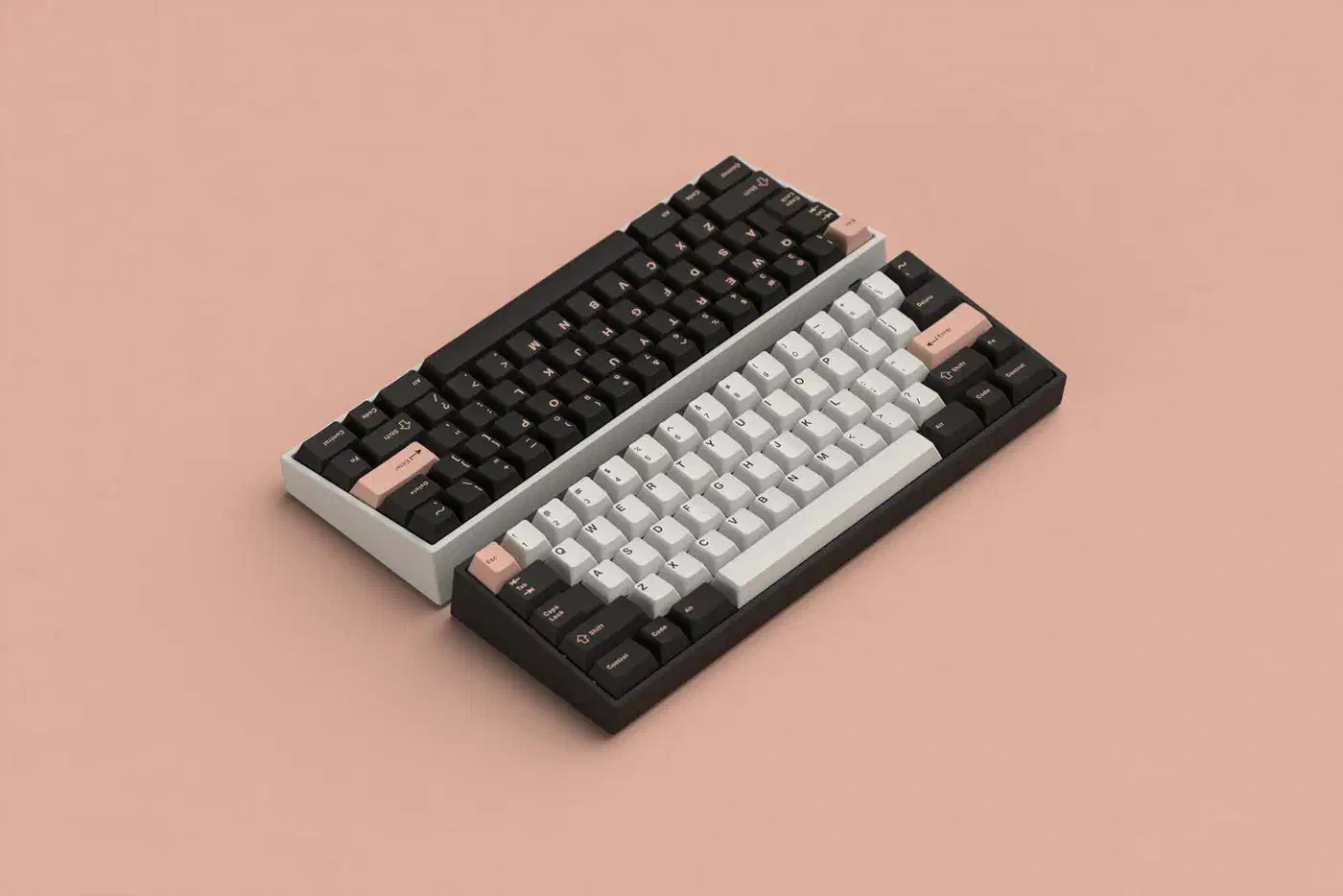
You do not have to choose. Hybrid sets, sold as PCPBT or Crystal Pudding, doubleshot the two plastics together. PBT forms the top surface and front wall where your fingers land. PC fills the sides and rear so backlight still escapes. You get PBT texture and shine resistance with most of the RGB glow. If you came here torn between feel and lighting, this is the way out.
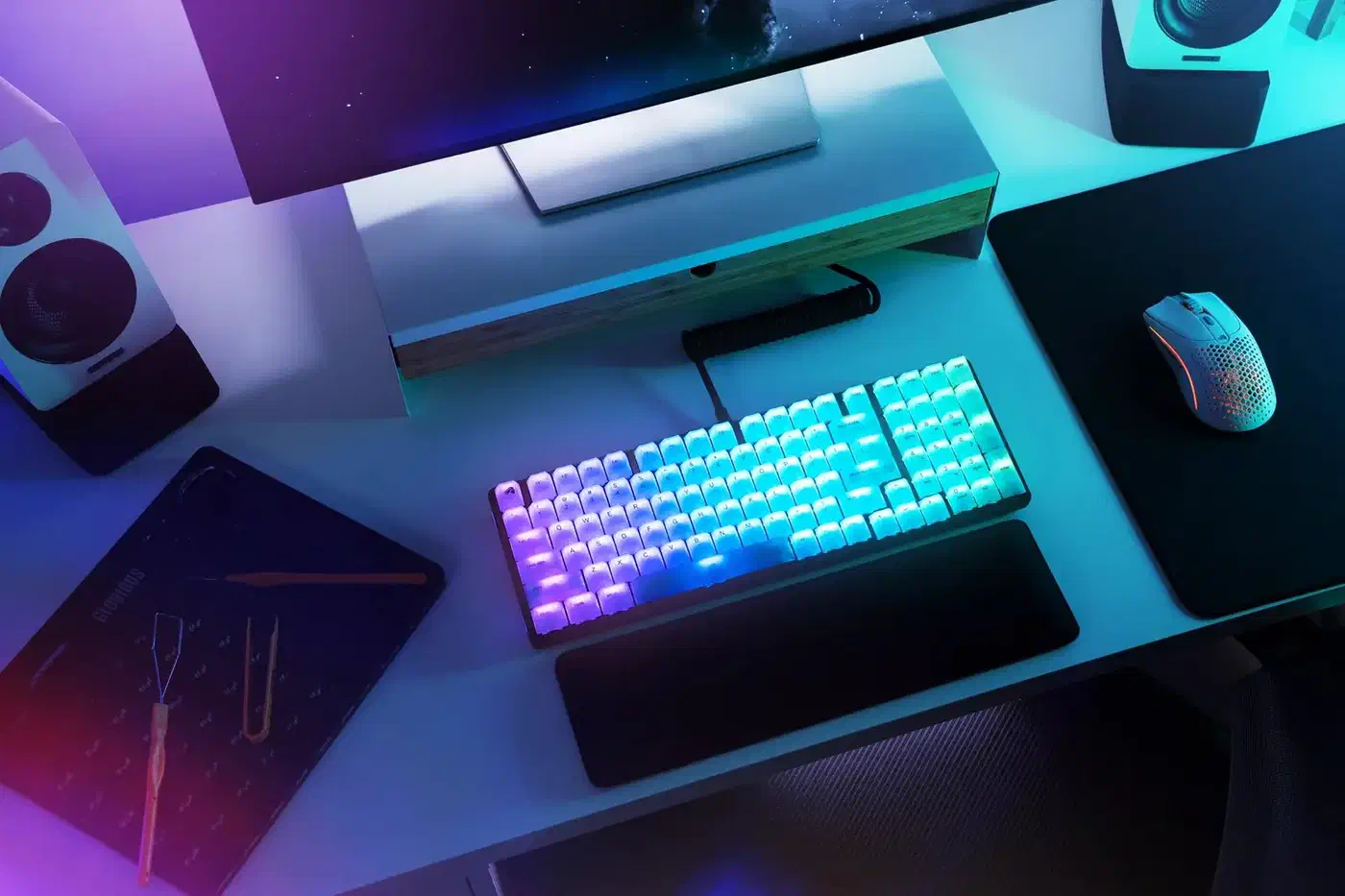
Legending on PC is almost always doubleshot. An opaque inner shot, usually black or white, blocks light everywhere except at the character. You get the classic shine-through look: the legend glows brightly and the rest of the cap glows faintly.
Two-tone pudding caps (opaque top, clear skirt) are the most common variant in 2026. They balance daytime legibility against nighttime diffusion.
Sets worth owning:
- Tai-Hao Pudding (the original PC-top ABS-skirt pudding)
- Akko PC sets
- Glorious GPBT Ice (semi-translucent hybrid)
- Glorious Polychroma RGB (fully translucent Cherry profile)
- KBDfans Clear PC blank sets
PC is also one of the cheaper enthusiast options. Budget sets run $35 to $80 and enthusiast-grade sets top out around $100 to $140, notably cheaper than GMK ABS.
POM keycaps: the premium thock
POM (polyoxymethylene, also sold as acetal or Delrin) is the newest arrival in the enthusiast scene. It is now the default pick for anyone chasing the deepest thock.
Density is the usual explanation. POM is the heaviest of the four, at about 1.42 g/cm³ against 1.31 for PBT, 1.20 for PC and 1.06 for ABS (MatWeb averages). Heavier caps damp more, and listeners widely report the strike sound dropping lower as a result.
Surface feel is the most polarizing thing about POM. The material is waxy and slippery because its surface friction is very low, the same property that puts it in gears and bearings. Some typists love the glide. Others hate the missing grip. If you have sweaty palms or type with a heavy hand, POM is probably not for you, and it can cause mis-hits on the home row.
The legending situation is limited. POM cannot easily be doubleshot molded, so most POM sets ship blank or with pad-printed and laser-etched legends. That limits design options significantly and is why most POM listings you see are minimal, monochrome, or blank with decorative novelties.
Real sets to consider:
- Keyreative POM in KAT profile (blank)
- TOFU POM from KBDfans
- Cherry-profile POM blank sets from Taobao vendors
- Domikey POM hybrid sets
POM sets typically run $90 to $180 blank, because the material is harder to mold and production runs are smaller. Weight is noticeable too. POM caps are 10 to 15 percent heavier than the same cap in PBT, which feeds the deeper sound and makes the board feel a touch firmer under the finger.
Gasket-mounted aluminum boards like the Mode 80, Keychron Q1 Pro, or QK75 pull the most out of POM. Board flex plus dense caps is where the thock comes from. A fully foamed tray-mount kills most of the character you paid for.
What nobody has measured about keycap sound
Every guide on this topic quotes confident numbers: exact decibels, exact frequencies in hertz. Earlier drafts of this one did too. So I went looking for the measurements behind them.
There are none. Not from a university group, not from an acoustics lab, not from Geekhack, Deskthority or KeebTalk. RTINGS has tested 296 keyboards and still publishes no per-material sound figures.
The numbers that circulate, and that AI answers now repeat as fact, trace back to a single keyboard vendor’s blog. That page publishes no plots, no raw data, no sample list and no equipment model, and it describes its own reasoning as an assumption rather than a measurement. There is also a widely repeated citation to an “ISO 3744 semi-anechoic chamber study” of keycap sound. I fetched the page it is credited to. The study is not there. It appears to have been invented somewhere in the summarizing layer and then copied around.
The closest anyone has come is still unmeasured. A KeebTalk thread ran spectrograms across keycap profiles, not materials, and produced no numbers. Click and Thock does side-by-side sound tests the right way, holding the board, case, plate and switches fixed so only the plastic changes. Then it just lets you listen, without offering a verdict.
So what can you trust? Density and hardness are real, published, and cited above. The jump from “POM is denser” to “POM sounds lower” is a fair hypothesis with plenty of listening behind it, and no data. Read the ordering in this guide as the consensus of people who have heard a lot of boards. Read any specific hertz figure, anywhere, as decoration.
Legending methods: dye-sub vs doubleshot vs pad-print
How letters get onto keycaps decides durability, legibility, and which materials are viable at all:
| Method | Durability | Works on | Typical cost |
|---|---|---|---|
| Doubleshot | Permanent (physical) | ABS, PBT, PC | Highest |
| Dye-sublimation | Permanent (ink) | Light PBT only | Mid |
| Reverse dye-sub | Permanent (masked dye) | Any PBT | Mid |
| Pad/UV print | Wears off in months | Any | Cheapest |
| Laser-etched | Permanent | Any (including POM) | Low to mid |
Doubleshot molds the legend as a separate piece of plastic fused into the cap, so it cannot wear off. It is the standard for GMK (ABS), ePBT and EnjoyPBT (PBT), and Tai-Hao Pudding (PC). Doubleshot PBT has closed most of the tolerance gap with ABS and now hits GMK-level crispness at 1.5mm walls.
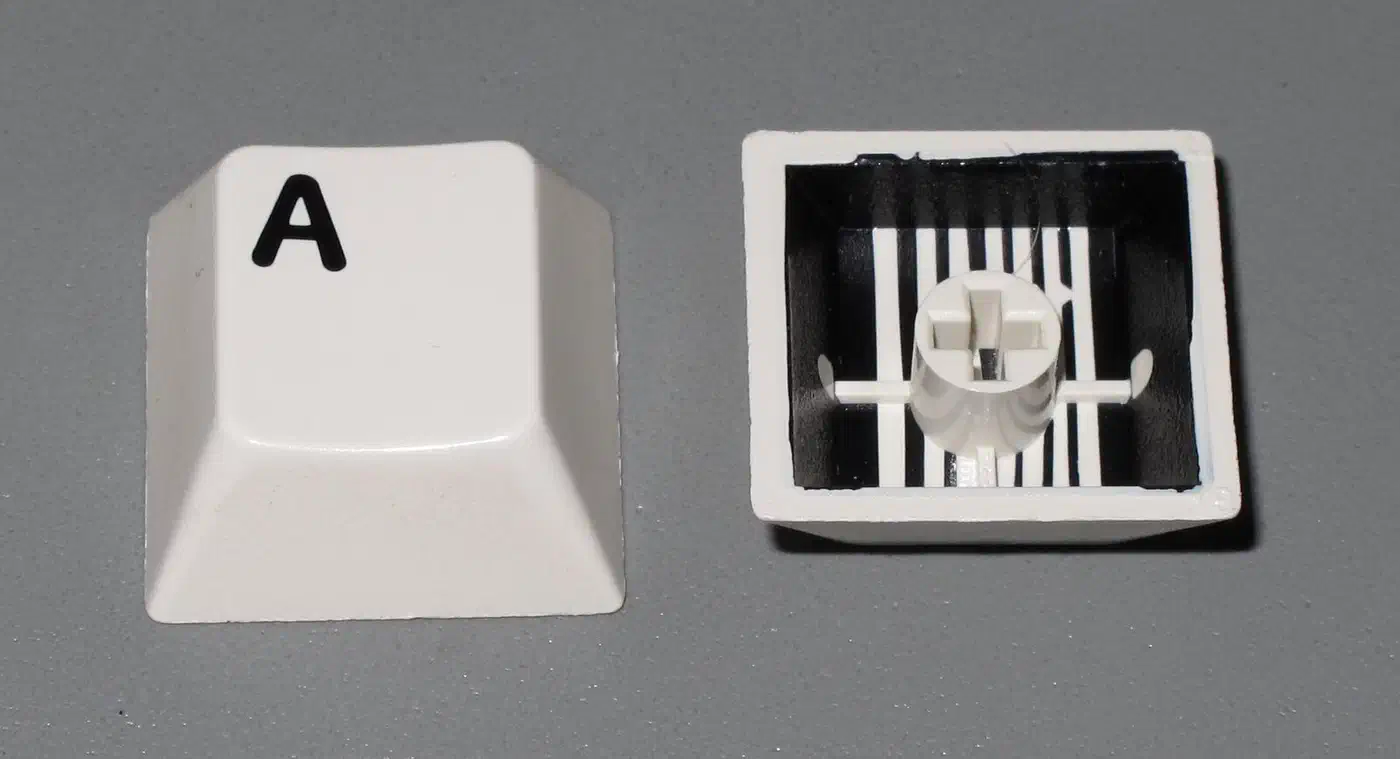
Dye-sublimation is heat-pressed ink that sinks about 0.1mm into the plastic. It only works on light PBT, because the ink can only darken the base color. Most KAT, XDA, and DSA sets on Drop and Divinikey are dye-sub, and the best ones match GMK at half the price.
For light legends on dark caps there is reverse dye-sub: dye the whole cap and mask the legend. Edge sharpness can be hit or miss.
UV-printed and pad-printed caps are the cheapest. Ink sits on top of the plastic and wears off in weeks to months. If a $20 “PBT” set on Amazon has a legend that smudges under rubbing alcohol, it is pad-printed and should not be considered an enthusiast option. Laser-etched legends are permanent and work on any material including POM, but the legend is always the color of the base plastic and legibility suffers.
The 2026 keycap decision framework
Picking the right set comes down to matching your use case, board, and switches.
Start with use case. Typing-focused buyers get the most out of PBT doubleshot in Cherry or MT3. Keycaps shape sound and feel but not posture, so programmers who type code all day should sort out the board first: a tented ergonomic keyboard does more for wrist strain than any cap swap. RGB showcase builds need PC pudding or full-translucent caps. Sound tuners chasing the deepest thock should go blank POM in KAT or Cherry.
PBT vs PC keycaps for gaming
Gaming puts weight on things a typing guide skips.
Wear lands in one place. WASD and the space bar soak up a huge share of your keystrokes, so ABS gloss shows there as a shinier patch while the rest of the set still looks new. PBT avoids that. PC mostly does too, though it picks up fine scratches and shows fingerprints on glossy surfaces.
Grip changes under sweat. PBT’s texture keeps its bite when your hands are damp. PC and ABS are smoother and turn slippery. POM is the slipperiest of the lot, which makes it a poor fit for tense sessions no matter how good it sounds.
Stem cracking is the one real PC worry, and the usual explanation gets it backwards. As covered above, PC is the toughest of these plastics, so cracks trace to thin walls and stem geometry on stabilized keys. If you bottom out hard, buy PC sets at the thicker end and check the spacebar.
The short answer for most gamers: PBT if you want it to last. PC if the lighting is the point. A hybrid if you cannot decide.
Profile comes next. Flat typists want XDA or DSA. Touch typists prefer Cherry or OEM. Anyone who likes sculpted keys should look at SA or MT3, and spherical-top fans tend to land on KAT or MT3. Here are the heights for reference:
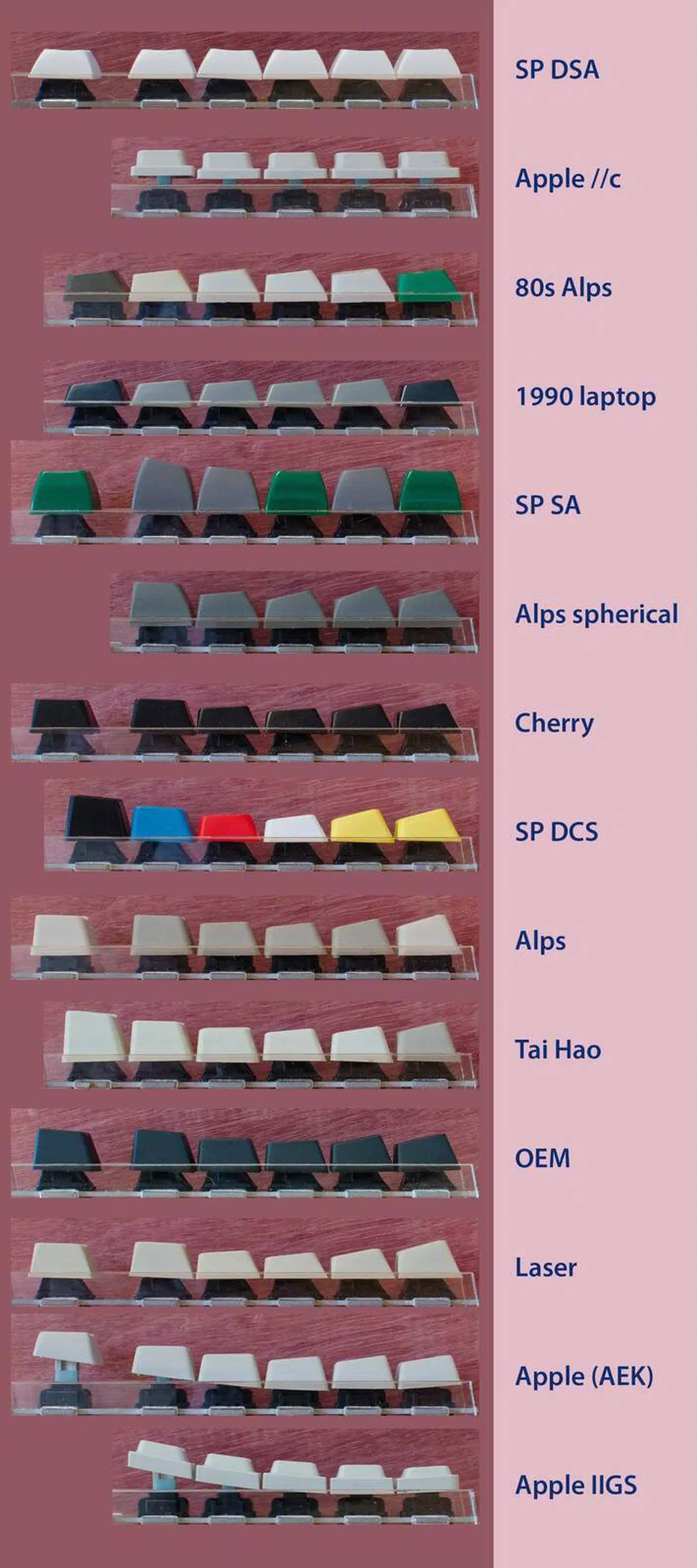
| Profile | Height | Shape | Typical material |
|---|---|---|---|
| XDA | 9.0mm | Uniform, flat-spherical | PBT dye-sub |
| DSA | 7.6mm | Uniform, spherical | PBT dye-sub |
| Cherry | 9.4mm | Sculpted, cylindrical | PBT/ABS doubleshot |
| OEM | 11.9mm | Sculpted, cylindrical | ABS/PBT |
| KAT | 10.4mm | Sculpted, spherical | PBT dye-sub |
| SA | 16.5mm | Sculpted, spherical | ABS doubleshot |
| MT3 | 16.5mm | Sculpted, scooped | ABS doubleshot |
Budget sorts the rest. $40 to $80 gets dye-sub PBT from EnjoyPBT or Akko. $80 to $140 gets doubleshot PBT or mid-tier PC. $140 to $220 gets GMK ABS or premium POM from Keyreative. Above $220 you are paying for novelty kits, artisans, and group-buy premiums, not better sound.
Board matching counts too. Brass-plate tray-mount boards sound better with PBT, which warms up an otherwise bright chassis. Flex-cut FR4 plates suit POM, which sits lowest of the four. Fully foamed tray-mounts kill most keycap character, so on a dampened board you can save money and pick on looks alone.
Switches finish the pairing. Linears like Gateron Oil Kings work best with PBT or POM for thock. Tactiles like Boba U4T work best with ABS or PC for a crisper clack. And if you mainly want the board quieter, silent switches cut far more noise than any cap swap, without changing how the caps feel.
Three mistakes come up again and again. Buying thin 1.0mm PBT and hating the tinny sound. Buying GMK for a gaming build, then watching it gloss within six months. Buying POM without checking the legending limits first.
One last rule of thumb. On a $200+ custom board, keycaps change the sound more than the switches do. Budget for that, and never pair a $300 board with $20 stock caps.
Common questions
Are PBT keycaps better?
For most people, yes, but only on the axes PBT competes on. It resists shine, holds its texture, and lasts years longer than ABS under the same use. It loses if you want RGB shine-through, where it cannot compete at all, or if you prefer a slick surface, which is a taste question rather than a quality one. GMK’s ABS sets cost more than most PBT and are aimed at a different buyer.
Is ABS or PBT more thocky?
PBT, generally. On the same switches and board, PBT reads lower and fuller while ABS reads brighter and clackier. Thickness complicates it: a thick 1.5mm ABS set like MT3 will sound deeper than a thin 1.0mm PBT set, so wall thickness can outweigh the plastic. Nobody has published measurements confirming the ordering, as covered above, so this is listening consensus rather than data.
What are PC keycaps?
Keycaps molded from polycarbonate, the clear, impact-resistant plastic used in safety glazing and headlight lenses. Being see-through is the entire point. Backlight passes through the whole cap, not just the legend. They feel smooth and glassy, sound brighter than PBT, and show up almost only in lighting-focused builds.
How to tell if keycaps are PBT or ABS?
Four checks, cheapest first. Feel the surface: PBT is slightly grainy, ABS is smooth and a little waxy. Tap two caps together: PBT gives a duller, deader knock and ABS a sharper click. Look at the wear on an old set, because gloss on WASD and the spacebar is a strong ABS signal. Finally, rub a legend with rubbing alcohol on a cotton bud. If it smudges, the legend is pad printed, which almost always means a cheap ABS set regardless of what the listing claims.