 Botmonster Tech
Hall Effect Mechanical Keyboard Switches: Wooting vs. Geon Raw HE

If you’ve been following the mechanical keyboard scene over the past couple of years, you’ve probably noticed Hall Effect keyboards moving from niche curiosity to genuine mainstream contender. The technology that was once confined to expensive custom builds and obscure group buys is now showing up in mid-range boards from Keychron, Razer, and SteelSeries. And at the top of the pile, two keyboards have emerged as the flagships of the Hall Effect world: the Wooting 80HE and the Geon Raw HE .
These two boards represent different philosophies. The Wooting is lean, focused, and purpose-built for competitive gaming. The Geon is heavier, more expensive, and designed for people who want Hall Effect precision in a package that can hold its own against a $500 custom mechanical board. Understanding which one makes sense for you requires understanding the underlying technology first - because Hall Effect keyboards genuinely work differently from every traditional mechanical switch you’ve used before.
How Hall Effect Switches Actually Work
A traditional Cherry MX-style switch registers a keypress through physical contact: two metal leaves touch each other when the stem is pushed down far enough, completing a circuit. It works, and it has worked reliably for decades. But it has two fundamental limitations.
First, metal contacts bounce. When the leaves first touch, they vibrate against each other briefly before settling, producing a rapid series of make-and-break signals that the keyboard firmware has to filter out. This is called debouncing, and it introduces a delay - typically 5 to 15 milliseconds - to ensure the firmware only registers one keypress per physical press. That delay is baked into the hardware and cannot be eliminated without introducing false inputs.
Second, the actuation point is fixed by the physical geometry of the switch. If your Cherry Red actuates at 2.0mm, it actuates at 2.0mm forever, regardless of whether you’re playing a reaction-time-critical FPS or writing a long document where a slightly deeper actuation would reduce accidental keypresses.
Hall Effect switches solve both problems at once. Instead of metal contacts, an HE switch has a small permanent magnet embedded in the stem. Beneath the switch, mounted on the PCB, sits a Hall Effect sensor - a semiconductor device that produces a voltage proportional to the strength of the magnetic field passing through it. As the stem travels downward, the magnet moves closer to the sensor, and the sensor output changes in a smooth, continuous, analog curve. The firmware samples this sensor continuously, converting the analog position reading to a digital value that represents exactly where in the travel range the key currently is.
Because there’s no physical contact, there’s nothing to bounce. The firmware knows the precise position of the key at all times, with no need for a debounce delay. And because the firmware knows the exact position, it can be configured to register a keypress at any point in the travel range - 0.1mm from the top for maximum speed, or 2.5mm down for deliberate, fatigue-reducing typing. That configuration can be changed in software, per key, at any time.
The killer feature that this enables is rapid trigger. Traditional switches have a fixed actuation point and a fixed reset point. You press down past 2.0mm to actuate, and you have to release back above roughly 1.6mm before the switch will actuate again on the next press. Rapid trigger replaces this with a dynamic system: the switch actuates when it moves downward by your configured trigger distance (say, 0.2mm), and resets the moment it changes direction and moves upward by your configured reset distance (say, 0.2mm). The result is that you can hold a key half-pressed and tap it rapidly in tiny movements, re-actuating with each downward flick. For FPS games, this means counter-strafing that is physically impossible with traditional switches - your movement key re-registers the instant you reverse direction, with no waiting for a fixed reset point.
The practical cost of all this is that HE keyboards are more expensive to manufacture. Each key requires its own Hall Effect sensor and analog-to-digital conversion circuitry. A standard hot-swap PCB is relatively cheap to produce; an HE PCB is not. This cost gets passed on, which is why the entry price for a decent HE board is higher than the equivalent mechanical board from the same brand.
Wooting 80HE: The Competitive Gaming Standard
The Wooting 80HE is a TKL (80%) layout keyboard with an aluminum top frame and polycarbonate bottom. It weighs around 830 grams - light enough that competitive players who move their keyboard during gameplay won’t find it annoying. The connection is USB-C wired only, which is the right call for a board aimed at people who care about consistent latency.
The switches are Wooting’s own Lekker v2 linear HE switches with a 55g bottom-out force and 4.0mm of total travel. The stems use standard MX cross geometry, so any MX-compatible keycap set will fit. They’re also hot-swappable, and the Wooting PCB is compatible with other Hall Effect switches like the Gateron KS-20 if you want to experiment with different feels.
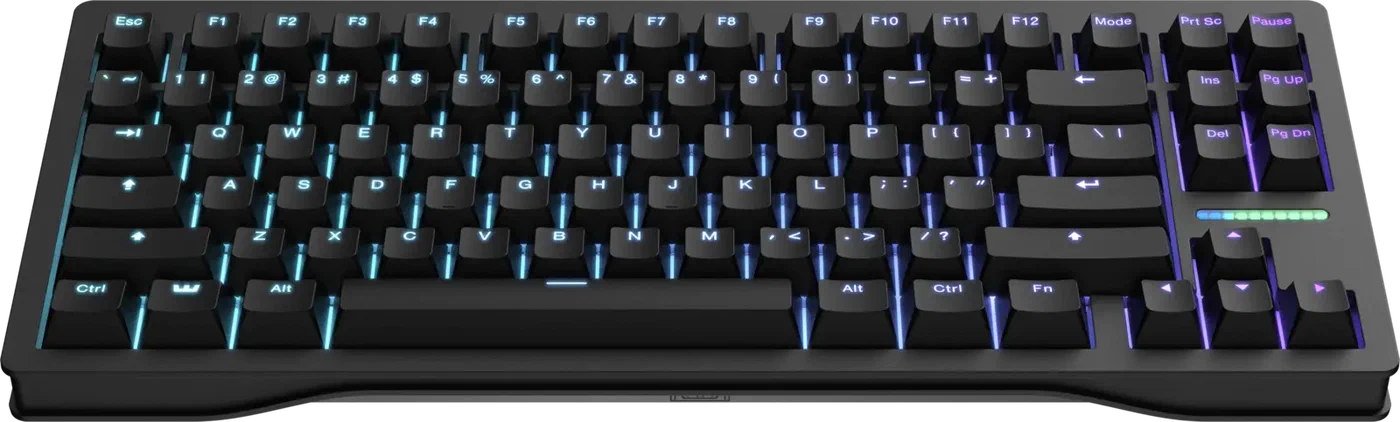
Where the Wooting really pulls ahead is firmware. Wooting’s Woot Dev configurator is web-based - no installation required, works on any OS with a modern browser - and it’s open-source. The feature set is the most complete in the consumer HE market. You get adjustable actuation (0.1 to 4.0mm, per key), rapid trigger with configurable sensitivity (0.1 to 4.0mm), Dynamic Keystroke (DKS) which lets you assign different actions to different depth zones within a single key press, and mod tap which lets you configure a key to have different behavior on tap versus hold. DKS alone is something no other manufacturer has implemented, and it opens up genuinely creative use cases - for example, mapping a key to walk when pressed halfway and sprint when pressed fully.
The Woot Dev community is active. Thousands of per-game profiles have been shared publicly, covering everything from Valorant to CS2 to Apex Legends to Minecraft. If you pick up a Wooting 80HE, you can have an optimized, per-game rapid trigger configuration running within minutes of plugging it in.
Latency testing by Optimum Tech and Rtings confirms end-to-end latency of around 2.5ms for the Wooting 80HE - among the lowest numbers recorded for any keyboard in 2026. Wooting uses a custom USB firmware implementation with sub-1ms polling that bypasses the standard USB HID debounce timing.
Pricing sits at $174.99 for the standard configuration, or $199.99 if you want the PBT double-shot keycap upgrade. Availability has improved substantially since the early days of persistent sellouts and multi-month wait lists.
Geon Raw HE: The Enthusiast Typing Experience
The Geon Raw HE takes a different approach. If the Wooting is a focused, sports-specific tool, the Raw HE is a luxury daily driver that happens to have Hall Effect technology inside.
The case is full 6063 aluminum, CNC-machined and anodized, and it weighs 2.2 kilograms. That’s not a typo. The weight is partly a feature - a heavy board stays put on the desk during typing - and partly a consequence of the thick aluminum construction. The layout is 75%, giving you function keys and arrow keys without the full numpad footprint of a TKL. Connectivity covers USB-C, Bluetooth 5.3, and 2.4GHz wireless, making it the only flagship HE board with a full wireless stack.
The plate system is the other major differentiator. The Raw HE ships with three plates - FR4, POM, and aluminum - and uses a gasket mounting system. Gasket mounting means the plate floats on silicone or rubber gaskets rather than screwing directly to the case. The result is flex on keystroke impact, which is softer on fingers during long sessions and produces a distinctly different sound profile. Combined with the silicone dampening sheets included in the kit, the Raw HE produces a deep, dense, thocky sound that holds its own against custom mechanical builds costing significantly more.
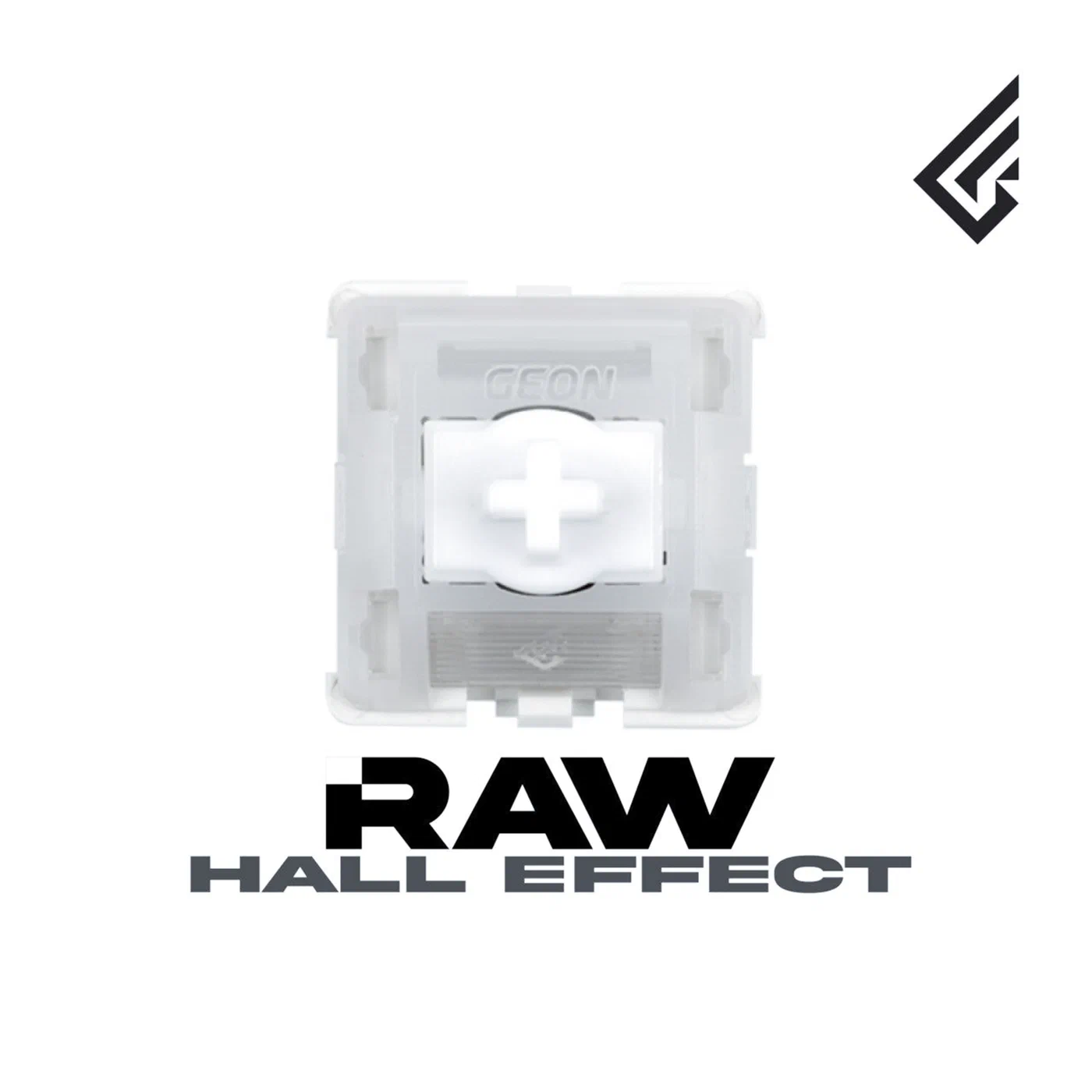
The switches are Geon x Gateron Magnetic Jade, a linear HE switch developed specifically for the Raw HE. They have a 50g bottom-out force (lighter than the Lekker v2) and 3.8mm of total travel. Gateron engineered the magnet strength specifically to produce a consistent analog readout across the full travel range - a detail that matters for rapid trigger precision at very low sensitivity settings.
Firmware covers the essentials: adjustable actuation from 0.2 to 3.5mm, rapid trigger, and per-key sensitivity. What it lacks relative to the Wooting is the advanced features - no DKS, no mod tap. Firmware updates are delivered through a desktop app that supports Windows, macOS, and Linux. The app is functional but less polished than Woot Dev, and the community sharing profiles and tips is much smaller.
The price reflects the premium positioning: $299 for the standard kit, $349 if you add the wireless module and extra plates.
Head-to-Head: Gaming vs. Typing vs. Programming
For competitive gaming, the Wooting 80HE wins without much argument. Lower weight means easier repositioning. The firmware iteration pace is faster, so new features arrive more frequently. The DKS feature has no equivalent on the Geon. The Woot Dev profile ecosystem means you spend less time configuring and more time playing. The Raw HE’s weight is a minor disadvantage for desktop FPS use, and its wireless latency over 2.4GHz (measured at 2-3ms in independent tests) is a real concession compared to the Wooting’s wired performance.
For extended typing - writing, documentation, blogging, anything that keeps you at the keyboard for hours - the Geon Raw HE earns its price premium. The gasket flex absorbs keystroke impact in a way that the Wooting’s stiffer plate doesn’t. Acoustics are substantially better; the Wooting sounds fine, but the Raw HE sounds genuinely good, and that matters when you spend eight hours a day in front of it. Enthusiast forums and long-term reviews consistently rate the Raw HE higher for comfort over multi-hour sessions. The lighter 50g Magnetic Jade switches reduce finger fatigue compared to the 55g Lekker v2.
Programming sits closer to a tie, but the Raw HE edges ahead for anyone at the keyboard most of the day. The optimal configuration for either board: set actuation to 1.5-2.0mm for deliberate keypresses that reduce accidental inputs, then set rapid trigger sensitivity to 0.5mm so the board stays responsive for navigation shortcuts without becoming twitchy during code editing. Both boards support this; the Raw HE just makes it more comfortable to sustain.
| Feature | Wooting 80HE | Geon Raw HE |
|---|---|---|
| Layout | TKL (80%) | 75% |
| Weight | ~830g | ~2,200g |
| Switches | Lekker v2 (55g) | Magnetic Jade (50g) |
| Mount type | Top mount | Gasket mount |
| Wireless | No | BT 5.3 + 2.4GHz |
| Rapid trigger | Yes | Yes |
| DKS / mod tap | Yes | No |
| Software | Web-based (Woot Dev) | Desktop app |
| Price | $174.99 | $299 |
| Best for | Competitive gaming | Typing, daily driving |
Keycap compatibility is a wash - both use standard MX stems and will accept any MX keycap set. The Geon ships with slightly higher-quality doubleshot PBT keycaps with tighter legends, but the Wooting’s stock keycaps are decent for the price.
The Broader Hall Effect Market in 2026
Wooting and Geon sit at the top of a market that has expanded significantly in the past 18 months. Understanding where they fit requires a quick tour of what else is available.
The budget tier ($60-100) now includes legitimate options. The Keychron K2 HE , DrunkDeer A75 Pro , and Akko MOD007B HE all include adjustable actuation and rapid trigger at a fraction of the flagship price. The compromises are real - plastic cases, lower USB polling rates, and less refined firmware - but the core HE feature set is functional. If you want to try Hall Effect before committing to a flagship price, the DrunkDeer A75 Pro is a reasonable starting point.
The mid-range ($100-175) has become more interesting. The Wooting 60HE brings the full Woot Dev feature set to a 60% layout at a lower price than the 80HE. The Razer Huntsman V3 Pro uses HE switches with Razer’s Snap Tap feature (their implementation of rapid trigger) and integrates with Razer’s existing software ecosystem. The SteelSeries Apex Pro HE remains a solid option for people already in the SteelSeries ecosystem.
At the premium tier ($175-350), where the Wooting 80HE and Geon Raw HE live, a couple of niche alternatives have carved out small followings: the MELETRIX Zoom HE 75 targets the same enthusiast-typing audience as the Raw HE with its own gasket mounting implementation, and the Monokei Standard HE suits people who want a minimal aesthetic with Hall Effect internals.
The switch aftermarket has developed meaningfully. Gateron KS-20 switches are widely available and compatible with the Wooting PCB. The new Cherry MX HE switches are starting to appear in retail - Cherry has historically been cautious about departing from its established designs, so this arrival is a reasonable indicator of where the market is heading.
The broader trend is convergence. Features that were Wooting-exclusive 18 months ago - rapid trigger, adjustable actuation, per-key configuration - are now present in $70 boards. The differentiation has shifted to build quality, sound, and software polish. That’s almost identical to what happened after the Cherry MX patents expired and competitors flooded the mechanical switch market. Prices fell, options multiplied, and the category matured.
Cherry, Kailh, and TTC are all either shipping or imminently releasing Hall Effect variants of their respective switch lines. Within two to three years, Hall Effect will likely be the baseline expectation in any keyboard above $100, the same way USB-C and hot-swap sockets went from premium features to standard inclusions.
Which One Should You Buy?
If you play competitive FPS games and want a measurable edge, buy the Wooting 80HE. The firmware is more mature, the community is larger, the latency is slightly better, and DKS is a genuinely unique feature that has no equivalent. At $174.99, it’s not cheap, but it’s reasonably priced for what it delivers.
If you type for a living - or even just spend long hours writing, coding, or doing anything that keeps your fingers on keys for extended periods - the Geon Raw HE is worth the premium. The gasket mount and acoustic profile make a real difference in the experience of using the keyboard, not just the output it produces. It’s a board you’ll actually enjoy sitting at, and that matters more than most hardware benchmarks suggest.
If you want one board that covers both use cases adequately: the Wooting 80HE is the safer choice. It’s better at gaming than the Raw HE is, and it’s perfectly capable at typing even if it doesn’t have the Raw HE’s acoustic refinement. The Raw HE’s wireless capability is a bonus for clean desk setups, but it’s not worth $125 extra if gaming performance is part of the equation.
Hall Effect keyboards are not a gimmick, and they’re not going away. If you’re still on a traditional mechanical board, this is the moment the technology has become mature enough to recommend without caveats.