 Botmonster Tech
Best React frameworks in 2026: Next.js vs Remix vs Astro

Picking a React framework in 2026 comes down to one question most comparisons skip: how cleanly does it run on your own box without Vercel? On that axis, Astro and React Router 7 (the merged Remix) self-host most cleanly, Next.js carries the heaviest hosting-feature footprint, and TanStack Start stays client-first while everyone else leans into React Server Components.
Key Takeaways
- Remix is now React Router 7; the React version merged into the router itself.
- Astro and React Router 7 self-host on a plain Node box with the least friction.
- Next.js bets hardest on React Server Components; TanStack Start stays client-first.
- Astro ships almost no JavaScript by default, so static export is its sweet spot.
- All four can leave Vercel, but each loses something different when you do.
Remix vs Next
Remix vs Next in 2026 means React Router 7 framework mode vs Next.js 16. Remix’s loaders, actions, and nested routes moved into React Router 7, while Next.js built its App Router around React Server Components and the Cache Components model. React Router 7 builds to a plain Node handler and is the easier one to self-host. Next.js has the bigger ecosystem and the steeper learning curve. For Remix vs Next on your own server, React Router 7 is the lighter lift.
TanStack vs Astro
TanStack vs Astro is a choice between an app framework and a content framework. TanStack Start is client-first and type-safe, with loaders, server functions, and SSR on Vite and Nitro. Astro is static by default and ships almost no JavaScript, adding React only where you place an island. Pick TanStack Start for dashboards and interactive apps, and Astro for blogs, docs, and marketing sites. Both self-host without Vercel: TanStack Start through Nitro presets, Astro as a folder of static files.
Why This Comparison Ignores the Vercel Default
Most “best React framework” posts assume, without saying so, a one-click Vercel deploy, with edge functions and image optimization handled for you. Take that away and the rankings shift.
So this comparison ranks by the two axes that decide a self-hoster’s life:
- Portability: how cleanly the app runs as a plain Node server, a Docker image, or a static export, with no platform adapter to fight.
- React Server Components commitment: how deep each framework bets on RSC, versus islands, versus a client-first loader model.
I self-host my own web apps behind Nginx in Docker on my own box. When I pick a framework, I check whether npm run build plus node ./server.js is enough, or whether the happy path assumes a hosting adapter I would have to work around. Frameworks that treat self-hosting as a first-class target save ops pain.
Some docs walk you straight to a plain Node deploy. Others bury the self-host page three clicks past the platform’s own “deploy now” button, and you can feel which target the team cares about. Hosting costs, data residency, and avoiding lock-in keep pulling developers off managed platforms, a theme you see in Escape from Vercel: self-hosting Next.js with Docker and the Show HN self-host Next.js thread .
Is Remix Still a Thing, or Is It React Router 7 Now?
It is React Router 7 now, at least for React. What was planned as Remix v3-for-React instead shipped as React Router v7 in December 2024. The merge folded Remix’s loaders, actions, nested routing, and server rendering directly into the router that already powers millions of React apps .
React Router 7 runs in two modes:
- Declarative / data mode: a drop-in router upgrade for existing apps.
- Framework mode: the full-stack, Remix-style framework with loaders, actions, and SSR.
Framework mode is the apples-to-apples match against Next.js, and it is the mode this post means whenever it says “React Router 7.” The LogRocket guide to choosing a React Router v7 mode breaks down when each one fits.
Remix 3 is a separate project, and its beta shipped on April 30, 2026. It dropped React entirely for a Preact fork, with no migration path from Remix v2, per LogRocket on Remix 3 ditching React . If you are committed to React, Remix 3 is not your framework. So when people say “Remix” for a React app in 2026, they mean React Router 7 framework mode, and that is how every table below treats it. Existing Remix v2 apps move over with the official React Router upgrade guide .
Rendering Models, Data Loading, and Developer Experience
The four frameworks differ in rendering model, data loading, and learning curve.
Next.js 16
builds the App Router around React Server Components. The original Next.js 16 release
folded Partial Pre-Rendering into the new Cache Components model with the "use cache" directive. The follow-up Next.js 16.2 release
then made cacheLife and cacheTag stable. Turbopack is now the default bundler for both dev and build. Data loading happens in async Server Components and Server Actions
. It needs Node 20.9 or newer.
React Router 7 framework mode covers SSR, SSG via prerendering, and SPA mode from one config. Data loading uses Remix-style route loader and action functions that run on the server. RSC support is arriving through an RSC framework-mode preview
, but the loader model stays the stable, idiomatic path, as the Syncfusion rundown of React Router 7
lays out.
TanStack Start reached its v1 release candidate in early 2026. It runs on TanStack Router plus Vite plus Nitro. The TanStack Start v1 RC announcement and InfoQ’s coverage describe SSR, streaming, and type-safe server functions. Data loading is loader-based and friendly to TanStack Query. The stance is client-first and type-safe, and Server Components stay experimental .
Astro
takes the opposite bet. The Astro 6 line is production-ready and adds a Cloudflare focus without changing the core idea. It uses islands architecture, stays static by default, and opts into SSR via adapters. Its server islands
defer dynamic chunks with server:defer. Astro ships near-zero JavaScript by default, and React is just one of several UI islands rather than the whole render model, as this Astro deep dive
explains. Astro 6 raised its floor to Node 22 or newer.
On learning curve: Astro is gentlest for content-first developers. React Router 7 framework mode feels instantly familiar to anyone who knew Remix. TanStack Start rewards people who like end-to-end type safety. Next.js has the steepest curve, because its RSC and caching mental model shifted again in v16.
| Framework | Version (2026) | Rendering models | Data loading | Learning curve | Ecosystem |
|---|---|---|---|---|---|
| Next.js | 16.2 | RSC, SSR, SSG, ISR, Cache Components, streaming | Async Server Components + Server Actions | Steep (RSC + caching) | Largest, most plugins and jobs |
| React Router 7 (Remix) | 7.x | SSR, SSG (prerender), SPA; RSC in preview | Route loader / action functions | Moderate (familiar to Remix devs) | Large, rides React Router’s install base |
| TanStack Start | 1.x (RC) | SSR, streaming, server functions; RSC experimental | Type-safe loaders + TanStack Query | Moderate to steep (type-first) | Growing, strong TanStack synergy |
| Astro | 6.x | Islands, SSG (default), opt-in SSR, server islands | Per-component frontmatter fetch, server islands | Gentle (content-first) | Large content and docs ecosystem |
On build tooling, Next.js 16 ships Turbopack by default, while TanStack Start and React Router 7 both build on Vite. That choice affects day-to-day dev speed and how predictably your build behaves across machines.
Self-Host Without Vercel: Portability and the RSC Axis
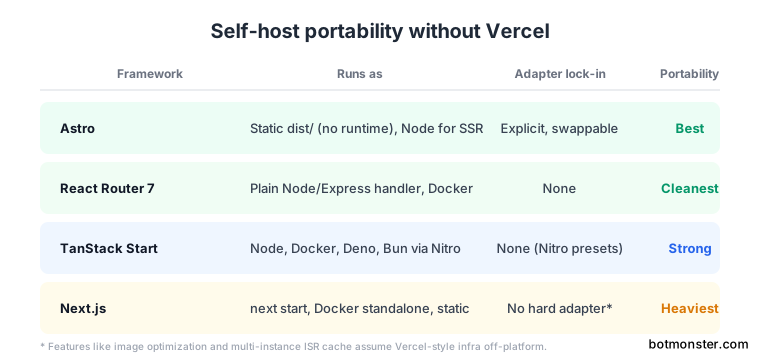
For anyone deploying to their own servers, three questions separate the frameworks: which runs cleanly as plain Node, Docker, or static files, what does it lock you to, and how far has it bet on React Server Components?
Next.js runs as a Node server via next start. It ships a standalone output mode that builds a minimal Docker image, and it supports static export for fully static sites. The Next.js self-hosting guide
confirms that self-hosting supports all features, including RSC. Image optimization, ISR cache shared across many instances, and some edge-flavored features assume infrastructure that Vercel provides for free. On your own box you set those up yourself, or they degrade. There is no hard adapter lock-in, but Next.js carries the most features that lean on the vendor platform.
React Router 7 builds to a server bundle. You run it behind your own Express or Node server with createRequestHandler, or you wrap the exported handler in a plain Node http.createServer listener. Static sites come from the prerender config
. This is the cleanest “plain Node box” story of the four. It needs no platform adapter, and there are official custom-server examples
to copy.
TanStack Start runs on Nitro, so one build deploys to a standard Node server, Docker, Deno, or Bun through Nitro presets, per the TanStack Start hosting docs . If you are still weighing Node, Bun, and Deno for the underlying process, that choice shapes your install speed and cold starts more than the framework does. Real-world VPS guides already exist, such as deploying TanStack Start on a VPS with Dokploy .
Astro is the gold standard for raw portability. A static export needs no adapter and no runtime at all: you serve dist/ from Nginx or any static host. For SSR you add the Node adapter
and run a Node server. Adapter choice is explicit and swappable, so leaving a platform means swapping one adapter while the app code is untouched.
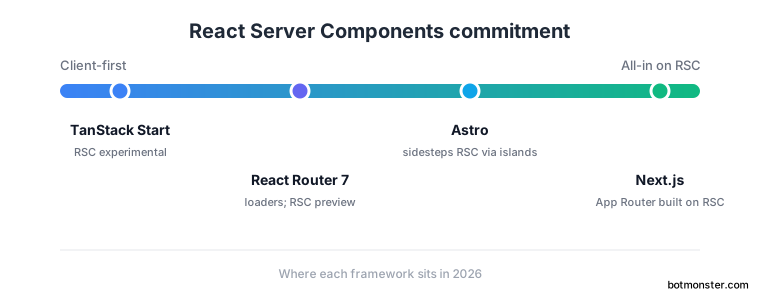
On React Server Components, the four spread out like this:
- Next.js is all-in on React Server Components; the App Router is built on them.
- Astro sidesteps RSC entirely with islands.
- React Router 7 uses the server loader and action model, with RSC arriving as a preview.
- TanStack Start is the most client-first, treating RSC as experimental, a contrast laid out in this TanStack Start vs Next.js server components comparison .
| Framework | Self-host (Node / Docker / static) | Lock-in | RSC stance | Static export | Runtime needed |
|---|---|---|---|---|---|
| Next.js | next start, Docker (standalone), static export | No hard adapter; features assume Vercel-style infra off-platform | All-in (App Router is RSC) | Yes (limited; loses dynamic features) | Node 20.9+ |
| React Router 7 (Remix) | Plain Node/Express handler, Docker, prerender static | None; bring your own server | Loader / action; RSC in preview | Yes (prerender) | Node, or any handler host |
| TanStack Start | Node, Docker, Deno, Bun via Nitro presets | None; Nitro preset per target | Client-first; RSC experimental | Partial (SSG-style) | Node / Deno / Bun |
| Astro | Static dist/ (no runtime) or Node adapter for SSR | Adapter per platform, explicit and swappable | Sidesteps RSC via islands | Yes (default, zero runtime) | None for static; Node 22+ for SSR |
The self-host commands are short. Next.js is next build then next start. React Router 7 builds a handler you mount on your own Node server. TanStack Start writes a .output folder you run with node. Astro is astro build to a static dist/, plus the Node adapter only when you need SSR. Three of the four hand you a plain Node process; Astro often hands you static files and nothing to run at all.
Which React Framework Should You Pick in 2026?
Each framework wins a clear lane once you frame the choice around self-hosting.
Next.js gives you the deepest RSC model plus the largest ecosystem and hiring pool. It fits best when you want bleeding-edge React and can either accept Vercel or invest the ops effort to self-host the standalone Docker image. It is a poor fit if you resent the recurring caching-model churn or want the lightest self-host footprint.
React Router 7, the Remix you remember, suits full-stack React apps you want to run on a plain Node box with little fuss. The loader and action model is stable and well understood. Its self-host story is the cleanest of the four for full-stack apps. Skip it if you specifically wanted Remix 3, which is a different, React-free project, or if you need RSC as a stable base today.
TanStack Start is the pick if you value end-to-end type safety and a client-first architecture, with Nitro’s deploy-anywhere portability on top. It shines for teams already living in TanStack Query and Router. For the most conservative production bets, wait: v1 is young and RSC is still experimental.
Astro fits content-heavy sites such as docs, blogs, and marketing pages, where near-zero JS and a zero-runtime static export pay off. It has the best raw portability of the four. If your app is an interactive SPA, islands fight your architecture. A browser-based 3D editor makes that trade obvious, because almost all of its work happens on the client and islands stop helping.
| Framework | Best for | Self-host verdict | Skip if |
|---|---|---|---|
| Next.js | Bleeding-edge React, big ecosystem | Works, heaviest footprint | You want the lightest box or hate caching churn |
| React Router 7 | Full-stack apps on your own server | Cleanest plain-Node story | You wanted Remix 3 or need stable RSC now |
| TanStack Start | Type-safe, client-first apps | Deploy-anywhere via Nitro | You need the most conservative, proven bet |
| Astro | Content sites, docs, blogs | Best portability (zero-runtime static) | Your app is a heavy interactive SPA |