 Botmonster Tech
Mechanical keyboard PCB repairs with flux and continuity tests

Fixing a broken mechanical keyboard PCB usually means re-soldering a loose hotswap socket or bridging a damaged trace with a small piece of wire. With a basic soldering iron, some flux, and a multimeter, you can fix the most common keyboard faults yourself. You don’t need to replace the whole keyboard. Most repairs take 15 to 30 minutes once you’ve found the fault.
Keyboard PCB soldering
Keyboard PCB soldering mostly means reflowing or replacing hotswap sockets, and less often bridging a broken trace or swapping a dead diode or MCU. Set a temperature-controlled iron to 300 to 320°C and use 0.6 mm rosin-core solder with plenty of flux. Fixed-temperature pencil irons run too hot for this work and lift pads. When you remove a socket, heat both pads at once, because prying against one cold pad tears it off the board.
Keyboard PCB repair
Keyboard PCB repair starts with finding the fault before you heat anything. A key tester in QMK or VIA shows which switches stop registering. A magnifier finds cracked joints and torn pads, and a multimeter in continuity mode confirms where the circuit breaks. Most faults turn out to be a loose hotswap socket or a cold joint, and those take 15 to 30 minutes to fix once found. Damaged traces and failed MCUs get their own sections below.
ESD Safety First
Before you touch any PCB, set up your ESD (electrostatic discharge) precautions. A static jolt too small to feel can wreck the microcontroller or the key matrix diodes on a keyboard PCB. Two steps cover almost every build:
- Anti-static wrist strap: A $5 wrist strap clipped to an earth ground keeps your body at the same charge as the board. The ground prong of a wall outlet works, or a metal chassis tied to ground. Wear it whenever the PCB is out of the case.
- Work surface: An anti-static mat, or even a grounded sheet of aluminum foil, stops static from the bench moving to the PCB.
Avoid carpeted floors in dry rooms, where most ESD damage happens. If you must work without a strap, ground yourself first. Touch a grounded metal object, such as a computer case plugged in but powered off. Then don’t shuffle your feet.
Diagnosing the Problem Before You Solder
A good diagnosis saves time and avoids needless desoldering. Work through the software and hardware checks before you apply heat.
Software Diagnosis via QMK/VIA
You can test QMK keyboards with the QMK Firmware matrix debug mode, or through VIA, without taking the board apart. Open VIA, go to the “Key Tester” tab, and press every key. Failed keys show up as dead. But that only tells you the switch position. It doesn’t say whether the fault is in the switch or the PCB.
To tell switch from PCB apart, remove the suspect switch and use metal tweezers to briefly short the two pads it plugs into. Those are the two through-hole pads or the two hotswap socket pads. If the keypress shows up in VIA, the PCB is fine and the switch is the problem. If the short gets no response, the PCB has a fault at that spot.
Visual Inspection Under Magnification
Take the PCB out of the keyboard case and study the problem area under a 10x loupe or a lit magnifying glass. Common faults you can spot:
- Cold solder joints: dull, grey, or crystalline solder around a pad rather than shiny and smooth
- Lifted pads: the copper pad has pulled away from the PCB, seen as a gap or slight bump
- Cracked PCB traces: hairline cracks in the copper traces near flex stress points, often by screws and cutouts
- Damaged hotswap sockets: the socket is clearly lifted, bent, or has lost one of its retaining pins
Multimeter Continuity Testing
A multimeter in continuity mode beeps when the probes are connected. It is the key tool for tracing broken connections. Set your multimeter to continuity mode, then:
- Touch both probes to the two pads of the suspect hotswap socket. You should get continuity along the switch’s path through the matrix.
- Trace from the suspect pad toward the MCU. Test continuity at each via and junction you can reach. Where the beep stops, the break is between your last good test point and the current one.
This step-by-step method pins trace breaks down to a small PCB segment. It tells you exactly where to apply conductive ink or a wire jumper.
Tools and Materials You Need
Keyboard PCB repair doesn’t need a pro electronics workstation. But the right tools do prevent more damage.
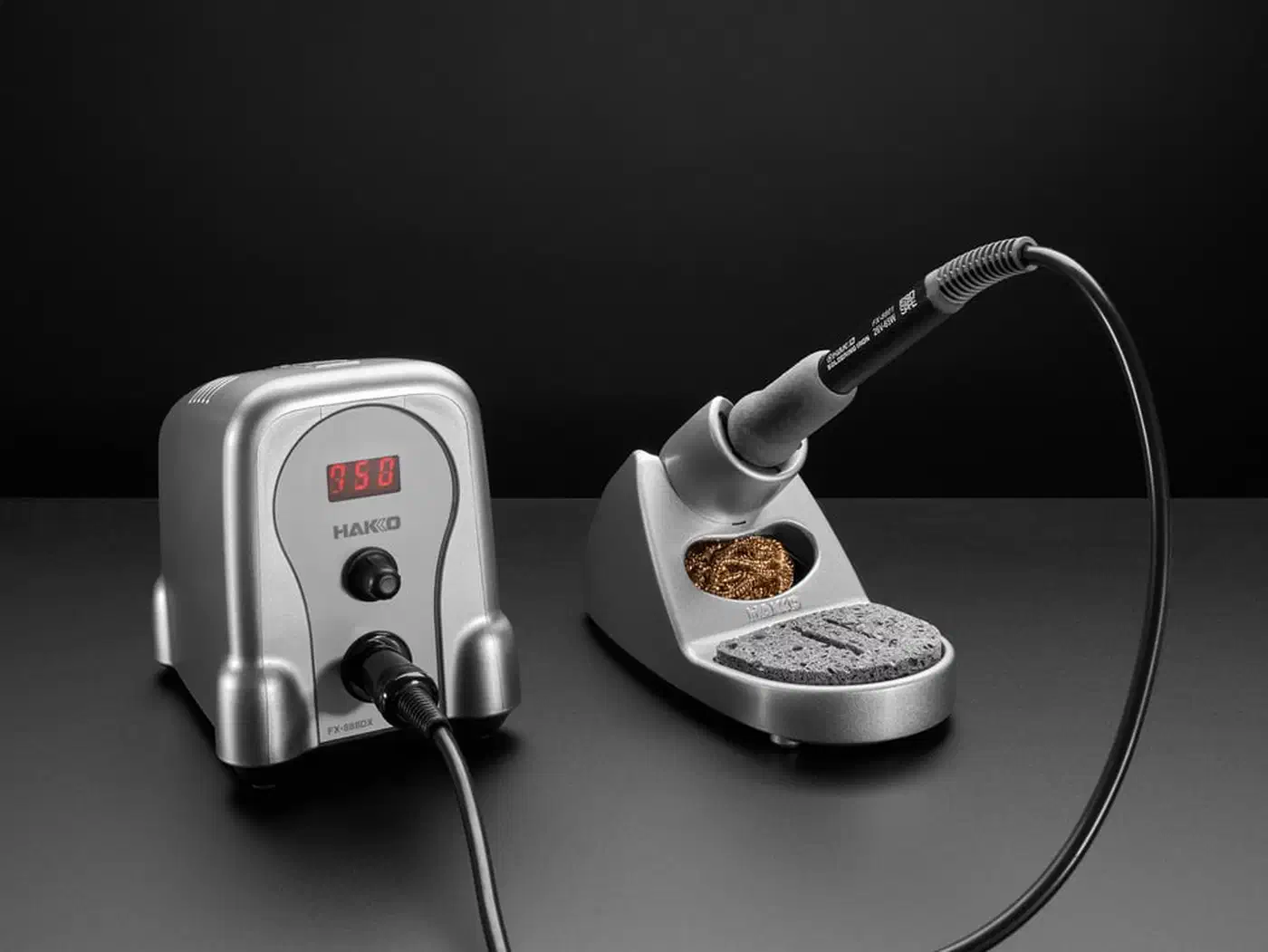
Soldering iron: A temperature-controlled station is the smart pick. Fixed-temperature “pencil” irons sold for $15 to 20 run too hot for fine PCB work. They risk lifted pads and burnt traces. The Hakko FX-888D ($110) and the TS101 portable iron ($40 to 50) are the two most popular picks in the keyboard community. Set the temperature to 300 to 320°C for standard keyboard work. That’s hot enough to melt solder fast, low enough to avoid damage.
Solder: 60/40 or 63/37 rosin-core solder at 0.6mm thickness. The thin gauge keeps you from bridging small hotswap pads and SMD pads. Lead-free solder needs hotter iron settings and doesn’t flow as well. For hobby repair, leaded solder gives better results at lower temperatures.
Flux: A no-clean rosin flux pen is the single most useful item in a keyboard repair kit. Flux makes solder flow much better, cuts the odds of cold joints, and makes re-flowing old joints far easier. Apply it freely before any solder work on a keyboard PCB.
Desoldering tools: To remove hotswap sockets or switches, desoldering braid is the method with the most control. The braid is a flux-coated copper wick. Lay it over the pad, apply heat, and the solder wicks into the braid. A solder sucker is a spring-loaded piston. It is faster but takes more practice to avoid PCB damage.
Extras: Use a brass tip cleaner instead of a wet sponge, since brass wire doesn’t cool the tip. Also keep 99% isopropyl alcohol and cotton swabs for flux cleanup, plus a PCB holder or third-hand tool to keep the board steady.
Re-Soldering a Loose Hotswap Socket
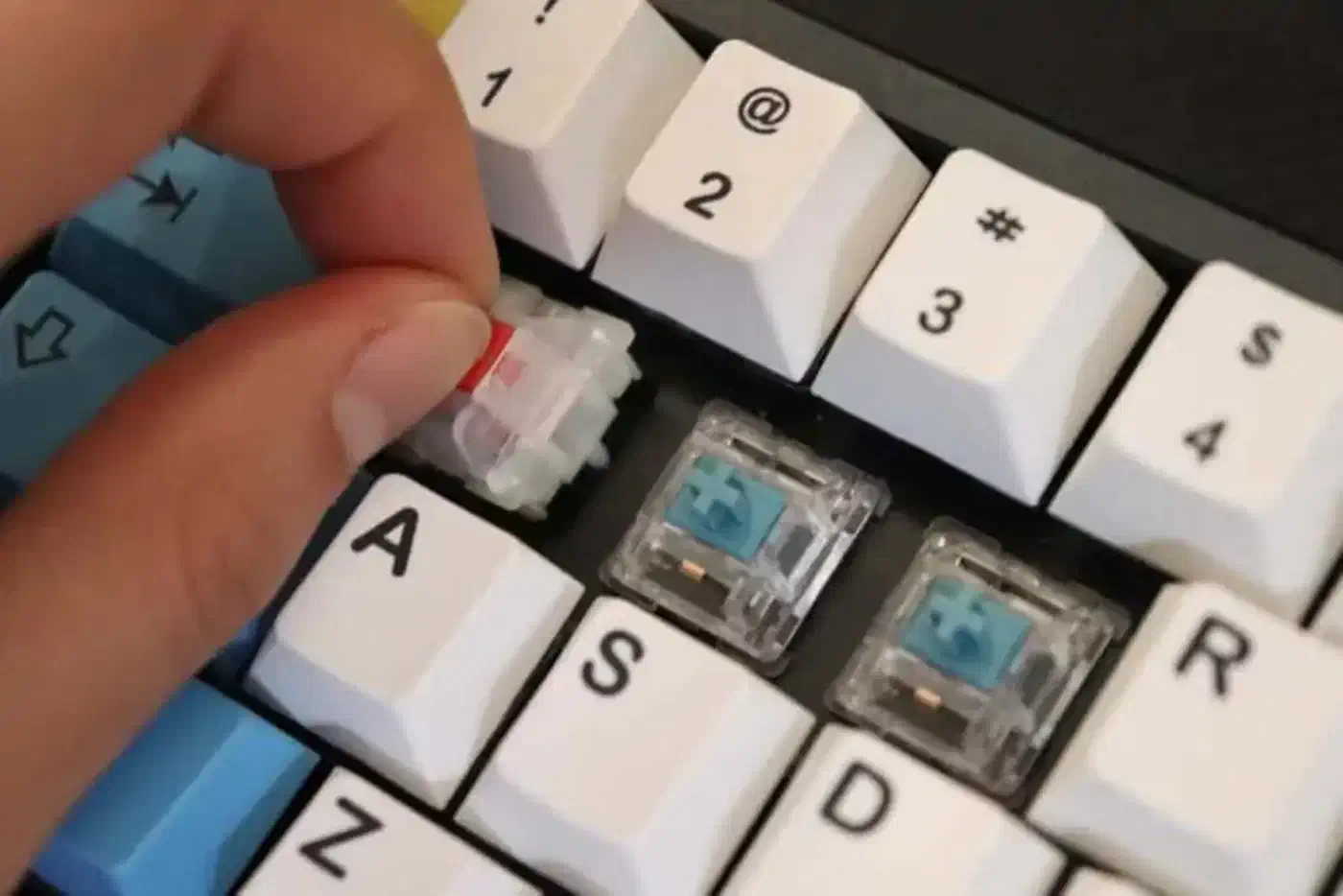
Loose or torn hotswap sockets are the most common mechanical keyboard PCB fault. They show up most on boards that see frequent switch swapping or mechanical stress. A loose socket makes the key fire on and off. It works sometimes, misses other times, or only fires with a certain finger pressure.
Spotting a loose socket: Gently wiggle the socket with tweezers. If it moves at all against the PCB, it’s loose. Also check if only one pin is firing. A socket with one good pad and one cold joint can look fine if you do the tweezer test carefully.
Safe removal: Apply flux to both pads first. Then heat both pads at once with the iron’s tip while you gently lift the socket. If you heat only one pad and try to pry the socket off, you’ll tear the other pad. That’s the most common way beginners damage PCBs.
1. Apply flux pen to both socket pads generously
2. Touch iron tip between the two pads at the base of the socket
3. Move tip to heat both simultaneously (requires some tip manipulation)
4. When solder melts on both, lift socket straight up with tweezers
Pad repair if lifted: If the copper pad peels up with the socket, you have two options. A copper pad repair kit ($10 to 15) gives you adhesive-backed copper pads that you solder over the damaged spot. For a single pad, a careful drop of conductive silver epoxy can bridge the gap. Bare Conductive Electric Paint is one such product. It cures in 15 minutes and you can solder on it once cured.
Installing the new socket: First pre-tin the PCB pads. Add a small bit of fresh solder to each pad before you place the socket. Then set the new socket in place and touch the iron briefly to each pad to reflow.
Repairing a Damaged PCB Trace
A broken trace is a hairline crack in the copper path between parts. It looks scarier than a loose socket, but silver ink or a wire jumper fixes it cleanly.
Finding the break: Once continuity testing points to the faulty segment, clean the area with IPA and study it under magnification. Trace breaks often turn up at corners, near mounting holes from flex stress, or at the edges of PCB cutouts. The break may be too fine to see with the naked eye. Very thin cracks need a loupe.
Conductive silver ink pen repair: For short trace breaks under 10mm, a conductive silver ink pen is the cleanest fix. Clean the area with IPA, let it dry fully, then trace over the broken segment with a steady hand. Apply two or three coats, with 10 minutes between each to cure. Test continuity after the final cure. Silver ink pens cost about $20 and handle most short trace repairs well.
Wire jumper method: For longer breaks, or spots where silver ink won’t stick well, a wire jumper is more reliable. Use 30AWG wire-wrap wire. It’s thin enough to lie flat without making a new stress point. Strip both ends, tin them with solder, then solder one end at a known-good point on each side of the break.
Insulating the repair: Cover any bare copper after the repair to prevent accidental shorts and oxidation. UV-cure solder mask comes in pen form and works best. Apply it, cure with a UV flashlight for 60 seconds, and the trace is protected. Clear nail polish is a fine substitute for hobby use.
Replacing a Failed MCU or Diode
These are harder repairs, but well within reach for anyone at ease with SMD rework.
Diode replacement: Each key switch in a keyboard matrix has a series diode that stops ghosting. Continuity testing finds failed diodes. A good diode passes current one way only. A failed diode passes both ways or neither. Note the polarity before removal. The cathode band on the new diode must match the PCB silkscreen direction.
Remove a diode with hot air. Set the hot air station to 300 to 350°C, aim the nozzle at the diode, and apply gentle heat until the solder melts in 5 to 10 seconds. Lift it off with tweezers. Place the new diode the right way around, tack one end, check the alignment, then solder the second end.
MCU replacement: This is the hardest keyboard repair. It’s usually worth doing only if the keyboard has sentimental or resale value. A new MCU plus the hot air rework can cost about as much as a new entry-level board. ATmega32U4 and RP2040 are the two most common keyboard MCUs in 2026. Buy replacements from Digi-Key or Mouser. Avoid no-name clones for an MCU swap.
After the swap, reflash the firmware with QMK Toolbox. If the keyboard uses the MCU’s native DFU bootloader, short the RESET and GROUND pads on the PCB to force bootloader mode. Those pads are usually exposed test points. Then flash the right .hex file.
When to give up: If the PCB has many lifted pads across several keys, water damage with oxidized traces throughout, or a cracked substrate, repair stops being practical. The keyboard community on GeekHack, Reddit r/mechanicalkeyboards, and the keyboards.university resource site can help you judge whether your damage is worth the effort.
Post-Repair Testing and Firmware Flashing
A full post-repair check catches any fault the repair missed before you close the case.
Full matrix test in VIA: Open the Key Tester and press every key, including modifiers, media keys, and the function row. Any key that fails to register needs a look before you reassemble.
QMK Toolbox firmware flash: If you replaced the MCU or suspect corrupt firmware, force bootloader mode and reflash the latest QMK build for your keyboard. The QMK firmware builder at config.qmk.fm makes firmware for hundreds of keyboards. The correct firmware file is usually listed in the keyboard’s QMK repository.
Electrical safety check: Before you plug back into a computer, use a multimeter to check there’s no short between the USB VBUS pin and GND. A PCB short on VBUS can damage the host computer’s USB controller. Touch one probe to the USB connector’s pin 1, the wider pin on USB-A, and the other to GND. No continuity is the result you want. Anything else needs a look. For USB keyboard traffic at the protocol level, our guide on reverse-engineering USB devices walks through packet capture and writing a custom Python driver, using a keyboard as the demo target.
Stress test: After you reassemble, type a 500-word document in a word processor, or use a typing test site like keybr.com for 10 minutes. Faults that come and go can pass the static matrix test, then show up under steady typing that flexes the PCB a little. If everything registers cleanly through 500 or more keystrokes, your repair is solid.
Bringing a dead keyboard back to life with a $0.50 socket and 20 minutes of work feels great, and the same soldering and continuity-testing skills work on any other embedded electronics board.