 Botmonster Tech
Low-profile mechanical switches compared: Kailh Choc v2, Cherry MX Low Profile, and Gateron KS-33

Picking Between Three Incompatible Low-Profile Worlds
Touch typists who want the most familiar desktop feel in a slim chassis should reach for Cherry MX Low Profile 2.0 . Its 3.2mm travel and 45gf actuation keep the tactile vocabulary of full-size MX intact, and it accepts standard MX-stem keycaps. Competitive gamers chasing the shortest travel win with Gateron KS-33 or Gateron Low Profile 2.0: 3.0mm travel, a 1.3mm actuation point, and a linear 45gf spring weight, shipping on boards like the Keychron K5 Max and NuPhy Air75 V2 . Custom-build enthusiasts soldering ergonomic splits such as the Corne, Ferris Sweet, or Ploopy Adept should buy Kailh Choc v2: it is the only switch in this trio that fits 18x17mm Choc-spaced PCBs while accepting MX-profile keycaps, something neither Cherry nor Gateron can offer on those boards.
Each of these families exists because a different segment of the mechanical keyboard market wanted low profile for a different reason. Cherry targeted slim gaming keyboards, Gateron went after cheap mainstream slim boards, and Kailh served the ergonomic split scene. That divergence is why you cannot just pick “the best low profile switch” and call it done. You pick the board type you want to build or buy, and the switch family follows from that choice.
What Low Profile Actually Means: Travel, Housing, and Stem Geometry
Low profile is not a single standard. Each manufacturer chose a different housing height, travel distance, and stem shape, and those choices ripple through keycap availability, sound, and typing feel. The plastic on top matters just as much, since PBT, ABS, PC, and POM caps each shift the pitch of the same switch.
The full-size MX reference point is a 4.0mm total travel, 2.0mm actuation, and roughly 18.5mm total switch height from PCB to keycap top. Low-profile families shave 35 to 45 percent off that stack height.
| Family | Total height | Travel | Actuation | Stem | PCB spacing |
|---|---|---|---|---|---|
| Cherry MX LP 2.0 | 11.9mm | 3.2mm | 1.2mm | MX cross | 19x19mm |
| Kailh Choc v1 | 11.5mm | 3.0mm | 1.3mm | Choc (two rails) | 18x17mm |
| Kailh Choc v2 | 12.1mm | 3.2mm | 1.3mm | MX cross on Choc footprint | 18x17mm |
| Gateron KS-33 / LP 2.0 | 12.2mm | 3.0-3.2mm | 1.3-1.7mm | MX cross (shorter) | 19x19mm |
| Full-size MX (reference) | 18.5mm | 4.0mm | 2.0mm | MX cross | 19x19mm |
A 0.2mm difference in travel sounds trivial on a spec sheet. On the keyboard, it changes bottom-out sound, finger fatigue during long typing sessions, and how aggressively a tactile bump registers against the spring return. Plate thickness is the other number people forget to check: all three families assume a 1.2mm steel or 1.5mm FR4 plate. Go thicker and the housing shoulders refuse to seat, leaving switches perched above the PCB and unable to register.
Kailh Choc v1 and v2: The Staple of the Ergonomic Scene
Kailh Choc is the de-facto switch for the split-ergonomic and ultra-portable keyboard scene. It has the broadest variant catalog and the only widely stocked hot-swap socket (the Kailh PG1350) for hand-wired and PCB builds.
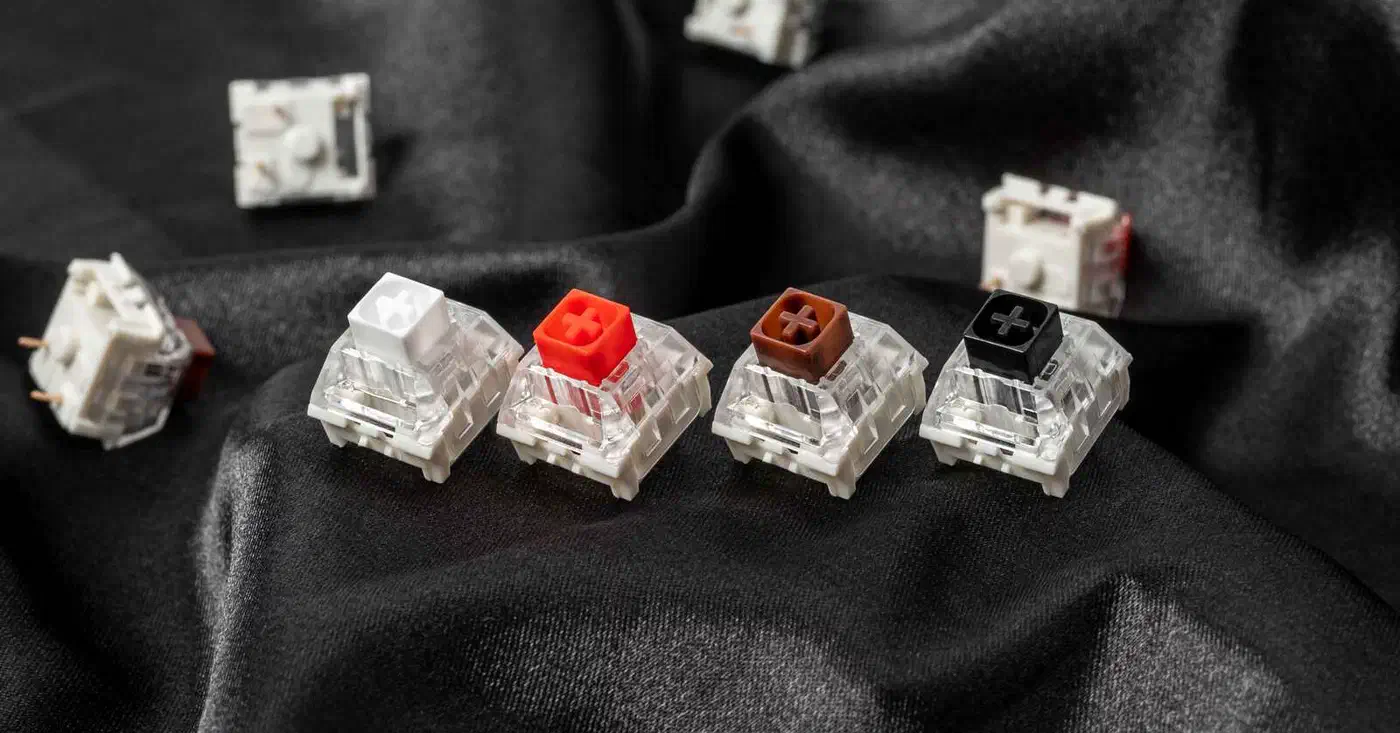
Choc v1 spans a wider spring weight range than anything from Cherry or Gateron. Red Pro (linear, 20gf actuation / 35gf bottom-out), Brown (tactile, 60gf), Sunset (tactile, 45gf), White (clicky, 55gf), and Pink (light linear, 20gf) cover cases from hand-strain builders who need 20gf actuation to typists who want a pronounced 60gf tactile bump. The full catalog lives on kailh.net .
Choc v2 is the important one for people coming from MX keycap libraries. It keeps the Choc footprint so it fits a Corne or Ferris PCB, but the upper housing accepts standard MX cross-stem keycaps - OEM, Cherry profile, XDA, even KAT and DSA. That single change means a builder with an existing MX keycap collection can build a Choc-spaced split without buying a second keycap set in MBK profile.
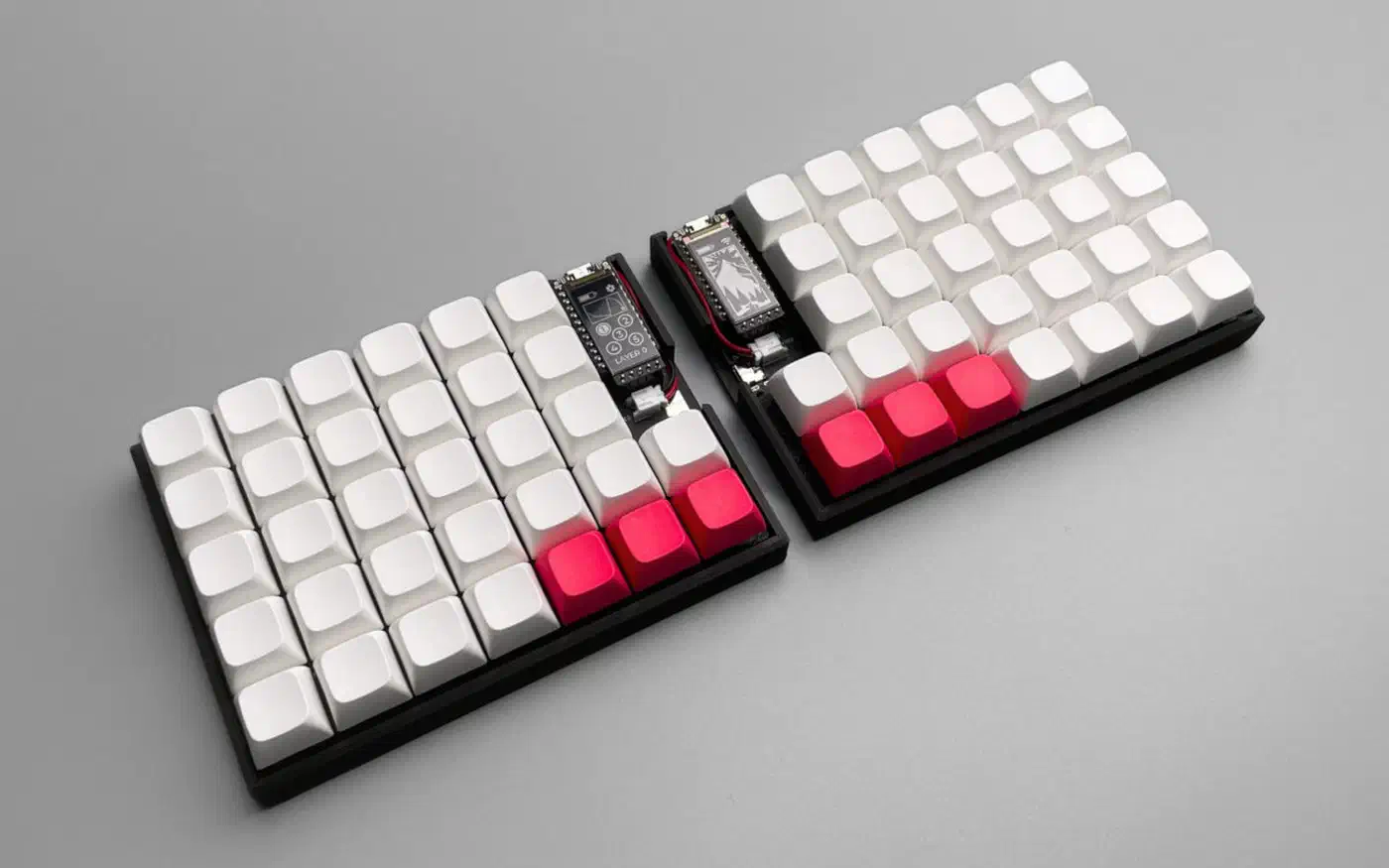
Boards that ship with Choc include the Corne (Crkbd), Ferris Sweet, Ploopy Adept, Keyboardio Atreus, Kinesis TKO, and several MoErgo Glove80 variants . The supporting parts catalog around these boards, from splitkb.com PCBs to LittleKeyboards stabilizer kits, is wired specifically for Kailh PG1350 sockets.
The sound signature skews higher-pitched and clackier than Cherry MX LP because of the shallower housing and thinner plastic. That brightness is obvious on tactile Sunset variants and muted on Red Pro with factory lube. Spring weight range across the Kailh catalog runs from 15gf to 70gf, the widest of the three families.
Choc v1 keycap selection was historically the weak point. MBK (1u only), Chocfox CFX, LDSA, and Kailh’s own factory PBT remain the main low-profile-specific options, and sculpted sets are rare. Choc v2 sidesteps this by accepting MX keycaps at the cost of a roughly 0.6mm taller stack. A Kailh Choc v2 hands-on on kbd.news walks through how the hybrid housing changes build plans.
Cherry MX Low Profile 2.0: Familiarity in a Shorter Chassis
Cherry’s second-generation low-profile switch is aimed at the gaming laptop and slim desktop market rather than the DIY ergo scene. Familiarity is the pitch: same MX cross stem, same click/tactile/linear nomenclature, same feel vocabulary as desktop MX, just compressed vertically. The Cherry MX Low Profile height of 11.9mm shaves about a third off standard MX. Typists moving from a full-size MX board will find the transition painless.
Core variants:
- MX Low Profile 2.0 Red is linear with 45gf actuation, 60gf bottom-out, 3.2mm total travel, 1.2mm pre-travel, and a claimed 100 million actuation lifetime.
- MX Low Profile 2.0 Speed keeps the 45gf actuation but shortens pre-travel to 1.0mm, marketed at esports players and shipped in the Razer DeathStalker V3 Pro.
- MX Low Profile 2.0 Tactile has a 55gf tactile bump, similar feel to full-size MX Brown but with a shorter return stroke.
- Low Profile Ivory and Clear are the 2024 linear and tactile variants under the MX2B product code, offered through Cherry’s own retail channels.
Boards that ship Cherry MX LP include the Keychron K1 SE, Razer DeathStalker V3 Pro, and Corsair K100 Air. Logitech’s older G915 uses a Kailh-made GL switch rather than Cherry MX LP, so do not assume Logitech’s slim boards belong in the Cherry camp.
Sound is the deepest of the three families thanks to the taller housing, especially with PBT keycaps and a gasket-mounted plate. Keycap compatibility is technically any MX-stem keycap, but the skirt has to clear the housing edge. Tall sculpted profiles like SA and MT3 will not fit. OEM, Cherry profile, XDA, and purpose-built low-profile PBT sets do.
The weak point is the DIY side. Cherry MX LP is almost always soldered, there is no commonly stocked hot-swap socket for it on the enthusiast market, and aftermarket switches are harder to find than Choc or Gateron alternatives. If you want to swap switches later without a soldering iron, do not pick Cherry.
Gateron KS-33 and Low Profile 2.0: The Mainstream Challenger
Gateron’s low-profile push is the reason the mainstream slim mechanical keyboard market felt competitive again by 2026. KS-33 and Gateron Low Profile 2.0 are what you find on most new Keychron and NuPhy releases, and they undercut Cherry on price while matching Cherry’s MX-stem keycap compatibility.
The KS-33 Red is linear with 45-50gf actuation, 3.0-3.2mm total travel, and 1.3-1.7mm pre-travel depending on batch and revision. Gateron’s datasheet publishes the full tolerance band, which is wider than Cherry’s spec window. Gateron Low Profile 2.0 Brown is the tactile variant, with a 55gf bump and similar travel, shipping on the Keychron K5 Max and K3 Pro SE.
Boards running KS-33 or Gateron LP 2.0 include the Keychron K5 Max, Keychron K3 Pro SE, NuPhy Air75 V2, NuPhy Halo75 Low Profile, and Epomaker Galaxy80 LP. The important detail on Keychron and NuPhy models is the low-profile hot-swap socket - these are the only mainstream low-profile boards that let you swap switches without a soldering iron. Builders on a budget who want the option to try tactiles later without buying a new keyboard should start here.
The sound sits in the middle. Shallower housing than Cherry gives a brighter top-out, but the factory-lubed linears on NuPhy boards are surprisingly muted, closer to a mid-profile board than the clack of a bare Kailh Choc.
Per-switch pricing typically runs 30-40 percent cheaper than Cherry MX LP when bought in bulk from kprepublic.com or divinikey. The tradeoff is factory QC: leaf spring inconsistency surfaced on early KS-33 batches, and community threads on kbd.news routinely turn up individual switches that actuate 10-15gf off spec. Check batch reports before ordering a hundred switches for a build.
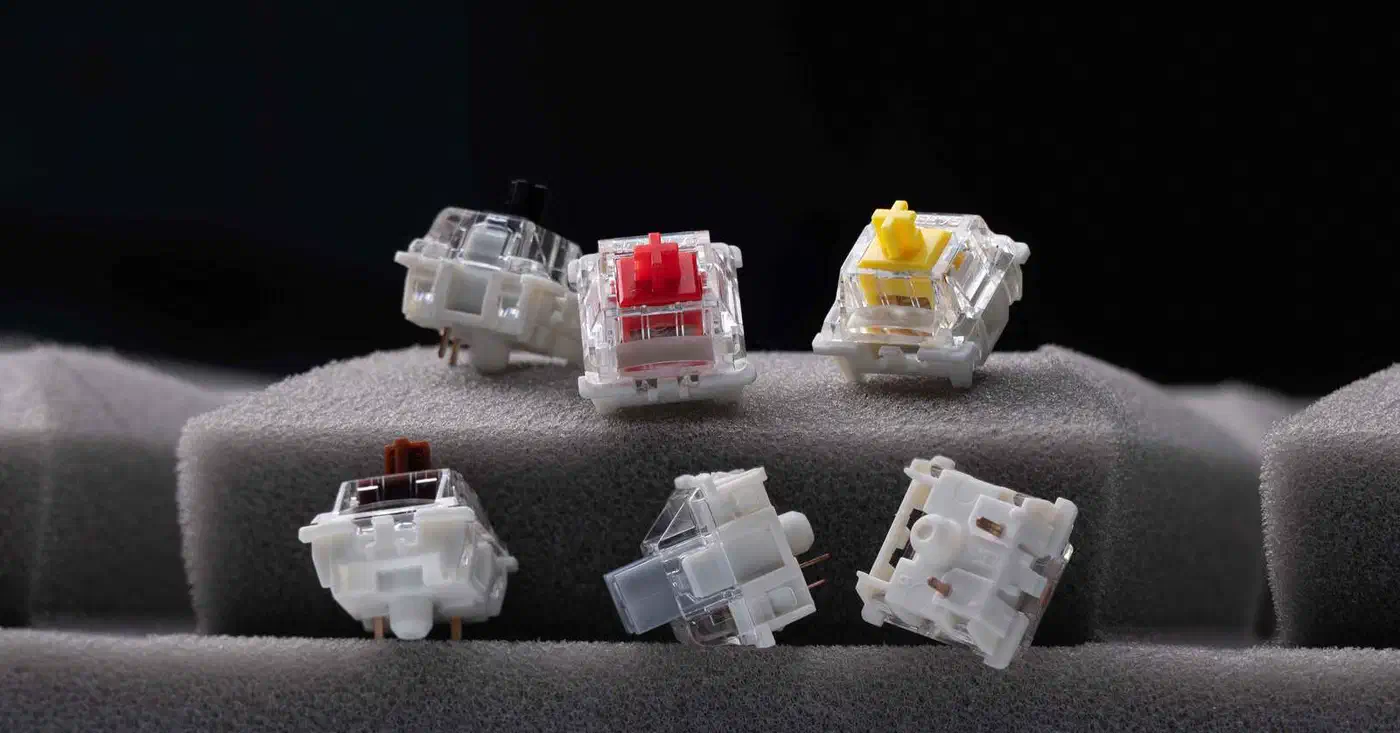
Keycap, Socket, and Plate Compatibility
Picking a switch is only half the decision. The other half is whether you can find keycaps, plates, and sockets for the build you want. This is where the three families diverge most sharply.
Keycap profiles that fit each family:
- Choc v1 accepts MBK (1u only), Chocfox CFX, LDSA sculpted, Kailh factory PBT low-profile, and PFF profile, available from splitkb.com and littlekeyboards.com.
- Choc v2 accepts everything that fits MX (OEM, Cherry, XDA, KAT, DSS) plus Choc v1 keycaps, which is the hybrid housing’s whole reason for existing. Tall sculpted profiles (SA, MT3) still foul the housing on most v2 boards, so stick to shallow or cylindrical shapes.
- Cherry MX LP 2.0 and Gateron KS-33 accept any MX-stem keycap with a shallow skirt. OEM, Cherry profile, XDA, KAT, and purpose-built low-profile PBT sets all fit. Sculpted tall profiles do not clear the housing.
Hot-swap socket reality: Kailh PG1350 (Choc v1 and v2) is the most widely stocked socket across hobbyist stores. Gateron ships a proprietary low-profile socket on Keychron K5 Max and NuPhy Air75 V2, but it is effectively only available inside those retail boards rather than as a separate component. There is no common Cherry MX LP socket, so Cherry LP builds are almost always soldered.
PCB spacing is the hard incompatibility. Choc uses 18x17mm spacing, which is noticeably tighter than MX. Cherry LP and Gateron LP both use the standard 19x19mm MX grid. You cannot mix Choc and MX LP switches on the same PCB, and you cannot put MX-spacing keycaps on a Choc PCB without gaps.
Plate thickness should stay at 1.2mm steel or 1.5mm FR4 for all three families. Thicker plates will foul the housing shoulders and prevent full seating. Stabilizers are another hidden gotcha: Cherry MX LP and Gateron KS-33 work with standard plate-mount MX stabilizers cut for low profile. Choc requires Kailh Choc-specific stabilizers, which are rare enough that small ergonomic builds often substitute extra switches in the stab positions instead.
Which Family To Pick
The decision collapses to board type more than feel:
- Building a Corne, Ferris Sweet, Ploopy Adept, or any other ergonomic split? Choc v1 or v2.
- Buying a Keychron or NuPhy off the shelf and wanting hot-swap? Gateron KS-33 or LP 2.0.
- Buying a gaming-laptop-style slim board from Razer or Corsair, or a full-size Cherry-branded desktop model? Cherry MX LP 2.0.
- Chasing the fastest possible key resets for ranked play? None of these three; you want a full-height magnetic board .
- Prioritizing the deepest, most desktop-like sound and typing feel in a slim chassis? Cherry MX LP 2.0.
- Prioritizing the shortest travel and lightest actuation for fast gaming input? Gateron KS-33 Speed or Cherry MX LP 2.0 Speed.
- Prioritizing custom spring weights down to 15-20gf for hand strain? Kailh Choc v1 Pink or Red Pro.
None of these are bad switches. They exist because three different parts of the mechanical keyboard world asked for three different things, and each manufacturer delivered for their segment. Trying to port a Choc build onto a Cherry MX LP PCB, or shoving MT3 keycaps onto a Gateron KS-33 board, is the fastest way to discover how incompatible they really are. Pick the board type first, then pick the switch family within it, and the build gets a lot simpler.