 Botmonster Tech
Why Small Language Models (SLMs) are Better for Edge Devices

Small Language Models - sub-4B parameter models designed to run locally on constrained hardware - now provide 90% of the utility of large cloud-hosted models for the vast majority of real-world embedded and IoT tasks. In 2026, models like Phi-4 (3.8B), Gemma 3 (4B), and Llama 3.2-1B are the standard for privacy-preserving, offline AI on everything from Raspberry Pi boards to industrial PLCs. The era of sending every inference call to a remote API is ending, not because large models have become less capable, but because small models have become good enough - and “good enough with zero latency and zero privacy risk” beats “better but slow, expensive, and cloud-dependent” for nearly every edge use case.
This post is written for embedded developers and ML engineers who are evaluating whether to keep their AI stack in the cloud or move it onto the device. The answer, in most cases, is to move it - and this guide explains exactly why, how, and when to do so.
Defining “Small”: What Counts as an SLM in 2026?
The word “small” in the context of language models is relative, and that relativity has shifted dramatically over the past three years. In 2023, a “small” model was anything under 13B parameters. In 2026, the meaningful size tiers have been redefined by improved training techniques, better hardware, and architectural innovations that extract far more performance per parameter than earlier generations.
The practical taxonomy for edge deployment breaks into three tiers. Sub-1B models - think Llama 3.2-1B and Apple’s OpenELM-270M - target on-sensor and MCU-class hardware. These run on devices with as little as 512MB of RAM, making them suitable for Cortex-M55 microcontrollers and similar embedded processors. Their capabilities are intentionally narrow: keyword spotting, intent classification over a fixed domain, simple structured data extraction. They are not general-purpose reasoning engines, and treating them as such leads to disappointment. The 1–4B tier is where the most exciting work is happening in 2026. This is the “smartphone and Raspberry Pi class” - models like Phi-4 (3.8B), Gemma 3 (4B), and Llama 3.2-3B that run comfortably on devices with 4–8GB of RAM. They can handle multi-turn conversation, offline translation, document summarization, and intent parsing for complex smart home commands. The 4–14B tier, represented by models like Mistral Nemo (12B), requires a laptop with a capable Neural Processing Unit (NPU) or a dedicated edge server. These are not truly embedded in the traditional sense, but they blur the line between edge and cloud in ways that matter for enterprise deployments.
The most important insight about the 2026 SLM landscape is that raw parameter count is a weak predictor of capability. A 3.8B-parameter Phi-4 running today outperforms 2023’s GPT-4 on many structured reasoning benchmarks - not because the architecture is fundamentally different, but because the training data is orders of magnitude better. Microsoft’s research team behind Phi demonstrated that “textbook-quality” synthetic data, generated by carefully prompting larger models to produce clean, educational, densely reasoned text, compounds more effectively than raw web-scraped data. A model trained on high-quality synthetic reasoning examples generalizes better at small parameter counts than a model of the same size trained on typical internet text. This is the core reason the 3–4B tier is viable for real applications today when it was not three years ago.
What SLMs genuinely cannot do well deserves equal attention. Long-document reasoning over multi-thousand-token contexts, complex multi-step code generation involving unfamiliar APIs, nuanced creative writing that requires broad world knowledge - these tasks still favor large models. If your edge application requires any of these, an SLM is the wrong tool, and you should architect accordingly, perhaps using a hybrid approach where the embedded device handles fast, narrow inference and routes complex queries to a cloud endpoint when connectivity is available.
The “Good Enough” AI: Phi-4, Gemma 3, and the 3B Tier
The phrase “good enough” sounds like settling, but in engineering it represents the optimal operating point on a cost-capability curve. For the specific tasks that dominate edge AI applications - intent parsing, summarization, classification, translation, and structured data extraction - the 3–4B parameter tier is not just good enough; it is often indistinguishable from much larger models when measured on the specific subtask at hand.
Microsoft’s Phi-4 is the flagship example of what targeted training methodology produces at this scale. The model’s training regime prioritized synthetic “textbook-quality” data generated to cover a wide range of reasoning patterns, followed by curated human feedback. The result is a model that scores competitively with much larger open-weight models on MMLU (multi-task language understanding), ARC (reasoning), and GSM8K (grade-school math). For developers, the practical implication is that Phi-4 handles the kind of structured reasoning your application actually needs - extracting JSON from unstructured text, parsing user intent into discrete action slots, summarizing a document into three bullet points - with consistently high accuracy at 3.8B parameters. At INT4 quantization via GGUF, it occupies roughly 2.2GB of RAM, comfortably fitting on a Raspberry Pi 5 with the 8GB RAM variant while leaving headroom for the operating system and application code.
Google’s Gemma 3 (4B) takes a complementary approach with a quantization-friendly architecture designed from the ground up for on-device deployment. The model uses grouped-query attention (GQA) and other architectural choices that reduce memory bandwidth requirements during inference - a critical consideration because memory bandwidth, not raw compute, is typically the bottleneck on embedded processors. Gemma 3 integrates directly with Android’s ML Kit via the MediaPipe LLM Inference API, making it the default choice for Android app developers who want a Google-supported path to on-device inference. Its support for INT8 and INT4 quantization via ONNX Runtime means it can target a wide range of NPU execution providers, from Qualcomm’s QNN EP to ARM’s Ethos-U backend for more capable microcontroller-class silicon.
The cost comparison between on-device inference and cloud API calls reveals the long-term economic argument that enterprise buyers care most about. Running 1 million inference calls through a cloud LLM API at typical 2026 pricing costs roughly $8–20 depending on context length and the provider. Running the same million calls on a device with an NPU - where the model execution is effectively free at marginal cost after hardware purchase - costs a fraction of a cent in electricity. The break-even point where on-device hardware purchase pays for itself through eliminated API costs varies by use case, but for high-throughput applications like a retail kiosk processing thousands of queries per day, on-device inference pays for the hardware within weeks. For privacy-sensitive applications, the economic analysis is irrelevant; the compliance requirement alone mandates on-device processing.
NPU-First Development: Why the CPU Isn’t the Target Anymore
Developers who have experimented with running language models on Raspberry Pi boards are familiar with the frustration of single-digit tokens per second on the CPU. This experience, based largely on older hardware and older software stacks, has created a misleading impression that on-device LLM inference is inherently slow. The NPU changes this calculus entirely. Understanding what an NPU is and how to target it is now a foundational skill for embedded ML engineers.
A Neural Processing Unit is dedicated silicon optimized for the specific mathematical operations that dominate neural network inference: matrix multiplication and accumulation. Unlike a GPU, which is a general-purpose parallel processor that happens to be efficient at matrix math, an NPU is purpose-built for low-power, high-throughput matrix operations with no flexibility overhead. In 2026, NPUs are standard components in every major consumer SoC: Qualcomm’s Snapdragon X Elite includes a 45 TOPS NPU, Apple’s M4 and M5 chips include a 38 TOPS Neural Engine, Intel’s Meteor Lake and Arrow Lake processors include an integrated NPU, and AMD’s Hawk Point APUs include a 16 TOPS XDNA NPU. The aggregate compute available in consumer devices for neural inference has increased by approximately 10x since 2022.
Programming for NPUs requires navigating a fragmented toolchain landscape that is still maturing. Qualcomm’s QNN (Qualcomm Neural Network) SDK provides a path for converting ONNX models to the hardware-specific .serialized.bin format and executing via the QNN Execution Provider in ONNX Runtime. Apple’s Core ML accepts models in the .mlpackage format, converted from PyTorch or ONNX using coremltools. Intel’s OpenVINO and AMD’s Ryzen AI Software Platform handle their respective NPU targets. The common thread across all of these is ONNX as an intermediate representation: export from PyTorch to ONNX, then convert to the target platform’s native format. For models that are too complex for full NPU execution, ONNX Runtime supports hybrid execution where NPU-friendly layers run on the NPU and the remainder falls back to CPU - delivering partial acceleration without requiring full compatibility.
The power consumption data makes the NPU case compelling. Running Phi-4 inference on the CPU of a Snapdragon X Elite laptop draws approximately 15–20W sustained. Running the same inference on the integrated NPU drops power consumption to 3–5W - an 80% reduction. For a battery-powered device, this represents the difference between a feasible product and a non-starter. Latency measurements show a more nuanced picture: the Snapdragon X Elite NPU achieves approximately 30–35 tokens per second with Phi-4 at INT4 quantization, compared to about 12–15 tokens per second on the CPU of the same device. Apple’s M4 Pro Neural Engine delivers approximately 40–50 tokens per second for comparable models. An RTX 4060 GPU in a laptop achieves 80–100 tokens per second but at 70–90W of sustained power draw - efficient only when performance absolutely outweighs battery life and heat.
Hardware Comparison: Raspberry Pi 5 vs. Jetson Orin vs. STM32
Choosing the right hardware for an edge AI deployment requires matching the model tier to the platform’s capabilities. The following comparison covers the three most common embedded AI hardware categories in 2026.
| Platform | CPU / Memory | AI Accelerator | Phi-4 (INT4, tokens/sec) | Llama 3.2-1B (INT4, tokens/sec) | Idle Power Draw | Active Inference Power |
|---|---|---|---|---|---|---|
| Raspberry Pi 5 (8GB) | Cortex-A76, 4-core, 8GB LPDDR4X | None (CPU-only via llama.cpp) | 4–6 t/s | 18–24 t/s | 2.5W | 6–8W |
| Jetson Orin Nano (8GB) | Cortex-A78AE, 6-core, 8GB LPDDR5 | 40 TOPS Ampere GPU + DLA | 22–28 t/s (GPU) | 55–70 t/s (GPU) | 5W | 10–15W |
| STM32N6 (with NPU) | Cortex-M55, 1-core, 4MB SRAM + external Flash | 600 GOPS Cortex-M55 with Helium | Not feasible | Not feasible | 0.05W | 0.3–1W |
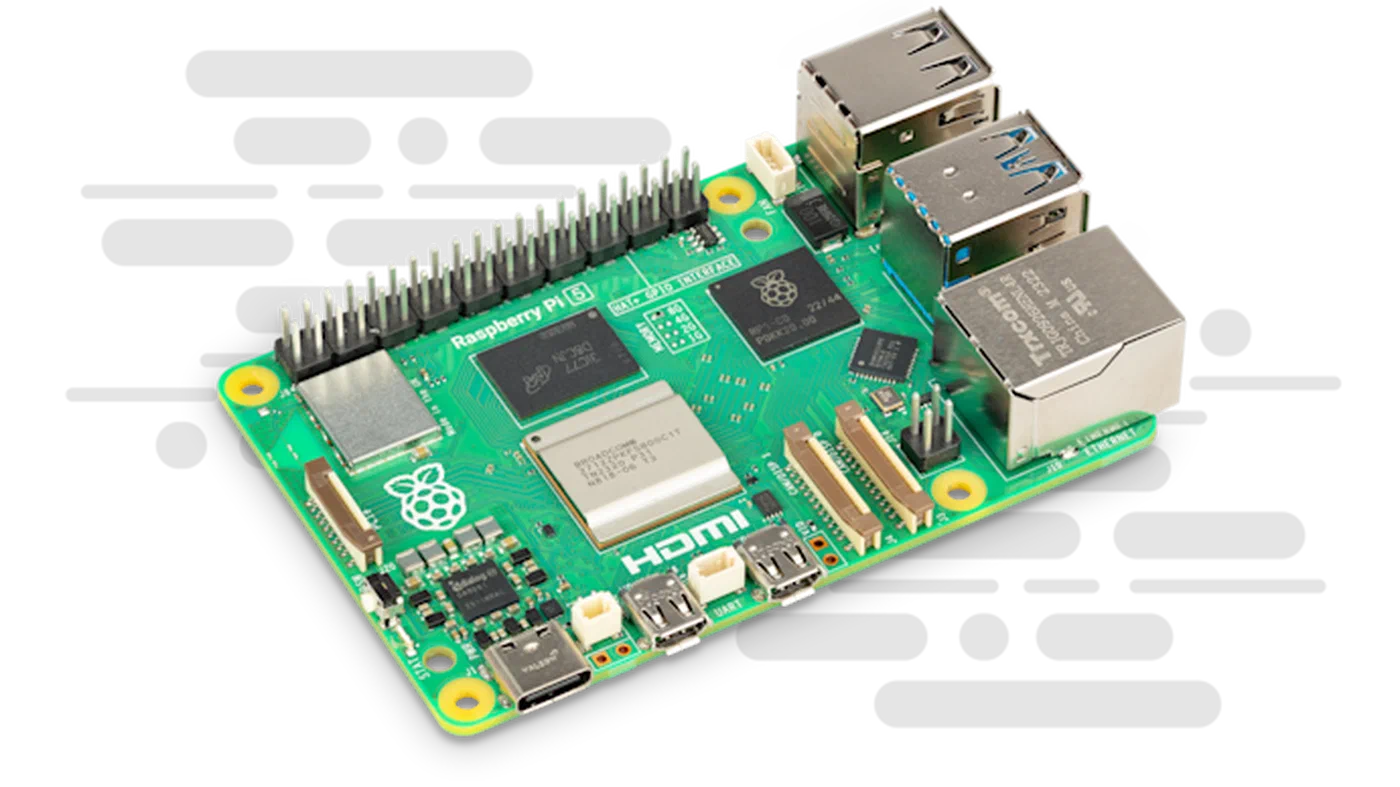
The Raspberry Pi 5 is the entry point for hobbyists and prototypers. With the 8GB RAM variant and llama.cpp compiled with NEON optimizations for the Cortex-A76, you can run Llama 3.2-1B at conversational speeds - approximately 18–24 tokens per second - which is fast enough for voice assistant and local command processing use cases where responses are typically under 50 tokens. Phi-4 at 3.8B parameters is feasible but slow at 4–6 tokens per second, making it suitable for batch processing tasks like nightly log summarization rather than interactive use. The Pi 5 has no hardware AI accelerator, so all inference runs on the CPU cores via llama.cpp’s ARM NEON optimized kernels. The new 16GB RAM option that arrived in late 2025 makes it possible to run Mistral 7B at INT4 quantization, though still at CPU speeds.

The NVIDIA Jetson Orin Nano is the professional embedded AI platform. Its 40 TOPS combined Ampere GPU and Deep Learning Accelerator (DLA) makes it capable of running Phi-4 at interactive speeds using ONNX Runtime’s TensorRT execution provider. At 22–28 tokens per second for Phi-4 and 55–70 for Llama 3.2-1B, the Jetson Orin Nano hits the sweet spot for real-time applications: smart cameras with local NLP, industrial inspection systems with anomaly explanation, retail kiosks with embedded conversation. The power envelope of 10–15W under active inference is manageable for always-on applications and dramatically better than any server-class GPU solution. The JetPack SDK provides CUDA, TensorRT, and ONNX Runtime with pre-compiled libraries, making software setup significantly easier than bare-metal MCU development.
The STM32N6 represents a fundamentally different design point: extreme low power for always-on sensing. With a Cortex-M55 core running at up to 600 MHz and 4MB of SRAM, it cannot run even the smallest 1B-parameter language models - the memory is simply insufficient for any transformer-based LLM. What it can run are small transformer-based classification models: intent classifiers with a vocabulary of a few hundred classes, keyword spotters, and anomaly detectors trained as small classification heads. Developers targeting this tier typically use a two-stage architecture: the STM32 handles always-on sensing at sub-watt power, triggers a wake event when a relevant signal is detected, and passes control to a more capable processor (like a Raspberry Pi or Jetson) that runs the actual language model inference.
Deploying SLMs: Quantization, ONNX, GGUF, and Runtime Choices
Getting a model from a research paper or a Hugging Face model card to a running embedded application involves a chain of format conversions and runtime choices that confuse many developers approaching edge AI for the first time. Two formats dominate in 2026: GGUF for CPU-focused deployment via llama.cpp and its derivatives, and ONNX for NPU and cross-platform deployment via ONNX Runtime.
Quantization is the foundational technique that makes SLMs viable on constrained hardware. Standard model weights are stored as 32-bit or 16-bit floating-point numbers. Quantization replaces these with lower-precision representations - INT8 (8-bit integers) or INT4 (4-bit integers) - reducing memory footprint by 2–4x and increasing inference throughput because integer arithmetic is faster and more power-efficient than floating-point on most embedded processors. The quality trade-off is real but manageable. INT8 quantization typically degrades benchmark performance by 0.5–2% relative to the FP16 baseline. INT4 quantization degrades performance by 2–5% on general benchmarks but can be worse on specific reasoning-heavy tasks. For most edge applications, this quality degradation is imperceptible because the task domain is narrow enough that the model’s effective accuracy remains high even on quantized weights.
GGUF is the native format for llama.cpp, the most widely used CPU inference engine for language models. A GGUF file bundles the quantized model weights and tokenizer configuration into a single portable file with no external dependencies. Quantization levels range from Q2_K (most aggressive, lowest quality) to Q8_0 (near-lossless), with Q4_K_M and Q5_K_M being the most common choices that balance size and quality. For Raspberry Pi deployment, Q4_K_M is typically the right choice: it fits Phi-4 into approximately 2.4GB of RAM while maintaining over 95% of the FP16 benchmark performance. llama.cpp compiles natively on ARM Linux with NEON optimizations and produces a static binary with no Python or PyTorch dependency, which is ideal for clean embedded Linux deployments.
ONNX and ONNX Runtime is the path to NPU acceleration. The conversion pipeline starts with exporting the model from PyTorch to ONNX using torch.onnx.export or Hugging Face’s optimum library, which handles the complex details of exporting attention mechanisms and KV cache correctly. The resulting ONNX model can then be quantized using ONNX Runtime’s quantization tooling to INT8 or INT4, or converted to a platform-specific format like TensorRT Engine for NVIDIA hardware or QNN .serialized.bin for Qualcomm. ONNX Runtime itself selects the optimal execution provider at runtime - if a QNN NPU is available and the model is compatible, it runs there; otherwise it falls back to CPU. This fallback behavior makes ONNX Runtime deployments more robust than platform-specific solutions but requires testing on representative hardware to confirm NPU acceleration is actually being used.
For Android deployment specifically, Google’s MediaPipe LLM Inference API provides the highest-level abstraction. It accepts GGUF-formatted models directly and handles the Android-specific complexities of memory management, GPU delegation, and APK packaging. A Gemma 3 4B model converted to INT4 GGUF and bundled in an APK via MediaPipe runs at approximately 12–15 tokens per second on a Snapdragon 8 Gen 3 device using the GPU backend, or 20–25 tokens per second when the QNN NPU backend is enabled. For iOS, Apple’s coremltools Python package converts ONNX models to the .mlpackage format, which can be embedded in an Xcode project as a resource and executed via the Core ML Swift API. On an iPhone 16 Pro with the A18 Pro Neural Engine, Phi-4 at INT4 runs at approximately 30–40 tokens per second with minimal battery impact.
Model lifecycle management on deployed devices deserves attention. Unlike server deployments where updating a model is a standard CI/CD operation, embedded devices have constrained storage, limited update bandwidth, and users who expect stability. Delta model updates - shipping only the changed weights rather than the full model file - can reduce update sizes by 60–80% for minor version bumps within the same model family. Model caching with version pinning ensures that an application always runs against the same model weights even after an OS update, preventing unexpected behavior changes. A fallback strategy for when local inference fails (model file corrupted, insufficient memory, hardware fault) is essential for production deployments: gracefully degrade to a simpler rule-based system or queue the request for later processing rather than crashing.
Privacy, Compliance, and the On-Device AI Case
For many of the teams considering edge AI, the privacy and compliance argument is not just a feature - it is a blocker. Regulated industries cannot send sensitive data to cloud inference endpoints without extensive legal review, data processing agreements, and often explicit user consent. On-device AI removes this complexity entirely, and this removal has real economic value that should be quantified when making the build-vs-buy decision.
GDPR Article 9 prohibits processing special categories of personal data - health data, biometric data, data revealing racial or ethnic origin - without explicit consent or a legitimate interest basis that is difficult to establish for cloud AI inference. HIPAA goes further: any patient health information (PHI) processed by a cloud AI system requires a signed Business Associate Agreement (BAA) with every AI vendor in the processing chain. In practice, the legal review process for a new cloud AI vendor in a healthcare organization can take 6–18 months. On-device AI eliminates this entirely: if the data never leaves the device, there is no third-party processor to regulate. This is not a minor convenience - it is the difference between a product that can ship and one that cannot.
The on-device privacy guarantee is architecturally verifiable in a way that cloud privacy policies are not. When a model runs locally, there is no network call, no server log, no possibility of the inference provider training on your users’ data. Network monitoring tools like tcpdump or a Pi-hole DNS sinkhole can verify at the infrastructure level that no outbound connections are being made during inference. This verifiability matters for enterprise security teams that must certify systems for compliance: “trust but verify” is replaced by “verify directly.” Cloud AI privacy policies, regardless of how carefully written, ultimately rely on the provider’s operational practices and cannot be verified by the customer.
Enterprise use cases that drive SLM adoption include local document summarization in legal and financial services (summarizing contracts and filings without exposing privileged content to external services), offline customer service in remote locations or areas without reliable connectivity (retail kiosks in dead zones, field service applications for utilities and telecommunications), and secure government applications where data sovereignty requirements prohibit cloud processing entirely. In each of these cases, the SLM is not competing with a cloud model on raw capability - it is filling a role that a cloud model legally or practically cannot fill.
The audit and reproducibility advantages of on-device AI are also significant in regulated contexts. A locally deployed SLM can be version-locked: a specific GGUF file with a known SHA-256 hash runs every inference call for the life of the deployment. When a regulator asks “what model generated this output and what were its training characteristics?” the answer is precise and verifiable. Cloud AI systems, where models are updated continuously by the provider, cannot offer the same guarantee. For applications where output reproducibility is a compliance requirement - certain financial advice systems, medical decision support tools - this is not an optional feature.
Practical Deployment Patterns for 2026
The most effective edge AI architectures in 2026 are not monolithic - they use a cascade pattern that routes requests to the smallest capable model and only escalates to larger or cloud-based models when necessary. Understanding these patterns helps developers design systems that are simultaneously fast, cost-effective, and resilient.
The classifier-first pattern is the most common cascade. A sub-100M parameter intent classifier - trained specifically on your application’s domain using a fine-tuned MobileBERT or similar compact transformer - processes every incoming request. If the classifier determines the request falls within a known category that the local SLM can handle (say, 95% of typical smart home commands), the request goes directly to the local 3B model. Only requests classified as “out of domain” or “complex” are escalated to a larger local model or cloud endpoint. This routing layer adds approximately 10–20ms of latency but dramatically reduces the compute load on the primary inference model, improving throughput and battery life.
Fine-tuning SLMs for narrow domains is more accessible than most developers expect. Using QLoRA (Quantized Low-Rank Adaptation), a Phi-4 or Gemma 3 model can be fine-tuned on domain-specific data using a single consumer GPU with 12GB of VRAM in 2–4 hours of training time for a dataset of a few thousand examples. The resulting adapter weights are small - typically 50–200MB - and can be merged into the base model or applied dynamically at inference time. A fine-tuned Phi-4 on a corpus of product support documentation will dramatically outperform the same base model on that specific support task, often matching or exceeding a much larger general-purpose model while running on the same constrained hardware. This task specialization is the practical argument against the assumption that bigger is always better.
The hybrid always-local / sometimes-cloud architecture is appropriate for applications that have a wide capability envelope but strong privacy requirements for certain data types. The key design principle is that sensitive data - PII, health information, financial records - always stays local, while non-sensitive requests that benefit from broader world knowledge can be routed to a cloud endpoint when connectivity is available and consent has been obtained. Implementing this correctly requires classifying data sensitivity before routing, which in turn requires a fast local classifier. The inference pipeline becomes: classify sensitivity → if sensitive, route to local SLM → if not sensitive and network available and quality threshold not met, route to cloud API. This architecture gives users the privacy guarantees they need while ensuring that capability limitations of the local model do not degrade the experience for tasks where cloud processing is acceptable.
Model Benchmarks: SLM Performance in Context
The following table provides a practical benchmark comparison across the models most relevant to edge deployment in 2026. Scores represent INT4-quantized inference on ARM CPU hardware (Raspberry Pi 5 or equivalent), reflecting realistic edge conditions rather than server GPU performance.
| Model | Parameters | MMLU (5-shot) | ARC-Challenge | GSM8K | RAM (INT4 GGUF) | Tokens/sec (Pi 5) |
|---|---|---|---|---|---|---|
| Llama 3.2-1B | 1.2B | 49.3% | 59.4% | 44.4% | ~0.7GB | 18–24 |
| Gemma 3 (4B) | 4B | 71.2% | 78.3% | 76.1% | ~2.5GB | 7–10 |
| Phi-4 | 3.8B | 78.4% | 83.6% | 91.2% | ~2.4GB | 5–8 |
| Mistral 7B | 7.2B | 64.2% | 70.1% | 52.2% | ~4.5GB | 3–5 |
| Mistral Nemo (12B) | 12B | 68.0% | 74.5% | 68.1% | ~7.5GB | 1–2 |
Phi-4 is the clear benchmark leader at the 3–4B scale, particularly on mathematical and structured reasoning tasks (GSM8K at 91.2%). Gemma 3 4B trails slightly on benchmarks but offers better quantization tooling for NPU deployment. Mistral 7B, once the reference edge model, now occupies an awkward position: its benchmark scores are lower than both Phi-4 and Gemma 3 despite being a larger model, a consequence of being an older architecture trained before the synthetic data techniques that power the 2025–2026 generation of SLMs. Llama 3.2-1B is the correct choice when hardware constraints make anything above 1GB RAM impractical - its benchmark scores reflect its size, but it performs reliably within its capability envelope for classification and simple structured extraction tasks.
When to Choose an SLM and When Not To
The most valuable skill in edge AI engineering is knowing the boundaries of the tool. SLMs are the right choice when: your inference task is narrow and well-defined (intent classification, document summarization within a specific domain, PII extraction); your hardware has less than 8GB of available RAM; your application requires sub-500ms response times without network round-trip; privacy or compliance requirements prohibit cloud inference; or your cost analysis shows that cloud API fees at projected inference volume exceed on-device hardware amortization within 12–18 months.
SLMs are the wrong choice when: your application requires broad world knowledge (news events, current prices, geopolitical context) that a small model cannot be expected to generalize across; your tasks involve genuinely complex multi-step reasoning over long documents; your users expect a general-purpose conversational agent capable of handling arbitrary queries; or you have no constrained hardware requirement and cloud inference economics are already favorable for your volume.
The pragmatic path in 2026 is to start with an SLM, measure its failure rate on your specific task distribution, and escalate to a larger or cloud-based model only for the cases where the small model demonstrably fails. Most teams discover that the SLM handles 80–95% of their production traffic with acceptable quality, and the cases requiring escalation are a small, well-understood subset. That distribution is the definition of a well-architected edge AI system - not the largest capable model everywhere, but the right model for each task at the lowest resource cost that meets the quality bar.
The shift from cloud-default to edge-default AI is not a trend - it is a structural consequence of the improvements in model training methodology and on-device silicon that have accumulated since 2022. For embedded and IoT developers, this means that the tools to deploy capable local AI are available, documented, and increasingly well-supported by major platform vendors. The remaining barrier is primarily engineering knowledge, and that barrier is lower in 2026 than it has ever been.