 Botmonster Tech
DIY NAS comparison: Raspberry Pi 5 vs. Intel N100

The Intel N100 is the better DIY NAS choice in 2026 if you plan to run Plex or Jellyfin, want ZFS, or need more than two drives. The Raspberry Pi 5 still wins for low-power, always-on file storage where idle power cost is what counts. The right pick depends almost entirely on what you want the box to do.
Why Build a DIY NAS in 2026? The Case Against Synology
Synology and QNAP have spent the last few years getting harder to recommend. Newer Synology units reject non-Synology drives. Those rejected drives work just like the approved ones. The DSM operating system has changed too. It used to be a handy management layer. Now it’s a closed platform that pushes cloud services you didn’t ask for. A Synology DS423+ costs about $500 with no drives. A DIY N100 build with four SATA ports runs under $200.
Software freedom is the other argument. Run TrueNAS SCALE or OpenMediaVault on your own hardware and you get ZFS snapshots, Docker containers, and zero lock-in. If the board dies, you can move your drives to other hardware. Synology makes that a slow, painful process.
A commercial NAS still wins in some cases: warranty support, lower power at high drive counts, and mature software for non-technical users. If you want a plug-in, forget-it box and don’t mind the cost, Synology is genuinely good. This guide is for the people who want more.
Hardware Breakdown - Raspberry Pi 5
The Raspberry Pi 5 brought PCIe 2.0 to the Pi lineup for the first time. That single change makes it a real NAS option. Older models were stuck with USB 3.0’s shared bandwidth and CPU overhead for storage. With the M.2 HAT+ add-on, you can attach a single NVMe SSD over a direct PCIe link. If you want the same trick on open silicon, Debian on RISC-V now handles NVMe too, though the throughput is nowhere near this.
Here are the storage options on a Pi 5 NAS build:
- M.2 HAT+ with NVMe: PCIe 2.0 x1 gives you about 350 MB/s sequential read. That is fast enough for a main storage pool or a cache drive.
- USB 3.0 enclosures: For a multi-drive array, USB 3.0 is the only path. It adds CPU overhead and shares bandwidth. Two drives on separate USB 3.0 ports each hit about 100 to 120 MB/s in practice.
- USB hub with multiple enclosures: A powered USB hub takes 4 to 6 drives. But the hub’s single controller shares bandwidth across all of them.
Power use is where the Pi 5 truly shines. At idle with two spinning hard drives, the whole system draws about 7 to 9 watts. Run it 24/7 for a year at $0.15/kWh and that’s roughly $9 to $12 in electricity. The Pi 5 board itself sips just 3 to 5W at idle. The drives use most of the budget.
The 4GB or 8GB LPDDR4X RAM is enough for file serving, Samba, and light Docker work. You can run TrueNAS SCALE on a Pi 5, but it’s not officially supported. OpenMediaVault is the practical choice for Pi-based NAS builds.
Hardware Breakdown - Intel N100
The Intel N100 sits inside boards like the Beelink EQ12 or the Cwwk N100 4-port NAS unit. It’s an Alder Lake-N chip: a power-thrifty design that gives you far more compute than the Pi 5 at modest idle power. What sets N100 storage boards apart is the connectivity. You get four native SATA ports wired straight to the chipset, an M.2 NVMe slot for a cache drive, and dual 2.5 Gigabit Ethernet for link aggregation.
The Intel UHD Graphics in the N100 includes AV1 hardware decode via Intel Quick Sync. That one feature is what makes the N100 a strong media server. Run Jellyfin on an N100 box and you can transcode 4 to 6 4K HEVC or AV1 streams at once with hardware acceleration. CPU overhead stays low, and the extra power draw is tiny next to software transcoding. The Raspberry Pi 5 has no hardware decode path for modern codecs, so it can’t handle transcoding work. Its spare cycles suit steadier jobs, like running Klipper for a 3D printer.

RAM headroom is another N100 win. Most N100 NAS boards take two DDR5 SODIMMs, up to 32GB. ZFS on TrueNAS SCALE leans hard on free RAM for the ARC (Adaptive Replacement Cache), and read speed climbs with it. 16GB is a fine starting point. 32GB is excellent for a family media server.
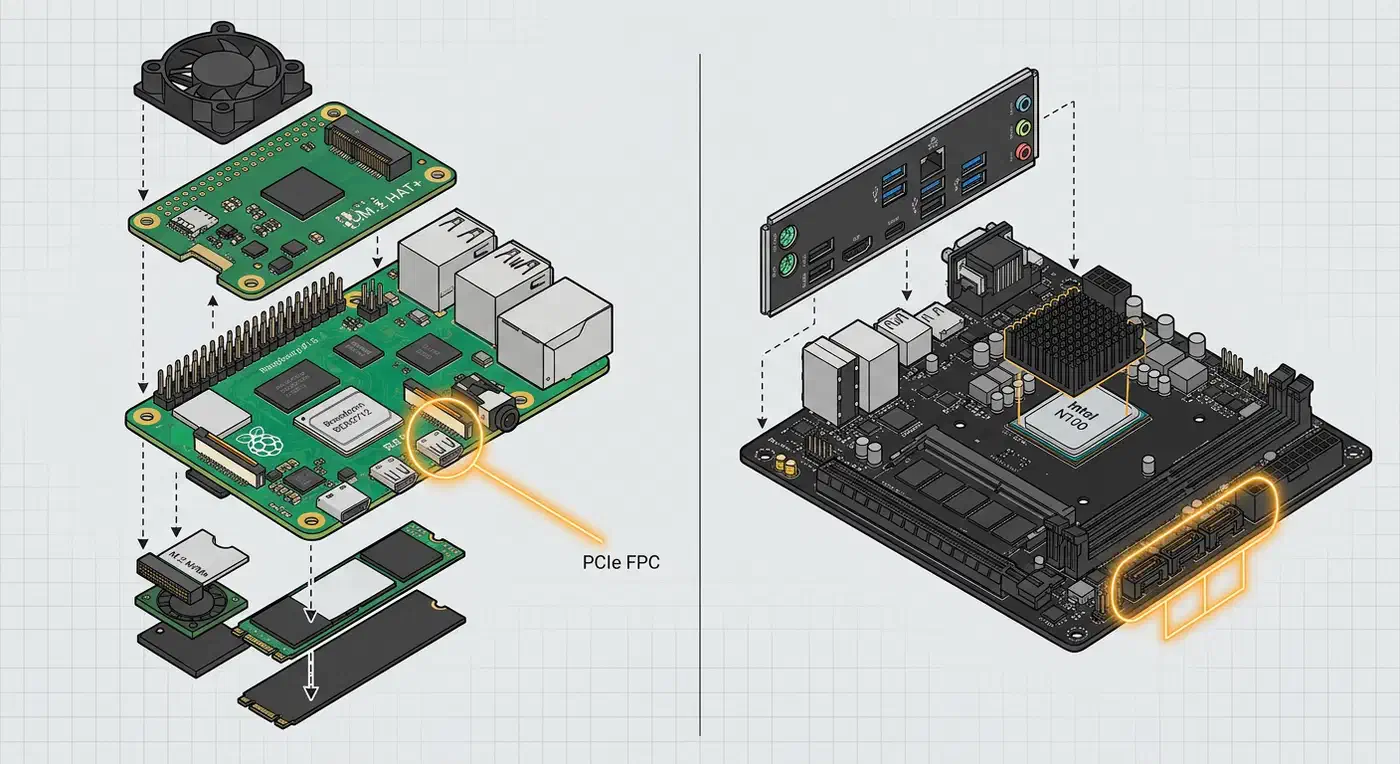
Idle power with four drives runs about 15 to 20 watts, depending on how you set drive spindown. The same math gives roughly $20 to $26 per year. That’s more than the Pi 5, but well under a comparable Synology or QNAP unit. Plug in your own electricity rate to compare their running costs side by side.
Software Stack - OpenMediaVault vs. TrueNAS SCALE
OpenMediaVault on Raspberry Pi 5
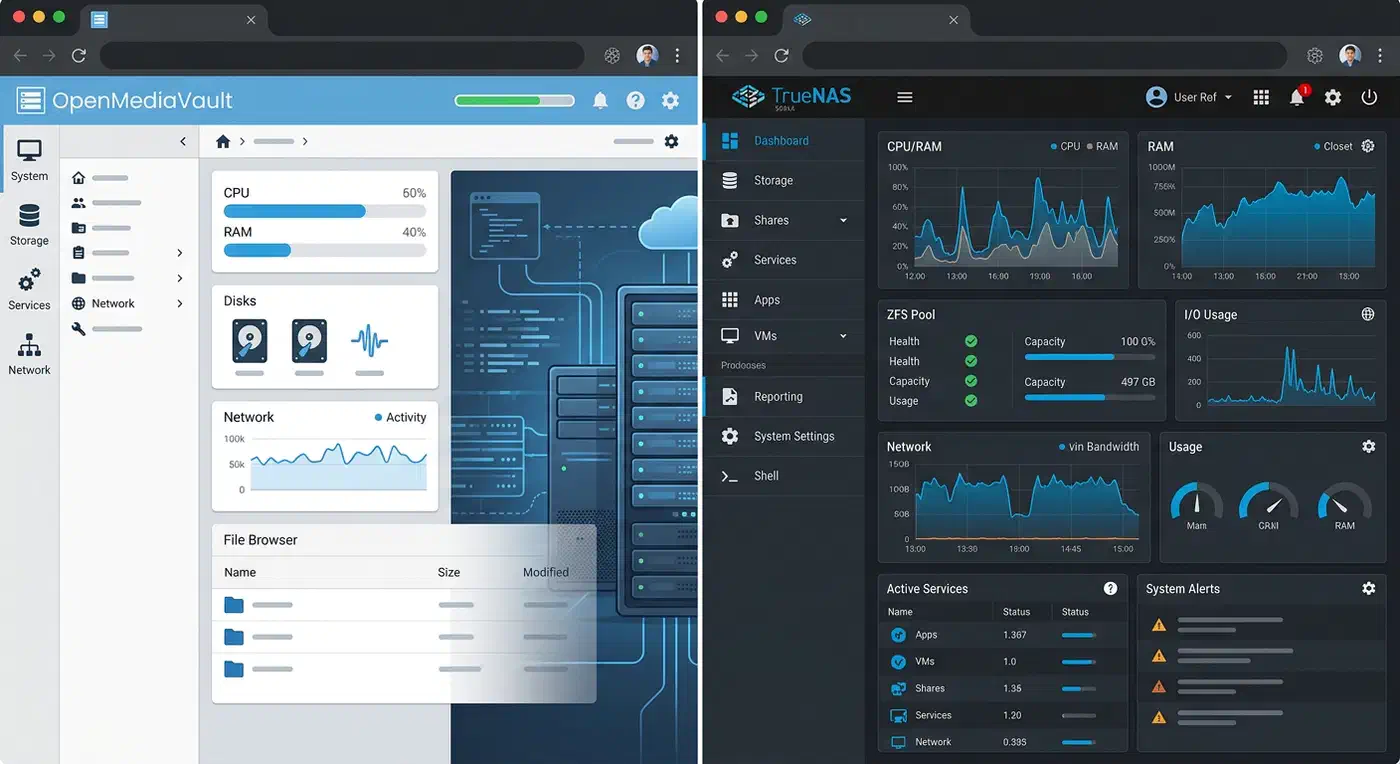
OpenMediaVault installs cleanly on Raspberry Pi OS. It gives you a web UI for Samba shares, NFS exports, user accounts, and Docker containers through Portainer. The mergerfs and SnapRAID pairing is the standard setup for a Pi-based multi-drive NAS. mergerfs shows several drives as one unified filesystem, with no RAID overhead and full drive use. SnapRAID runs nightly parity passes so you can recover from a single drive failure.
The catch is that mergerfs and SnapRAID don’t give you true real-time redundancy. If a drive fails between SnapRAID sync runs, you lose any data written since the last sync. For a backup target or a media archive that also lives elsewhere, that’s fine. For primary storage with no other copies, it’s a real risk.
TrueNAS SCALE on Intel N100
TrueNAS SCALE on an N100 gives you enterprise-grade ZFS. You get datasets with native compression, copy-on-write design, automatic checksums that catch silent data corruption, and scheduled scrubs that verify every bit on disk. ZFS RAIDZ1 across four drives gives you three drives of usable space with one-drive fault tolerance. Unlike RAID5/6 on hardware controllers, ZFS RAIDZ1 has no write hole flaw.
TrueNAS also ships a proper VM hypervisor and a mature app catalog that goes well past OpenMediaVault’s Docker support. Running Nextcloud, Immich for photo backup, and Jellyfin as TrueNAS apps next to your NAS services is a common setup.
Cockpit as a Middle Ground
Want more control than OpenMediaVault gives but find TrueNAS too opinionated? Cockpit on bare Debian is an excellent middle path. It’s a light web UI for Linux with disk management, Docker support, and system monitoring, and you don’t have to commit to a NAS-specific distro. Docker Compose on bare metal next to Samba works well on both platforms and gives you the most flexibility.
Performance Benchmarks
| Metric | Raspberry Pi 5 | Intel N100 |
|---|---|---|
| Sequential read (SMB, NVMe) | ~310 MB/s | ~950 MB/s |
| Sequential read (SMB, USB HDD) | ~100–120 MB/s | ~450 MB/s (SATA) |
| 4K HEVC simultaneous streams | 0 (no hardware decode) | 4–6 (Quick Sync) |
| Idle power (2 drives) | ~8W | ~18W |
| Idle power (4 drives) | N/A (USB hub limits) | ~22W |
| Annual idle electricity ($0.15/kWh) | ~$10–12 | ~$24–29 |
| RAM max | 8GB | 32GB |
| ZFS ARC cache | Limited | Scales with RAM |
The 10GbE angle is worth a note. Some N100 NAS boards include 10GbE ports or M.2-to-10GbE cards, so they can saturate a 10G home network. The Pi 5 is capped at its built-in 1 Gigabit Ethernet port, with no upgrade path. The switch and cabling for that side cost less than most people expect: a full 10GbE home network runs under $200.
Drive Selection and Network Configuration
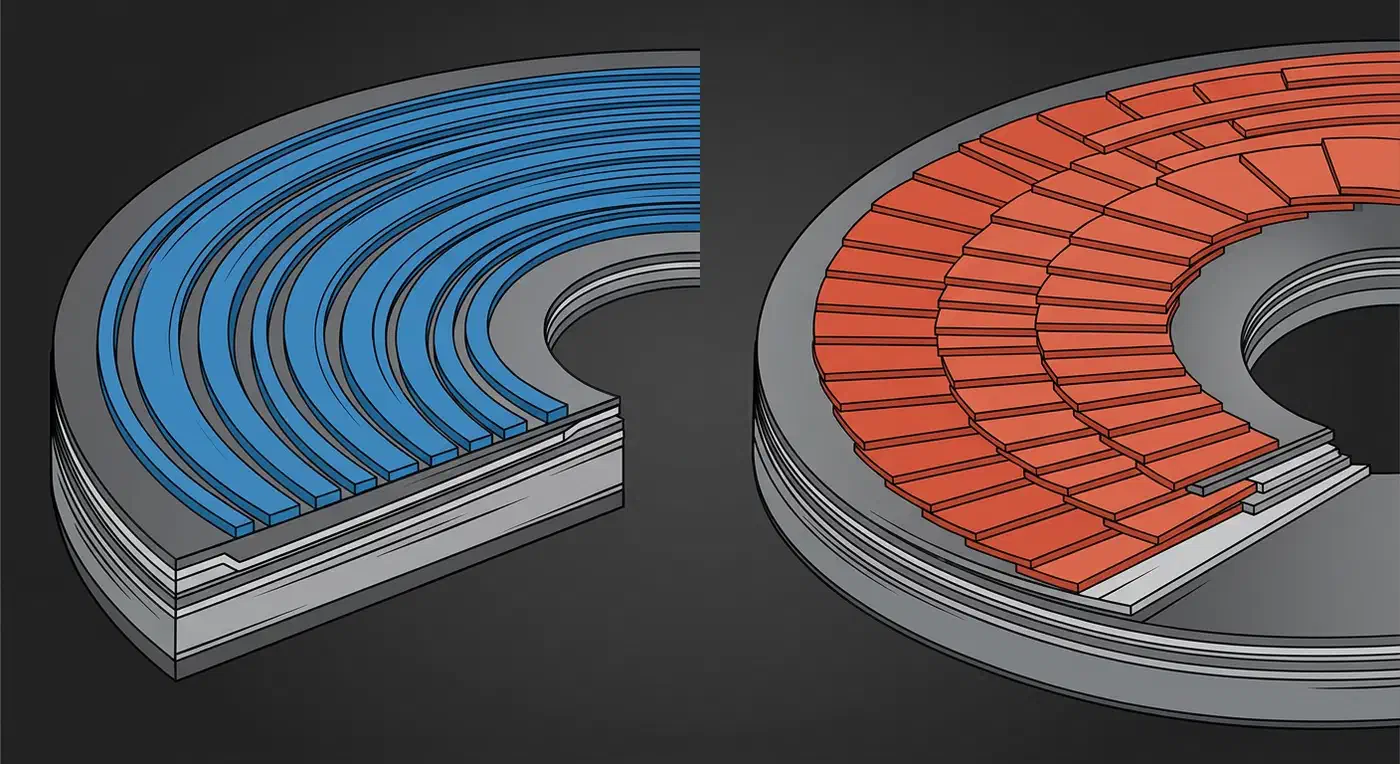
The storage hardware around your NAS counts as much as the compute. For spinning drives, pick CMR (Conventional Magnetic Recording) over SMR (Shingled Magnetic Recording). SMR drives do poorly under the random write patterns that ZFS RAIDZ and SnapRAID parity passes create. WD Red Plus and Seagate IronWolf are the safe CMR picks. Avoid WD Red non-Plus models, which use SMR.
For the network, both platforms gain from a dedicated VLAN for NAS traffic on a managed switch. That keeps NAS transfers off the general home network and makes firewall rules simpler. 2.5GbE is the practical sweet spot for a home NAS in 2026. Most modern motherboards and many USB 3.0 adapters support it, and it saturates SATA drives without the cost of 10GbE gear. To reach your NAS from outside your home network, an encrypted tunnel built on a private VPN gives you a low-overhead link on both platforms.
The 3-2-1 Backup Rule
One key point gets lost in NAS talk: your NAS is not a backup. Whether you run a Pi 5 with mergerfs or an N100 with ZFS RAIDZ1, RAID gives you fault tolerance, not backup. Ransomware, an accidental delete, or a fire takes out all your drives at once.
The 3-2-1 rule: 3 copies of your data, on 2 media types, with 1 copy off-site. Your NAS is one copy. Back it up to a cloud service like Backblaze B2 or Hetzner Storage Box, or to a separate drive in another location. That gives you the protection RAID cannot.

TrueNAS has built-in replication to remote TrueNAS boxes or rsync targets. OpenMediaVault can drive rsync or rclone backups through cron. Neither runs a real backup plan by default, so set one up on purpose.
Which Should You Build? Decision Framework
Choose the Raspberry Pi 5 if:
- Primary use is file backup or cold storage for photos and documents
- Power consumption is genuinely the primary concern (off-grid, low electricity budget)
- Budget is under $150 total including case and storage
- No transcoding or multi-user media streaming needed
- You enjoy tinkering with ARM Linux and the Pi community
Choose the Intel N100 if:
- Running Plex or Jellyfin for household media consumption
- Want ZFS’s data integrity guarantees and TrueNAS SCALE’s full feature set
- Planning to expand to 3-4 drives in the next year
- Running self-hosted services (Nextcloud, Immich, Home Assistant) alongside storage
- Prioritize a long-lived, performant platform over minimum power draw
Hybrid approach: Pair a Pi 5 as a backup target with an N100 as the main media and file server. The Pi pulls nightly backups from other machines via rsync over SSH. Its low idle power makes it great for always-on duty, while the N100 does the heavy lifting when needed.
The N100 has more upgrade room, and the NAS software world targets it most actively. The Pi 5 is more hackable, has a bigger support community, and will stay a capable light-duty NAS for years. Neither choice is wrong if it fits your real workload.