 Botmonster Tech
Tuning the Steam Deck OLED kernel for gaming performance
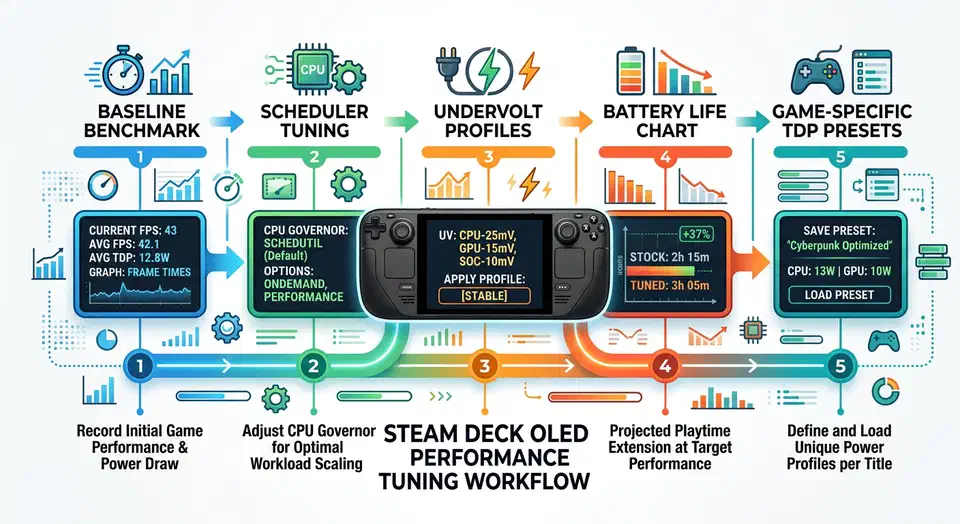
Steam Deck OLED tuning is no longer just about pushing sliders and hoping for more FPS. The stack is layered. Valve’s kernel, your Proton version, the game engine, and power policy all interact. Tune one layer alone and you often trade smoothness for crashes, or frame rate for battery drain. The Deck’s own compositor is part of that stack, and Gamescope brings its HDR, VRR, and FPS caps to a desktop too.
This guide chases one goal: steadier frame times and longer battery life, without turning your Deck into a fragile science project. You get a safe workflow, specific kernel options, and game profiles you can reuse.
Understanding the Steam Deck OLED Hardware
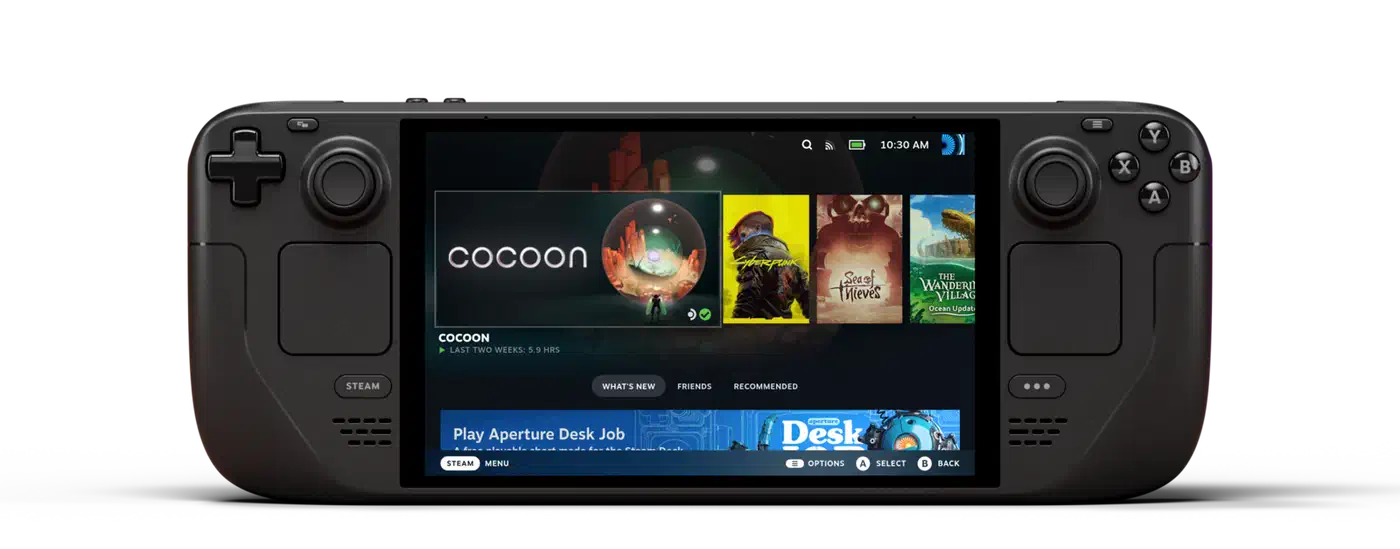
Kernel tuning only pays off if you map changes to real hardware limits. The Steam Deck OLED still uses the AMD Van Gogh APU family. It packs 4 Zen 2 CPU cores and an RDNA 2 iGPU, and both share one 16 GB LPDDR5 memory pool. That shared pool is why CPU-heavy and GPU-heavy games react so differently to the same TDP limit.
Compared with the original LCD model, the OLED gives you three real wins for tuning. First, the 90 Hz panel shows frame pacing flaws far more clearly than a 60 Hz display. So scheduler quality and frame-time variance count for more than raw average FPS. Second, the OLED wastes less power at mid-load, so undervolting and power-limit shaping pay off better. Third, the larger 50 Wh battery gives you more room to test profiles, especially if you target 40-60 FPS locks.
Thermals stay the hard ceiling. The Deck can burst high power for a moment, but sustained speed depends on the vapor chamber, room temperature, and fan curve behavior. In plain terms, long sessions in heavy games are capped by heat buildup and sustained power limits, not by peak clocks.
You should also know how Valve splits power management. SteamOS sets game-level policy, while kernel drivers enforce frequency, voltage, and thermal limits. So a custom kernel patch can do nothing if user-space policy still clamps the workload. The reverse is true too.
SteamOS 3.8 and the Game Mode Overhaul
Before you touch custom kernels, build a baseline on current SteamOS. SteamOS 3.8 already ships real gains in amdgpu states, frame pacing, and dynamic refresh. Many people still apply old tweak lists from 2024-2025 that now fight Valve’s defaults.
Game Mode and Desktop Mode are not the same for tuning. In Game Mode, SteamOS puts the foreground game first, boosts harder, and syncs display refresh with frame limiters. Desktop Mode is tuned for general response and background services. So benchmark numbers from Desktop Mode usually mislead you.
SteamOS channels matter as well:
| Channel | Typical use | Risk profile | Recommendation |
|---|---|---|---|
| Stable | Daily gaming | Lowest | Start here for baseline |
| Beta | Near-term fixes/features | Moderate | Good for enthusiasts who test often |
| Preview | Experimental rollout | Highest | Use only if you can recover quickly |
If you want repeatable tuning, lock to one channel while testing. Don’t benchmark on Beta, then apply kernel tweaks on Stable and expect a fair comparison.
Prerequisites, Disclaimers, and Backup First
Any kernel change or undervolting workflow needs a clear safety policy. Most guides skip this part, and it is where most broken installs come from.
Use this checklist before changing anything:
| Item | Why it matters | How to verify |
|---|---|---|
| SteamOS channel fixed | Stops a moving target | Settings > System > OS Update Channel |
| Recovery media ready | Fast rollback from a bad boot | Create SteamOS recovery USB |
| Baseline metrics captured | Compare gains honestly | Record FPS, 1% lows, battery drain |
| Game list selected | Avoids random testing noise | Pick 3-5 repeatable scenes |
| Proton versions pinned | Kernel and translation layer interact | Per-game Compatibility settings |
Backup procedure (minimum):
# In Desktop Mode terminal: keep a copy of your tunables and logs
mkdir -p "$HOME/deck-tuning-backup"
cp -a /etc "$HOME/deck-tuning-backup/etc-$(date +%F)" 2>/dev/null || true
cp -a "$HOME/.steam" "$HOME/deck-tuning-backup/steam-$(date +%F)" 2>/dev/null || true
You should also export your Steam controller layouts and note current per-game launch options. If you later chase a stutter, this saves you from guessing whether kernel changes, launch flags, or a Proton update caused it.
One disclaimer: undervolting and unsupported kernel patches can cause crashes, data loss in edge cases, and failed updates. If the Deck is your only gaming device, try reversible changes first.
Custom Kernels for the Steam Deck: Risks and Options
The safest path is usually to stay on Valve’s kernel and tune policy. But if you want deeper scheduler or power changes, custom kernels work fine, as long as you treat them as controlled experiments.
Most users weigh three routes:
| Option | Upside | Downside | Best for |
|---|---|---|---|
Valve default kernel (linux-neptune lineage) | Maximum compatibility with SteamOS updates | Less aggressive tuning options | Most users |
| Community Deck-focused kernels | Extra scheduler/power patches | Update friction, variable QA | Advanced tinkerers |
| Bazzite (immutable alternative) | Curated gaming kernel + atomic updates | Migration effort from SteamOS | Users wanting pre-tuned reliability |
If you patch the kernel by hand on SteamOS, expect updates to overwrite your changes over time. Write down what you changed and re-test after major OS updates.
Bazzite earns its own mention because it chases the same goals with cleaner rollback. If you value stability but still want advanced tuning knobs, Bazzite often beats re-patching stock SteamOS again and again. For a wider look at how immutable Linux distros handle atomic updates and rollback, see our comparison of Debian, Arch, and SteamOS update models.
CPU Scheduler Tuning with BORE and CachyOS-Inspired Patches
Frame pacing issues on handhelds are often CPU scheduling issues disguised as GPU bottlenecks. Average FPS can look fine while 1% lows feel rough because short CPU bursts miss their render deadlines.
BORE-style scheduling targets this exact problem. It reacts to bursty game threads better than the default general-purpose settings. On Deck-like workloads, that can cut microstutter during open-world travel and shader-heavy transitions.
If your kernel exposes scheduler tunables, test in small steps:
# Inspect current scheduler tunables
sysctl kernel.sched_latency_ns
sysctl kernel.sched_min_granularity_ns

# Example: reduce latency window slightly (values are examples)
sudo sysctl -w kernel.sched_latency_ns=12000000
sudo sysctl -w kernel.sched_min_granularity_ns=1500000
Don’t chase extreme values. A latency window set too low can raise CPU overhead and drain battery for little gain. Use MangoHud to compare 1% lows and frame-time consistency before and after, not just peak FPS.
A practical workflow:
- Run a 10-minute baseline in one fixed scene.
- Apply one scheduler change.
- Repeat same scene with same frame cap and brightness.
- Keep the change only if frame-time percentile improves consistently.
Proton and Wine Version Context: Why Kernel Tuning Alone Is Not Enough
Kernel tuning works hand in hand with the translation layer for Windows games. A game on Proton 9 can behave very differently on Proton 10 with the same kernel settings. Shader compile paths, DXVK versions, and sync primitives all change between builds.
Treat Proton version as part of your tuning profile. For each game you optimize, record:
- Proton build used (
Proton Experimental,Proton 9.x,GE-Proton, etc.). - Launch options (FSR flags, mangohud,
gamemoderun). - In-game graphics preset and frame cap.
Example launch option pattern:
MANGOHUD=1 gamemoderun %command%If you use FSR environment variables, check that the game actually honors them. Some titles now use native upscaling paths and ignore the old flags. A wrong flag can make you blame visual artifacts on a flaky kernel when the real cause sits in the graphics stack.
FSR 4.0 and Upscaling Strategy on the Deck OLED
The Deck’s GPU budget is fixed, so upscaling stays one of the highest-impact tuning tools. The smart play is not “always turn on the newest upscaler.” It is “match the upscaling mode to the game’s bottleneck and refresh target.”
For GPU-bound AAA titles, use quality-first upscaling plus a stable frame cap. For CPU-limited games, heavy upscaling may lift the FPS counter without smoothing frame pacing.
Common approach in Steam launch options where relevant:
WINE_FULLSCREEN_FSR=1 WINE_FULLSCREEN_FSR_STRENGTH=2 %command%Then confirm in MangoHud whether frame-time spikes improved. If they did not, your bottleneck is likely CPU scheduling, shader compilation, or storage streaming.
A good rule for the OLED panel is to align output with display divisors: 45 FPS for 90 Hz, or 30 and 60 targets for specific titles. Steady frame pacing usually feels better than a higher but jumpy average.
Undervolting and Power Limit Tuning
Undervolting and power shaping can give the biggest battery gain, but they also carry the most risk. Start with power limits before you touch voltage offsets.
ryzenadj remains the common Linux-side control tool for AMD APU limits:
# Example values only - tune gradually
sudo ryzenadj --stapm-limit=12000 --fast-limit=15000 --slow-limit=13000 --tctl-temp=80
Interpretation:
--stapm-limit: sustained package target, central for heat/battery tradeoff.--fast-limit: short burst ceiling, affects responsiveness spikes.--slow-limit: medium-window sustained behavior.--tctl-temp: thermal target guardrail.
Once power limits are stable, test voltage offsets in small steps. A small offset may cut heat and fan noise, but each APU chip behaves differently. If you see random game exits, shader compile crashes, or resume bugs, roll back at once.
To keep settings across reboots, use a small systemd unit that runs after login plus another hook for resume. Keep the defaults nearby so rollback is one command away.
Per-Game Performance Profiles That Actually Work
One global profile is handy, but it leaves gains on the table. Different engines stress different parts of the APU. You get better results with at least three profile classes.
| Profile type | Typical games | Suggested tuning direction |
|---|---|---|
| GPU-heavy | AAA open-world, high effects | Slightly higher GPU budget, moderate CPU cap |
| CPU-heavy | Strategy, simulation, large AI scenes | Favor CPU burst behavior and scheduler responsiveness |
| Balanced/indie | 2D, stylized, lightweight 3D | Lower TDP, strict frame cap for battery |
Example profile notes you can store in a text file:
Cyberpunk 2077: Proton Experimental, 45 FPS cap, medium preset, moderate TDP
Baldur's Gate 3: Proton 9.x, CPU-favor profile, shader cache warmed
Hades II: 60 FPS cap, low TDP profile for long battery sessions
This approach avoids endless retuning and helps you restore known-good behavior after OS updates.
Battery Life Benchmarks and Measurement Method
Claims like “15% better battery” mean nothing unless you measure them the same way each time. Use repeatable scenes and report watt draw plus playtime.
Benchmark method:
- Set fixed brightness (for example 50%), Wi-Fi state, and audio volume.
- Use the same in-game scene or route for each run.
- Log average power draw and battery drop over 20-30 minutes.
- Repeat at least twice and average.
Example results template:
| Game | Profile | Avg FPS | 1% low | Avg package power | Estimated playtime |
|---|---|---|---|---|---|
| Game A | Stock | 44 | 31 | 16.8 W | 2h 35m |
| Game A | Tuned | 45 | 36 | 14.9 W | 2h 55m |
| Game B | Stock | 60 | 49 | 13.2 W | 3h 18m |
| Game B | Tuned | 60 | 55 | 11.7 W | 3h 45m |
These numbers are just examples, but the pattern is real. A well-tuned profile lifts 1% lows and battery life more reliably than it lifts peak FPS.
Monitoring and Validation Tooling
Without telemetry, tuning is guesswork. Keep your validation toolchain simple and consistent.
Useful tools and what they answer:
| Tool | Purpose |
|---|---|
| MangoHud | FPS, frame-time graph, CPU/GPU usage |
radeontop | Real-time GPU load and activity |
s-tui or similar | CPU temp/frequency trends |
journalctl -b | Boot/session errors after tuning changes |
Quick checks:
# Session-level errors after a crash/reboot
journalctl -b -p err

# Verify governor behavior exposed by kernel
cat /sys/devices/system/cpu/cpu0/cpufreq/scaling_governor
When results conflict, trust frame-time consistency and thermals over short benchmark spikes.
Troubleshooting Table: Symptom to Cause to Fix
If tuning goes wrong, this table helps you find the issue fast.
| Symptom | Likely root cause | First fix to try |
|---|---|---|
| Better average FPS but worse stutter | Over-aggressive scheduler tweak | Revert scheduler tunables toward default |
| Random game crashes after undervolt | Voltage offset too aggressive | Remove offset, keep only power-limit tuning |
| Battery drain unchanged | Frame cap missing or profile mismatch | Apply per-game cap (30/45/60) and retest |
| Good performance in one game, bad in others | Single global profile overfitted | Split into CPU-heavy/GPU-heavy profiles |
| Performance regressed after SteamOS update | Kernel/proton interaction changed | Re-pin Proton version and retest baseline |
| Fan noise higher despite undervolt | Fast-limit too high for ambient temp | Reduce burst limit and lower thermal target |
A Practical, Low-Risk Tuning Sequence
If you want one sequence to follow, use this:
- Establish baseline on SteamOS Stable with fixed Proton versions.
- Add frame cap strategy per game (30/45/60 depending on title).
- Tune power limits with
ryzenadjin small steps. - Validate with MangoHud and battery drain logs.
- Only then test scheduler changes.
- Consider custom kernel or Bazzite migration if gains plateau.
This order gives most of the upside while minimizing breakage.
Conclusion
The Steam Deck OLED rewards careful tuning, but the biggest gains come from steady profiling, not from the most aggressive kernel patch. In real use, the best results are better 1% lows, steadier frame pacing on the 90 Hz panel, lower fan noise, and a real battery boost in the games you actually play.
If you keep one rule, keep this: tune the stack, not just the kernel. Track your Proton version, your per-game profiles, and your battery numbers. That is how you get a faster Deck that still behaves the same after updates.