 Botmonster Tech
Hailo-8 vs Google Coral TPU for Frigate NVR: which edge AI accelerator wins in 2026

The Hailo-8 (26 TOPS) is the clear winner for any Frigate build beyond four cameras, and the Hailo-8L (13 TOPS) has taken over as the sweet spot for mid-tier setups of six to ten cameras. The Google Coral Edge TPU (4 TOPS) is still a defensible pick for ultra-budget one-to-three-camera Raspberry Pi builds where an M.2 slot or spare USB port is already sitting idle, but the Hailo-8L usually beats it on price per TOPS even in that range. Reach for Coral when the only goal is stopping Frigate from melting a Pi’s CPU. Reach for Hailo-8 when there is headroom to grow into YOLOv8, higher resolutions, and future model upgrades.
Why Frigate needs an edge AI accelerator
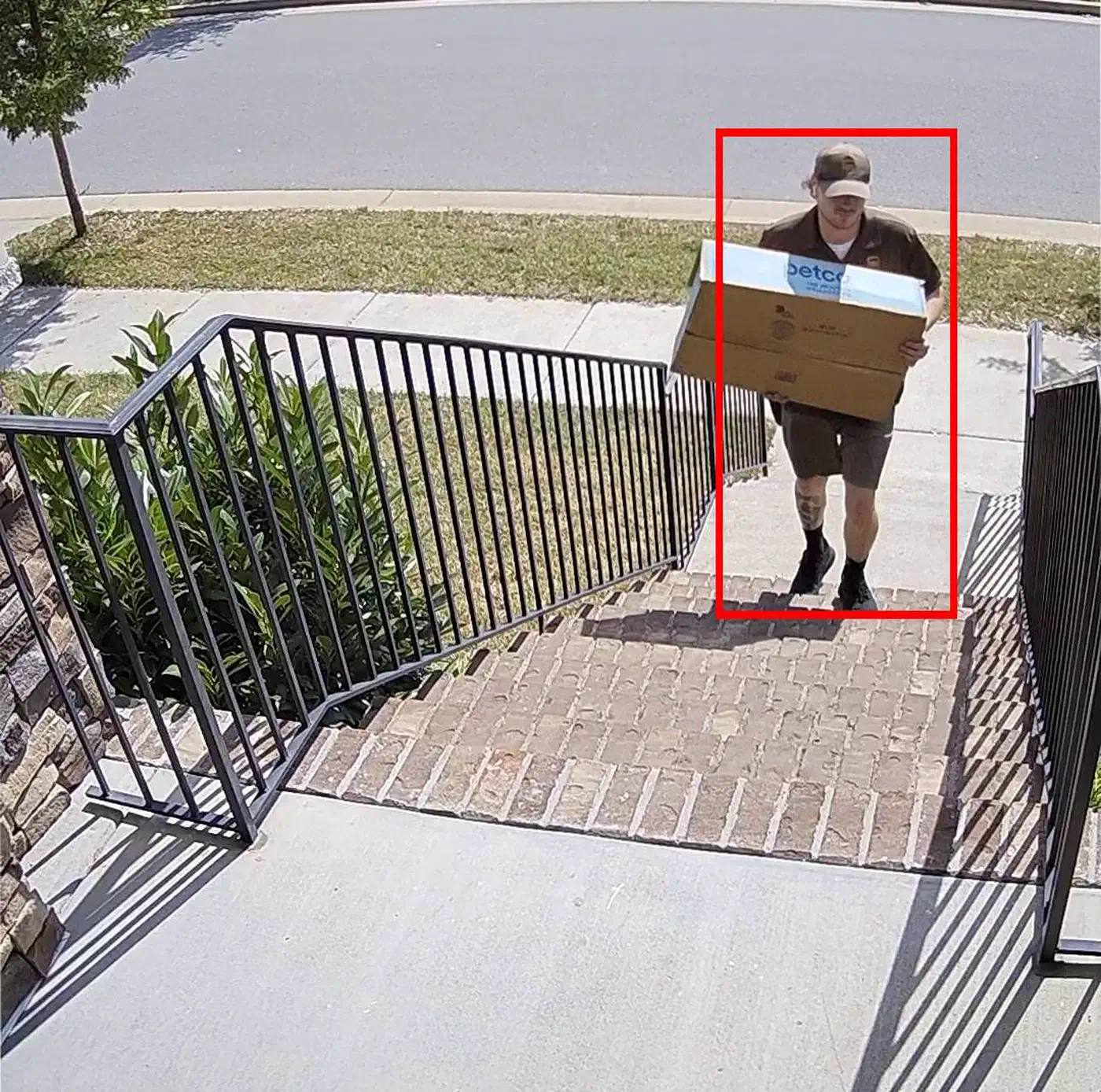
Frigate earns its keep by running real-time object detection locally, without ever shipping frames to someone else’s cloud. That job will crush a CPU unless inference gets offloaded to dedicated silicon. Inference is the bottleneck, so the choice between Hailo and Coral is the biggest hardware decision for a self-hosted NVR.
Inside Frigate, every frame follows the same path: motion regions get pulled from the decoded video stream, resized to the model input size (usually 320x320 or 640x640), and fed to the detector for classification. Every millisecond of inference latency directly caps how many cameras one instance can watch. An SSD MobileNet run on a 4-core N100 at 5 FPS per camera saturates the CPU around two cameras, leaves nothing for ffmpeg, and starts dropping frames that mask real detections.
Frigate 0.14 and 0.15 rewrote the accelerator story. Hailo-8 and Hailo-8L became officially supported detectors via HailoRT, joining Coral’s long-standing edgetpu support. The object detectors documentation
now lists both as first-class options, and Frigate 0.16 added YOLOv9 support that runs well on Hailo but requires manual model conversion on Coral.
Inference FPS is the metric to compare. A detector rated at 150 FPS can feed fifteen cameras at 10 FPS each; a 30 FPS detector caps the build at three cameras at 10 FPS. Headline TOPS numbers mislead when model compatibility is uneven. In 2026, with sub-$200 N100 mini PCs and $110-175 Raspberry Pi 5 boards both viable Frigate hosts, the accelerator is often more expensive than the computer it plugs into, which is why price-per-effective-TOPS and long-term driver support have become the dominant concerns.
Hailo-8 and Hailo-8L: Hardware, HailoRT, and Frigate Integration
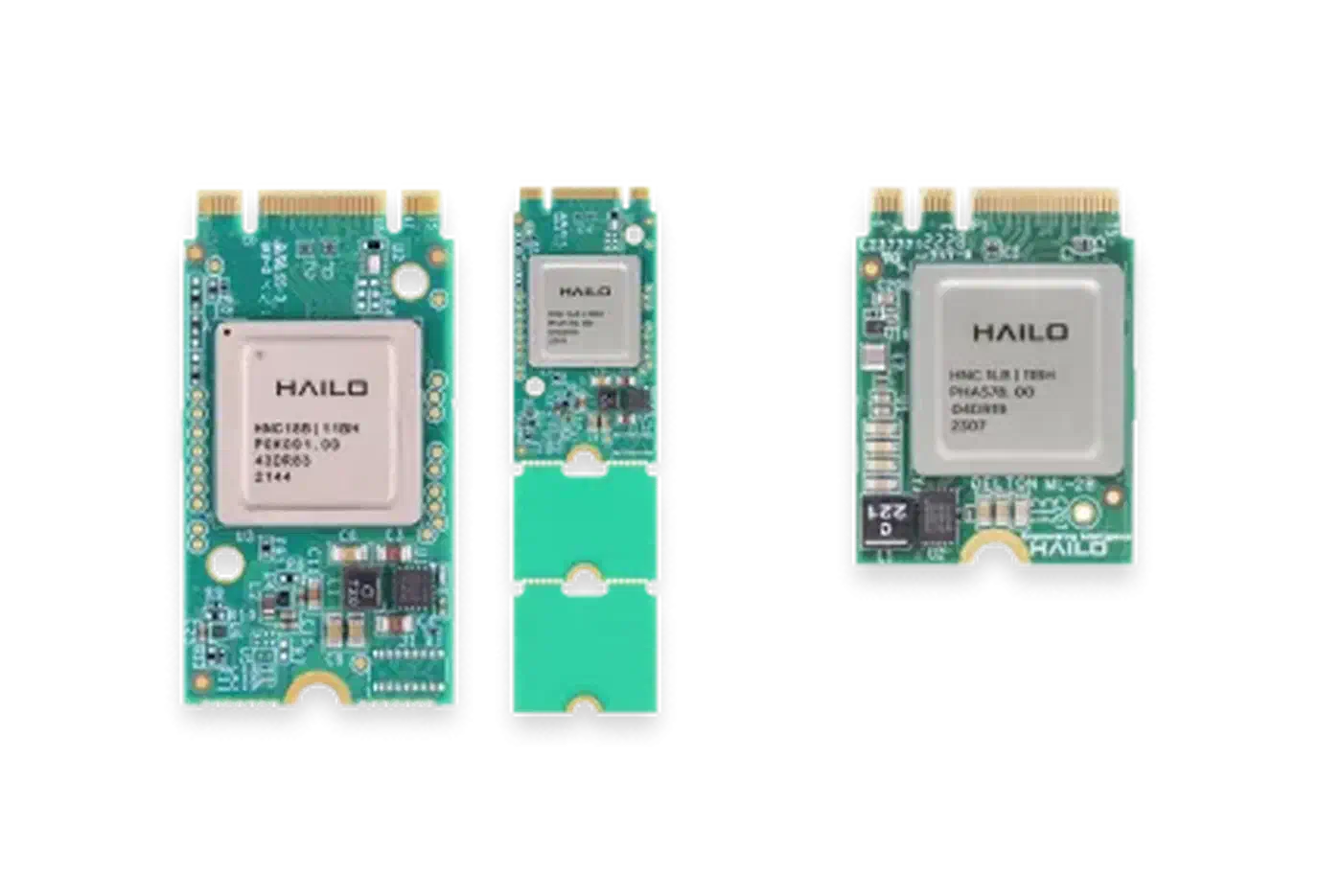
Hailo shipped the Hailo-8 as a 26 TOPS INT8 accelerator aimed at automotive and industrial vision, and over the last two years it has become the default recommendation in the Frigate community. The hardware available today falls into three buckets:
- Hailo-8 M.2 2230 M+B key module, 26 TOPS, roughly 2.5W typical draw, around $170 from distributors like Waveshare
- Hailo-8L M.2 module, 13 TOPS, roughly 1.5W, around $70, the “lite” SKU positioned to replace Coral
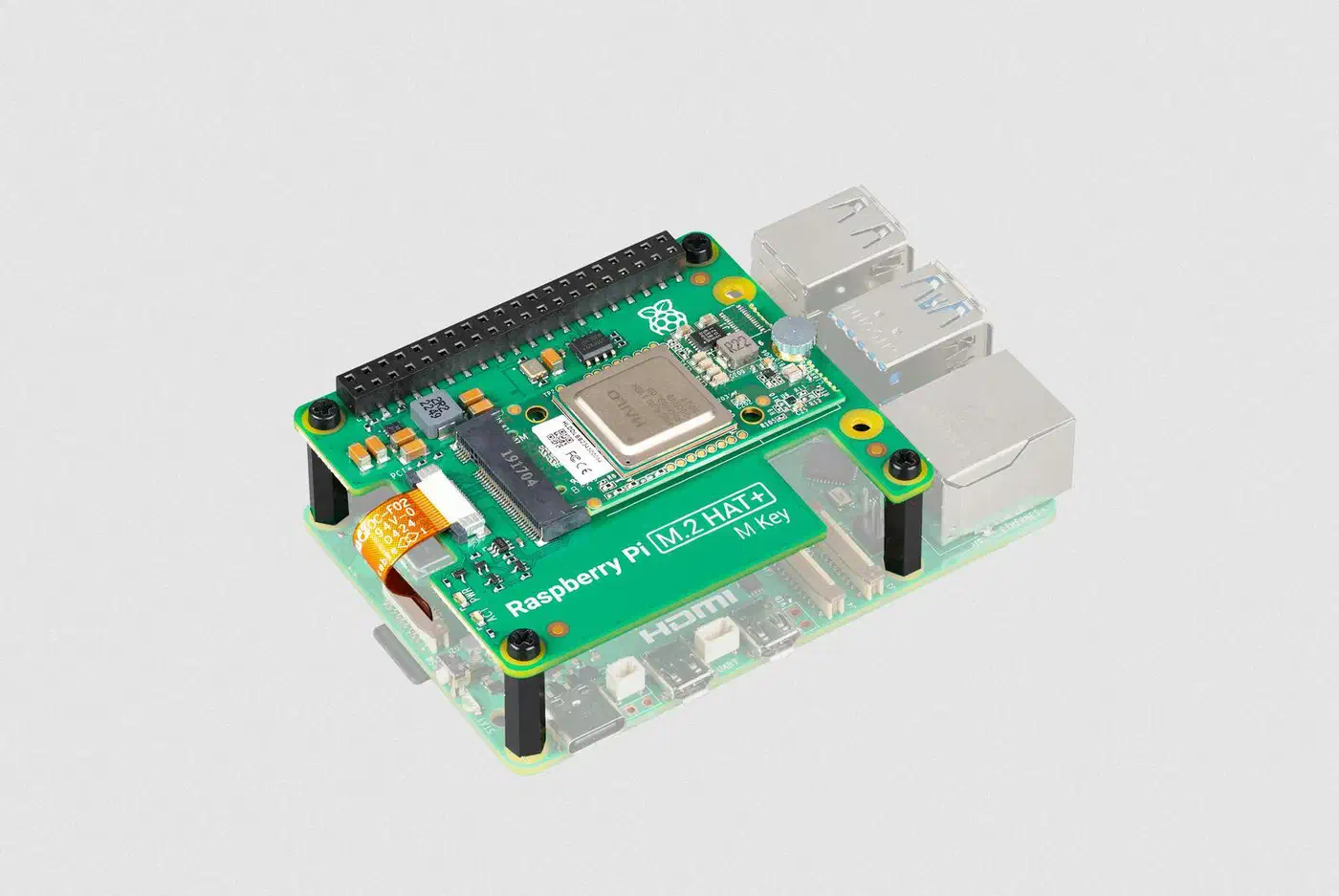
- Raspberry Pi AI HAT+, exposing the Hailo-8 or Hailo-8L over the Pi 5’s PCIe FPC connector, around $70 for the 8L version (the older AI Kit is out of production)
The M.2 2230 M+B form factor fits most N100 and N305 mini PCs that expose an M.2 slot intended for WiFi. The AI HAT+ is the only practical way to get Hailo onto a Raspberry Pi 5, because the Pi’s single M.2 connector is usually already occupied by NVMe storage.
The software side runs on the HailoRT
stack: a userspace runtime plus a kernel driver, shipped as Debian and Ubuntu packages with support for Linux kernels 6.1 through 6.8 and official arm64 builds for Raspberry Pi OS Bookworm. Models must be compiled to the proprietary .hef format using the Hailo Dataflow Compiler, but Frigate ships precompiled .hef files for YOLOv6n, YOLOv8s, and YOLOv8m, so most users never touch the compiler.
A working Hailo-8L detector block in config.yml looks like this:
detectors:
  hailo:
    type: hailo8l
    device: PCIe

model:
  width: 640
  height: 640
  input_tensor: nhwc
  input_pixel_format: rgb
  input_dtype: int
  model_type: yolo-generic
  path: /config/model_cache/hailo/yolov8s.hef
  labelmap_path: /labelmap/coco-80.txt
HailoRT requires the kernel module to match the userspace version exactly, so an unattended apt upgrade on the Pi will break the stack; pinning hailort and hailort-pcie-driver packages is standard practice. The M.2 module also runs warm, around 60-75C under sustained load, and benefits from a small heatsink, though unlike Coral USB it does not aggressively throttle. Throughput stays within 5% of peak even at 80C in published Hailo benchmarks.
Google Coral Edge TPU: Hardware, libedgetpu, and Frigate Integration
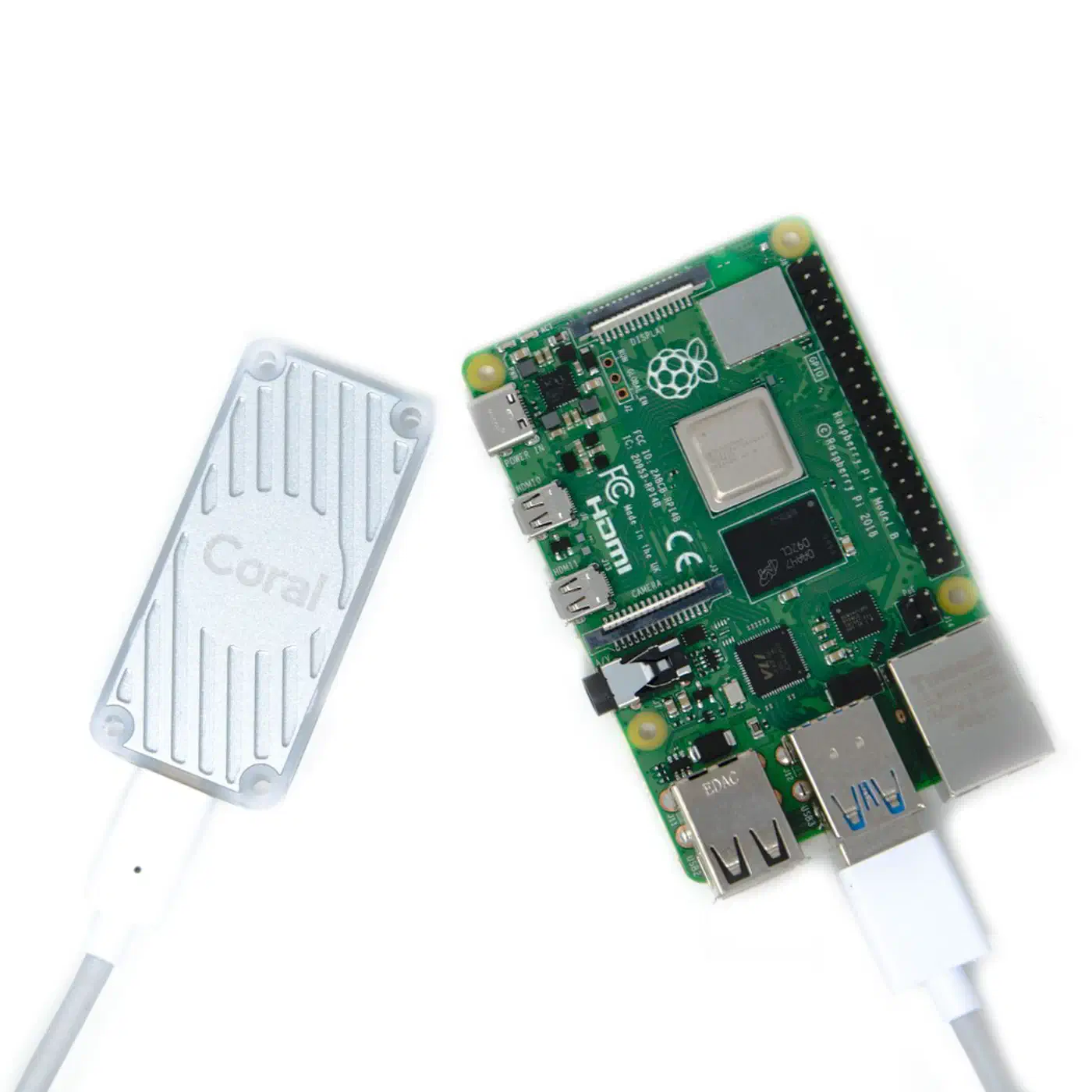
The Coral Edge TPU has been the default Frigate accelerator since 2020. Its software stack is the most mature of any accelerator Frigate supports, the config is the simplest, and the form-factor selection is the widest. What is still in production at coral.ai in 2026:
- USB Accelerator, USB 3.0, around 2W, the easiest plug-and-play option
- M.2 A+E key card, fits WiFi slots in many mini PCs
- M.2 B+M key card, fits NVMe slots, less common
- Mini PCIe card for older chassis
- Dev Board Mini for all-in-one builds
Specs: 4 TOPS INT8, Edge TPU ASIC running at 480 MHz, TensorFlow Lite models compiled for the Edge TPU via the edgetpu_compiler toolchain. The software stack is the libedgetpu
userspace library plus the gasket kernel driver for PCIe and M.2 variants. The USB variant works without a kernel driver on most distros.
Coral only runs models compiled to the Edge TPU TFLite format, which in practice means SSD MobileNet V2 is the realistic default. YOLOv8 support depends on community-compiled models that often fall back to CPU for unsupported ops, which negates most of the benefit. YOLOv9 works through the dbro/frigate-detector-edgetpu-yolo9 community plugin, but it is a separate install path.
A working Coral detector block:
detectors:
  coral:
    type: edgetpu
    device: usb
Frigate ships the ssdlite_mobiledet model by default, at 320x320, and for a Coral USB build that is what most users run. The entire config is two lines longer than a CPU-only setup.
libedgetpu has not seen a major release in nearly two years, and the gasket driver requires out-of-tree DKMS compilation on any kernel newer than 5.15. That turns Ubuntu 24.04 and Debian 13 hosts into a pain point, and the Frigate documentation now explicitly calls Coral a legacy option
, recommending it only “in deployments with particularly low power requirements.”
Pricing in 2026 is uneven. The USB Accelerator is still the most reliably stocked SKU at roughly $60. The M.2 A+E lives in the $25-30 range when it shows up at all. Supply has been erratic since the 2023 silicon shortage, and several variants are effectively end-of-life. The USB stick is also notorious for thermal throttling to roughly 50% of peak throughput after 30 seconds of sustained inference unless a heatsink and forced airflow are added, so detection FPS collapses after the first minute of running.
Head-to-Head Benchmarks
The numbers below use real workloads on identical hosts. Power and FPS figures are averaged across community benchmarks on an N100 mini PC and a Raspberry Pi 5 8GB, using Frigate 0.15 and 0.16.
| Accelerator | Model | Input Size | Inference FPS | Power | Cams @ 10 FPS |
|---|---|---|---|---|---|
| Coral Edge TPU (USB) | SSD MobileNet V2 | 320x320 | ~100 | 2.0W | 6-8 |
| Coral Edge TPU (USB) | YOLOv8n | 640x640 | fallback to CPU | n/a | n/a |
| Hailo-8L | YOLOv6n | 640x640 | ~80 | 1.5W | 6-8 |
| Hailo-8L | YOLOv8n | 640x640 | 60-80 | 1.5W | 6-8 |
| Hailo-8L | SSD MobileNet V2 | 320x320 | 200+ | 1.5W | 15-20 |
| Hailo-8 | YOLOv8s | 640x640 | 130-160 | 2.5W | 12-16 |
| Hailo-8 | SSD MobileNet V2 | 320x320 | 400+ | 2.5W | 30+ |
On YOLOv8n at 640x640 (the default for new Frigate installs on Hailo), the Hailo-8 lands in the 130-160 FPS range and the Hailo-8L reaches 60-80 FPS. Coral does not play in this benchmark because YOLOv8 does not compile cleanly to the Edge TPU, so Coral owners stay on SSD MobileNet V2 at 320x320.
On SSD MobileNet V2 at 320x320, which is Coral’s home turf, the Hailo-8L still clears 200 FPS and the Hailo-8 clears 400 FPS. That is a 4x margin on the model Coral was purpose-built for.
Detection accuracy tells a similar story. YOLOv8n on Hailo consistently beats SSD MobileNet V2 on Coral for small objects such as packages at the front door, cats at the end of the driveway, and people at the edge of the yard. Those are the scenarios that fill the Frigate subreddit with “why didn’t it detect that” complaints from Coral users.
Power draw is nearly identical: roughly 2W sustained for Coral, 2.5W for Hailo-8, 1.5W for Hailo-8L. On a TOPS-per-watt basis the Hailo-8 hits around 10.4 TOPS/W versus Coral’s 2 TOPS/W, but for a 24/7 NVR the absolute difference works out to pennies per month. If you want the exact figure at your own electricity rate, run a Pi plus accelerator power estimate .
Price per effective TOPS in early 2026 looks like this: Coral USB at $60 for 4 TOPS lands at $15/TOPS on paper (worse in practice due to throttling), Hailo-8L M.2 at roughly $70 for 13 TOPS lands at $5.40/TOPS, and Hailo-8 M.2 at roughly $170 for 26 TOPS lands at $6.50/TOPS. Hailo wins on absolute price per useful TOPS by nearly 3x.
Driver maturity on the Raspberry Pi 5 splits the market cleanly. Hailo ships first-party Pi 5 packages via the AI Kit and AI HAT+, with Raspberry Pi OS support baked into the standard image. Coral relies on community workarounds for the Pi 5’s kernel and has no official Pi 5 support page. On N100 mini PCs both work, but HailoRT packages stay versioned against current Debian and Ubuntu kernels while the gasket driver requires DKMS patches on anything newer than kernel 5.15.
Decision Matrix for 2026 Builds
The right pick depends on camera count, host hardware, and whatever accelerator might already be in a drawer.
Pick Coral Edge TPU if the setup has one to three cameras, a USB Accelerator is already on hand, the host is an older Raspberry Pi 4 where USB 3 is the only viable interface, or the kernel is older than 5.15 where the gasket driver still works without DKMS patches. The window is narrow now.
Pick Hailo-8L if the setup has four to ten cameras, YOLOv8 accuracy matters, the host is a new Raspberry Pi 5 NVR (use the AI Kit), or the host is an N100 mini PC with a free M.2 2230 slot. For most builds in 2026, this is the new default.
Pick Hailo-8 (full 26 TOPS) if the setup has ten or more cameras, 4K substreams are in play, YOLOv8m or larger models are planned, license-plate recognition or face recognition plugins will share the accelerator, or the intent is a five-year upgrade runway without swapping hardware.
Skip Coral if the host runs a 6.x kernel without DKMS patches, YOLOv8-class accuracy is required, the cameras produce small objects at distance, or local stock has dried up (which happens regionally and without warning).
Skip Hailo if the host has no M.2 slot and no PCIe connector, because Hailo has no USB option and that is unlikely to change. Also skip if the platform is anything other than x86_64 or arm64, or if a fully open-source inference stack is a hard requirement, because HailoRT is closed-source userspace.
Frigate 0.14 and later support multiple detectors simultaneously, so large deployments sometimes run a Hailo-8 as the primary object detector while keeping a Coral as a secondary detector for audio classification or a specialized purpose-compiled model. That squeezes real value out of existing Coral hardware instead of letting it gather dust in a drawer.
On the roadmap: the Hailo-10H started shipping in mid-2025 with 40 TOPS of INT4 performance aimed at edge generative AI, and it is overkill for a pure NVR workload today. Competing silicon includes the NPU in Intel’s Meteor Lake and Arrow Lake-N chips, which OpenVINO already wires into Frigate, and the Rockchip NPU on RK3588 boards, which has community support but lacks first-party Frigate integration. None of those change the 2026 answer, but they will reshape this same comparison by 2027.