 Botmonster Tech
EU AI Act rules and deadlines for developers in 2026
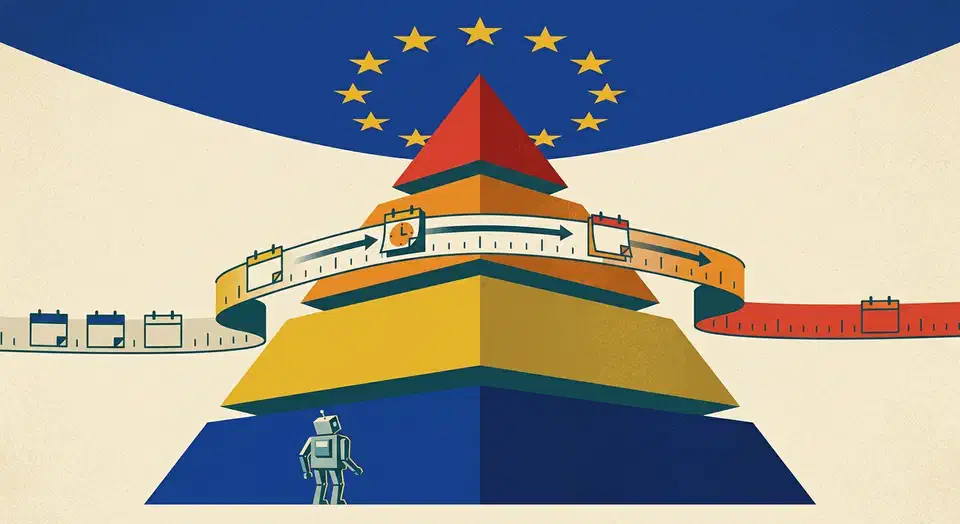
The EU AI Act compliance deadlines shifted in 2026. Regulation (EU) 2026/1744 pushed the high-risk deadline from 2 August 2026 to 2 December 2027. Three duties still bind you today: the banned-use list, the general-purpose model rules, and the duty to tell people they are talking to AI. Most small apps owe nothing more.
Key Takeaways
- The big high-risk deadline slipped from August 2026 to December 2027.
- Banned uses, general-purpose model rules, and AI disclosure already apply today.
- Most small apps land in the minimal-risk tier and owe almost nothing.
- Fines can reach 35 million euros or 7% of worldwide turnover.
- Open-source models get a partial pass, but not the biggest ones.
What is the EU AI Act?
The EU AI Act is Regulation (EU) 2024/1689, the first broad law for AI anywhere. It is a regulation, not a directive. So it applies directly in all 27 member states. No national law is needed to switch it on.
The duties depend on the use case. The same model can be minimal risk in one product and high risk in another. The tier follows how you deploy it. A face-matching model is trivial in a photo app but high risk in a hiring tool.
The Act also sorts everyone into roles, and your role decides your duties. A provider builds the system or rebrands it as their own. A deployer uses it inside their own business. Importers and distributors move it along the chain. Most indie makers are deployers, the lightest role.
Its reach crosses borders too. A provider outside the EU is still covered if the system reaches the EU market. It is also covered if its output is used inside the EU. In July 2026 the Digital Omnibus on AI, Regulation (EU) 2026/1744, amended the Act. That is where the new deadlines come from.
Which AI Act deadlines are already in force in 2026?
Many readers still think 2 August 2026 was the cliff edge for everything, but it was not. The high-risk rules moved, but a stack of duties went live well before 2026 and stayed live.
| Obligation | Who it hits | Status |
|---|---|---|
| Banned practices (Article 5), AI literacy | Everyone in scope | Live since 2 Feb 2025 |
| General-purpose model rules, AI Office, penalties | Model providers | Live since 2 Aug 2025 |
| Transparency and disclosure (Article 50) | Chatbot and content makers | Live from 2 Aug 2026 |
| Standalone high-risk systems (Annex III) | Hiring, credit, biometrics, etc. | Pending to 2 Dec 2027 |
| AI inside regulated products (Annex I) | Machinery, devices, vehicles | Pending to 2 Aug 2028 |
| Older general-purpose models | Models sold before Aug 2025 | Pending to 2 Aug 2027 |
The penalty framework and the general-purpose model rules have been enforceable since 2 August 2025. So the parts of the Act with real force are running now, well ahead of 2027.
The high-risk delay came for a plain reason. In the regulation’s own words, the shared tech standards that high-risk providers must follow were not ready in time. Systems marked before 2 August 2026 also get a short runway, to 2 December 2026, to add proper marking to generated output.
The four risk tiers, with real examples
The Act sorts every system into one of four tiers, from the top down.
Unacceptable risk is banned outright. This covers social scoring by public bodies, scraping faces off the internet to build face databases, reading emotions in workplaces and schools, and tricks that prey on someone’s weakness. The 2026 amendment added two more bans: AI that makes non-consensual intimate images, and AI that makes child sexual abuse material.
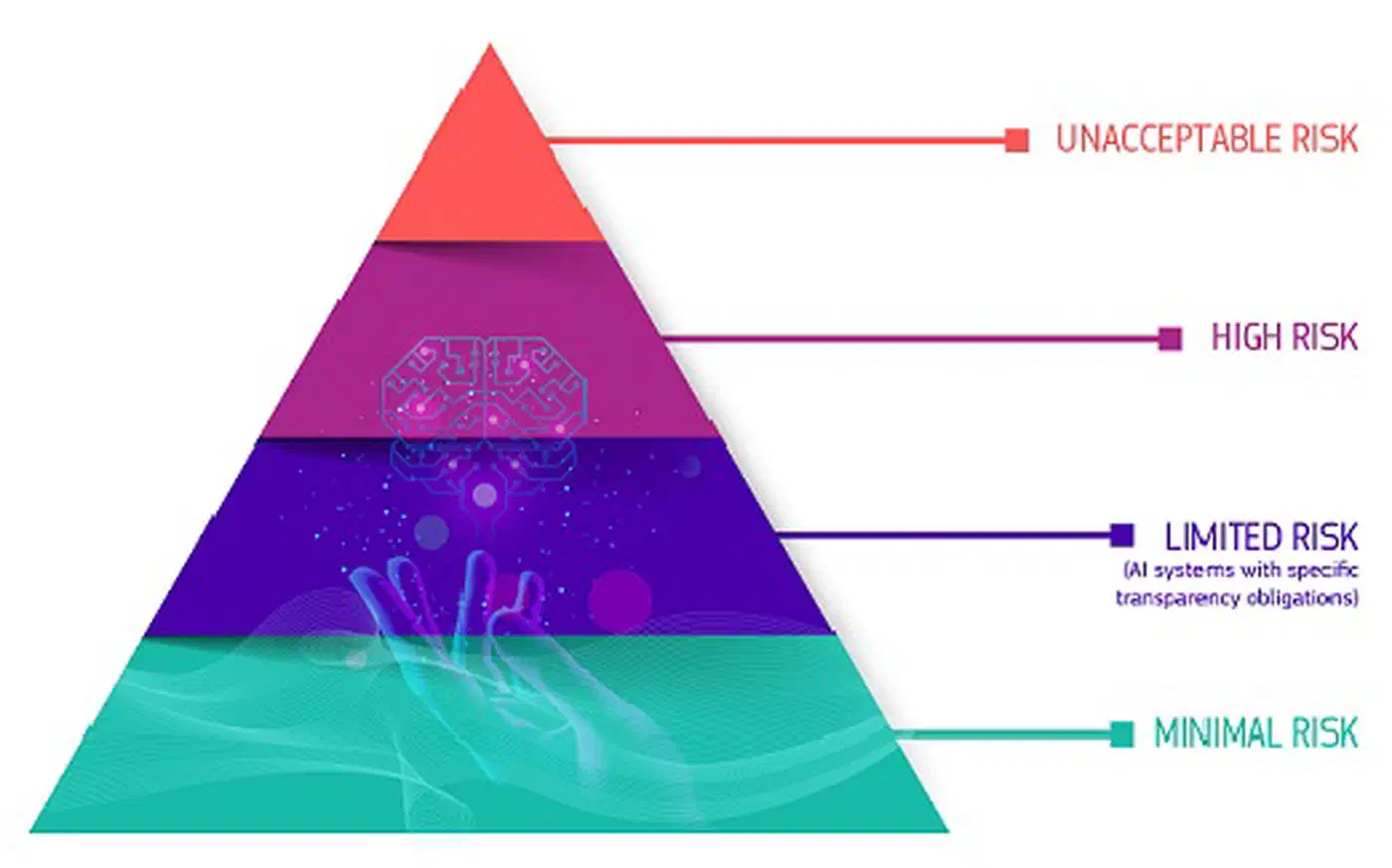
High risk is the heavy tier. Think CV screening, credit scoring, exam grading, medical triage, biometric ID, and safety parts inside machinery. These carry the real paperwork: risk plans, data governance, logging, human oversight, and a conformity assessment before launch.
Limited risk means transparency only. Chatbots, deepfakes, and synthetic media sit here. You disclose, and that is the whole job. No filing, no assessment.
Minimal risk is where almost everything lives: spam filters, recommendation engines, game AI, autocomplete, and most SaaS features. There are no specific duties at all. The European Commission says most AI systems in use sit right here. Your product is probably one of them.
What the general-purpose AI model rules require, and who they hit
People often mix up two very different things: building a model, and calling one. The general-purpose AI (GPAI) rules land on model providers. They do not land on the far larger group of people building apps on top of a hosted API.
If you do build and release a model, the baseline duties are mostly paperwork. You keep technical docs, give downstream builders the details they need, publish a copyright policy, and post a summary of your training data. None of that touches an app developer calling GPT-5 or Claude over an API.
A stricter tier kicks in for the largest models. The Commission AI Act service desk assumes systemic risk once total training compute passes 10^25 FLOP. Those providers take on extra duties: model testing, attack testing, incident reports, and cybersecurity. Almost no one reading this trains at that scale.
Two edge cases are worth knowing. Fine-tuning a released model can make you the provider of that new version, but only for the compute you added. And older models sold before 2 August 2025 have until 2 August 2027 to fully comply. If you build apps, your duties flow from the model provider’s docs.
Transparency duties for chatbots and AI-generated content
This is the one live duty that touches ordinary product work in 2026. Article 50 is concrete, checkable, and cheap to satisfy:
- Tell users they are dealing with an AI system, unless that is obvious to a normal person.
- Mark synthetic audio, image, video, and text so a machine can spot it as AI-made.
- Label deepfakes of real people. Label AI text on public-interest topics, in a way a person can see or hear without a special tool.
- Warn anyone exposed to emotion reading or biometric sorting.
In a shipped product this stays small. A visible “AI assistant” label on the chat window covers the first duty. For generated media, C2PA metadata or an equivalent machine-readable mark covers the second. A short disclosure line in the footer handles the rest. Systems already on the market before 2 August 2026 got until 2 December 2026 to adapt their marking, per the 2026 amendment.
What an indie developer or self-hoster has to do
When I mapped my own self-hosted local-model setup against the Act, most of it turned out to be irrelevant, and the single shipped feature that did need work needed one line of copy.
Running a local model on your own hardware for your own use does not place a system on the market. The Act covers market placement and business use. Personal use by one person sits outside the deployer duties entirely. So a homelab running a local model has no compliance task at all.
A hobby project with a chatbot UI is nearly as light. The entire job is a disclosure line telling users the assistant is AI. That is Article 50, and it is the change I made: one sentence added under a chat box.
A paid SaaS with an AI feature is minimal risk too, unless the use case sits on the Annex III high-risk list. Keep the disclosure, label any generated media, and read the model provider’s docs so their duties don’t land on you. One duty catches people off guard. The AI literacy duty is already live, and it is broad. Staff who use AI at work should grasp what it does and where it fails.
Do not buy a compliance product for a minimal-risk app. If your product is a spam filter or an autocomplete feature, there is nothing to certify, and a vendor selling you a certificate is selling you paperwork you don’t owe.
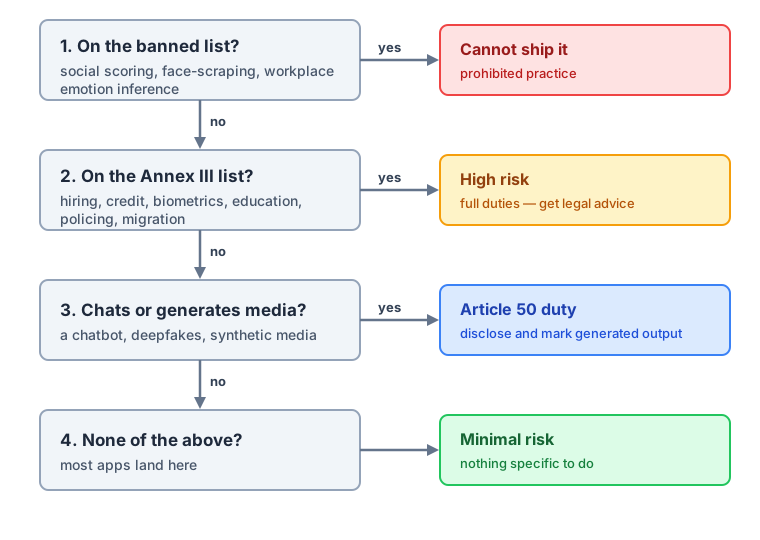
A four-question test for your tier
You can place most products in under a minute:
- Is the use case on the banned list (social scoring, face-scraping, workplace emotion inference)? If yes, stop; you cannot ship it.
- Is it on the Annex III high-risk list (hiring, credit, biometrics, education, essential services, policing, migration)? If yes, you are high risk and need real legal advice.
- Does it chat with people or generate media? If yes, you owe the Article 50 disclosure and marking.
- None of the above? You are minimal risk and owe nothing specific.
Open-source exemptions and where they stop
The open-source carve-out is real, and widely misread. Free, open-source AI under a genuine open licence is exempt from parts of the Act. Three things switch that exemption off, and that is where people get caught.
Charge for the component or otherwise monetise it, and the carve-out drops away. A high-risk use case or a banned practice is covered regardless of the licence. And open models above the systemic-risk compute threshold keep every GPAI duty, licence or not.
Even exempt open model providers keep two duties: the copyright policy and the training-data summary. Maintainers who want the detail can read the Linux Foundation Europe explainer and the Hugging Face guidance write-up, both written for open-source projects rather than large vendors.
Penalties and who enforces them
The fines are large, and the fear around them is often misaimed. They come in three bands under Article 99.
| Breach | Maximum fine |
|---|---|
| Banned practices | 35M euros or 7% of worldwide turnover |
| Most other breaches | 15M euros or 3% of turnover |
| Wrong or misleading info to authorities | 7.5M euros or 1% of turnover |
For a large company the fine is the higher of the two figures. For SMEs and startups, the Act flips this and applies the lower of the two.
“The EU” does not enforce any of this, though. The work is split. National watchdogs handle AI systems inside each member state. Spain, for example, runs its own agency, AESIA, as its single point of contact. The European AI Office handles general-purpose models across the union. Many member states were slow to name their watchdogs, so the map is still filling in.
No big fine has landed on a small developer. The penalty rules have been live since 2 August 2025. So far the action sits at the banned-practice and general-purpose model tier, well away from hobby chatbots.
Where AI handles personal data, the Act stacks on top of the GDPR rather than replacing it. Training data and profiling can trigger both. So a system that is minimal risk under the AI Act can still owe GDPR duties.
When this guide does not apply to you
This post does not replace legal advice, and a few situations sit outside its scope:
- You sell into healthcare, hiring, credit, education, policing, or border control. You are likely Annex III high risk and need a lawyer.
- You embed AI in a regulated physical product (machinery, a medical device, a vehicle). Your clock is Annex I, 2 August 2028, and sector law stacks on top.
- You train frontier models above the systemic-risk compute threshold. The open-source carve-out does not reach you.
- You want a compliance certificate or a signed conformity assessment. This post explains the map; it does not produce documents.
- You operate outside the EU with zero EU users. Read the territorial hooks in Article 2 before assuming you are clear.
For everyone else, the summary is short. Check your tier against the four questions, add a disclosure line if you ship a chatbot, and get back to building.