 Botmonster Tech
Production LLM hallucinations: taxonomy, evals, and RAG defenses

Fixing LLM hallucinations in production needs a layered defense. Use Chain-of-Verification at inference time. Ground the model in trusted data. Build eval suites that give you a hallucination rate you can track and gate in CI. No single trick fixes this. But pair prompt rules with retrieval-augmented grounding, self-checking, and validation layers, and you turn it into a problem you can measure and ship against.
What Is Hallucination? A Taxonomy for Developers
“Hallucination” has become an umbrella label for almost any unexpected LLM output. That fuzziness is dangerous in production. Each failure mode has a distinct cause and a distinct fix. Lump them together and you’ll apply the wrong remedy to the wrong problem. You’ll spend cycles on prompt tuning when the real issue is retrieval quality, or add RAG when the failure is instruction-following. Before you can fix hallucinations, you need a precise vocabulary for what you’re seeing.
Factual hallucination is the most-discussed type: the model invents facts. In a dev context this is nasty. Wrong API paths, fake library functions, made-up parameter names, bad version numbers. A human writer might hedge (“I think the method is called…”). An LLM delivers invented facts with the same fluency as correct ones. The model isn’t lying. It’s completing a token sequence that’s statistically coherent but factually wrong. Parametric memory is both the model’s strength and its weakness. It has seen millions of code examples, but those memories are blended and reconstructed, not retrieved.
Faithfulness hallucination is the worst variant for RAG teams. It hits when devs think they’ve solved the problem. The model gets a retrieved chunk that holds the right answer. Then it outputs something that contradicts that chunk. This happens when the model’s parametric priors are stronger than the retrieved signal. Or when the context window is crowded. Or when the prompt doesn’t tell the model to prefer retrieved evidence over internal knowledge. Faithfulness failures break RAG’s whole value pitch. You did the retrieval work, but the model is still making things up.
Instruction-following failures often get labeled as hallucinations. They’re a different problem. The model ignores format constraints. It outputs JSON with extra, undeclared fields. It skips required keys. It returns a numbered list when the schema called for an array of objects. These failures are costly in pipelines where downstream code parses model output. A missing required field throws a KeyError that crashes the app. This is a prompt constraint problem, not a factual accuracy one. So the fix is structured output enforcement, not grounding.
Confidence miscalibration is subtler, but it can sink you in production. The model states false info with high confidence and true info with hedging. It says “The correct answer is X” when X is wrong. Then it says “I believe it might be Y, though I’m not entirely sure” when Y is right. This breaks filter logic. You can’t just threshold on hedge words to route bad outputs to a human. The signals are flipped. Calibration is a trait of training. Different model families calibrate in very different ways. One lab now trains for it directly. A decision model built around calibration tunes its probabilities against outcomes and ships a confidence score with every answer, which gives your filter logic a threshold worth trusting. Some frontier models have improved here, but miscalibration is still a real operational risk.
Context sensitivity rounds out the list. Same model, same prompt, same question. Different answers on different runs. This isn’t a bug. It’s a feature of temperature sampling. At temperature > 0, the model samples from a probability spread instead of picking the single top token. Randomness is useful for creative tasks. It’s a liability when you need stable, factual answers. Knowing that sampling is the root cause, and setting temperature to 0 for factual tasks, is the baseline for everything that follows.
Prevention at the Prompt Level
The cheapest hallucination fix is a better prompt. Before spending cycles on RAG infra or eval pipelines, exhaust what prompt engineering can do. These changes need no code beyond the prompt. You can ship them in minutes. The techniques below have measured effects on hallucination rates across standard benchmarks. They work on any hosted or self-hosted LLM.
System prompt constraints are the first line of defense. Tell the model to say “I don’t know” when unsure. Tell it to cite sources for factual claims. Tell it to refuse questions outside the given context. This cuts confabulation in measurable ways. Without explicit license to flag doubt, most models default to answering. Training rewards smooth, helpful replies. Give the model leave to defer, plus a few examples of what that looks like, and the output token spread shifts in a useful way. It’s not a full fix, but it’s free.
Chain-of-Thought (CoT) prompting forces the model to reason step by step before it commits to a final answer. Instead of “What is the output of this function?”, you prompt “Think through this step by step, then give your final answer.” On reasoning-heavy tasks like code analysis, multi-hop facts, and logic puzzles, CoT has cut factual errors by 20 to 40% on standard benchmarks. The trick is simple. By writing out the steps, the model is less likely to skip one that would expose a clash. The reasoning chain is also a diagnostic. When the final answer is wrong, you can read the chain and spot where it went off the rails.
A concrete CoT prompt for a code analysis task looks like this:
System: You are a code reviewer. When asked to analyze code, always:
1. Identify the purpose of each function
2. Trace the data flow step by step
3. Note any potential edge cases
4. Then state your conclusion

Only after completing steps 1-4 should you give your final answer.
If you are uncertain about any step, say "I am not sure about this step"
rather than guessing.
Structured output constraints fix instruction-following failures head-on. Use the response_format arg in the OpenAI API to set a JSON schema. Or use the instructor library on any OpenAI-compatible endpoint. The model can’t add fields that aren’t in the schema. It can’t skip required ones. This won’t stop the model from putting wrong content in a valid field. But it kills a whole class of failures from bad format. In pipelines where model output feeds downstream parsing, structured output is not optional.
Few-shot examples with “I don’t know” responses are underused. If your few-shot examples only show the model answering correctly, you’re training it (in context) to always answer. Add 1 or 2 examples where the model correctly defers, such as “I don’t have enough information to answer this accurately.” This re-tunes the model’s in-context behavior. It helps most when the question mix has edge cases outside the model’s reliable knowledge.
The Inference-Time Compute Solution
Giving the model more “thinking time” before it commits to a final answer is one of the most effective and most under-used hallucination fixes today. A single forward pass, one call and one response, is the cheapest mode. It’s also the most hallucination-prone. Spending more compute at inference time, by sampling multiple candidates or running a verification pass, trades cost for accuracy in a controlled way.
Best-of-N sampling is the simplest form of inference-time compute. Generate N candidate replies to the same query. Score each one against a quality bar. Return the top score. For factual questions with a checkable answer, scoring can be as simple as checking which replies agree. If 4 out of 5 samples agree on a claim, the consensus is likely more reliable than any single sample. For richer checks, a second LLM call can score each candidate. Best-of-N is trivially parallel. All N samples fire at once, so latency grows far less than cost.
Chain-of-Thought plus Self-Verification is a two-call pattern worth building. Call 1 generates a draft answer with a full reasoning chain. Call 2 gets the original question, the draft answer, and the chain. It’s asked to flag any errors or inconsistencies before producing a revised final answer. This pattern mimics checking your own work. In practice it looks like this:
# Call 1: Generate draft with reasoning
draft_prompt = f"""
Question: {question}

Think through this carefully, step by step. Show your reasoning,
then provide your answer.
"""
draft_response = llm.complete(draft_prompt)

# Call 2: Self-verify
verification_prompt = f"""
Original question: {question}

A draft answer was produced with this reasoning:
{draft_response}

Review this answer carefully. Identify any factual errors, logical
inconsistencies, or unsupported claims. If the answer contains errors,
correct them and explain what was wrong. If the answer is correct,
confirm it and explain why you are confident.

Provide a final, verified answer.
"""
final_response = llm.complete(verification_prompt)
The Reflexion pattern is a lighter version of the same idea. After the model’s first response, a single follow-up call asks: “Is this answer correct? If not, correct it.” It’s a few lines of code. It has cut hallucinations across many task types. Reflexion works because when the model is asked to judge rather than write, it uses different attention patterns. They’re more skeptical and better at spotting errors. It’s not a perfect checker. The model can confirm its own errors. But it catches a real share of hallucinations at low cost. For richer pipelines that chain many check and fix steps, the stateful graph design used in multi-step AI agents is a natural fit for building these loops in production.
The cost-versus-quality trade-off for inference-time compute is real. You have to weigh it per app. Best-of-5 sampling multiplies inference cost by 5x. A two-call CoT plus Self-Verification pattern adds about 1.5 to 2x cost. For a casual chatbot where the odd error is fine, this isn’t worth it. For medical, legal, financial, or safety-critical apps, where one confident hallucination can cause real harm, the cost bump is tiny next to the liability. The right answer depends on the app. The only way to know your real gain is to measure it with an eval suite.
Grounding with RAG and Knowledge Graphs
When facts must be right, grounding the model in trusted data is the safest design. Prompt rules and inference-time compute cut hallucination rates. Grounding changes the source of the model’s facts. It moves from shaky parametric memory to a controlled, version-managed knowledge base that you own.

RAG as the first-line grounding fix feeds the prompt with relevant, verified document chunks next to the query. The model is told to answer from the given evidence, not from internal memory. When the retrieved context holds the right answer, and the model uses it faithfully, factual hallucination on the covered domain drops sharply. RAG is now table-stakes for any production LLM app that needs domain accuracy. The build cost is low. Vector databases like Qdrant, Weaviate, and pgvector are mature. Embedding models are cheap to run. The real work is in ingestion, chunking, and retrieval quality.
Citation enforcement closes the loop between retrieval and output. Instead of letting the model say things that may or may not be backed by the retrieved context, the prompt makes it cite a specific chunk ID for every claim: “According to [source: chunk_42]…” A post-processing step then checks that the cited chunk actually contains text that supports the claim. That’s a simple semantic similarity check. Claims without citations, or citing chunks that don’t support them, get flagged. The response can be routed to a verification queue or a second model. Citation enforcement also gives you an audit trail. When a user challenges a claim, you can pull up the source doc and verify it.
Knowledge Graphs for structured fact grounding fix the domain where RAG does worst. That’s precise, structured facts about entities. Who is the CEO of a company? What’s the current version of a software library? What are the known drug interactions for a medication? Unstructured retrieval is a blunt tool for these queries. The answer may sit across many documents. Retrieval may return stale info. A local Neo4j graph or a SPARQL-queryable Wikidata endpoint gives deterministic answers to entity-relationship queries. The LLM uses tool-calling to query the graph. It then folds the structured result into a natural language reply. The graph is your single source of truth for facts.
Retrieval quality as a hallucination multiplier gets less attention than it should. A RAG system with bad retrieval can raise hallucination rates above a model with no retrieval at all. That covers chunks that are too large, embeddings that don’t line up with the query, or a stale or thin knowledge base. When the retrieved context is off-topic or wrong, the model has to square two signals. The context says one thing. The model’s own memory says another. The conflict often tips toward confabulation. Retrieval quality isn’t a nice-to-have. It’s a load-bearing piece of your defense.
Automated Evaluation Suites
You can’t fix what you can’t measure. A vibe check on whether your model “seems to hallucinate less” after a prompt change isn’t engineering. It’s guesswork. A production LLM system needs a hallucination rate metric with the same rigor as a service’s error rate. Track it over time. Regress it in CI. Tie it to deploy decisions. Building an automated eval pipeline is the investment that makes every other technique in this post actionable.
The current eval framework landscape gives you distinct tools for different use cases. The table below sums up the four most widely used options:
| Framework | Best For | Metrics | CI/CD Integration | Licensing |
|---|---|---|---|---|
| Promptfoo | CLI-driven prompt testing, multi-model comparison, regression testing | Custom assertions, LLM-as-judge, similarity scores | First-class GitHub Actions support | Open source (MIT) |
| Ragas | RAG-specific evaluation, faithfulness and relevance scoring | Faithfulness, answer relevance, context precision, context recall | Python library, integrates with any test runner | Open source (Apache 2.0) |
| HELM | Comprehensive academic-grade benchmarking, cross-model comparison | 100+ metrics across 40+ scenarios | Designed for batch evaluation, not streaming CI | Open source (Apache 2.0) |
| DeepEval | Production monitoring, A/B testing, real-time evaluation | Hallucination, coherence, toxicity, custom G-Eval metrics | Native CI/CD integration, Pytest plugin | Open source + cloud tier |
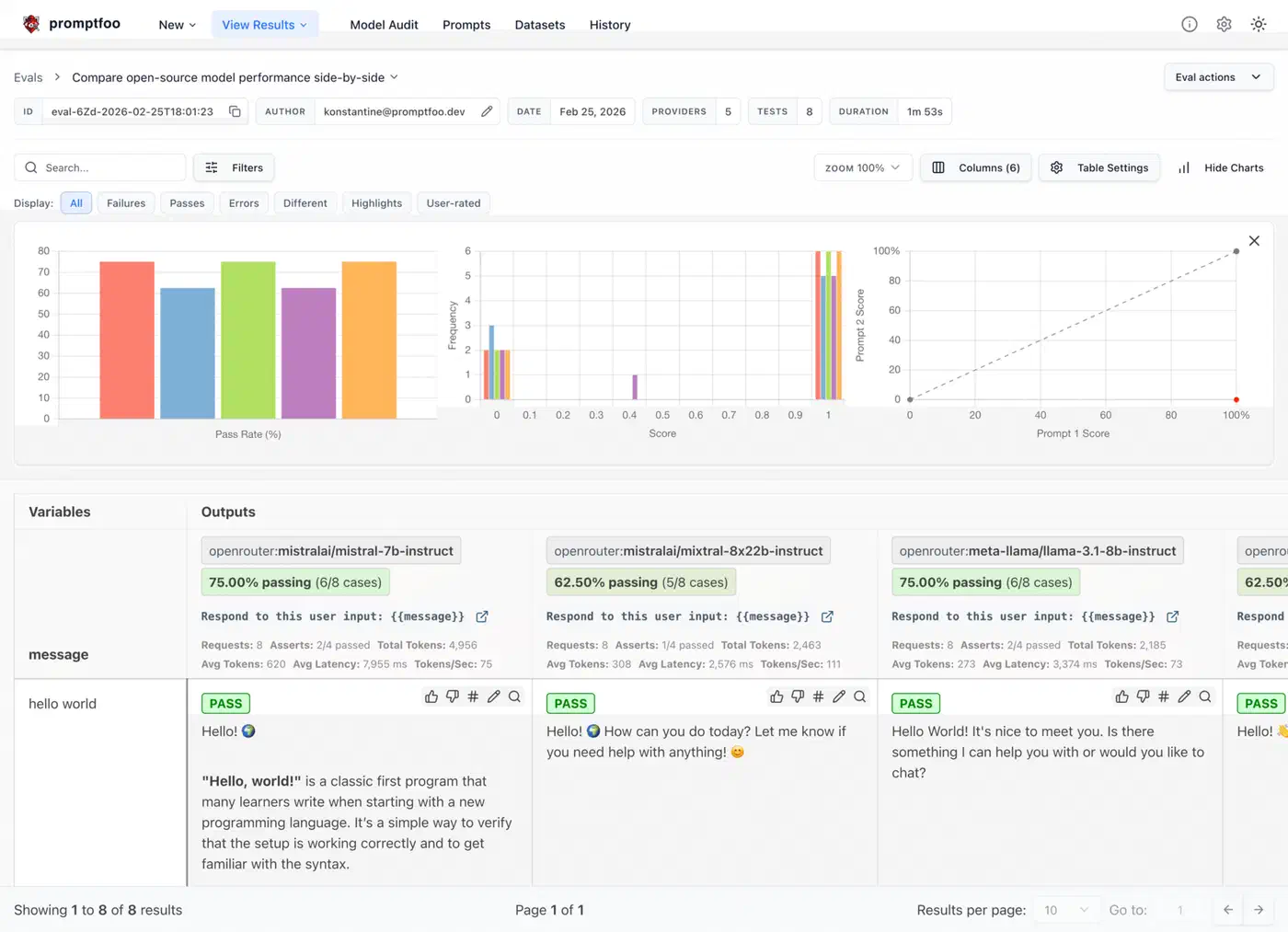
For most production apps, Ragas and Promptfoo cover the bases. Ragas gives you the three metrics every RAG app must track. Faithfulness (does the answer contradict the retrieved context?). Answer relevance (does the answer address the question?). Context precision (is the retrieved context useful, or is it noise?). A faithfulness score below 0.8 on your golden dataset signals that your system prompt needs stronger grounding rules, or that your retrieval is pulling irrelevant chunks. Promptfoo handles prompt regression. It checks that a change meant to lift one metric doesn’t silently hurt another.
Building a golden dataset is the prerequisite for real evals. It’s a one-time investment that pays forward forever. A golden dataset is a curated set of 100 to 200 question-answer pairs with verified correct answers. It should match your app’s real query mix. Each entry needs a question, a human-verified reference answer, and (for RAG evals) the ground-truth chunks that should back the answer. The curation work is tedious but not hard. It’s also when you often find that you didn’t have a clear “correct” for edge cases. Resolving those is worth doing before you run a single eval.
G-Eval uses a strong LLM as a judge to score another model’s outputs. It has emerged as the current state of the art for nuanced eval. It goes well past string matching or keyword overlap. A reference answer and a model-generated answer both go to a judge model (typically a frontier model like GPT-4o or Claude Opus) with a scoring rubric. The judge returns a number. G-Eval lines up well with human judgments. It can score dimensions you can’t measure with deterministic metrics: factual completeness, fitting hedging, logical coherence. DeepEval and Ragas both support G-Eval-style scoring. The cost is a few cents per run against a frontier model API. That’s trivial for a golden dataset of 200 examples.
Integrating evals into CI/CD turns evaluation from a periodic check into a safety net. With Promptfoo, a GitHub Actions workflow can run your full eval suite on every pull request that touches a prompt template or model config. If the faithfulness score drops below a set threshold, the merge is blocked. A practical setup:
# .github/workflows/eval.yml
name: LLM Eval Suite
on:
  pull_request:
    paths:
      - 'prompts/**'
      - 'src/llm/**'
jobs:
  eval:
    runs-on: ubuntu-latest
    steps:
      - uses: actions/checkout@v4
      - name: Run Promptfoo evals
        run: npx promptfoo eval --config promptfooconfig.yaml
      - name: Check faithfulness threshold
        run: |
          SCORE=$(cat eval-results.json | jq '.summary.faithfulness')
          if (( $(echo "$SCORE < 0.80" | bc -l) )); then
            echo "Faithfulness score $SCORE is below threshold 0.80"
            exit 1
          fi
This pattern catches well-meant prompt edits that accidentally weaken grounding rules. They get caught before they ship to production users.
Architectural Patterns for Hallucination-Resistant Production Systems
Single techniques like better prompts, CoT, RAG, and evals are necessary but not enough. A production-grade LLM system treats hallucination as a systems problem, not a model problem. It builds defense-in-depth at every layer. The design should assume the model will hallucinate on some share of requests. Then it should build infra to detect, handle, and recover from those failures cleanly.
Output validation layer is the most important addition for pipelines where model output feeds downstream systems or reaches users without human review. Every response should pass through a validation stage before it’s used. For structured outputs, Pydantic models with strict field validation catch format breaks. For factual content, a second LLM call can score the response against known facts or the retrieved context. For code, the output can be run through a linter or static analyzer. The validation layer isn’t about killing every error. It’s about catching the worst failures before they do visible damage. Log validation failures with the full request context for later review. This log is your best data source for improving the system.
from pydantic import BaseModel, field_validator
from typing import Optional

class LLMResponse(BaseModel):
    answer: str
    confidence: float
    sources: list[str]

    @field_validator('confidence')
    @classmethod
    def validate_confidence(cls, v):
        if not 0.0 <= v <= 1.0:
            raise ValueError('Confidence must be between 0 and 1')
        return v

    @field_validator('sources')
    @classmethod
    def sources_not_empty(cls, v):
        if len(v) == 0:
            raise ValueError('Response must cite at least one source')
        return v

def validated_llm_call(query: str, context: str) -> Optional[LLMResponse]:
    raw = llm.complete(build_prompt(query, context))
    try:
        return LLMResponse.model_validate_json(raw)
    except Exception as e:
        log_validation_failure(query, raw, str(e))
        return None
Human-in-the-loop for high-stakes outputs isn’t a fallback for a broken system. It’s a planned design choice. Use it when the cost of a hallucination is higher than the cost of human review lag. When the validation layer flags a low-confidence response, or the model reports doubt, the response goes to a human reviewer queue. It doesn’t auto-publish or auto-run. This pattern is standard in medical AI, where every diagnosis suggestion is reviewed by a clinician. It’s standard in legal AI, where every contract clause suggestion is reviewed by a lawyer. It should be standard in any domain where one confident hallucination can cause real harm. The reviewer’s call (approve, reject, or correct) also feeds back into your golden dataset. That lifts future eval quality.
Canary deployments for prompt changes apply the same deploy discipline to LLM prompts that you’d apply to app code. A new prompt version goes to 5% of traffic. The current prompt keeps serving the other 95%. Hallucination rate, validation failure rate, and user feedback scores are compared between the two groups over a set window. Typically 24 to 48 hours of production traffic. If the new prompt performs at least as well as the baseline on every metric, the rollout proceeds. If any metric regresses, the canary stops and the change is reverted. This pattern stops prompt regressions that pass automated evals but fail on the long tail of real-world queries that no golden dataset fully covers.
Fallback strategies round out the defense. When the primary model fails the validation layer (wrong format, claims with no citation, low self-reported confidence), the system shouldn’t just return an error. It also shouldn’t quietly serve a bad reply. Use a tiered fallback:
- Retry with a corrective prompt: on first failure, retry the same model with a prompt that surfaces the issue: “Your previous response was missing required citations. Please try again, ensuring every factual claim includes a [source: id] citation.”
- Escalate to a higher-capability model: if the retry also fails, route to a more capable (and pricier) model. A pipeline that normally uses a fast, cheap model for routine queries can jump to a frontier model for edge cases that need higher reliability. This keeps average costs low. It also preserves quality on hard cases.
- Return a safe default response: if both retries fail, return a graceful degraded response. Something like “I was unable to provide a verified answer to this question. Here is what I know, but please verify before acting on it: [partial response].” Don’t silently serve a hallucinated answer. Don’t throw an unhandled exception.
Log the full context of every fallback call. Frequent fallbacks on a specific query type point to a systematic gap. That gap could be in your golden dataset, your retrieval quality, or your prompt design. Either way, it deserves engineering attention.
Code Hallucinations: The Most Common Developer Failure Mode
Code generation gets its own section. It’s where most developers first hit LLM hallucinations. The failure modes are different from general factual hallucination. AI coding editors like Cursor and VS Code Copilot are the front line where these show up daily. A made-up fact in prose is embarrassing. A made-up function signature in code throws a TypeError at runtime. That’s hard to debug because the dev trusted the model and didn’t check the code.
The most common code hallucinations are these. Non-existent library methods (the model invents a plausible-sounding method that doesn’t exist). Wrong function signatures (calling a real function with wrong arg names, wrong order, or wrong types). Outdated API usage (using an API that was valid in training data but has since been deprecated). Version confusion (mixing syntax from incompatible library versions).
The systematic fix is to feed the actual library docs, type signatures, or source code as grounding context in the prompt. This is a special form of RAG. Instead of grounding against a doc knowledge base, you ground against the source of truth for the code you’re generating. For libraries that change often, keep an up-to-date index of type stubs and docstrings in your RAG knowledge base. Pull the relevant signatures at generation time. That nearly wipes out the “outdated API” hallucination. For any code that ships to a production codebase, run static analysis (mypy, pyright, or language-server-based validation) in CI. That catches signature errors that slipped past every other defense.
Decision Framework: Which Technique to Use
The right mix depends on your app’s accuracy needs, budget, and latency. Don’t apply every trick to every app. Use this decision tree:

For apps where the odd error is fine (creative assistants, brainstorming, exploratory chat): start with system prompt rules and CoT. Add structured output if the output feeds downstream parsing. Skip inference-time compute and RAG unless you have a specific factual domain.
For apps that need facts but where errors are fixable (internal knowledge bases, developer tools, doc summarization): add RAG grounding with citation enforcement. Build a Ragas eval suite and run it in CI. Add output validation with Pydantic. Use Reflexion on queries that trigger low-confidence signals.
For apps where one hallucination can cause real harm (medical, legal, financial, safety-critical): build the full stack. RAG with knowledge graph grounding for structured facts. Best-of-N sampling or two-call CoT plus Self-Verification. Strict output validation. Human-in-the-loop for low-confidence responses. Canary deploys for all prompt changes. A tiered fallback. Accept the 2 to 5x cost bump as the price of high-stakes work.
The big meta-principle is simple. You can’t optimize what you don’t measure. Whatever tier your app falls into, the eval suite comes first. Build your golden dataset. Set a baseline hallucination rate. Then apply techniques in order of cost-effectiveness. Validate every change to your prompt, retrieval, or model against the eval suite before shipping. Hallucination isn’t a solved problem. But it’s an engineerable one.