 Botmonster Tech
Can Kronos really forecast the next 24 hours of Bitcoin?
The Kronos financial forecasting model does produce a 24-hour Bitcoin forecast, and you can run the same code yourself. But the variant behind its best published results, Kronos-large at 499.2 million parameters, is marked not open source. Three smaller sizes are free to download. The repo itself has gone quiet.
Key Takeaways
- Kronos predicts price candles the way a language model predicts words.
- Three sizes download free, but the biggest, half a billion settings, does not.
- A live demo forecasts Bitcoin’s next 24 hours so you can watch it work.
- The paper passed peer review at a major AI conference.
- Nobody has touched the code in months, and the trading example is just a demo.
What the Kronos financial forecasting model actually predicts
The input to Kronos is a K-line, the candlestick every trading chart is drawn from. Each bar carries an open, high, low, and close, plus optional volume and amount.
The output is the same shape, pushed forward in time. Give it 400 bars of history and ask for the next 120. It hands back a predicted open, high, low, close, volume, and amount for every future bar.
The design works in two stages. First a special tokenizer chops raw price data into discrete tokens. Then an autoregressive transformer predicts the next token, the same way a language model predicts the next word. That is why the project calls candlesticks a language.
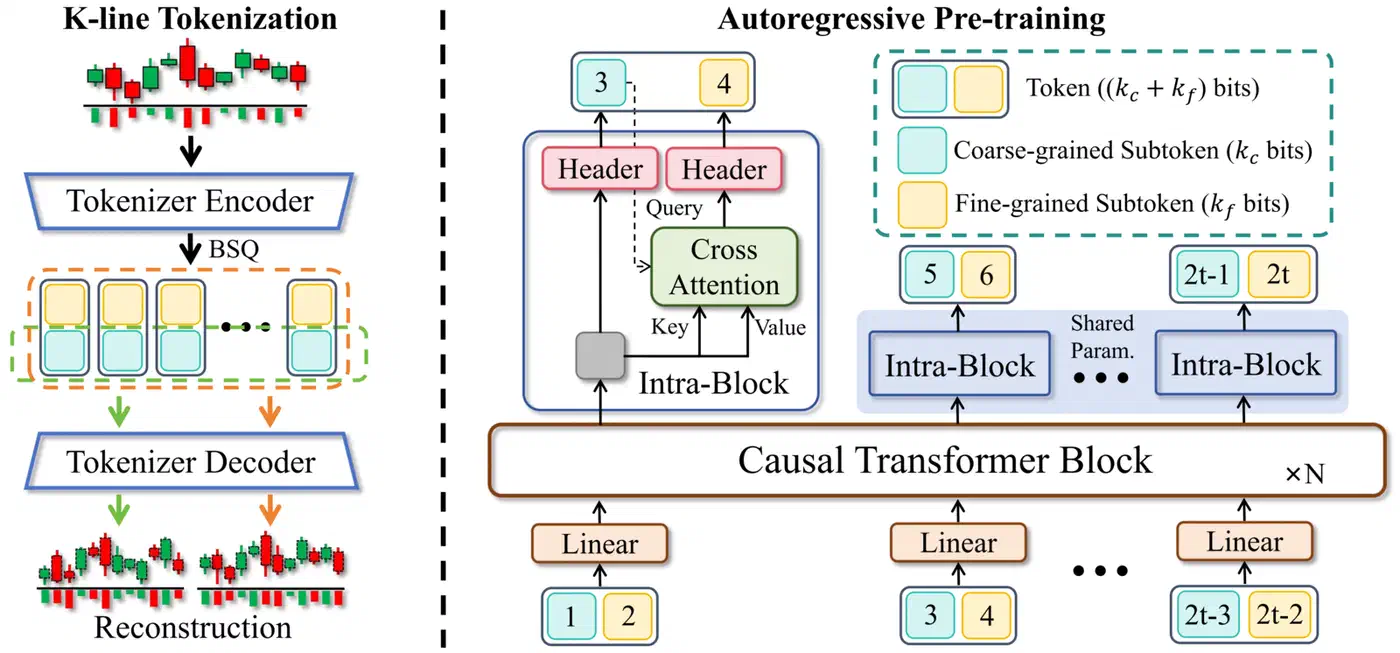
Sampling is probabilistic, and the knobs sit right in the API. You set a temperature, a nucleus sampling cutoff, and a sample count, then average several forecast paths into one. Averaging smooths out the noise in any single run.
Kronos-small and Kronos-base accept at most 512 steps of history. Anything longer gets cut down for you.
The training set is what earns the “foundation model” tag. The arXiv paper counts over 12 billion K-line records, pulled from 45 global exchanges at seven time frames.
The model zoo, and the one you cannot download
Four models exist. Three sit on Hugging Face under the NeoQuasar account and pull down like any other checkpoint. The project’s own table marks the biggest one as not open source.
| Model | Parameters | Context | Available |
|---|---|---|---|
| Kronos-mini | 4.1M | 2048 | Yes |
| Kronos-small | 24.7M | 512 | Yes |
| Kronos-base | 102.3M | 512 | Yes |
| Kronos-large | 499.2M | 512 | No |
Kronos-large carries roughly five times the parameters of the largest checkpoint you can actually get. It is also the variant behind the paper’s headline chart. The authors are explicit about what size buys you:
as the model size scales up, performance on these tasks consistently improves, empirically validating the scaling laws for time series foundation models
So the 93% RankIC gain over the best rival foundation model comes from a family whose top member is the one you can’t download. Before you try to repeat a published result, check which size produced it.
No reason for the hold-back is given anywhere. Both tokenizers are released, so the pipeline runs end to end at every size on offer.
What the live Bitcoin demo shows, and what it hides
The live demo forecasts the BTC/USDT pair over the next 24 hours, and refreshes as new candles land. A Bitcoin chart is easy to read at a glance, which is a big part of why Kronos-base has passed 1.4 million downloads.
The demo proves the pipeline runs on live data and produces plausible candles on a wild asset. Profit is another question. A forecast that traces the rough shape of tomorrow is a long way from a tradable signal, and fees and slippage eat the difference.
Read any forecast chart against the naive baseline of “tomorrow looks like today.” A model has to beat that visibly and repeatedly before its shape means anything. The demo also shows a single asset, and Bitcoin is unusually well behaved for a sequence model. It trades around the clock, so there are no overnight gaps of the kind a thinly traded stock throws at you.
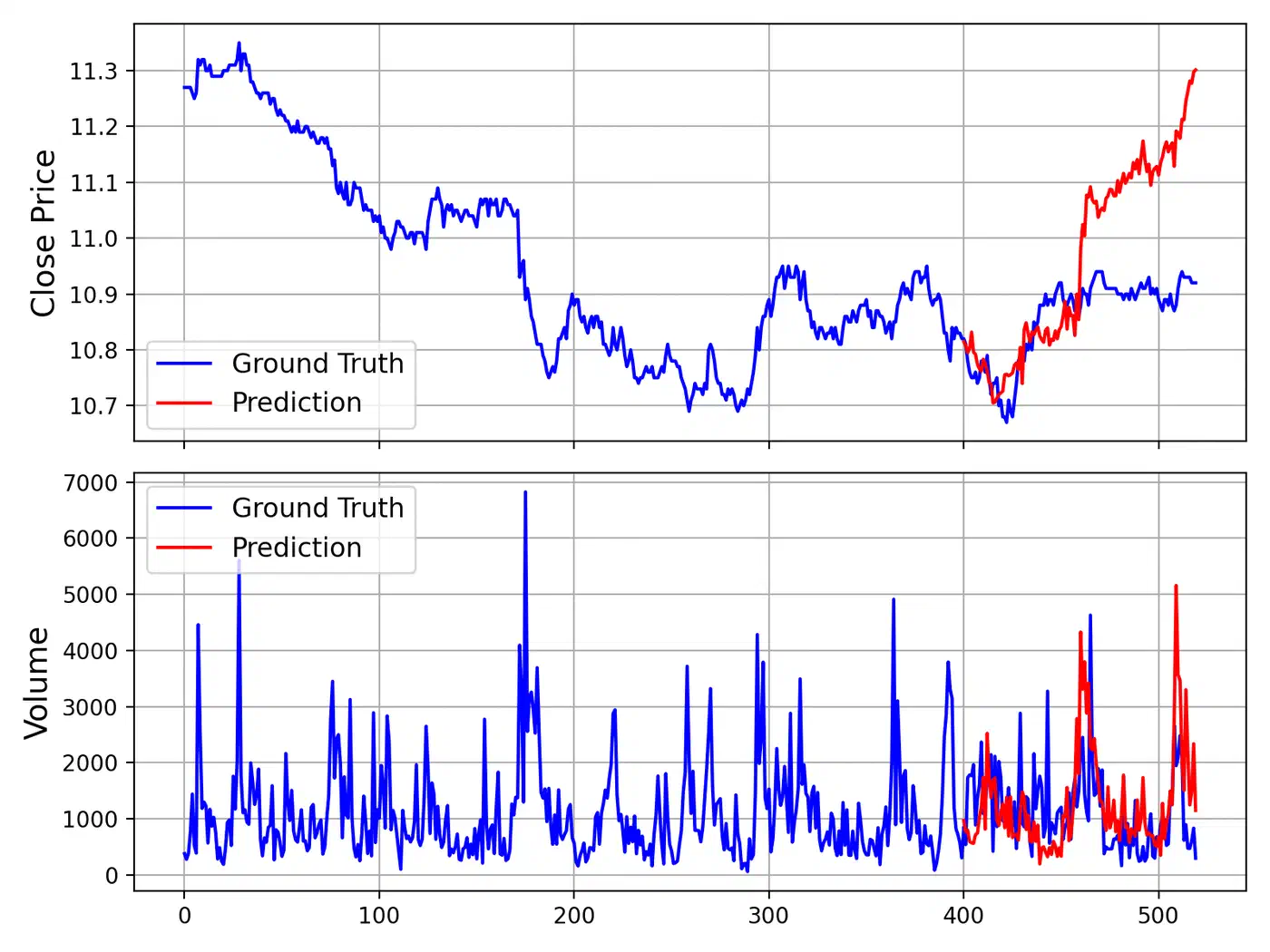
The real evaluation lives in the paper, which was accepted to AAAI 2026 and published in the conference proceedings. Peer review says the method held up, but it says nothing about the chart in front of you. Treat the demo as a working example of the API.
What the authors themselves warn you about
The project’s own docs are blunter than most of the write-ups built on them. They call the fine-tuning pipeline a demo. A real strategy, the guide adds, needs portfolio optimization and risk-factor neutralization on top.
That distinction is the one retail readers usually skip. Raw model output is a signal, not alpha. Real workflows feed the signal into a portfolio model that first strips out market beta and style factors such as size and value.
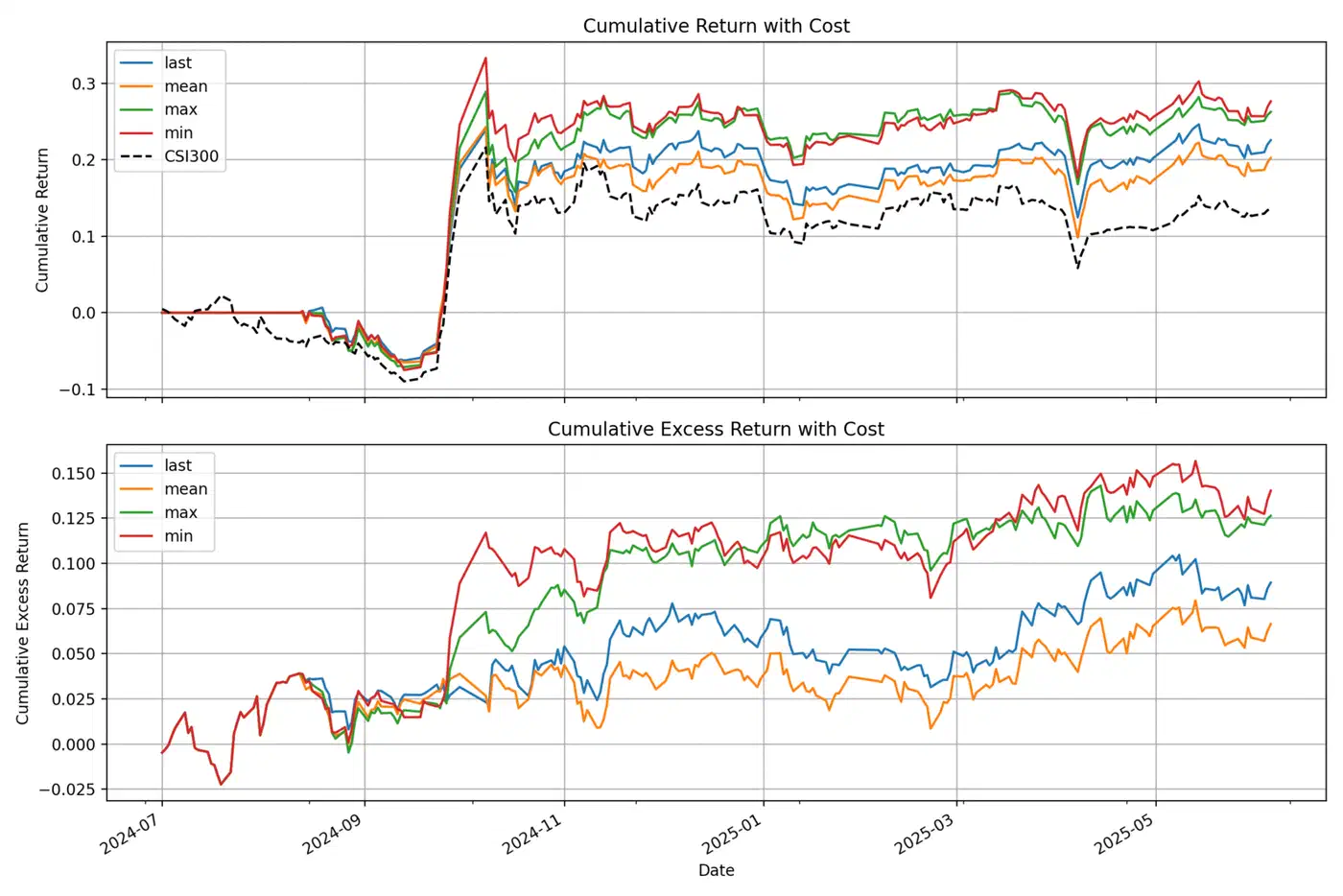
The shipped backtest is a simple top-K strategy. The guide says a serious backtest has to model transaction costs, slippage, and market impact, none of which the example does.
An AI assistant wrote many of the code comments in the finetune/ directory. The project warns they may be wrong and tells you to trust the code itself instead.
The fine-tuning path also leans on Qlib to prepare data. The worked example assumes a Chinese A-share daily dataset, so moving it to your own market is real work. Training runs through torchrun across several GPUs, which puts the bigger sizes out of reach of one consumer card. The authors trained and tested on a cluster of 24 RTX 4090D cards.
Kronos is a research project the authors shared generously, and it deserves to be judged as one.
The repository has gone quiet
Anyone about to build on Kronos needs to know whether a bug report will get an answer. The last push to the repository landed on 2026-04-13. The issue queue holds 204 open against 85 closed, so more than two thirds of everything ever filed is still waiting. Pull requests run 51 open against 19 merged, from 19 contributors.
There are no tagged releases at all. Versioning happens through Hugging Face checkpoints, and those have not been updated since shortly after the first release.
The project’s news feed ends with the AAAI acceptance, which came after the fine-tuning scripts. The fair reading is that an academic group shipped a paper, released the models, and moved on to the next paper. That is a normal ending for academic code.
Fork it, pin it, and expect no maintainer. If you need Kronos in production, budget time for keeping it running.