 Botmonster Tech
Scientific agent skills turn AI assistant into a researcher

Scientific agent skills pack 177 research workflows and wire up more than 100 scientific databases for any coding agent. The database layer does the heavy lifting here, since a general agent already writes Python against any library but has no way to know which database holds the answer or how to query it correctly.
Key Takeaways
- 177 packaged workflows cover biology, chemistry, medicine, and drug discovery.
- Over 100 scientific databases arrive pre-wired, which saves the worst of the work.
- Works with Claude Code, Cursor, Codex, and other agents on the open standard.
- One benchmark found the skill cut tool errors by 92 percent.
- Small models mostly ignore the skill unless you name it in the prompt.
What scientific agent skills add that a general agent lacks
A capable coding agent can import a scientific Python library and call a REST API today. Give it the docs and it will write something that runs.
Choosing is the unreliable part. Six overlapping tools exist for most bioinformatics jobs, and picking the wrong one wastes a day. The agent also has no feel for which parameters change the answer in a field it has never worked in.
A skill supplies that missing judgment. Each one is a folder with a SKILL.md file holding curated documentation, worked examples, and the conventions of a field. The agent loads it only when the task calls for it.
The Scientific Agent Skills project frames it the same way. Its own README admits the agent can use any Python package by itself. Named skills just make it stronger and steadier on these jobs.
Skills also encode which source to query and the syntax it expects, something no model picked up well on its own. Without that, an agent will invent a pipeline that looks fine and breaks at step one.
The measured payoff, and where it vanishes
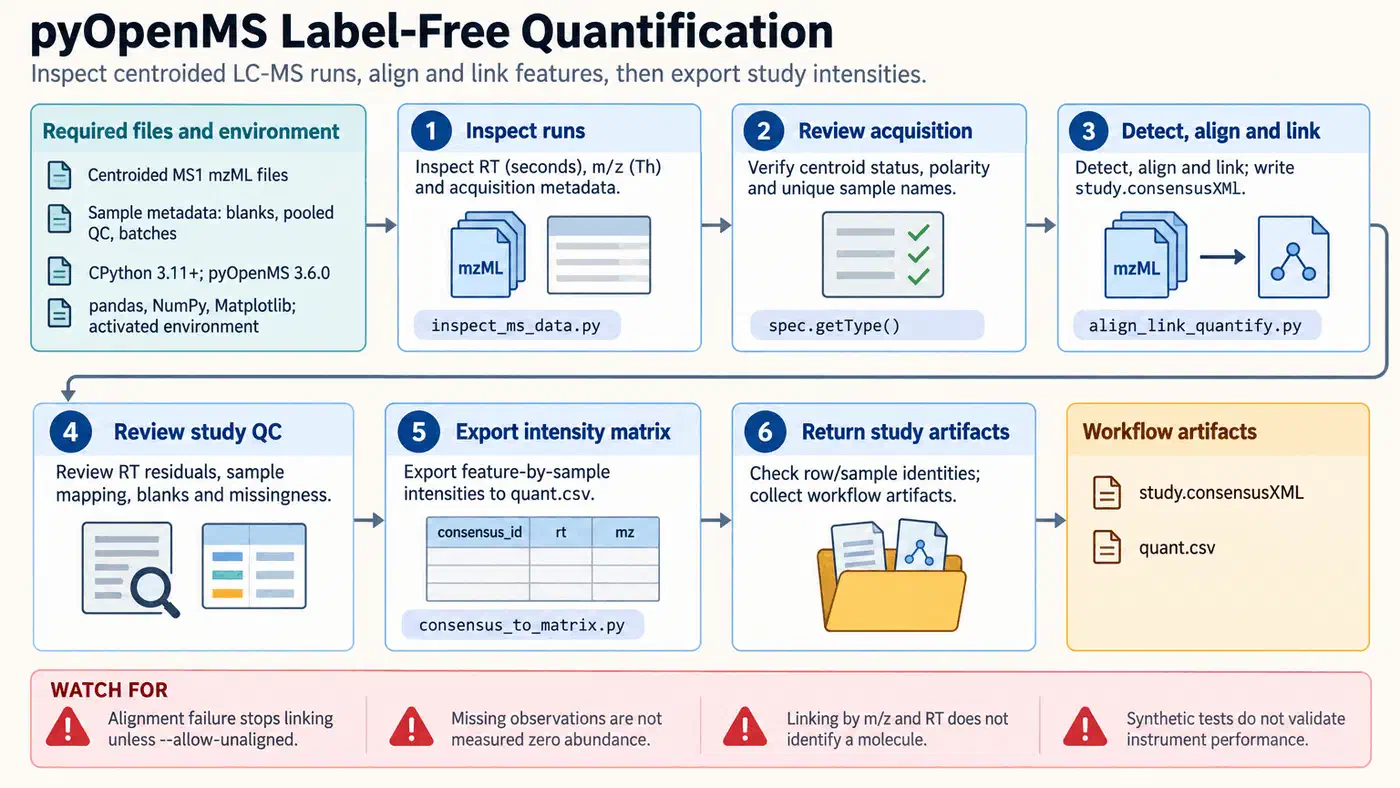
K-Dense ran a controlled study on one of its own skills, and the numbers are more useful than its marketing. The pyOpenMS skill benchmark covers 250 runs across ten mass-spectrometry tasks: five repeats per arm, Claude Sonnet 4.6 and Claude Haiku 4.5, an automated grader, and no LLM judge.
On a strong model the skill helped on every axis at once.
| Measure (Sonnet 4.6) | Without the skill | With the skill |
|---|---|---|
| Task success | 96% (48/50) | 100% (50/50) |
| pyOpenMS API errors per run | 1.00 | 0.08 |
| Wall-clock time per task | 42.3 s | 33.8 s |
| Cost per correct result | $0.180 | $0.162 |
| Runs that invoked the skill | n/a | 98% |
The API error rate fell by 92 percent, and output tokens dropped by more than a third. The mechanism is dull and believable: a strong model that hits a changed API can usually recover, but it burns turns and tokens doing it. The skill gets the call right the first time and skips the debugging loop.
On version-specific pipeline tasks the skill was about twice as fast and 24 percent cheaper. On routine jobs it was overhead: time per task rose from 24 to 32 seconds and cost from 13 to 15 cents, since a strong model was already fine.
Haiku 4.5 without the skill took two minutes per task, made nearly four API errors per run, and timed out on the hardest jobs. Installing the skill barely helped, because the model reached for it in only 8 percent of runs.
| Measure (Haiku 4.5) | No skill | Skill available | Skill forced |
|---|---|---|---|
| Success rate | 74% | 86% | 88% |
| Runs that invoked the skill | 0% | 8% | 100% |
| Wall-clock time per task | 121.5 s | 83.5 s | 31.1 s |
| Cost per task | $0.152 | $0.133 | $0.074 |
| API errors per run | 3.74 | 3.00 | 0.52 |
Forcing the skill with a one-line instruction made the cheap model the cheapest arm in the whole study, at $0.074 per task.
a great skill is necessary but not sufficient, because a weak model has to actually trigger it
The Haiku cost figures in the first two columns exclude runs that hit a ten-minute timeout, so the real gap is wider. The study also tests one skill, so the result doesn’t automatically transfer to the other 157.
The failures that should worry a working scientist are the ones that return a clean number that happens to be wrong.
The study caught two of them in Sonnet’s no-skill runs, so the strong model wasn’t immune. One reported the doubly charged m/z of a modified peptide as 574.26 instead of 583.27, with no error raised, a number that would sail downstream unnoticed. Another ran a full adduct-grouping pipeline without a single error and annotated zero adducts, because it used the wrong syntax. On feature detection the weak model produced noise-inflated results in 13 of 15 runs without the skill, and 0 of 15 with it forced.
Still, the effect has a ceiling. A separate K-Dense study on NVIDIA BioNeMo skills reached a narrower verdict. Skills help most with routing to odd endpoints and with weak models. They don’t make the science model itself any more accurate: ProteinMPNN’s native-sequence recovery stayed near 40 percent in every arm.
What the 177 skills cover
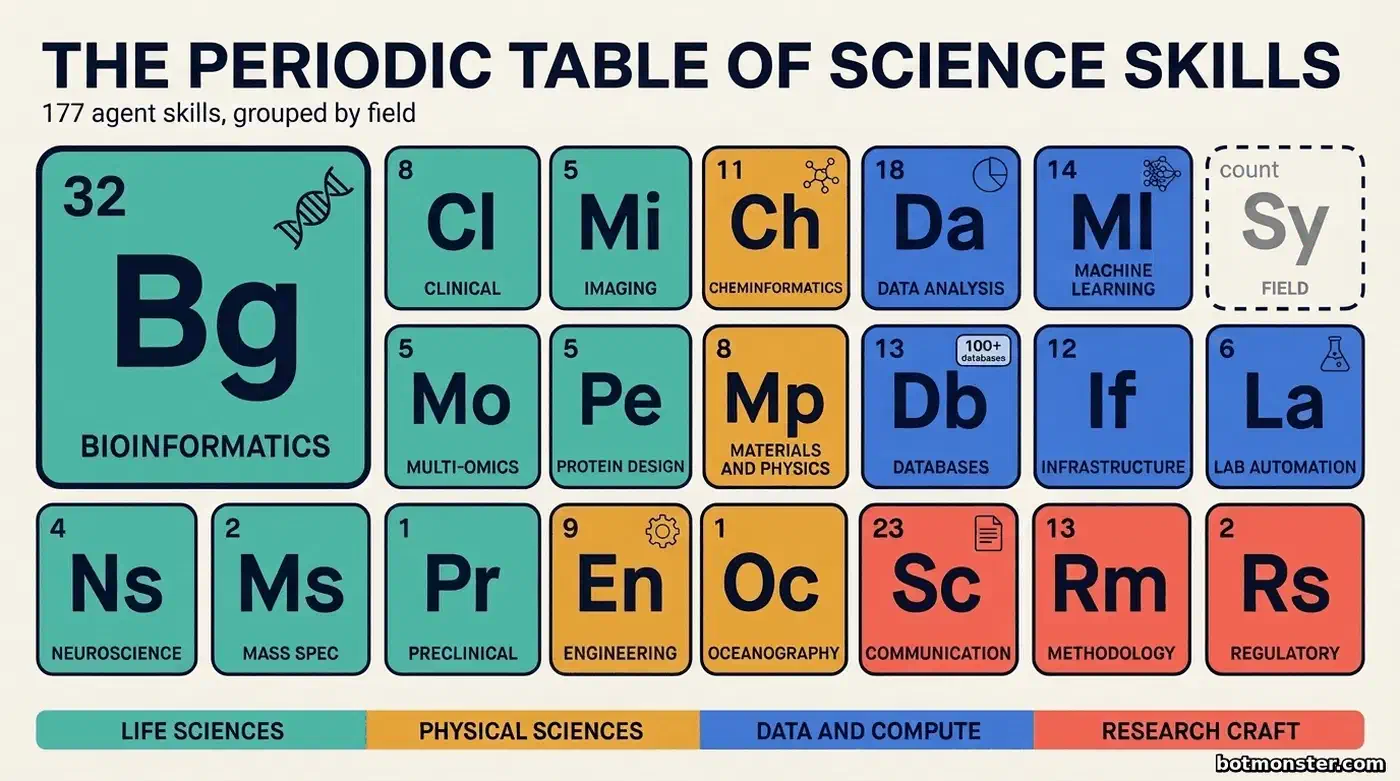
Counting the directories in release v2.72.0 confirms the badge: 177 skill folders, each with its own SKILL.md. The count was 181 until October 1, when the project dropped the four document skills (docx, pdf, pptx, xlsx) it had vendored from Anthropic.
The README sorts them into 20 fields. A few skills appear in two groups, so the counts add up to more than 177.
- Bioinformatics and genomics (32): single-cell RNA-seq with Scanpy, primer design, pooled CRISPR screens, AlphaGenome variant effects, phylogenetics
- Scientific communication (23): literature search across PubMed, arXiv and OpenAlex, evidence-traceable writing, peer review, slides, posters, citations
- Data analysis and visualization (18): statistics, power analysis, experimental design, measurement uncertainty, publication figures
- Machine learning and AI (14): PyTorch Lightning, scikit-learn, SHAP, PyMC, TimesFM forecasting
- Databases and data access (13): the 80-database lookup router, DepMap, PrimeKG, live pathogen surveillance
- Research methodology (13): hypothesis generation, critical thinking, grant writing, market research
- Infrastructure and platforms (12): Modal, GPU acceleration, Nextflow, DNAnexus, LatchBio, OMERO
- Cheminformatics and drug discovery (11): RDKit, DeepChem, DiffDock docking, OpenMM dynamics, NMR processing
- Engineering and simulation (9): PyBaMM battery models, Cantera kinetics, fluid dynamics, CAD for lab hardware
- Clinical research (8): PK/PD modeling, trial and variant evidence, decision-support evaluation
- Materials, chemistry and physics (8): pymatgen, CALPHAD phase equilibria, Astropy, Qiskit and other quantum toolkits
- Lab automation (6): Opentrons and PyLabRobot protocols, Benchling, Ginkgo Cloud Lab
- The long tail: medical imaging (5), multi-omics (5), protein design (5), neuroscience (4), mass spectrometry (2), regulatory standards (2), oceanography (1), preclinical animal welfare (1)
Every skill also has a plain-language guide with a workflow diagram, like the pyOpenMS one above. Find the two or three skills matching workflows you already run by hand, open those SKILL.md files, and read them. If they encode things you know to be true, the rest of the library probably earns its place.
The database layer is the real payload
Anyone can write a skill file. Wiring up more than 100 scientific databases with the right query rules is the part you can’t copy in an afternoon.
The bulk of it lives in one database-lookup skill. That single skill catalogs 80 databases across chemistry, genomics, clinical data, patents, and economics, most of them public and a few behind registration or a license. PubChem, ChEMBL, UniProt, PDB, ClinVar, COSMIC, ClinicalTrials.gov, FDA, FRED, and USPTO are all in there. Dedicated skills add DepMap, PrimeKG, and pathogen surveillance. Packages like BioServices and BioPython push the total past 100.
Every database has its own identifiers, query syntax, rate limits, and idea of what a record is. A guessed query returns nothing, and the agent may report that as a real negative result, while a skill that encodes the right pattern at least fails loudly.
Bundling them into one skill has a measured payoff. Back when the router covered 78 databases, K-Dense tested one skill against 78 separate ones. The split version costs 13.9 times more always-on context: 3,358 tokens per request against 242. The reference corpus runs to about 100,000 tokens, and 93 percent of it never loads until the agent picks a database.
Routing quality held up too. On single-database lookups all five tested models scored 96 to 100 percent either way, so the guide bought nothing. Cross-domain questions told a different story: without the guide, Gemini 3.5 Flash fell to 92 percent, GPT-5.5 to 89 percent and Nemotron 3 Super to 63 percent, while with it all five held at 100 percent.
The docs bury the fact that most of these databases are open. The skill’s credential table lists 18 databases, and four of those keys (NCBI, OpenFDA, BLS, and Census) only raise rate limits. Three more, DrugBank, COSMIC, and BRENDA, need a paid license or registration. The keyed ones skew toward economics, government, and weather sources such as FRED, BEA, NOAA, and Materials Project. The core biology and chemistry stack is keyless: PubChem, UniProt, ChEMBL, PDB, and Ensembl. You can run most of the library without signing up anywhere.
The same team also ships K-Dense BYOK, a free, open-source desktop app that bundles these skills with a research workspace and your own model keys.
How to add scientific agent skills to your coding agent
Install the library, confirm your agent can see it, then run a workflow and check what it did.
Pick your agent
The library targets the open Agent Skills standard. That means Claude Code, Cursor, Codex, Gemini CLI, and Google Antigravity all work from the same source.
Install only the domains you use
The standard installer is npx skills add K-Dense-AI/scientific-agent-skills. If you use the GitHub CLI, gh skill install K-Dense-AI/scientific-agent-skills (CLI 2.90.0 or later) picks the right directory for your host and records provenance metadata. Pin a release with --pin v2.72.0 rather than tracking a branch. Skip the full collection. The project’s own security notice advises against it, since many skills now come from the community, and 177 skills add up to a lot of standing context.
Verify discovery
Start a new session and ask the agent to list the skills it can see. If the domain skills are missing, the install path is wrong for your build. In Cursor, they show up under Customize.
Start with a read-only task
Ask for a database lookup rather than an analysis. A single fact from PubChem or UniProt is something you can check against the source in seconds.
Name the skill in your prompt
If you run a small or cheap model, say “use the pyopenms skill” instead of hoping it triggers. Auto-discovery worked 98 percent of the time on a strong model and 8 percent on a weak one.
Read what it ran
Ask the agent to show the commands and the sources it used. A skill is documentation plus examples, so the underlying call should be inspectable. Treat any result you can’t inspect as unverified.
Check the result against the primary source
Open the database record it cited. In scientific work this step isn’t optional. A pipeline that annotates zero adducts and exits cleanly will never tell you it failed.
Keep the environment separate
Scientific Python stacks clash often. The repo wants Python 3.13 and uv for its own tooling. Give the agent its own environment, so a dependency change doesn’t break your lab’s setup.
What the rename says about agent skills
The project used to be called Claude Scientific Skills and is now Scientific Agent Skills, with the same content pointed at the open Agent Skills standard.
That change goes past branding. Write a skill once and Claude Code, Cursor, Codex, and Antigravity can all load it. That is a different business case from a per-vendor plugin. The Model Context Protocol set the standard for how agents reach tools. The skills standard is trying to do the same for packaged know-how.
The engineering around the library is unusually serious for a skill collection. It’s MIT licensed and on a 2.x release line. Five GitHub Actions workflows run on it, including a pull-request skill scan, a spec validator, and a test suite. Every skill shipping a scripts/ folder needs tests, and CI blocks pull requests that skip them.
A skill is instructions your agent will follow. Installing one is a trust decision about its authors. K-Dense scans the repo weekly with the Cisco AI Defense skill scanner and publishes what it finds. Its own guide to reviewing skills before you install says to read the whole skill first: SKILL.md, every file in scripts/, and every file in references/. You can run that scanner yourself too.
Individual skills carry their own licences, which can differ from the repo’s MIT terms. Most say MIT, BSD-3-Clause, or Apache 2.0, and three say Unknown. Check the license field in each SKILL.md if you plan commercial use.
Skills make an agent better at scientific workflows, but the output still needs a domain expert reading it with a normal amount of doubt.