 Botmonster Tech
Fixing Wayland screen tearing on Linux Mint (2026)
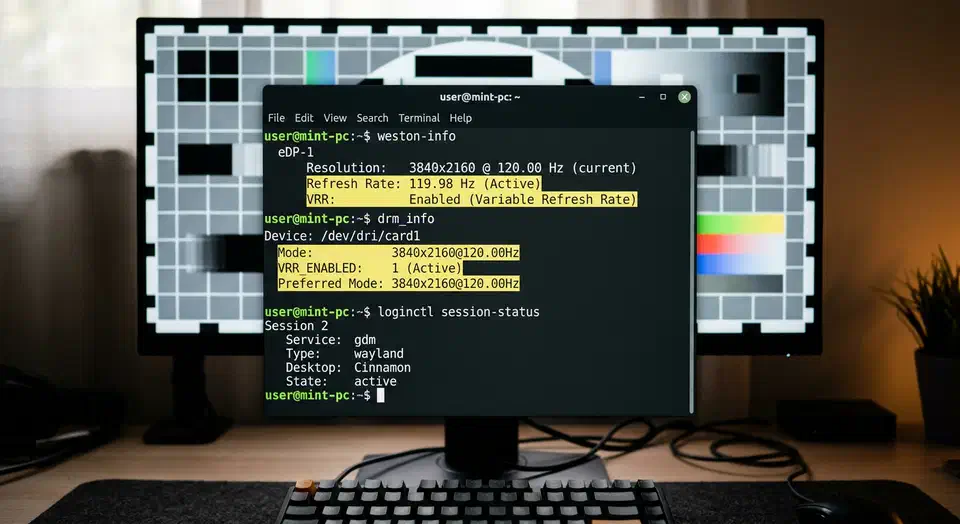
Screen tearing on Linux Mint in 2026 is rarer than in the X11 days. It still shows up on Wayland when the render pipeline is not in sync end to end. Most guides oversimplify and claim Wayland alone wipes out tearing forever. In practice, you need the right kernel, the right driver path, sane compositor settings, and monitor settings that match what your GPU can deliver.
This guide is for Linux Mint users on modern hardware, especially high refresh displays and mixed monitor setups. It walks through root causes, check commands, VRR setup, fractional scaling traps, NVIDIA steps, and a full troubleshooting matrix. By the end, you can tell whether tearing comes from compositor timing, GPU sync, display config, or a bad session choice for your hardware.
Prerequisites and Baseline Requirements
Before you tune, set a known-good baseline. Wayland tearing fixes rely on several layers, and each one needs to be current. That means kernel DRM/KMS, Mesa or the proprietary NVIDIA stack, the compositor, and the monitor firmware. If one layer is too old, you’ll burn hours tweaking knobs that never work right.
Use this baseline for Linux Mint 22.x era systems in early 2026:
| Component | Recommended baseline | Why it matters |
|---|---|---|
| Linux kernel | 7.x (or latest Mint-supported HWE equivalent) | Better explicit sync, VRR, and multi-monitor timing behavior |
| Mesa (AMD/Intel/NVK path) | 25.x or newer | Frame pacing, Vulkan WSI stability, VRR behavior |
| NVIDIA proprietary path | 570.x or newer | Improved Wayland explicit sync handling |
| Display connection | DisplayPort preferred for high refresh + VRR | HDMI VRR support varies by monitor and cable quality |
| Monitor OSD | FreeSync/G-Sync Compatible enabled | VRR cannot work if disabled at panel level |
| Session type | Wayland session confirmed | Avoid testing Wayland fixes while logged into X11 |
Quick checks:
echo "$XDG_SESSION_TYPE"
uname -r
inxi -Gxx
XDG_SESSION_TYPE must return wayland. inxi -Gxx should show the active driver and renderer. If it reports software rendering or fallback drivers, fix that first.
GPU model notes:
- AMD RDNA 2/3/4: the easiest path under
amdgpuplus Mesa. - Intel Xe / Arc: solid Wayland support with current Mesa, and the Arc 140V control panel options let you check clocks and power from the desktop.
- NVIDIA RTX (Turing and newer): usable on Wayland. Setup differs a lot between the proprietary stack and the NVK path.
What Causes Tearing on Wayland? (And Why It Is Not Always Fixed)
Wayland changes who runs frame presentation, but it does not magically wipe out every timing mismatch. Under Wayland, the compositor decides when a frame gets scanned out to the display. That design should prevent classic out-of-sync flips. The compositor still leans on kernel DRM/KMS, GPU driver fences, and monitor timing limits.

The artifact people call “tearing” shows up when a frame misses the ideal vblank window. Part of the old frame and part of the new frame both reach the screen during scanout. In theory, the compositor should hold back late frames. In practice, late commits still slip through when the pipeline is under pressure, especially with:
- Different refresh rates across monitors (for example 165 Hz plus 60 Hz).
- Fractional scaling on one display but not another.
- GPU driver fence timing bugs.
- Fullscreen apps that skip the compositor’s usual rules.
Wayland surfaces use a commit model (wl_surface.commit). Clients submit buffers and metadata for composition. If buffer readiness and frame fences are out of sync, the compositor is stuck with worse scheduling choices. That is where explicit sync protocols help. They remove guesswork about when a frame is truly ready.
Compositor choice is just as important. Linux Mint users often compare Cinnamon (Muffin path), KDE (KWin), and GNOME (Mutter). Each one handles multi-monitor clocking, VRR gating, and low-latency fullscreen in its own way. So the same hardware can give very different results across desktops.
Wayland’s Perfect Frame Promise vs Real Multi-Monitor Reality
The phrase “Wayland is tear-free by design” is true in spirit but not in practice. On a single monitor at a stable refresh rate, modern Wayland sessions can look flawless. On mixed refresh desktops, the compositor often picks a pacing strategy that favors one output. The other output can look jittery or show artifacts that users read as tearing.
A common 2026 setup is a 144/165/240 Hz primary plus a 60 Hz panel for chat, browser, or monitoring tools. If an app updates fast on both screens, the compositor may sync to one output while re-timing the other. The result is not always a hard tear line. It can be micro-stutter or tear-like edge breaks that come and go.
Explicit sync via linux-drm-syncobj-v1 helps a lot. It makes GPU and compositor coordination predictable. Instead of guessing when a buffer is ready, fences spell it out. In practice, that kills a whole class of race conditions that used to show up as tearing during heavy scene changes.
You may also see tearing-control and FIFO protocol extensions (fifo_v1, plus per-compositor tearing rules). Support is still patchy across compositors in Q1 2026. Don’t assume every desktop turns on the same behavior by default.
To split driver-level issues from compositor-level issues, run controlled tests with glxgears and vkcube:
vblank_mode=0 glxgears
vkcube
If artifacts show up in one test path but not the other, that points you in a useful direction. glxgears is not a benchmark. It is still a fast behavior probe when you toggle compositor settings.
Fractional Scaling and Buffer Alignment
Fractional scaling is one of the most missed causes of tearing on Linux Mint Wayland sessions. The problem is not that fractional scaling is “bad”. It adds extra resampling and composition work, which piles on timing pressure. On high refresh monitors, that extra work can turn near-miss frame schedules into visible artifacts.
Typical pattern:
- Primary monitor at 165 Hz with 125% or 150% scaling.
- Secondary at 60 Hz and 100% scaling.
- Browser video on secondary, game or animation on primary.
In this setup, the compositor juggles scale transforms and mixed refresh output. If your GPU has plenty of headroom, you may never notice. If headroom is tight, you can see edge tearing, jitter, or rough frame pacing.
A practical fix path:
- Set both monitors to 100% scaling for a moment.
- Test for tearing with the same workload.
- Turn fractional scaling back on for only one monitor.
- Retest and compare.
If tearing shows up only after fractional scaling is on, keep scaling on the less busy display. You can also lower refresh on the secondary monitor to ease the load. Another fair trade: keep the primary gaming or work display at integer scaling and use fractional scaling only on side panels.
On Linux Mint, test this before deep driver surgery. Many users blame drivers first when the real trigger is composition load from scaling choices.
The COSMIC Option on Mint
In 2026, COSMIC is a strong pick for users hitting limits with Mint’s default desktops. COSMIC uses cosmic-comp, built on smithay. It has focused hard on modern Wayland, including explicit sync and cleaner high refresh handling.
Is COSMIC a fix for everyone? Not really. It is a different compositor stack with different trade-offs. Still, if your current desktop always tears on your hardware, testing COSMIC in parallel is a valid check and often a real fix. If you are picking a Wayland desktop from scratch, our side-by-side compositor breakdown weighs COSMIC against Sway and Hyprland on tiling, display handling, and stability.
You can install it without removing Cinnamon. Keep a parallel desktop and pick the session from the login manager. The key is to avoid destructive package changes.
General path:
sudo apt update
sudo apt install cosmic-session
Package names can vary by repo state on Mint. Check availability first:
apt search cosmic | grep -E "session|comp|desktop"After install, log out and pick the COSMIC session at login. Keep Cinnamon installed so rollback is instant.
Community reports in early 2026 show strong frame pacing gains on AMD Radeon RX 9070 and good results on Intel Arc B580. The gains are biggest on mixed refresh monitor setups. NVIDIA is improving, but it stays more sensitive to driver branch and explicit sync support.
Configuring VRR (FreeSync and G-Sync Compatible)
Variable Refresh Rate (VRR) is often the single biggest win against tearing and stutter on dynamic frame workloads. Instead of fixed 60/120/144/165 Hz scanout, VRR lets the display shift refresh timing to match the frames it gets, within a set range.
For Linux Mint users, VRR needs three layers to agree:
- Monitor VRR turned on in the OSD.
- Driver path with VRR support.
- Compositor setting that allows VRR.
Check whether your connector reports VRR support with drm_info:
drm_info | grep -A6 -E "Connector|VRR_CAPABLE"If VRR_CAPABLE is present and turn-on-able, move to compositor settings. For GNOME/Mutter desktops, you may need an experimental feature toggle. For KWin, use the VRR option in display settings. Cinnamon Wayland support keeps moving, so the exact UI labels can shift between Mint updates.
Low framerate behavior is just as important. If your game or workload drops below the monitor VRR floor, frame pacing gets uneven and can look like tearing. Use a frame limiter to stay inside the live VRR range when you can. On OLED panels, uneven pacing also shows up as VRR flicker on OLED in dark scenes, and the same frame limiter fixes both.
Practical rule:
- 48-165 Hz panel: cap around 160 FPS, and avoid dipping below 48 FPS in heavy scenes.
If low-FPS dips are hard to avoid, dropping graphics settings a bit often looks better than running uncapped with big frame swings.
NVIDIA Proprietary Driver Walkthrough (Mint Wayland Path)
NVIDIA needs its own treatment. The proprietary stack acts differently from Mesa-first AMD and Intel paths. In 2026, the 570.x branch is much better than older ones. You still need careful, explicit setup.
First, confirm your active NVIDIA stack:
nvidia-smi
inxi -Gxx
If nvidia-smi fails, don’t go further with Wayland tuning yet. Fix the driver install first.
On Linux Mint, install the recommended proprietary driver through Driver Manager or package tools. After reboot, verify the right kernel module is active.
For VRR and stable Wayland behavior, check these points:
- Driver branch is 570.x or newer.
- Session is Wayland.
- Monitor OSD has adaptive sync on.
- Compositor VRR toggle is on where supported.
For X11 fallback sessions, VRR often uses xorg.conf.d options like AllowVRR, depending on the branch and distro packaging. Many users test in X11 and assume the same knobs work on Wayland. They don’t always map one-to-one.
If you still see tearing under proprietary NVIDIA on Wayland:
- Turn off fractional scaling and retest.
- Lower secondary monitor refresh mismatch.
- Test single-monitor mode to isolate multi-head timing.
- Compare with NVK (where it makes sense) for behavior differences.
NVK (Mesa path) helps with diagnosis and some workloads. Proprietary drivers may still be a better fit for CUDA or app fit needs. Pick based on your real workload, not ideology.
Step-by-Step Fix Checklist
Use this checklist in order. Skipping around makes diagnosis harder. Changing several things at once hides the real cause.
- Confirm session and compositor state using
loginctlandweston-info.
echo "$XDG_SESSION_TYPE"
loginctl show-session "$XDG_SESSION_ID" -p Type -p Name -p State
weston-info | head -n 40- Confirm kernel and driver baseline.
uname -r
inxi -Gxx- Check monitor refresh and scaling settings in Linux Mint Display settings.
- Set the refresh you want on each monitor.
- Set scaling to 100% on all monitors for a moment.
- Retest before turning fractional scaling back on.
- Turn on VRR at the monitor OSD and at the compositor.
- Check the panel OSD first.
- Verify connector support with
drm_info.
- Test with controlled workloads.
vblank_mode=0 glxgears
vkcube- Strip out multi-monitor variables.
- Unplug the secondary display.
- Retest on the primary only.
- Plug it back in and lower secondary refresh if needed.
- For NVIDIA proprietary users, check branch and module health with
nvidia-smi.
nvidia-smi
cat /proc/driver/nvidia/version
If it still tears, test another Wayland compositor (for example COSMIC or KDE) to spot compositor-specific behavior.
Keep X11 as a fallback session if your daily workload still tears on Wayland.
To make X11 the default without removing Wayland, pick the X11 session at the login screen. Then set it as your remembered session in the display manager.
Troubleshooting Matrix
Use this table to map symptoms to likely causes fast.
| Symptom | Likely root cause | Fix |
|---|---|---|
| Horizontal tear line during video playback | VRR disabled or compositor pacing mismatch | Enable VRR in monitor OSD and compositor settings; verify with drm_info |
| Tearing appears only with second monitor connected | Mixed refresh timing conflict | Lower secondary refresh, test single monitor, keep primary as timing priority |
| Smooth at 100% scale, tears at 125%/150% | Fractional scaling composition overhead | Use integer scaling on primary display; apply fractional only where needed |
| NVIDIA only: random tearing after suspend | Driver state instability or branch issue | Update to latest 570.x point release, reload session, retest |
| Stutter mistaken for tearing at low FPS | VRR floor exceeded | Cap FPS within panel VRR range, lower graphics settings |
| Tearing in one desktop, not another | Compositor-specific behavior | Test KDE/COSMIC/GNOME session and keep the one with stable pacing |
| No improvement after all tuning | Wrong session type or fallback renderer | Confirm XDG_SESSION_TYPE=wayland and hardware acceleration in inxi -Gxx |
Before and After Validation (Terminal Output Examples)
If you can’t include screenshots in your workflow, terminal output is still useful and easy to reproduce. Capture “before” and “after” snapshots of session, driver, and VRR signals.
Example “before” (tearing likely):
$ echo $XDG_SESSION_TYPE
wayland

$ inxi -Gxx
Graphics:
  Device-1: NVIDIA ... driver: nvidia v: 565.xx
  Display: wayland server: Xwayland v: 24.x compositor: Muffin
  Resolution: 2560x1440@165Hz, 1920x1080@60Hz

$ drm_info | grep -A3 VRR_CAPABLE
VRR_CAPABLE: 0 (not set)
Example “after” (improved pacing):
$ echo $XDG_SESSION_TYPE
wayland

$ inxi -Gxx
Graphics:
  Device-1: NVIDIA ... driver: nvidia v: 570.xx
  Display: wayland server: Xwayland v: 24.x compositor: Muffin
  Resolution: 2560x1440@165Hz, 1920x1080@60Hz

$ drm_info | grep -A3 VRR_CAPABLE
VRR_CAPABLE: 1 (set)
Record a short video test before and after each major change (VRR toggle, scaling change, monitor refresh change). Small, isolated changes with clear evidence are the fastest way to land on a stable setup.
A practical workflow is to keep a simple log:
| Change | Result | Keep? |
|---|---|---|
| Enabled monitor FreeSync | Reduced tearing in fullscreen apps | Yes |
| 150% scaling on primary | Reintroduced jitter in browser scroll | No |
| Secondary monitor from 60 Hz to 120 Hz | Worse frame pacing under load | No |
| Secondary monitor from 60 Hz to 50 Hz | Improved stability for primary gaming | Yes |
This log stops circular tuning where you unknowingly undo a fix from two hours back.
When to Fall Back to X11
Wayland is the right default for Linux desktops. Reliability still wins over ideology. If your workflow still tears after baseline updates and careful tuning, X11 as your daily driver is a fine short-term choice.
Good reasons to fall back:
- Critical recording or live streaming where visual artifacts are a non-starter.
- A proprietary app stack with known Wayland regressions on your GPU branch.
- A multi-monitor layout your compositor cannot pace right today.
Keep Wayland installed and retest after major kernel, Mesa, compositor, or NVIDIA updates. The ecosystem moves fast in 2026, and many issues vanish one release later.
If you switch to X11, write down the reason and the exact case that fails on Wayland. That gives you a clean re-test list later. It also helps you skip vague “it felt better” claims. The same idea of saving before and after command output works for other Linux speed issues.
Final Recommendations for Linux Mint 2026
Most Linux Mint tearing cases in 2026 are fixable without big changes. The high-impact order is: verify baseline versions, turn on and check VRR, cut mixed-refresh load, and test fractional scaling with care. For NVIDIA, make sure you are on a modern 570.x proprietary branch. Treat Wayland tuning as a separate path from old X11 guides.
If Cinnamon Wayland still struggles on your setup, a parallel COSMIC session is worth a try. It changes the compositor behavior without forcing a full distro swap. Keep your evidence in command output and short before-and-after clips. You will reach a stable setup much faster.
The key idea is end-to-end alignment. Wayland output, driver fences, monitor support, and desktop config must all line up. Once they do, Linux Mint can run smooth and tear-free even on modern high refresh multi-monitor desktops.