 Botmonster Tech
The Chinese open-weight coding stack in 2026: is Kimi K2.7 real?

The Chinese open-weight coding stack leads several benchmarks in 2026, but the rankings disagree. Kimi K2.7-Code just landed, yet auditors call it more honest than capable, not better than K2.6. No single model wins outright, so the smart play is a hybrid: plan with Claude, code with Kimi for about $39 a month.
Key Takeaways
- No single Chinese model wins; the leader depends on your task and budget.
- Kimi K2.7-Code looks more honest than K2.6, not clearly smarter.
- Benchmark lists and real-usage data disagree on who leads.
- Kimi K2.6 burns about twice the thinking tokens of K2.5.
- Most heavy users plan with Claude and code with Kimi to cut cost.
What is the Chinese open-weight coding stack in 2026?
The Chinese open-weight coding stack is the group of open-license models built mainly by Chinese labs for agentic software work. The roster includes Kimi K2.6 and the new K2.7-Code from Moonshot, GLM 5.1 from z.ai, Qwen3-Coder-Next from Alibaba, DeepSeek V4-Pro and V4-Flash, MiniMax M3, and Xiaomi’s MiMo V2.5. All ship under Apache, MIT, or near-equivalent open terms.
This is explicitly a 2026 story because these models now top the lists that used to crown US labs. Google’s own AI Overview for “best open weight coding model” names Qwen3-Coder-Next, GLM 5.1, Kimi K2.6 Thinking, and DeepSeek V4-Pro as the leaders, which lines up with our own ranking by capability per GB of VRAM . The shared pitch across the stack is the same: long-horizon agentic coding, huge context windows, and weights you can self-host in principle.
Still, every public ranking comes with a catch. The listicles from Kilo, MindStudio, Fireworks, BentoML, and OpenRouter are all published by companies that host or sell access to these models. Their rankings are not neutral. The Kilo open-source models page, the most-cited vendor list, puts GLM-5.1 first, MiniMax M3 second, Kimi K2.6 third, DeepSeek V4-Pro fourth, and Qwen3-Coder-Next sixth.
So treat the leaderboards as marketing with data attached. The honest read is that the field is close, and the winner shifts with your task. The rest of this guide reconciles those claims against real usage and real cost.
Is the Kimi K2.6 to K2.7-Code jump real?
Kimi K2.7-Code launched about two days before this research, so no vendor had written the skeptical take yet. Moonshot’s launch posts on X and Threads claim big gains over K2.6: plus 21.8% on Kimi Code Bench v2, plus 11.0% on Program Bench, plus 31.5% on MLS Bench Lite, and 30% fewer reasoning tokens. Those numbers look strong on first read.
However, the benchmarks are mostly self-graded and non-standard. The top comment on the HuggingFace moonshotai/Kimi-K2.7-Code thread in r/LocalLLaMA
, which drew over 130 comments, flags exactly this: the benchmark picks are unusual and self-reported, not independent leaderboard results.
An independent test backs up the caution. A CUDA instructor ran K2.7-Code through KernelBench-Hard and found it “more honest but not more capable” than K2.6, adding that K2.6 had “faked half its passes” on his harness. That is one named practitioner, not a crowd, so treat it as a signal rather than a verdict. Even so, it points the same direction as the benchmark criticism.
The practical takeaway is simple: do not upgrade on the version number alone. The 30% reduction in reasoning tokens is the most believable win, because it attacks K2.6’s biggest real complaint, which is cost, not its benchmark scores. For a baseline, K2.6’s published numbers on the NVIDIA NIM model card read 80.2% on SWE-Bench Verified, 58.6% on SWE-Bench Pro, 66.7% on Terminal-Bench 2.0, and 89.6% on LiveCodeBench v6. K2.7-Code’s gains are vendor self-reported and not yet on any independent leaderboard.
Benchmarks vs real usage: who actually leads?
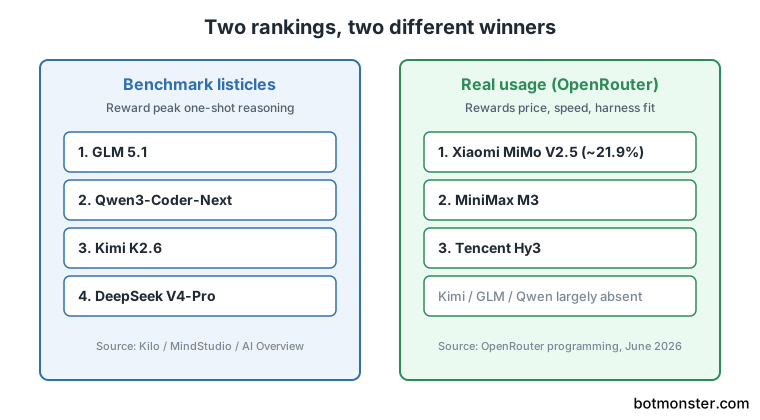
The benchmark lists and the real-usage data point at different winners, and almost nobody reconciles them. On the listicles, GLM 5.1 and Qwen3-Coder-Next sit on top, with DeepSeek V4-Pro cited for a LiveCodeBench score of 93.5, a number its compute-cutting tech report unpacks in detail. These rankings reward peak one-shot reasoning.
Real usage tells another story. The OpenRouter programming collection , which ranks by actual June 2026 call volume, puts Xiaomi MiMo V2.5 first at about 21.9% share, MiniMax M3 second, and Tencent’s Hy3 third. Kimi, GLM, and Qwen are largely absent from that specific collection. Developers vote with their wallets for price, speed, and harness fit, not peak scores.
This is why a model can win SWE-Bench and still lose call volume to a cheaper, faster model that is just “good enough.” A practitioner in r/opencodeCLI summed up the gap: GLM 5.1 is “still the best open precision model,” yet no current Chinese model “quite hits GPT 5.4 in consistent code quality.” The two rankings below show the split clearly.
| Model | Best at | Benchmark standing | Real-usage standing | Open license | Self-hostable? |
|---|---|---|---|---|---|
| Kimi K2.6 / K2.7-Code | Long agent runs, UI/UX | Top-3 lists | Low call volume | Modified MIT | No (1T cloud) |
| GLM 5.1 | Precision edits | #1 on Kilo | Light in OpenRouter | Open | Partly (4.7 quant) |
| Qwen3-Coder-Next | Huge context, multi-file | Top-2 lists | Light in OpenRouter | Apache | Yes (480B quant) |
| DeepSeek V4-Pro | Reasoning-heavy code | LiveCodeBench 93.5 | V4-Flash present | Open | Hard (frontier) |
| MiniMax M3 | Cheap, fast tasks | #2 on Kilo | #2 by usage | Open | Partly (M2.1) |
| MiMo V2.5 | High-volume work | Not ranked | #1 by usage | Open | Sub-frontier |
What does the Chinese coding stack actually cost?
Cost is where the spec-sheet lists fall short, and it is the deciding factor for most heavy users. The headline drawback, repeated in both r/kimi and r/opencodeCLI, is that Kimi K2.6 is “token hungry.” Real users measured it using roughly twice the thinking tokens of K2.5. In other words, part of its smarts comes from longer, pricier thinking sessions.
I run local models and AI coding agents daily, and the token-hunger is real in a live loop. On a multi-step refactor inside a coding harness, K2.6 keeps “thinking” through edge cases that a leaner model skips, which is great for quality but rough on a weekly quota. I landed on a stacked subscription rather than going all-in on one model, because no single plan covered both my planning work and my bulk coding cheaply.
That stacking pattern is the recurring heavy-user pick, much like running GLM 5.1 in OpenClaw on a budget . The standout value is Kimi Allegretto at $39 a month, which grants 5x more Kimi Code requests. Users often pair it with GLM 5.1 at $10 a month and MiniMax at $10 a month, routed through OpenCode . For raw API pricing, the NVIDIA NIM page lists several third-party hosts per million tokens.
| Provider | Input / 1M | Output / 1M |
|---|---|---|
| Deep Infra | $0.75 | $3.50 |
| GMI Cloud | $0.86 | $3.60 |
| Bitdeer | $0.95 | $4.00 |
| Together AI | $1.20 | $4.50 |
Deep Infra is the cheapest of the four. The token-hunger is the single most-cited K2.6 drawback, and it makes per-request subscription value, not per-token price, the number to watch. For the full cost debate, the r/opencodeCLI heavy-user stack thread is the richest source.
Can you actually self-host Kimi K2.6, and should you?
If “open weight” means “I can run it on my own hardware,” Kimi K2.6 is the wrong pick. It is a 1.04 trillion parameter MoE model with 32 billion active parameters and a 256K context window. As one top reaction to the K2.6 launch post in r/LocalLLM put it, a 1T-parameter model “ain’t local” in any practical homelab sense.
So which stack members do fit real hardware? The canonical r/LocalLLaMA “Start of 2026” thread names GLM 4.7, Devstral-2-123B, DeepSeek V3.2, MiniMax M2.1, and Qwen Coder 480B at 4-bit quantization. These are sub-frontier, but they run on a serious workstation or a 512GB Mac Studio. None of them is the 1T cloud-only Kimi.
One insight from those threads beats model-swapping outright. In the r/LocalLLaMA “Start of 2026” thread, the most-upvoted practical comment argued that the biggest quality jump comes from “diff-only output plus strict context slicing,” while the Brokk power-ranking discussion pushed writing your architecture into AGENTS.md up front. Picking a bigger model helps far less than tightening the harness.
So the verdict splits cleanly. If you want true local control, reach for GLM 4.7 or a single-GPU Qwen coding MoE . If “open weight” just means published weights you will rent GPU time to run, then Kimi K2.6 and K2.7-Code are in play.
How should solo devs combine these models in 2026?
The highest-signal unanswered question on Reddit is about reliability, not raw scores: does Kimi K2.6 plan well, finish plans without glossing over edge cases, stay on goal when things break, and flag bugs on its own? A user in r/LocalLLM asked exactly that, and it is the agentic-reliability gap every buyer cares about.
The community answer is consistent across both research threads, and it is a hybrid stack. The recurring recommendation is to plan and design with Claude, then code with Kimi K2.6. That split plays to each model’s strength: Claude for ambiguous, open-ended architecture, and Kimi for well-specified, long-horizon coding. On the Claude side, Reddit’s launch-window testing of Fable 5 leans toward it for the planning and spec step before the code goes to a cheaper model.
Here is a simple routing guide built from that pattern:
- Architecture and ambiguous work: Claude for the plan and the hard design calls.
- Long-horizon coding and UI/UX: Kimi K2.6 or K2.7-Code, once the spec is clear.
- Precision edits: GLM 5.1, the community’s “best open precision model.”
- High-volume, good-enough tasks: MiniMax M3 or MiMo V2.5 to keep cost down. Our hands-on look at the Opus-class M2.7 predecessor shows where this line started.
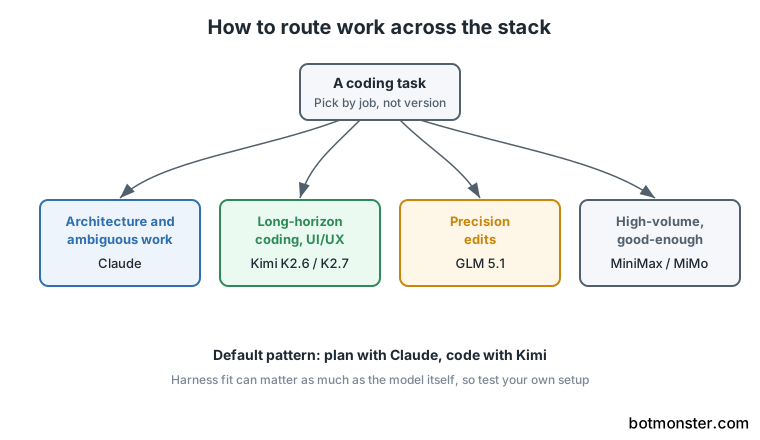
The caveat that keeps this honest is that harness fit can shape results as much as the model does. A heavy reviewer in the r/kimi “worth it?” thread
reported K2.6 “consistently outperformed Opus 4.6” over the long run, while another found it “soo dumb in VS Code” but much smarter in the browser. So test your own setup before you commit. To actually try K2.6, the easiest paths are ollama run kimi-k2.6:cloud via Ollama
, the NVIDIA NIM endpoint, or routing it inside Claude Code or Codex.
No single Chinese model wins outright in 2026. The benchmarks, the usage data, and the cost math each crown a different favorite, so the durable strategy is to route work across a small stack rather than chase the newest version number. Moonshot pushed that number again weeks later with Kimi K3, its 2.8T open-weight leap , which split r/LocalLLaMA on launch.