 Botmonster Tech
Grok 4.6 undercuts Claude and GPT and still keeps pace

Grok 4.6 pricing lands at $2 per million input tokens and $6 per million output, undercutting Claude Opus 5 by roughly 2.4x per finished task. It scores 61 on the Artificial Analysis Intelligence Index, tying GPT-5.6 Sol and trailing Opus 5 by two points. The trade-off is a 500K context window, half of what its rivals offer.
Key Takeaways
- Grok 4.6 costs $2 in and $6 out per million tokens, far below Claude and GPT.
- It ties GPT-5.6 Sol on intelligence and sits two points under Claude Opus 5.
- Agentic tasks finish at about $0.84 each versus $2.03 on Opus 5.
- Its 500K context window is half of what Claude and GPT now offer.
- It markets itself as agentic yet loses the pure coding benchmarks to GPT-5.6 Sol.
What does Grok 4.6 cost?
Grok 4.6 costs $2.00 per million input tokens and $6.00 per million output tokens, with cached input at $0.50. The Grok 4.6 announcement from xAI sets those as the standard rates.
Two conditions push the price up. Requests over 200K tokens double to $4 input and $12 output, and the surcharge applies to the whole request, not just the tokens above the line. The low-latency “fast” variant also runs at twice the base rate. So a long-context job on the fast tier can cost four times the sticker price.
The context window caps at 500K tokens. That is the ceiling both the standard and long-context tiers share, per the Artificial Analysis model page. Half of that window sits at the cheaper rate before the surcharge kicks in.
Free access is limited. Both grok.com and X carry a free tier, but it excludes Grok 4.5 and 4.6. Frontier access needs a SuperGrok subscription or X Premium+.
How does Grok 4.6 score on benchmarks?
Grok 4.6 posts 61 on the Artificial Analysis Intelligence Index, a nine-eval average, and ranks sixth out of 186 models. That puts it among frontier models.
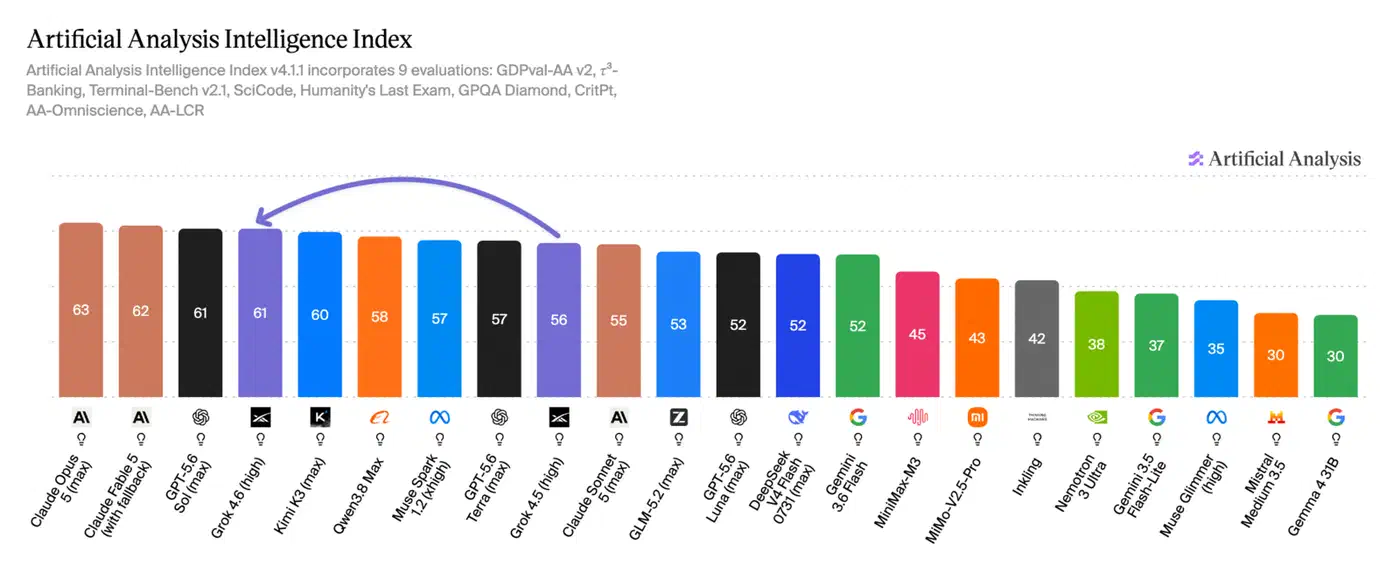
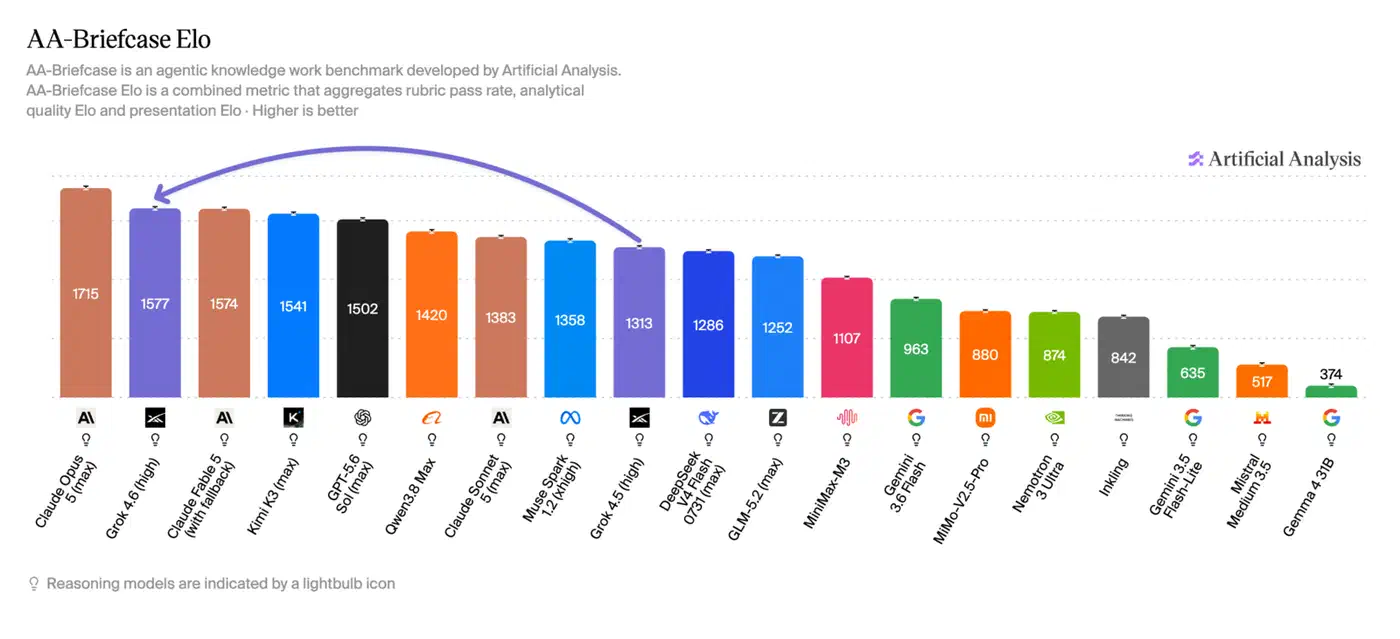
xAI’s own table reports a GDPval-AA v2 Elo of 1753, AA-Briefcase Elo of 1577, CursorBench v3.2 at 69.9%, DeepSWE v1.1 at 65.9%, and APEX-Agents at 57.5%. The Artificial Analysis benchmarks writeup tracks the same figures across the field.
The agentic gains are the headline. APEX-Agents climbed 10.4 points over Grok 4.5’s 47.1%, which is a large jump for a point release. VentureBeat’s launch coverage framed 4.6 as reaching the world’s third-best slot on the index.
Still, the marketing overshoots. xAI sells 4.6 as an agentic-coding model, and it does win the knowledge-work evals like GDPval-AA and the legal Harvey LAB test. On pure software-engineering benchmarks like DeepSWE and Terminal-Bench v3.0, though, GPT-5.6 Sol beats it. A team picking a model for raw code generation should weigh that gap.
Grok 4.6 vs Claude Opus 5 and GPT-5.6 Sol on price and quality
| Model | Input / output (per 1M) | Context | Intelligence Index |
|---|---|---|---|
| Grok 4.6 | $2 / $6 | 500K | 61 |
| Claude Opus 5 | $5 / $25 | 1M | 63 |
| GPT-5.6 Sol | $5 / $30 | 1.05M | 61 |
GPT-5.6 Sol runs a promotional $4 input and $20 output through 2026-11-21, so its effective gap narrows for now. Even so, a job that reads a million tokens and writes a million costs about $8 on Grok versus $30 on Opus 5. Anthropic has since cut Opus to $4 and $20 with its 5.5 update, so that gap is shrinking.
The per-token gap turns into real money at scale. A coding agent that burns 8 million input and 2 million output tokens a month runs about $28 on Grok 4.6, near $90 on Opus 5, and near $100 on GPT-5.6 Sol standard pricing.
Cost per completed task sharpens the gap. The cost-per-task comparison puts Grok 4.6 near $0.84 against Opus 5’s $2.03, about 2.4x cheaper. Grok gets there partly through efficiency. On long-horizon work it finishes in roughly 53 turns and half a billion input tokens, against about 103 turns and 2.0 billion tokens on Opus 5.
Grok does concede ground. Its context window is half its rivals’ (500K against 1M or more, and GPT-5.6 Sol lists 1.05M in the OpenRouter listing). Opus 5 keeps a narrow quality lead at 63 on the index, with Fable 5 at 62. And GPT-5.6 Sol still wins the pure coding evals. The choice comes down to whether a shorter window and a two-point quality gap are worth cutting the bill by more than half.
The same value pitch shows up on the open-weight side. Qwen3.8-Max matches Opus 4.8 on the intelligence index at a fraction of the cost, and it may ship open weights.
What changed from Grok 4.5 to 4.6?
Grok 4.6 is built on 4.5 with a focus on long-running agents. The model does more self-testing before it advances a step, which drives the jump on agentic evals. The reasoning core itself did not get a major overhaul.
The reasoning controls grew too. A new “xhigh” reasoning level joins the earlier tiers, giving more headroom for hard problems at the cost of latency and tokens. The APEX-Agents score moving up 10.4 points over 4.5 is the clearest sign the agent loop improved.
The feature set stays broad. Grok 4.6 handles text and image input, function calling, structured outputs, web search, X search, and code execution. That covers most agent-building needs out of the box.
The context window stayed at 500K, unchanged from 4.5. Reviewers also flagged a measured regression on some pure-SWE evals even as the agentic marketing pushed forward, so an upgrade from 4.5 is not a clean win on every axis.