 Botmonster Tech
Qwen3.8-Max matches Claude Opus 4.8 and might go open

The Qwen3.8-Max price and benchmarks land here: it costs $2 in and $6 out per million tokens and scores about 56 on an independent intelligence index, level with the previous Claude Opus 4.8. The twist is open weights, a first for Alibaba’s top Max tier.
Key Takeaways
- It costs $2 in and $6 out per million tokens, a quarter of Opus 5’s output price.
- It scores about 56 for intelligence, level with last year’s Claude Opus 4.8.
- It’s the first top-tier Alibaba model set to release open weights.
- The design fires only 95 billion of its 2.4 trillion parameters per token.
- It wins partly by burning far more tokens per task, which narrows the price gap.
What does Qwen3.8-Max cost?
Standard pricing through Alibaba Cloud Model Studio is $2.00 per million input tokens and $6.00 per million output tokens. Cached input drops to $0.25. The context window holds 1 million tokens, so a whole codebase or a long chat history fits in one call.
Those numbers came down from the last version. Input fell from $2.50, output from $7.50, and cache hits from $0.50. Alibaba’s pitch is to match US closed-model quality at a fraction of the sticker price.
Before you budget, note that some resellers list context-tiered rates, around $1.20 in under 32K tokens and rising past that mark. The flat $2/$6 through Model Studio is the rate most sources cite, so plan around it and treat the tiered lists as reseller quirks.
There is also an open-weights angle to the price. Alibaba plans a smaller Qwen3.8-27B under Apache 2.0 plus a Max-class checkpoint on Hugging Face. The Max checkpoint’s license was undisclosed at launch, so self-hosting terms are still an open question.
How does Qwen3.8-Max score on benchmarks?
On the Artificial Analysis Intelligence Index, a composite of nine evaluations, Qwen3.8-Max scores about 56. That is a 10-point jump over Qwen3.7-Max’s 46, and it ties the previous Claude Opus 4.8.
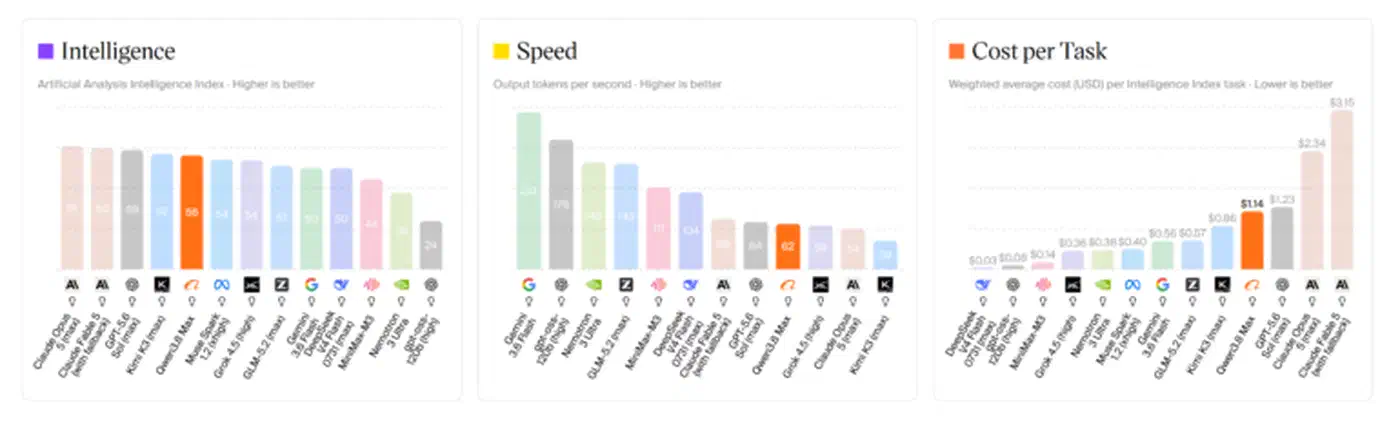
Among rivals, 56 trails Kimi K3 at 57 and beats GLM-5.2 at 51, and it clears every current model from Google, Meta, and xAI. As officechai reported, only Anthropic, OpenAI, and Moonshot sit above it. An earlier run showed 53, but that endpoint had intermittent issues; a re-run on Alibaba’s public API pushed the number to 56.
Much of that gain came from the model doing more work rather than raw smarts. On the GDPval-AA task it now averages 64 steps per task versus 14 before, and input tokens grew roughly 15x because each step resends the full history. So the higher score partly reflects more effort per task.
The model also has real weak spots. The Decoder’s analysis notes AA-Omniscience accuracy stayed near 31% while its hallucination rate climbed from 23% to 40%. In plain terms, it now guesses far more often instead of admitting it doesn’t know. Its Humanity’s Last Exam result also lands last among the flagship models.
Anyone quoting numbers should note that Alibaba shipped the model with no official benchmark table, so vendor figures for OSWorld, PaperBench, or SWE-bench are unverified until the company or a third party publishes them.
Qwen3.8-Max vs Claude Opus 5 and GPT-5.6 on price and quality
| Model | Input / output per 1M tokens | Context | Intelligence index |
|---|---|---|---|
| Qwen3.8-Max | $2 / $6 | 1M | ~56 |
| Claude Opus 5 | $5 / $25 | 1M | 63 |
| GPT-5.6 Sol | $5 / $30 | 1M | 61 |
The output gap stands out most, at $6 against the $25 or $30 the US leaders charge. Qwen sits one tier below them on intelligence, so it trades some raw smarts for a much lower rate.
The sticker price is not the whole bill, though. Because Qwen3.8-Max burns far more steps and tokens per task, its real cost per task rises. One Intelligence Index task now costs about $1.14, more than double Qwen3.7-Max’s $0.53. Kimi K3 scores a point higher at about $0.86 per task, so a cheaper rival can still finish the same job for less. The same holds for Grok 4.6: its matching $2/$6 rate still lands near $0.84 a task, well under Qwen’s $1.14, because it burns far fewer tokens getting there.
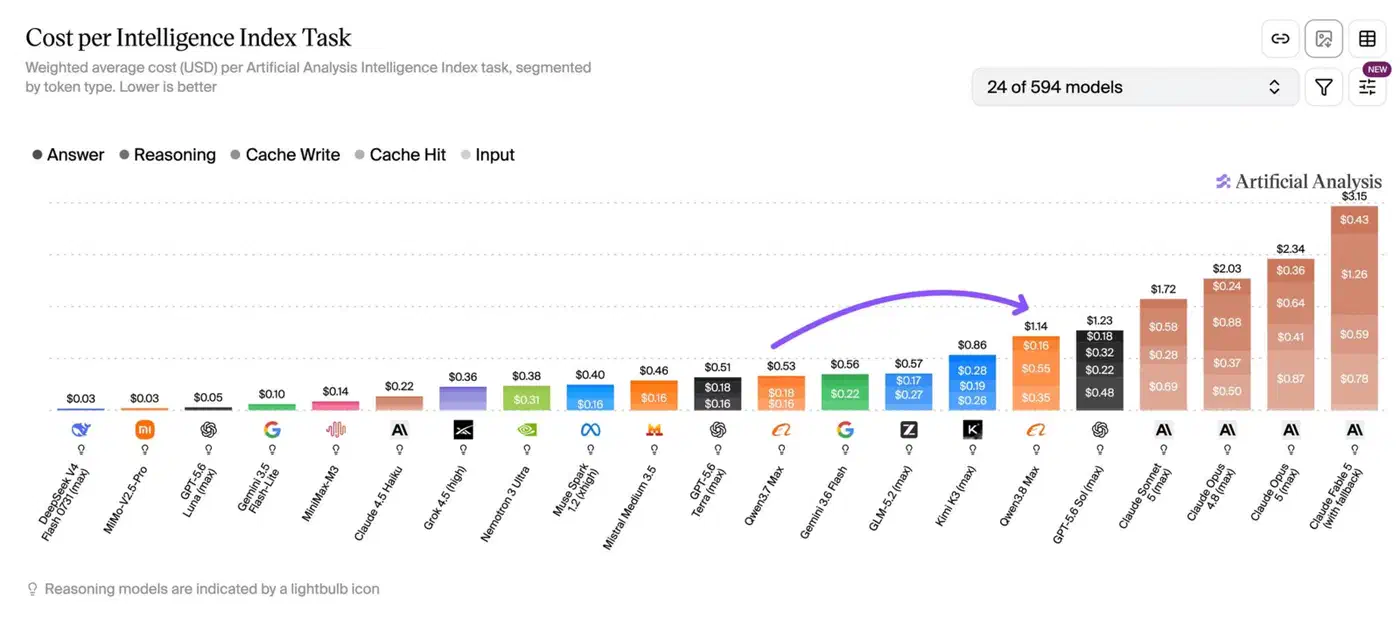
At $6 per million output tokens, a task that emits 145 million output tokens across its steps runs about $870 in output alone. The low per-token rate helps, but a model that writes far more tokens per task can erase that edge. Budget by counting tokens per finished task, since the rate card alone understates the bill.
One advantage has nothing to do with pricing: a Max-class model with open weights lets a team self-host instead of renting an API. Neither Opus 5 nor GPT-5.6 offers that, and for some teams it outweighs a few index points.
What changed from Qwen3-Max to Qwen3.8-Max?
The architecture is the biggest shift. Qwen3.8-Max is a 2.4-trillion-parameter mixture of experts that fires about 95 billion parameters per forward pass. As MarkTechPost describes, that makes it roughly six times the size of Alibaba’s largest prior open release and second in scale only to Kimi K3. The earlier Qwen3-Max was a smaller, closed model.
Input is broader too. The new model takes native text, image, and video, where the earlier Max was mostly text, a shift the DataCamp writeup also documents.
Its reasoning style also changed. Qwen3.8-Max is heavily agentic, chaining multi-step tool use across dozens of turns. That is the same behavior behind the 64-steps-per-task pattern, and it explains both the higher scores and the higher token bills.
The strategic shift is open weights. This is the first Max-class Qwen slated to release them, paired with the smaller Qwen3.8-27B sibling. If Alibaba ships the Max checkpoint under a usable license, it hands teams a frontier-adjacent model they can run themselves.
When Qwen3.8-Max is the wrong pick
Cheap and open does not make it the right tool for every job. Skip it in these cases:
- You need the top intelligence score today. Claude Opus 5 at 63 and GPT-5.6 Sol at 61 both sit above Qwen’s 56. Its successor, Anthropic’s September Opus, costs $4 in and $20 out.
- You want a verified official benchmark table. Alibaba shipped no official numbers at launch.
- You need predictable cost per task. The heavy step and token use makes real cost swing far above the rate card.
- You want open weights on day one. The Max checkpoint’s license was undisclosed and lands after the API.
- A cheaper rival already beats it. Kimi K3 reportedly scores a point higher for roughly 25% less.
For a team that values a low output rate and the option to self-host later, Qwen3.8-Max earns a serious look. For anyone who needs the top score or a stable per-task budget, the US flagships or Kimi K3 remain the safer call.