 Botmonster Tech
Gemma 4 vs Qwen 3.5 vs Llama 4: which open model should you actually use? (2026)

For most developers in 2026, Gemma 4 31B is the best all-around open model. It ranks #3 on the LMArena leaderboard, scores 85.2% on MMLU Pro, and comes with zero usage limits. Qwen 3.5 27B edges it on coding, and its Omni variant offers real-time speech output that no other open model matches. Llama 4 Maverick (400B MoE) wins on raw scale, but it needs datacenter hardware and Meta’s restrictive 700M MAU license. So pick Gemma 4 for the best quality-to-size ratio, Qwen 3.5 for coding-heavy work, and Llama 4 only when you need the largest open model. For pictures rather than text, Alibaba’s Qwen-Image tops the local image field.
The Contenders - Model Specs at a Glance
Before you compare output quality, it helps to know what each family looks like under the hood. These three families differ in design, parameter counts, and release plan. Those gaps shape everything from hardware needs to deployment options.
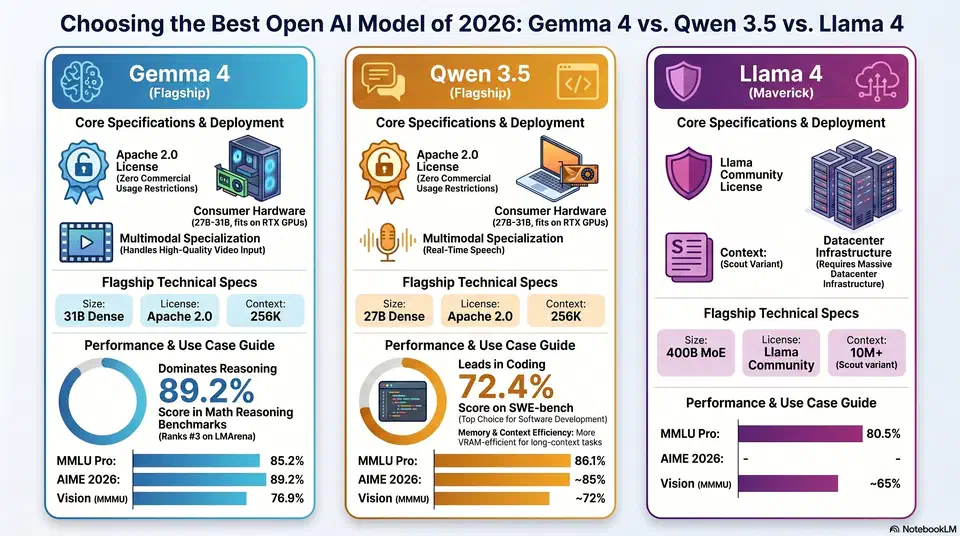 Image: Botmonster.com
Gemma 4 (released April 2, 2026) comes in four sizes: E2B (2.3B effective), E4B (4.5B effective), a 26B MoE model that fires only 3.8B parameters per token, and a 31B dense model. All variants ship under Apache 2.0 with 128K-256K context windows. The edge models (E2B and E4B) take text, image, and audio input. The larger models handle text, image, and video (up to 60 seconds at 1fps) but oddly lack audio input.
Qwen 3.5 (released February 16, 2026) centers on a 27B dense flagship, with the family spanning 0.8B to 397B parameters. The Qwen 3.5-Omni variant (released March 30) adds input across text, image, audio, and video. It is the only model here that can produce real-time streaming speech output. Licensed under Apache 2.0 with 128K context.
Llama 4 (initial release April 5, 2025, with LlamaCon updates) offers Scout (17B active / 109B MoE) and Maverick (17B active / 400B MoE). Scout claims a 10M+ token context window, the largest of any open model. Both variants take text and image input only. They ship under the Llama 4 Community License, which is free for firms under 700M monthly active users but adds compliance terms.
One design gap stands out. Gemma 4’s 26B MoE model fires 3.8B parameters per token. Llama 4’s Maverick fires 17B per token. Both are labeled “MoE,” but the compute profiles are worlds apart.
| Feature | Gemma 4 | Qwen 3.5 | Llama 4 |
|---|---|---|---|
| Release | April 2, 2026 | Feb 16, 2026 | April 5, 2025 |
| Flagship Size | 31B dense | 27B dense | Maverick 400B MoE |
| Smallest Model | E2B (2.3B) | 0.8B | Scout (109B total) |
| License | Apache 2.0 | Apache 2.0 | Llama Community (700M MAU) |
| Max Context | 256K | 256K | 10M+ (Scout) |
| Modalities | Text, image, video, audio* | Text, image, video, audio | Text, image only |
*Audio input limited to E2B/E4B edge models.
Benchmark Showdown - Numbers That Matter
Benchmarks are flawed and everyone knows it. Still, they stay the most consistent way to compare models across labs. Here is how the flagships stack up on the tests that get cited most.
| Benchmark | Gemma 4 31B | Qwen 3.5 27B | Llama 4 Maverick 400B |
|---|---|---|---|
| MMLU Pro | 85.2% | 86.1% | 80.5% |
| GPQA Diamond | 84.3% | 85.5% | 69.8% |
| AIME 2026 | 89.2% | ~85% | - |
| LiveCodeBench v6 | 80.0% | 80.7% | 43.4% |
| SWE-bench Verified | - | 72.4% | - |
| Codeforces ELO | 2150 | ~1900 | ~1400 |
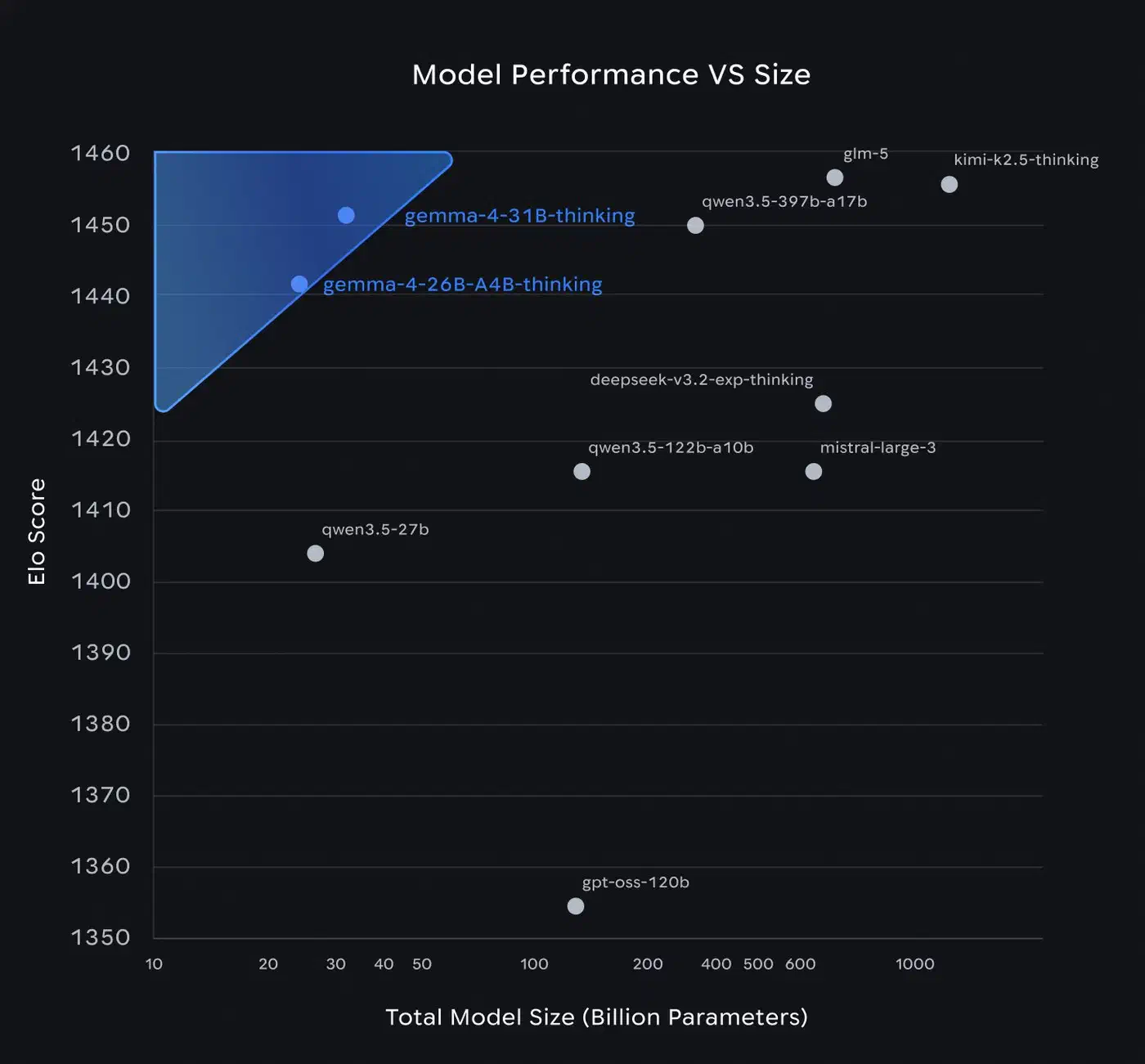
| LMArena ELO | ~1452 (#3) | ~1450 (#2 est.) | - |
| MMMU Pro (Vision) | 76.9% | ~72% | ~65% |
Gemma 4 and Qwen 3.5 trade blows at the ~27-31B scale. They sit within 1-2% on most reasoning tests. Qwen 3.5 takes a slight edge on MMLU Pro and GPQA Diamond. Gemma 4 pulls ahead on math (AIME 2026 at 89.2%) and competitive programming (Codeforces ELO at 2150).
Llama 4 Maverick lags on coding despite being roughly 13x larger than either rival. The 43.4% on LiveCodeBench v6 stands out. MoE routing does not promise better code, and Maverick’s 17B active parameters per token spread too thin across the huge expert pool for structured coding work.
Qwen 3.5 leads on SWE-bench Verified at 72.4%. That is the most practical coding test, since it grades real GitHub issue fixes rather than synthetic puzzles. If your main job is writing patches, fixing bugs, and working in existing codebases, Qwen 3.5 has a clear edge.
The LMArena leaderboard leans on crowdsourced human votes rather than automated metrics. It places Gemma 4 31B at #3 worldwide among open models. That is the closest proxy for how good a model feels to use. It tracks with community talk that Gemma 4 writes more natural, less robotic output than its raw scores suggest.
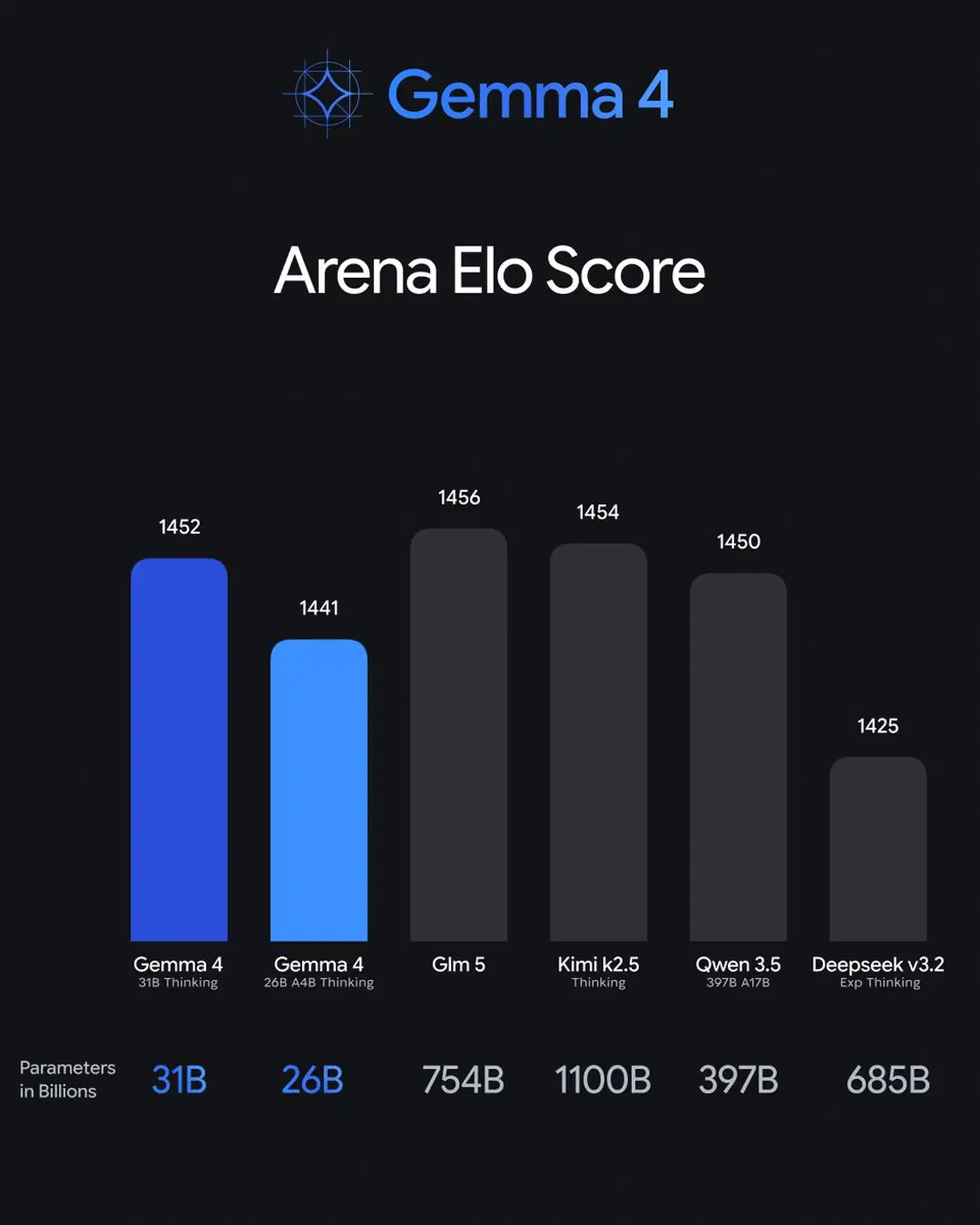
On MoE efficiency, Gemma 4’s 26B-A4B model (firing just 3.8B parameters) ranks 6th on the same leaderboard with a score of 1441. That puts it within reach of the dense 31B model. Per active parameter, it is the most efficient reasoning engine among current open models.
The License Question - Apache 2.0 vs Llama Community License
Licensing is often the deciding factor for production. The picture shifted in a real way in April 2026.
Gemma 4 and Qwen 3.5 both ship under Apache 2.0. No usage limits, no monthly active user caps, no acceptable use policies to track. You can use, change, and ship the weights freely. It is the same license behind Linux, Kubernetes, and TensorFlow. For Gemma, that is a big change. Every prior Gemma release (versions 1 through 3) shipped under a custom Google license that scared off enterprise teams. Hugging Face CEO Clement Delangue called the switch “a huge milestone” that drops the legal friction once pushing teams toward Qwen.
Llama 4 ships under the Llama 4 Community License. It is free for firms under 700 million monthly active users. Past that line, you need a separate deal with Meta. The license also makes you follow Meta’s Acceptable Use Policy, bars training rival foundation models, and tells you to include the license when you share weights.
The practical impact is clear. A startup can ship Gemma 4 or Qwen 3.5 into production with no legal review cycle. Llama 4 needs a license audit even at modest scale, since someone has to check the use policy and redistribution terms. For side projects this does not matter. For anything touching revenue, it counts a lot.
Multimodal Capabilities - Vision, Audio, and Video
All three families read images natively, not through bolted-on vision adapters. But they split sharply on audio and video support.
Gemma 4 E2B/E4B handles text, image, and audio (speech, not music). These edge models use a USM conformer encoder for audio. Google ships day-zero MediaPipe and LiteRT support for mobile. The larger Gemma 4 models (26B and 31B) handle text, image, and video up to 60 seconds but cannot read audio. That gap looks like an oversight, since the edge models already have it.
Qwen 3.5-Omni handles every modality. It reads text, image, audio, and video, and it produces real-time streaming speech output. No other model here can talk back to you. If you are building a voice assistant, an interactive tutor, or any app that needs spoken replies, Qwen 3.5-Omni is the only open-weight pick right now.
Llama 4 Scout and Maverick take text and image input only. No audio, no video. That is the most limited multimodal support of the three families.
Gemma 4 also lets you set the vision token budget between 70 and 1120 tokens per image, trading quality for speed. On MMMU Pro (a vision test), Gemma 4 31B leads at 76.9%. If you want to run vision models locally for image analysis and VQA, the Qwen family’s vision variants are a strong start.
| Capability | Gemma 4 | Qwen 3.5 | Llama 4 |
|---|---|---|---|
| Image Input | All models | All models | All models |
| Video Input | 26B/31B (up to 60s) | Native | No |
| Audio Input | E2B/E4B only | Omni variant | No |
| Speech Output | No | Omni (real-time streaming) | No |
| Vision Score (MMMU Pro) | 76.9% | ~72% | ~65% |
Inference Speed and Hardware Requirements
A model you cannot run is a model you cannot use. This is where theory meets your GPU budget.
| Model | Active Params | VRAM (Q4_K_M) | ~tok/s (RTX 4090) |
|---|---|---|---|
| Gemma 4 31B Dense | 30.7B | ~20 GB | ~25 |
| Gemma 4 26B MoE | 3.8B active | ~16 GB | ~11 |
| Qwen 3.5 27B Dense | 27B | ~17 GB | ~35 |
| Llama 4 Scout | 17B active / 109B total | ~70 GB | ~15 |
| Llama 4 Maverick | 17B active / 400B total | 200+ GB | Multi-GPU only |
Qwen 3.5 27B is the speed champ at this size class. It pushes roughly 35 tokens per second on an RTX 4090 with Q4 quantization. Gemma 4 31B Dense holds its own at around 25 tok/s. In the first 72 hours after Gemma 4’s release, testers found the 26B MoE model running at only about 11 tokens per second on the same card. The MoE routing cost and the need to load all 25.2B parameters into VRAM explain the weak throughput despite the low active count.
Llama 4 Scout at 109B total parameters needs roughly 70 GB of VRAM even with quantization. That makes it a multi-GPU or cloud-only model. Maverick at 400B is firmly in the datacenter tier. You are not running it on consumer hardware. For a deeper look at making Llama 4 fit a consumer GPU, see how to run Llama 4 on consumer GPUs.
All three families had day-one support from Ollama, vLLM, llama.cpp, and Hugging Face Transformers. Gemma 4’s first fine-tuning tooling (QLoRA via PEFT) had bugs, but a patch landed within hours of release.
One practical note on context window versus VRAM. Gemma 4 31B at Q4 quantization fills about 20 GB of VRAM for the weights alone. The full 256K context window on top of that needs much more memory. Community reports show only about 20K context tokens fitting on a single RTX 5090 with Gemma 4, while Qwen 3.5 27B reaches 190K tokens on the same card. If long context drives your work, Qwen 3.5 is more memory-efficient in practice.
Fine-Tuning and Customization
Fine-tuning support varies across the three families. That counts if you need to adapt a base model to a domain task.
Gemma 4 launched with rough edges. Within hours of release, the community found that HuggingFace Transformers did not know the gemma4 architecture, PEFT could not handle Gemma4ClippableLinear layers, and training needed a new mm_token_type_ids field. Patches landed fast in both huggingface/peft and huggingface/transformers. Still, check that you have the latest library versions before you fine-tune.
Qwen 3.5 gains from Alibaba’s steady tooling across Qwen releases. LoRA and QLoRA work out of the box with standard HuggingFace pipelines. The 27B model is the sweet spot for fine-tuning on a single consumer GPU with QLoRA.
Llama 4’s MoE design adds friction to fine-tuning. Training only the active expert parameters works, but it needs careful setup. Axolotl v0.16.x claims 15x faster and 40x less memory for MoE + LoRA training. That helps, yet Scout at 109B total parameters still demands far more resources than Gemma 4 31B or Qwen 3.5 27B.
Cloud API Pricing
If you prefer hosted inference over local setup, all three families run on the major cloud providers. Pricing varies by provider.
Vertex AI offers Gemma 4 models with flexible pricing. Together AI and Fireworks AI host all three families with serverless inference from $0.10 per million tokens for smaller models. Together AI tends to be cheaper on roughly half of shared models versus Fireworks. Dedicated endpoints cost much more, yet still far less than the same calls to GPT-4o or Claude. A newer open-weight release stretches that gap wider: DeepSeek V4-Pro is 39x cheaper per task than Claude Opus 5.
The Apache 2.0 license on Gemma 4 and Qwen 3.5 lets you self-host through any provider with no extra licensing cost. Llama 4 self-hosting still needs you to follow Meta’s license terms wherever you deploy.
Decision Framework - Picking the Right Model
Here is which model to pick based on what you actually need.
For a local coding assistant, go with Qwen 3.5 27B. It has the best SWE-bench score, the fastest inference at this size, and good fit with Continue.dev and similar tools.
For general reasoning and chat, Gemma 4 31B is the stronger pick. It has the highest LMArena ELO among open models in this weight class and the best math at 89.2% on AIME 2026.
On budget hardware or a laptop, look at Gemma 4 26B MoE or E4B. The MoE model gives near-flagship quality at lower compute, while E4B fits devices with very limited VRAM.
If you are building a production API or startup product, stick with Gemma 4 or Qwen 3.5, both Apache 2.0. Llama 4’s license adds legal work you probably do not need.
For voice and real-time use, Qwen 3.5-Omni is the only pick with streaming speech output.
For video understanding, Gemma 4 26B/31B has native video input with tunable quality.
If you want maximum raw power and cost is not a factor, Llama 4 Maverick’s 400B MoE gives you the most parameters. But you need datacenter hardware to run it.
For edge, mobile, or IoT use, Gemma 4 E2B runs on smartphones and Raspberry Pi while still taking multimodal input, audio included. Google ships official MediaPipe and NVIDIA Jetson support.
If long context (100K+ tokens) is your priority, choose Qwen 3.5 27B. Gemma 4 supports 256K on paper, but Qwen 3.5 is far more VRAM-efficient at long context in practice.
The bottom line is simple. Gemma 4 31B and Qwen 3.5 27B sit very close in overall capability, so the choice comes down to your priorities. Gemma 4 wins on math, vision, and edge use. Qwen 3.5 wins on coding, inference speed, and practical long context. Both leave Llama 4 behind on license freedom and hardware access. The days of Meta’s Llama being the default open model are over.