 Botmonster Tech
The best AI agent book of 2026 is free and in Chinese

The best AI agent book of 2026 is free, open source, and written in Chinese first. AI Agents in Depth by Bojie Li ships 10 chapters and 93 companion projects, more than 70 of them runnable. The English edition is a volunteer translation, and I checked how far behind it really runs.
Key Takeaways
- One idea drives the book: an agent is a model, its context, and its tools.
- Ten chapters ship 93 code projects, and over 70 run on their own.
- The English text tracks the Chinese within an hour, closer than the warning suggests.
- Chapter 7 wants a GPU, and 19 code repos live elsewhere and need cloning.
- Everything is free: the book, the PDF, the EPUB, and the web reader.
What is AI Agents in Depth and who wrote it?
AI Agents in Depth is a full technical book about building AI agents, plus every line of its companion code. It lives at bojieli/ai-agent-book on GitHub. The Chinese title is 《深入理解 AI Agent:设计原理与工程实践》.

The author is Bojie Li, who publishes at 01.me. His own bio there lists him as chief scientist at Pine AI, with a PhD from USTC and Microsoft Research Asia behind him. That background shows up in the chapter order, which spends more pages on evaluation and post training than most agent guides do.
The whole project ships under Apache 2.0. The repository was created in September 2025, so ten months of writing sit behind it.
There are four ways to read it, and all of them cost nothing:
- The online reader has a language switcher, chapter folding, and full-text search. It rebuilds on every push to the main branch.
- PDF and EPUB downloads sit on the Releases page, with a floating “latest” build and pinned versions.
- The raw markdown is right there in the repo, from
book/chapter1.mdthroughbook/chapter10.md. - You can build your own PDF with
cd book && bash build_pdf.sh, which needs pandoc, xelatex, and the ElegantBook document class.
The book has nine language editions: Chinese, English, Traditional Chinese for Taiwan, Japanese, Russian, Vietnamese, Tamil, Arabic, and Turkish. Every non-Chinese edition names its volunteer translator in the README. The English one is credited to two contributors, @nsdevaraj and @whanyu1212.
Agent equals LLM plus context plus tools, and why harness engineering wins
The book compresses its whole argument into one equation, stated in the opening lines of the repo: agent equals LLM plus context plus tools. Ten chapters carry that formula from first principles through to production engineering, and the text, the diagrams, and all 93 companion experiments are open source so you can run them yourself.
Chapter 1 then makes the claim the rest of the book defends: the real advantage sits in harness engineering rather than model choice. The harness is everything wrapped around the model call. That means the agent loop, the prompt assembly, the tool schemas, the retry paths, the memory writes, and the context trimming. Swap the model underneath and almost all of that survives, but change the harness and users get a different product.
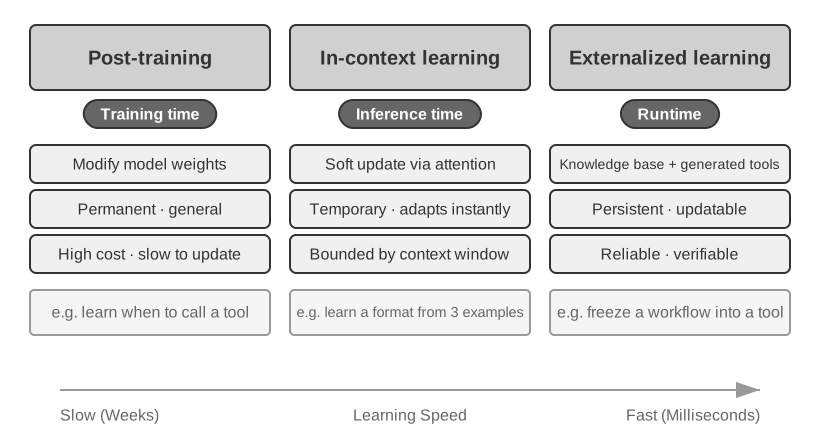
That framing differs from most English agent material, which starts at ReAct and then tours frameworks. Here, orchestration libraries are a side detail. Context budget, evaluation rigor, and model training get the middle of the table instead. For an engineer already shipping agents, that is the more useful lens, since framework choice is rarely what broke last week’s release.
| Resource | Format | Cost | Runnable code | Covers evaluation and post training |
|---|---|---|---|---|
| AI Agents in Depth | 10 chapter book, PDF, EPUB, web | Free | 93 projects in-repo | Yes, two full chapters |
| Anthropic’s agent engineering guides | Short articles | Free | Snippets and cookbooks | Light on both |
| DeepLearning.AI agent courses | Video short courses | Mostly free | Notebooks | Some evaluation, no post training |
The 10 chapter map of the best AI agent book, and what to read first
Here is the full map, with each chapter’s one-line thesis and its companion project count, taken from the README chapter table.
| Ch | Topic | One-line thesis | Projects |
|---|---|---|---|
| 1 | Agent basics | Agent equals LLM plus context plus tools, and harness engineering is the edge | 4 |
| 2 | Context engineering | Context sets the capability ceiling: KV cache, prompting, agent skills, compression | 9 |
| 3 | User memory and knowledge bases | Remember users across sessions: user memory, RAG, structured indexes, knowledge graphs | 13 |
| 4 | Tools | Tools are the agent’s hands: MCP, perception and execution tools, async agents, tool discovery | 7 |
| 5 | Coding agents | Code is the tool that creates new tools, plus a production coding agent in full | 12 |
| 6 | Agent evaluation | Turn behavior into comparable signal: environments, metrics, statistical significance | 11 |
| 7 | Model post training | Pretraining, SFT, and RL: when to pick which, internalizing tool calls, sample efficiency | 16 |
| 8 | Continuous evolution | Pull learning signal from run traces to update knowledge, instructions, and weights | 8 |
| 9 | Multimodal and realtime | Voice, GUI, and the physical world: three voice paradigms, computer use, robotics | 7 |
| 10 | Multi-agent collaboration | Groups beat individuals: collaboration frameworks, context sharing, agent societies | 7 |
If you already ship agents for a living, read chapter 2 first. Context engineering is the densest chapter in the book. It’s also the topic vendor docs serve worst, since they tend to stop at “keep your prompts short.” Then read chapter 6, then chapter 8.
Most agent comparisons published online report a single run on a single benchmark, and chapter 6 treats run-to-run variance as a first-class problem. Statistical significance in agent evaluation is genuinely rare in English blog material, and getting it wrong is how teams ship a model swap that helps nothing.
Some chapters you can skip without losing the thread. Chapter 7 is a post-training course wearing an agent-book cover. A reader with no GPU and no plans to fine-tune can walk past it. The robotics half of chapter 9 needs hardware almost nobody has at home. Both are good; neither is load-bearing for the rest.
Check the count before you quote a number. The README header says 93 companion projects. Its own Chinese chapter table sums to 94. The English chapter table sums to 92, because it still lists 6 projects for chapter 8 where the Chinese lists 8. Use 93, the project’s own headline figure. The slack comes from experiments marked as reader exercises or cross-chapter reuses, such as 6-2, 6-3, 6-4, 6-9, 5-12, 7-8, and 7-9.
The README also links a learning-path guide with study routes and difficulty grading, in English at docs/en/LEARNING.md and Chinese at docs/zh-CN/LEARNING.md.
What running the 93 companion projects actually requires
Every chapter README sorts its projects into three types: standalone, reproduction guide, and design doc. More than 70 of the 93 are standalone. That means the full code sits in the repo and runs once you set an API key. Reproduction guides lean on outside repos you clone yourself, and design docs are plans with the code still in progress.
API keys come first. The README recommends six platforms, and three of them are a problem outside China:
| Platform | Access | Notes |
|---|---|---|
| Kimi (Moonshot) | China mainland | Strong coding and agent models |
| Zhipu GLM | China mainland | Zhipu’s flagship coder and siblings |
| SiliconFlow | China mainland | Open-weight models, fast domestic routes |
| DeepSeek | Global and China | Official DeepSeek API |
| Krill AI | Global and China | Sponsor, relay access to Western and Chinese models |
| OpenRouter | Global | One key for most major models |
For readers outside mainland China, OpenRouter or DeepSeek are the realistic default. Several chapter 1 projects also hard-code specific providers in their examples, so expect a little editing.
Next comes the cloning. Nineteen outside repos are left out of the book’s repo on purpose, for size and licence reasons. Each one has to land in a specific chapter folder, and the README ships a copy-paste script with the exact paths:
- Chapter 6, six benchmark repos: SWE-bench, OSWorld, GAIA, terminal-bench, tau2-bench, and android_world.
- Chapter 7, nine training repos: verl, minimind, minimind-v, AdaptThink, AWorld, SFTvsRL, tinker-cookbook, rlvp, and SimpleVLA-RL.
- Chapter 9, two repos: browser-use and Anthropic’s claude-quickstarts.
- Chapter 10, two repos: TalkAct and the Stanford generative agents town.
Most chapter 7 clones point at bojieli/* forks rather than upstream, and those forks carry tweaks made for the book’s experiments. Several project READMEs also pin a commit and expect a git checkout first, so matching the published results takes an extra step.
Hardware sorts the chapters more sharply than the text does. Chapters 1 through 5 need nothing but API credit. Chapter 6 benchmark runs are long but CPU-friendly, and chapter 7 training runs want a GPU. A few need real machinery. Experiments 9-8, 9-9, and the second half of 9-10 want an SO-100 robot arm on your desk, and 10-7 is the Stanford agent town.
Disk space is the last surprise. The repo alone reports about 293 MB through the GitHub API. The 19 outside clones pile on much more, since benchmark data sets and training frameworks aren’t small.
The project’s contribution bar reflects the same hands-on stance as the code. It asks you to run the relevant experiment and confirm it reproduces before you submit anything, and to open an issue first if you would rather talk the idea through.
If you want a low-commitment start, clone the repo, set one API key, and run experiment 1-1 in chapter1/context. It’s an ablation study that strips context out one piece at a time, so you can watch the agent get worse. Twenty minutes there tells you whether the other nine chapters deserve your disk.
The language barrier and the sponsor links, stated plainly
Two things about this repo are easy to miss at first glance. Start with its own warning about the translations. The Chinese source text lives in book/, and the English, Arabic, Traditional Chinese, Russian, Tamil, Vietnamese, Japanese, and Turkish versions are all community work that may lag the original. A Chinese-first release is common in this space, and the Dive into LLMs course ships its 11 chapters the same way, minus even a license file.
The warning sounds worse than what the commit history shows. I compared commit times on the Chinese and English chapter files through the GitHub API, and the gap is tiny. Chapter 1’s English file landed 45 minutes after the Chinese one, and chapters 7 and 10 were updated in the very same commit. Chapter 5 trailed by 49 minutes. The English chapter 2 was committed four hours ahead of the latest Chinese edit. Somebody is watching that queue closely.
The lag that does exist has moved into the surrounding docs. The English README still lists 6 companion projects for chapter 8 where the Chinese lists 8. It also describes that chapter with an older thesis line. So treat the English chapter text as current and the English navigation copy as a snapshot. Checking commit dates on book/chapterN.md against book-en/chapterN.md takes seconds and settles the question.
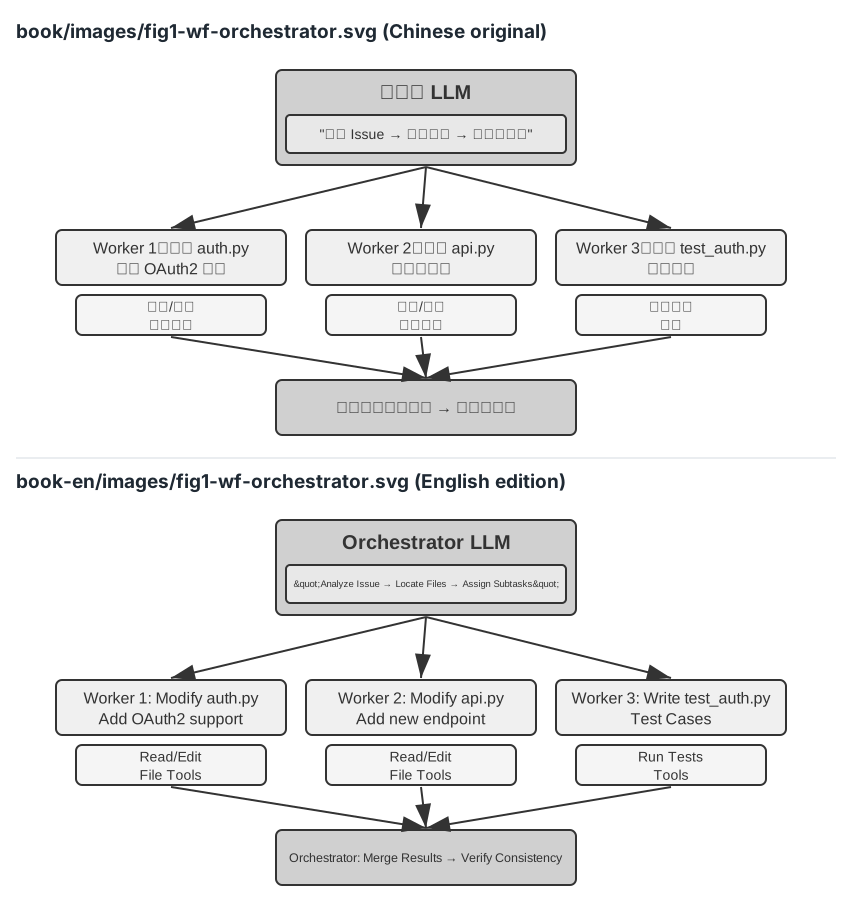
The figures got the same care. All 133 of them are checked-in SVG files, and book-en/images/ holds 133 translated twins with the same geometry and English labels. Nobody exported a screenshot and called it done. That gives you a workaround for any chapter you think has drifted. Read the Chinese original through a browser translator, and the diagrams beside it are identical apart from the words.
Now the sponsor. Krill AI sponsors the project, and its link shows up twice, once in the API key table and once in the sponsor block. Both carry the same referral code. The sponsor block also adds a reader discount on a first Codex plan purchase. The README says all of this out loud, and the other five platform links carry no referral codes. As sponsored links go, that is about as clean as it gets.
Neither issue changes the verdict. A 10 chapter Apache 2.0 book with 93 open projects, 133 original diagrams, and a chapter on statistical significance is serious work. One referral link doesn’t dent it. Treat the English PDF as a snapshot and the repo as the source of truth, and you lose nothing.
One caveat on audience. This book is for engineers who already build agents and want a clear mental model plus code to test it against. Beginners looking for a first tutorial will hit the KV cache section in chapter 2 and stall. Read Anthropic’s shorter guides first. Then come back here for the version with 93 experiments attached.