 Botmonster Tech
AI Engineering from Scratch is 1,095 hours, not 320

The AI Engineering from Scratch curriculum advertises about 320 hours of study across 503 lessons. Add up the per-phase estimates in its own roadmap file and you get 1,094.5 hours. The course itself is real, free, and finished, but the time budget on the label is off by more than three times.
Key Takeaways
- The course is free, finished, and runs from school maths to agent swarms.
- Add up the course’s own phase list and you get about 1,095 hours.
- The capstone phase alone claims 620 hours across 17 big projects.
- Every lesson makes you build the thing by hand before showing the library.
- The badge says 503 lessons while the roadmap lists only 501 rows.
What the AI Engineering from Scratch curriculum actually contains
Most free course repos are a table of contents with three real lessons behind them. In rohitg00/ai-engineering-from-scratch , every lesson row is marked done, with nothing left in progress or planned.
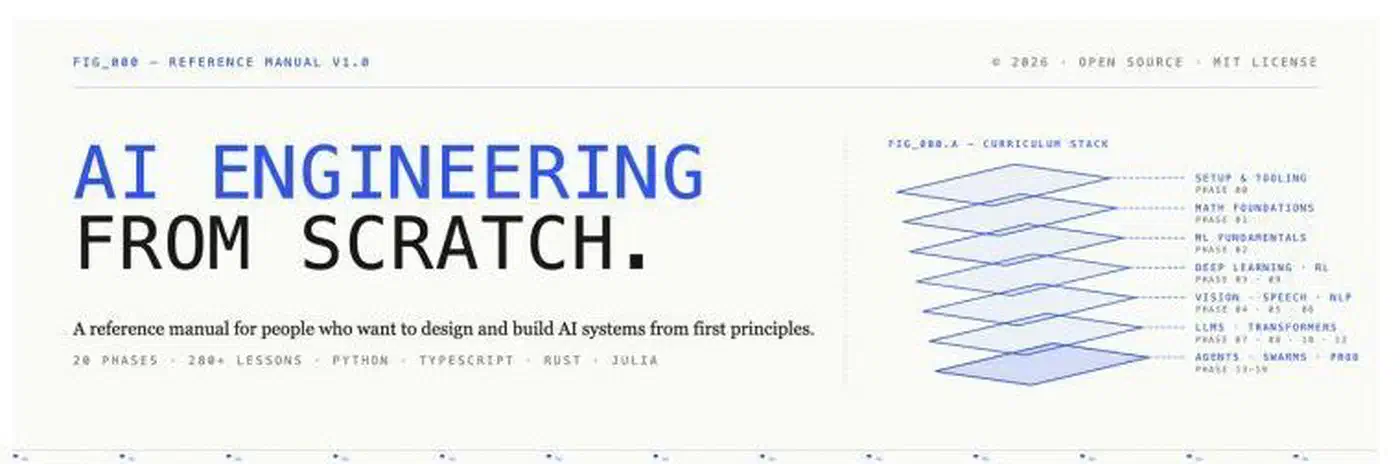
The course stacks 20 phases, with maths as the floor and production agents as the roof. The lower half runs through setup, maths, machine learning basics, deep learning, vision, language, speech, transformers, generative models, and reinforcement learning. The upper half builds large language models by hand, then covers LLM engineering, multimodal work, tools and protocols, and agent engineering. It ends with autonomous systems, swarms, infrastructure, ethics, and capstones.
Every lesson is a folder with the same three parts. A code/ folder holds code you can run, docs/en.md holds the written lesson, and outputs/ holds the thing you keep. The writing is meaty: the first linear algebra lesson ships a 16.5 KB write-up, and capstone folders carry code, notebooks, assets, and a quiz file.
Four languages appear across the code: Python, TypeScript, Rust, and Julia. The whole thing is MIT licensed, and people beyond the author have contributed to it. Every lesson ends with a tool you keep. The repo ships 388 skills and 99 prompts built that way, plus agents and MCP servers.
You don’t have to clone anything to read it. The lessons are published on aiengineeringfromscratch.com . The whole course also compiles into a six-volume book series, with EPUB and PDF files attached to every release.
The hours do not add up
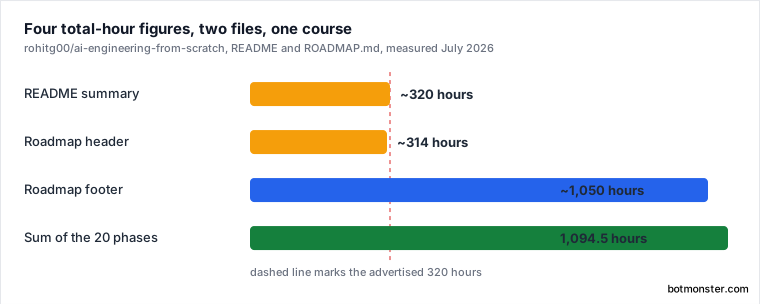
The project README summarises the course as 503 lessons and about 320 hours. The header of the roadmap file says about 314. At the bottom of that same file, the footer says about 1,050. Add up the 20 phase headings in between and the total comes to 1,094.5.
| Where the number appears | What it claims |
|---|---|
| README summary | 503 lessons, about 320 hours |
| Roadmap header | About 314 hours total |
| Roadmap footer | 503 lessons, about 1,050 hours |
| Sum of the 20 phase headings | 1,094.5 hours |
| Count of lesson rows in the roadmap | 501 |
Four different totals live in two files, and none of them is 320. Phase 19, the capstone phase, is labelled at about 620 hours on its own.
Seventeen end-to-end projects at 25 to 40 hours each come to 525 hours. They include a terminal coding agent, a real-time voice assistant, a Kubernetes troubleshooting agent, and a speculative-decoding inference server. Then 68 shorter agent-harness exercises at about 90 minutes each add another 102. The phase heading rounds that to 620, so the capstone figure is the one number here that survives a recount.
A charitable reading of the 314 hours
There is a defensible explanation for the 314-hour figure: it may cover only the taught lessons and exclude the capstones, which are projects rather than lessons. Drop phase 19 and the remaining phases total 474.5 hours, which is still not 314, but it is a lot closer.
The README’s own “Where to start” table makes that reading hard to hold, though. It gives an estimated time for each entry point, and the numbers do not line up under any interpretation.
| Your background | Suggested start | README estimate | Phases from there add up to |
|---|---|---|---|
| New to programming and AI | Phase 0 | ~306 hours | 1,094.5 hours |
| Know Python, new to ML | Phase 1 | ~270 hours | 1,080.5 hours |
| Know ML, new to deep learning | Phase 3 | ~200 hours | 1,036.5 hours |
| Know deep learning, want LLMs and agents | Phase 10 | ~100 hours | 905.5 hours |
| Senior engineer, only wants agents | Phase 14 | ~60 hours | 773 hours |
Read “estimated time” as the run from that phase to the end, and every row is off by three to nine times. The single-phase reading fails harder still, because phase 0 comes to 14 hours in the roadmap rather than 306.
The lesson count has a smaller version of the same problem. The badge and the roadmap footer both say 503 lessons, while the roadmap itself contains 501 lesson rows. The creator’s own write-up counted 435 lessons, and coverage before that counted 428, so the course has genuinely grown. Growth explains stale numbers elsewhere on the internet, though it does not explain two figures disagreeing inside one file.
A self-paced learner budgets against the advertised number. The gap between one focused quarter and most of a year decides who finishes and who quits at phase 6. The lessons behind those hours all exist. One corrected sentence in the README would settle the arithmetic.
Build it, then use it
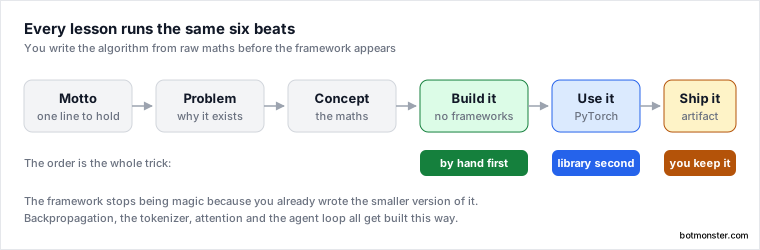
The teaching method is the reason to recommend this course anyway, because it flips the order most free AI material uses. Every lesson runs the same six beats: motto, problem, concept, build it, use it, ship it. You write the algorithm from raw maths with no frameworks, then run the same thing through PyTorch or scikit-learn .
The creator, Rohit Ghumare, argues that neither half works alone.
The Build It half on its own leaves you with toy code that does not scale. The Use It half on its own leaves you with a library call you cannot debug.
That order pays off most on backpropagation, the tokenizer, attention, and the agent loop . Those are the parts people use without understanding them. Here you build each one by hand before the library shows up.
The map of what feeds what is written down, which is rare for a free course. Maths feeds machine learning basics, which feed deep learning, which branches into vision, speech, language, and reinforcement learning. Language leads into transformers, and transformers sit under everything modern. The advice attached to it is sound: skip ahead if you know the lower layers, and expect the top to break in ways you can’t explain if you skipped a layer you needed.
Two agent skills ship with the repo to make skipping deliberate. Running /find-your-level gives a ten-question quiz that maps what you know to a starting phase and builds a path with hour estimates. Running /check-understanding <phase> gives an eight-question quiz with feedback and the lessons to review. Both work in any assistant that reads a SKILL.md file.
Who should actually work through this
More than a thousand hours is not something to wave people into, so the useful advice is about which slices to take.
| If you are | Take | Roughly |
|---|---|---|
| Early career, with real time, aiming at AI engineering jobs | The whole thing | 1,095 hours |
| Solid on maths and ML, want the modern working core | Phases 10 to 14 | 175 hours |
| A working developer who needs to build agents and MCP servers | Phases 13 and 14 | 67 hours |
| Building a portfolio rather than taking a course | Phase 19 only | 620 hours |
| After a fast practical result this month | Something else | 0 hours |
Writing the parts from scratch is the skill an API caller never picks up, so the full run makes sense only if you have years to give it. Phases 10 to 14 cover language models from scratch, LLM engineering, tools and protocols, and agent engineering. That slice is about a sixth of the total, and it’s where current work happens.
The 17 capstone projects at 25 to 40 hours each would spread across a year or two of evenings. Treat that phase as a portfolio backlog and pick the three that fit the jobs you want.
Build-from-scratch is the wrong shape for a deadline, and a focused tutorial will serve you better. There’s also a free open-source agent book with ten chapters and 93 side projects, and that one takes a weekend. For a shorter LLM-specific path, one repo packs 11 free chapters with notebooks , all in Chinese and with no license attached.
Whatever slice you pick, budget from the roadmap rather than the badge. Add the stated hours for your phases, then divide by the hours per week you will honestly give it. Because every lesson ships an artifact, stopping at phase 14 still leaves you holding prompts, skills, agents, and MCP servers you built yourself.