 Botmonster Tech
Can Inkling 2 Mini replace Qwen 27B for local coding?
This post is open for corrections. Highlight any line of text to challenge it or ask for a clearer explanation and leave a comment.
Inkling 2 Mini can replace Qwen3.8-27B for local coding only if you value speed over finished edits. It beats Qwen on most published coding benchmarks and writes around 200 tokens per second on two RTX 3090s. Yet the first independent test of real coding work ranks it below Qwen, because there it read the code without editing a file.
Key Takeaways
- Inkling 2 Mini is a 26B model that uses only about 3B of itself per word.
- It edges out Qwen3.8-27B on most published coding benchmarks.
- It writes about 200 tokens a second on two older gaming GPUs.
- Early testers say it often reads your code and then forgets to change it.
- Use it for fast research and agent work, and keep Qwen for heavy editing.
What is Inkling 2 Mini?
Inkling 2 Mini is a small open-weights model from Thinking Machines, which means anyone can download it, and it’s released under the Apache 2.0 license. It’s a Mixture-of-Experts model: its 26.4B parameters are split into many small groups called experts, and only a few of them run for each token (roughly one word). Each layer sends a token to 8 of its 128 experts, so only 3.4B parameters work on any one token, close to the active size of Alibaba’s Qwen3.6-35B-A3B.
You’ll also see 5.4B quoted as the active count. That figure counts the extra passes: each repeat through the middle layers adds about 1B of weight reads per token.
The model stores 24 layers in four blocks of six and loops the middle ones. The first and last blocks run once, while the two middle blocks run three times, so each token passes through 48 layer steps.
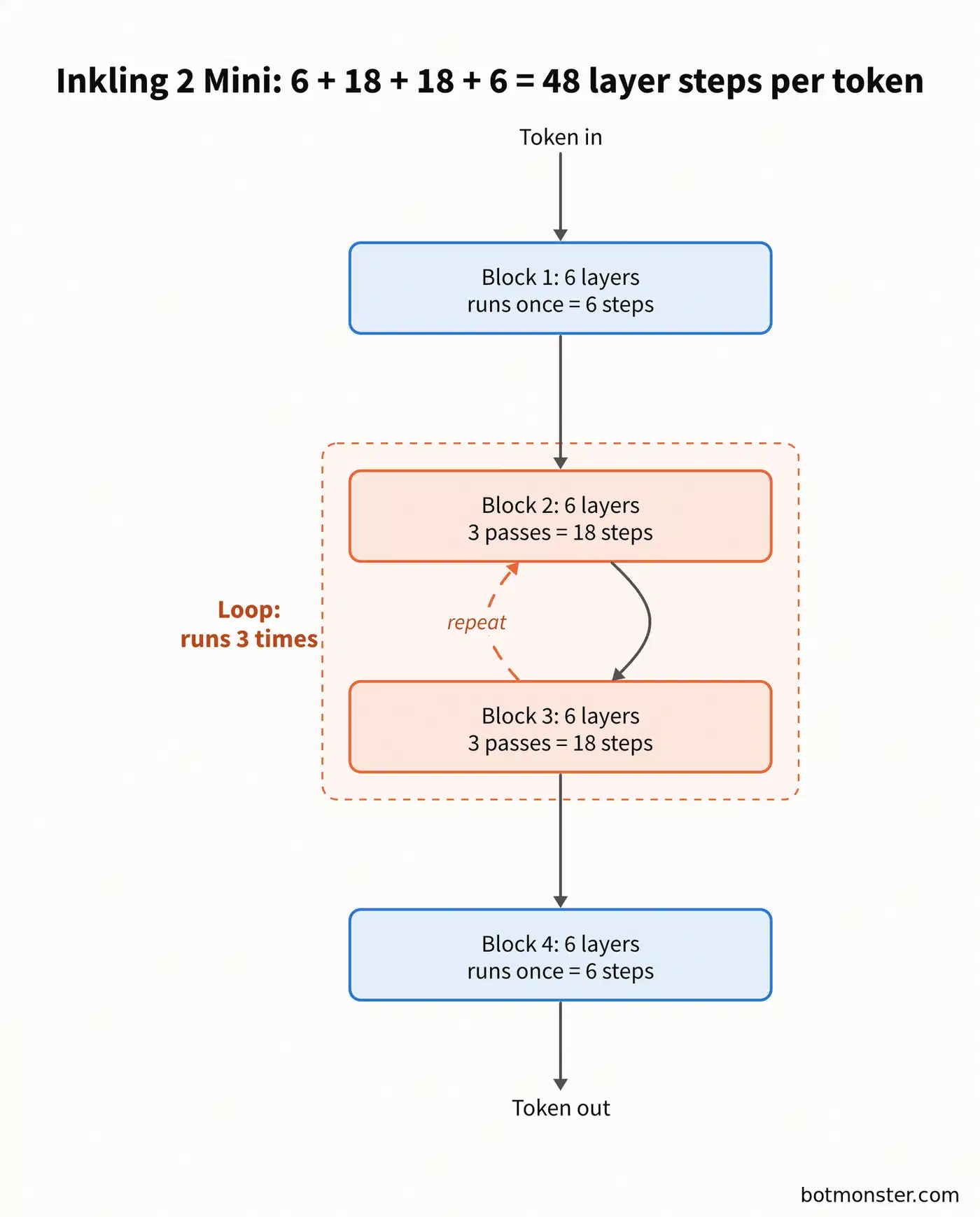
The extra passes add reasoning depth. Factual recall still tracks total parameter count, so Inkling knows about as much as any other 26B model. Z.ai scaled the same trick up to 750B in GLM-5.4, though that looped flagship isn’t downloadable yet.
The model was also cut down on purpose. It began training with 384 experts per layer, then lost two-thirds of them midway through. A 1T-token distillation run from a larger Inkling model healed the damage, and reinforcement learning over 2.2T tokens followed. Most weights were trained and ship in 4-bit NVFP4, with the last four layers in 8-bit MXFP8, so there’s no conversion loss. The full model takes about 20 GB and has a context window of up to 1M tokens.
A Thinking Machines engineer tied the looped design straight to coding:
This model is looped, which allows more depth at the same parameter count, which we particularly notice seems helpful for coding tasks.
Inkling 2 Mini vs Qwen3.8-27B on coding benchmarks
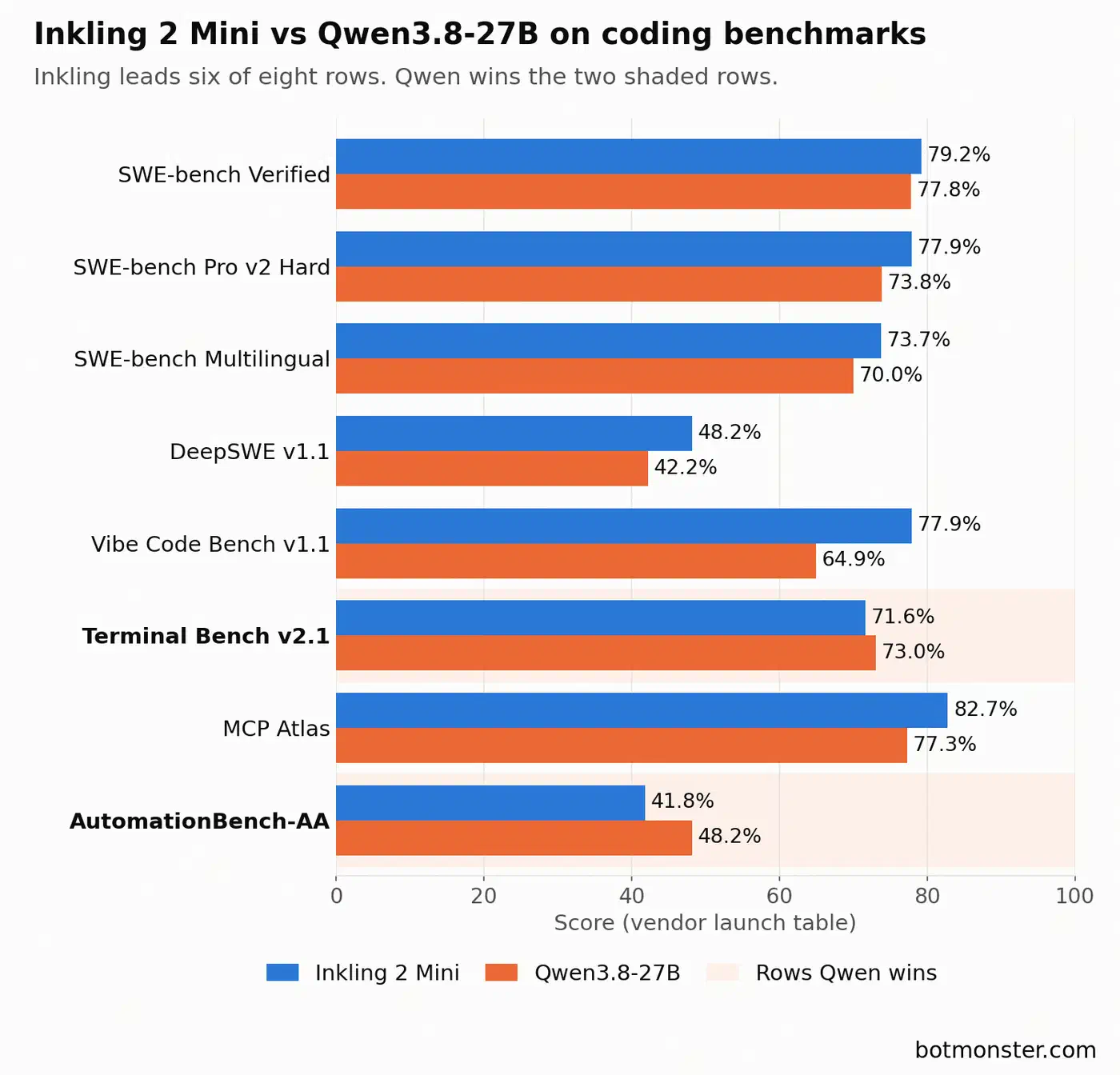
Every score below comes from Thinking Machines’ own launch table. Because the company that makes Inkling published these scores, treat them as vendor claims until independent tests confirm them. Both models also compete in the wider field of open-weight coding models.
| Benchmark | Inkling 2 Mini | Qwen3.8-27B |
|---|---|---|
| SWE-bench Verified | 79.2% | 77.8% |
| SWE-bench Pro v2 Hard | 77.9% | 73.8% |
| SWE-bench Multilingual | 73.7% | 70.0% |
| DeepSWE v1.1 | 48.2% | 42.2% |
| Vibe Code Bench v1.1 | 77.9% | 64.9% |
| Terminal Bench v2.1 | 71.6% | 73.0% |
| MCP Atlas | 82.7% | 77.3% |
| AutomationBench-AA | 41.8% | 48.2% |
Inkling loses the two rows that look most like driving a shell and automating a workflow.
Qwen also wins outside this table. It beats Inkling on multi-turn chat, where Inkling scores 50.0% on MultiChallenge, and on instructions with many constraints, where Inkling scores 33.4% on ComplexConstraints. It leads on EnterpriseOps-Gym as well. Those weak spots are important for coding agents, because an agent session is one long multi-turn chat full of rules about files, tests and style.
Some readers call the matchup unfair, since a model with 3B active parameters faces a dense 27B one. However, local users choose by memory budget and job. At 4-bit, both models fit on one 24 GB card, so they compete for the same slot.
A Vals AI result had Inkling 2 Mini tying Opus 5.5 on CyberBench. Smaller models such as Haiku and Mimo Flash beat Opus on that test too. Frontier models refuse many security tasks and score zero on them, so the tie says little about coding skill.
What hardware does Inkling 2 Mini need?
In the mostly 4-bit format it ships in, Inkling 2 Mini needs about 20 GB of memory. Thinking Machines targets any Mac with 32 GB of memory or more through the Ollama app, and NVIDIA’s DGX Spark can run those NVFP4 weights without converting them. Older NVIDIA cards are harder, because the standard release of vLLM, a popular program for serving models, doesn’t support Inkling on Ampere GPUs such as the RTX 3090.
The speeds below come from single users tuning their own machines, so expect your numbers to differ.
| Setup | Runtime | Decode |
|---|---|---|
| 2x RTX 3090 | Patched vLLM | 183-328 tok/s |
| 2x RTX 3090 | llama.cpp | 50 tok/s |
| RTX 5090 | Basalt NVFP4 | 613 tok/s |
| Ryzen AI Max 395 | llama.cpp Vulkan | 27 tok/s |
The fastest older-hardware result is a patched vLLM build for two RTX 3090s joined by an NVLink bridge. It runs a draft model and serves a 196K window by default. A cold 120K-token prompt reaches its first token in 20.5 seconds.
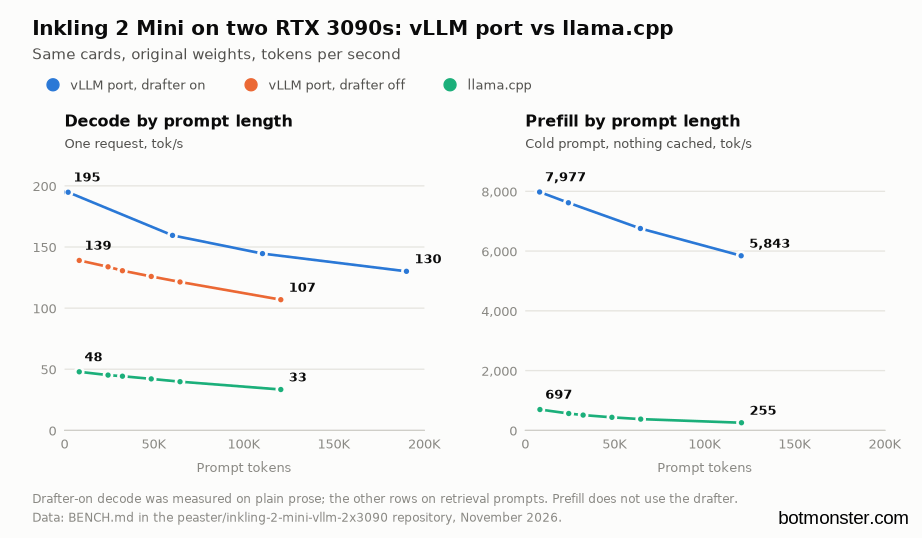
The RTX 5090 run also reached 14,100 tokens per second prefill. The Ryzen AI Max 395 result needed several unmerged llama.cpp patches.
Quality looks usable on small machines too. On an M4 Pro Mac mini with 64 GB, Inkling scored a B on a 43-question data analytics exam. That’s the same grade as DeepSeek V4.1 Flash and Sonnet 5, although the model fell into an occasional runaway loop.
Inkling 2 Mini GGUF builds
Unsloth publishes GGUF builds, smaller compressed copies of the model in the file format that llama.cpp and Ollama load, in the same dynamic format it uses for Llama 4 Scout on 24 GB cards. The last column measures accuracy: how often each build picks the same most likely next token as the 8-bit reference build.
| Quant | Size | Top-token match |
|---|---|---|
| UD-IQ1_S | 7.8 GB | 89.4% |
| UD-IQ3_XXS | 11.7 GB | 94.7% |
| UD-Q4_K_M | 16.6 GB | 97.9% |
| UD-Q8_K_XL | 22.9 GB | Reference |
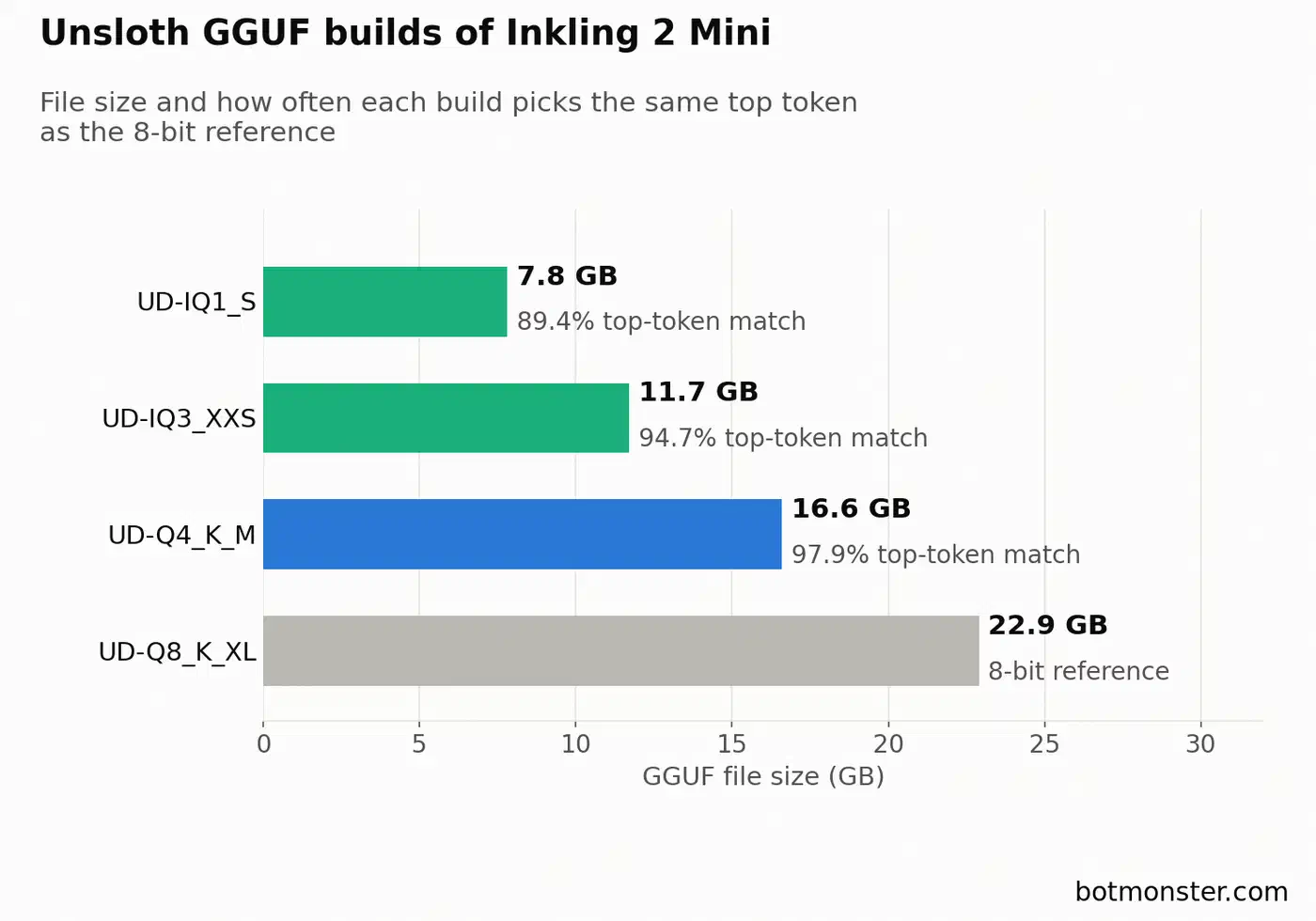
The 4-bit build is the sensible default for a 24 GB card or a 32 GB Mac:
ollama run hf.co/unsloth/Inkling-2-Mini-GGUF:UD-Q4_K_MFull looped-model support in llama.cpp is still an open pull request, so GGUF speeds should climb as kernels land. A community quant also goes as low as 5.4 GB for very tight machines, and the expert offloading used to fit Gemma 4 26B into 8 GB is the other route.
Why Inkling 2 Mini reads your code and then stops
The first independent agentic coding test, in which the model works through coding tasks on its own, ranks Inkling below Qwen3.8-27B. The test was shared on r/LocalLLaMA, Reddit’s local-model forum. Inkling ranked lower because it read files and reasoned through the tasks without editing any of the files.
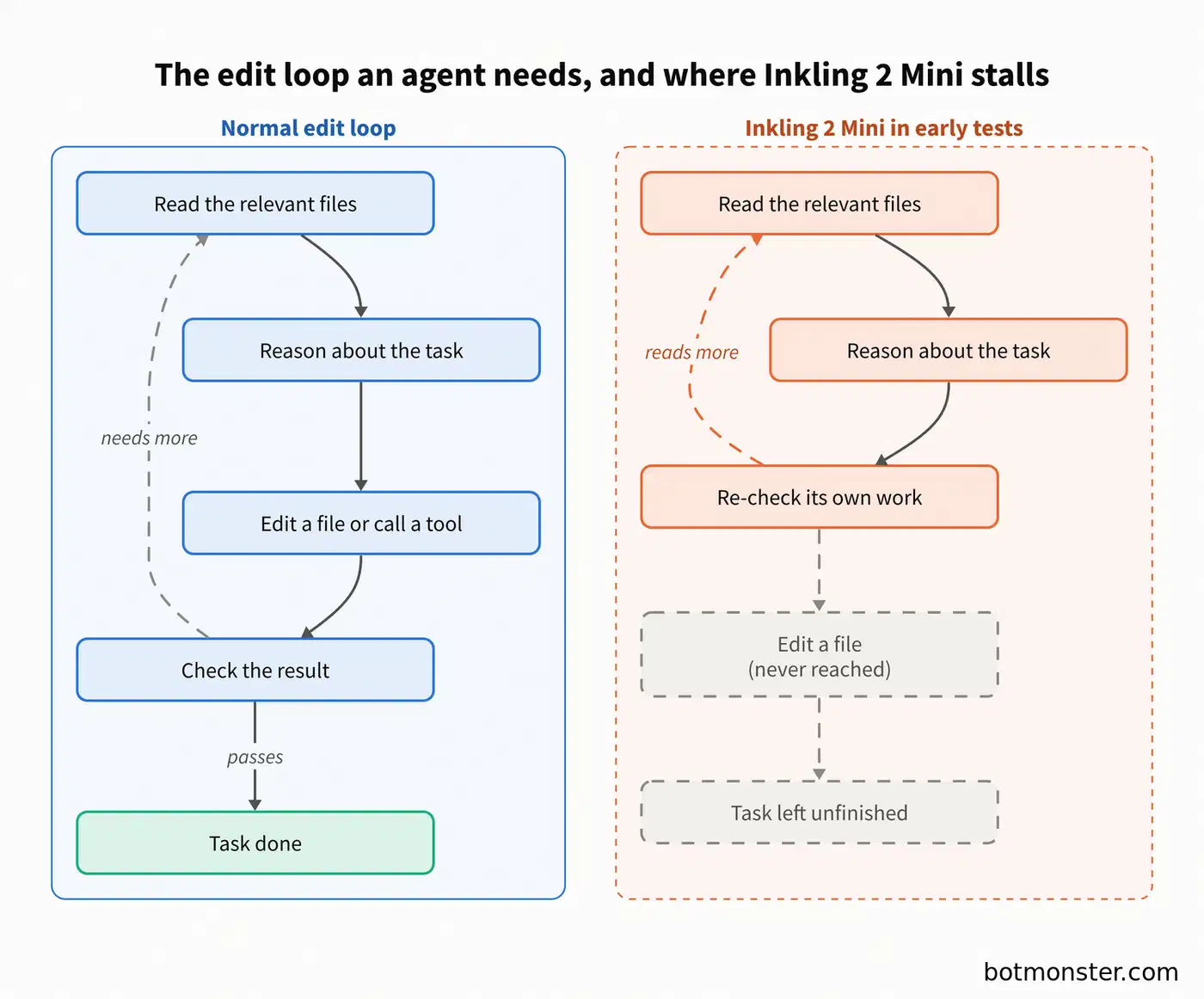
The bug-fix runs went worse: when told the cause of a bug outright, about half of Inkling’s responses suspected a trick and never applied the fix. Qwen applied the same fix three times out of four. Inkling also finished last of eight systems on translation.
Other users see the same habit:
YES, I have observed it reading and reading and reading with a little thinking, without doing the thing I told it to do. It seems to be more happy to learn about stuff than do the tasks given to it.
Thinking Machines knew about the weakness before launch. In its internal testing, the model sometimes got stuck in long reasoning loops or kept re-checking its own work, mostly while debugging code. With tools, it’s also less reliable than larger models at following detailed instructions and project conventions.
Three causes look likely, though none is proven:
- Young templates: chat templates and tool-call parsers for a days-old model are still changing, so some failures may be setup bugs.
- Weak multi-turn skills: the low MultiChallenge and ComplexConstraints scores match an agent that loses track of its orders.
- Loop habits: a model built to think longer per token may also prefer to keep thinking instead of acting.
You can push back on the habit today:
- Cap the run: always set
max_tokensand limit agent turns, as Thinking Machines recommends. - Pick the right effort: the model struggles at very high reasoning effort, and
highworks best for coding agents on the 3090 build. - Demand edits: write a system prompt that requires a file change or tool call at every step.
- Stay current: pull the newest GGUF and chat template, and use a harness that forces tool calls.
Verdict on Inkling 2 Mini for local coding
| Job | Pick |
|---|---|
| Fast agent research | Inkling 2 Mini |
| Long context, one GPU | Inkling 2 Mini |
| Agentic file edits | Qwen3.8-27B |
| Translation | Gemma 4 31B |
| Laptop or 32 GB Mac | Inkling 2 Mini |
Qwen3.8-27B finishes its edits when it works through a task on its own, so it’s the default for agentic coding. Test Inkling again once the open pull request for looped-model support merges into llama.cpp and the chat templates stop changing, because some of Inkling’s failures may be setup bugs.