 Botmonster Tech
Humanizer borrows Wikipedia's list of AI writing tells
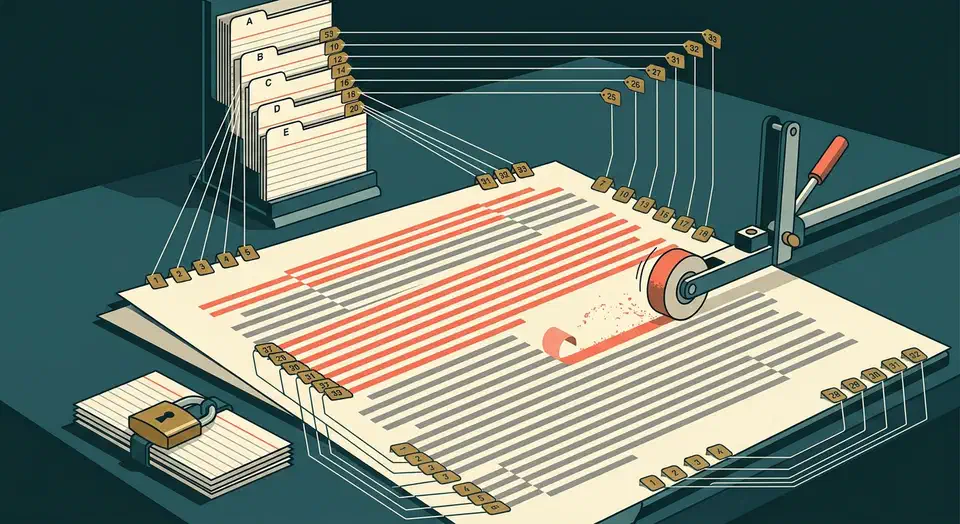
Humanizer is an agent skill that can remove AI writing patterns from a draft you already wrote. Its 33 named tells come from Wikipedia’s field guide to AI text, built by volunteers who clean up thousands of real cases. A no-fabrication rule stops the rewrite from inventing facts, so a thin draft comes back thin.
Key Takeaways
- Humanizer rewrites 33 habits that make writing read as machine-made.
- The list comes from Wikipedia editors who clean up AI text daily.
- It never adds a fact, name, or date that wasn’t there.
- The whole skill is one Markdown file, so almost any AI tool runs it.
- It only fixes sentences and won’t add substance to a weak draft.
How to remove AI writing patterns without inventing facts
The rule that makes Humanizer usable on real work is short. A rewrite must never add a fact, name, number, date, or citation that the source text didn’t already have. The skill’s instructions call a fabrication a defect even when the invented version sounds more human.
That constraint carries most of the weight. Vague AI prose gets repaired by adding specifics, and a model with no source will happily supply them.
The rule arrived late, after a user caught the project breaking it. In issue #187, 1avishek found the skill’s own showcase example inventing detail. It added a travel month, a neighbourhood, and a café that appeared nowhere in the source.
This can make a polished rewrite factually unreliable. Humanizing should preserve the supplied facts and keep unsupported claims general instead of inventing specific details.
The fix shipped in version 2.9.0. Every example that modelled invented detail got re-cut to use source facts only. So specificity now has to come from you or from your text. The skill can delete a vague claim, but it can’t fill the hole that claim was covering.
The practical effect is that your draft gets shorter and flatter. A padded paragraph shrinks down to whatever it actually said.
A second pass backs the rule up. After the first rewrite, the skill interrogates its own output. It asks what still reads as obviously AI generated, and whether the rewrite has stated any fact the source did not. Then it revises again. One rewrite tends to swap one set of tells for another, so the audit exists to catch the survivors.
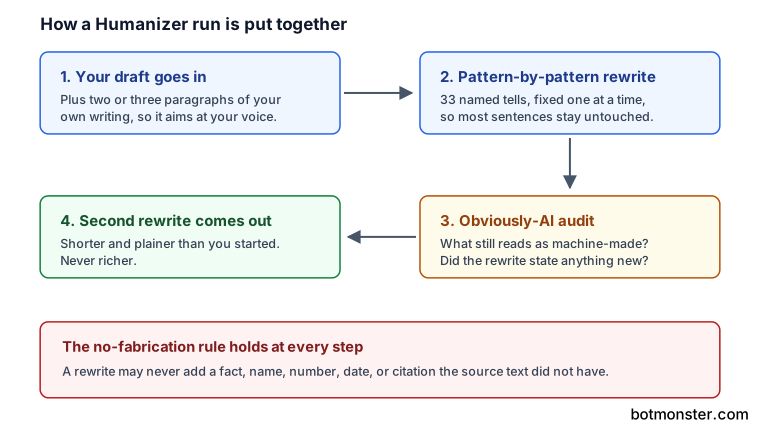
Voice calibration is the other half of the design. Feed it two or three paragraphs of your own writing. It then aims at the gap between your habits and the model’s. Without a sample, the output drifts toward one neutral register. A supplied sample even outranks the skill’s own em dash ban. If you use them, it keeps them at roughly your rate.
The skill stops well short of editing, though. It won’t restructure your argument or check a claim against reality.
The 33 tells, grouped
The pattern list is the substance here, and you can use it whether or not you install anything.
| Group | Tells | Something it flags |
|---|---|---|
| Content | 6 | “marking a pivotal moment in the evolution of” |
| Language | 7 | “it’s not just X, it’s Y” |
| Style | 14 | Title Case headings, heavy bolding, em dashes |
| Communication | 3 | “I hope this helps! Let me know if…” |
| Filler and hedging | 3 | “could potentially possibly” |
Style is the biggest group by a wide margin, and most of it targets formatting habits. Em and en dashes are a hard cut. So are emojis, curly quotes, bolded lead-in labels, and headings that repeat the sentence underneath them.
Content tells are the ones that inflate. Significance inflation puffs up a plain fact into a turning point. Notability name-dropping lists four outlets that cited someone without saying what any of them said. Vague attributions hand a claim to unnamed experts.
Language tells sit at sentence level. Copula avoidance replaces “is” and “has” with “serves as” and “boasts”, and synonym cycling swaps in “central figure” or “the hero” when “protagonist” was already fine. Negative parallelism manufactures a contrast that was never there.
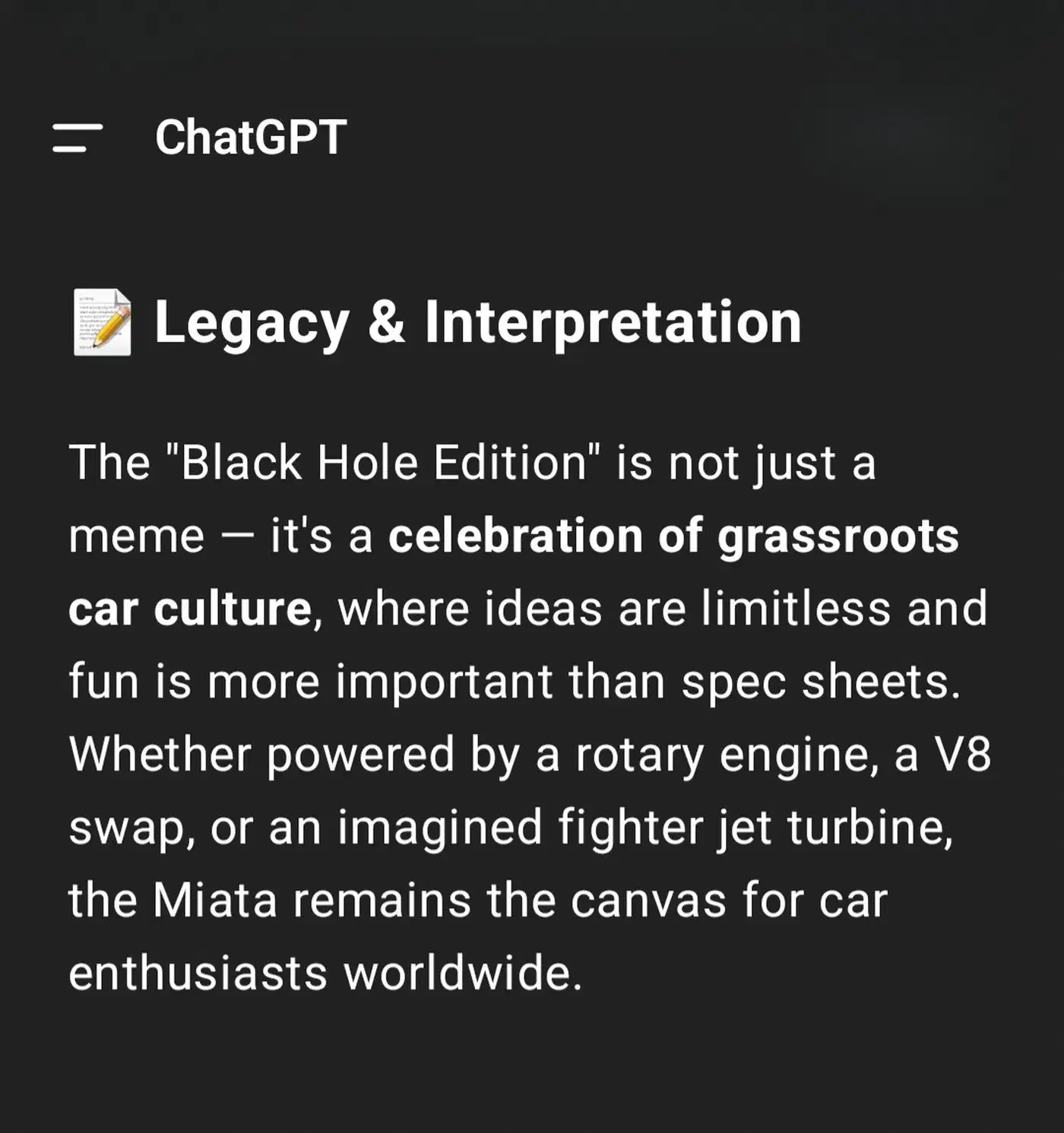
The communication group catches the assistant register leaking into published text. Chatbot closers, sycophancy, and disclaimers about limited available sources all sit here. Filler and hedging covers the qualifiers that soften a claim until nothing has been said.
The source of all this is Wikipedia’s “Signs of AI writing”, a page maintained by WikiProject AI Cleanup . It runs past 200,000 bytes and is edited constantly by people who read suspect text professionally. Its own account of where the tells come from is short.
LLMs use statistical algorithms to guess what should come next. The result tends toward the most statistically likely result that applies to the widest variety of cases.
A model aims at the average of everything. The tells are what the average looks like when you read it.
Install Humanizer and run it on a draft
Install it across your agents
Run npx skills add blader/humanizer --global to install it once for every project. Add --agent '*' to reach every supported agent harness in one go. Drop --global for a project-local copy you can commit next to a repository, so collaborators inherit the same rewrite rules.
Or install it as a Claude Code plugin
Run /plugin marketplace add blader/humanizer, then /plugin install humanizer@humanizer. It then answers to /humanizer:humanizer.
Or install it by hand
The runtime artefact is a single SKILL.md. Clone the repository into whatever directory your harness reads skills from, or copy that one file into an existing skill folder. Then restart the session.
Calibrate it to your voice
Paste two or three paragraphs of your own writing before you ask for anything. The skill reads your sentence lengths, word choices, and quirks first, so the rewrite chases your habits instead of a generic clean tone.
Run it on a draft
Ask the agent to humanize the text, or point it at a file and it rewrites that file in place. It works through the patterns one at a time, so most of your sentences survive untouched.
Read the second pass
In pasted-text mode you get the draft, a short list of what still reads as machine-made, and the final rewrite. Read the middle part. It tells you which of your habits survived the first round.
Check what it changed
Diff the result against your original. Revert anything where the fix cost you a meaning you wanted, especially in technical passages.
One Markdown file, any agent
The whole runtime is plain Markdown with no code to execute. That’s why it spreads: any harness that reads skill-style instructions can load it, including Claude Code, Codex, and Cursor. The repository is labelled Python on GitHub, but the only Python in it is a script that validates the package.
The same plain format is why some tools write skills rather than ship them. book-to-skill compiles a PDF into one, so your agent reads a book a chapter at a time.
You can also read the entire thing before you trust it, because there is no compiled code to hide behind. The repository is MIT licensed. It also ships through skills.sh for cross-agent installs.
Results depend on the model behind your agent, since the skill is a prompt and nothing more. The same 33 patterns produce noticeably weaker rewrites on a small local model than on a frontier one.
Where it overcorrects
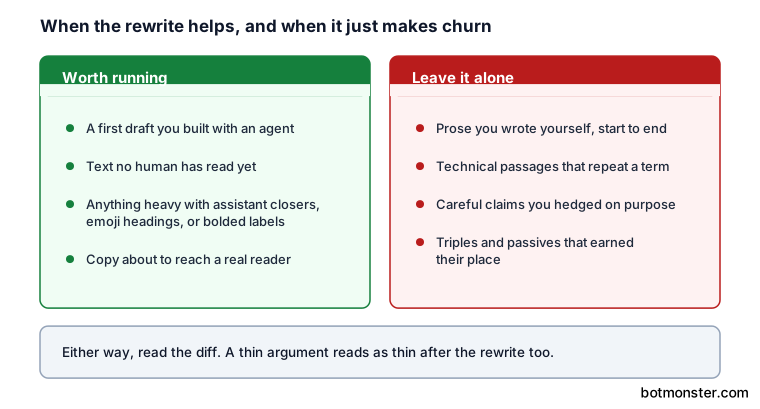
A rewrite tool with strong opinions will damage some text. The rule of three, for one, is a real rhetorical device with a long history behind it. Strip every triple and you flatten sentences that earned their rhythm. Passive voice has the same problem. Sometimes the actor really is unknown or beside the point, and forcing a subject in reads as clumsy.
Cutting hedges is the riskiest fix. A careful claim turned blunt is an overstatement, which is worse than sounding like a model. Technical writing also repeats a term on purpose, so treat the vocabulary fixes with suspicion in anything precise.
Running it on already-human text mostly produces churn, which is why the diff step is not optional.
The bigger limit sits above the sentence. Detectors that read plot instead of prose still flagged professionally de-slopped fiction 93.9% of the time. No word swap changes the shape of a story.
Wikipedia carries a warning on the very page the skill is built from.
Please do not merely treat these signs as the problems to be fixed; that could just make detection harder.
Wikipedia calls its own page descriptive, a set of observations about how AI text reads. It also says outright that human editorials and blogs carry many of the same habits.
Take a first draft you built with an agent or one of the AI drafting tools , run Humanizer over it, read the diff, and hand the result to a human. For anything you wrote yourself, you can usually skip it.