LogoBotmonster Tech
AI Smart Home Self-Hosting Coding Web Dev Hardware Bootpag Image2SVG Tags

Langgraph

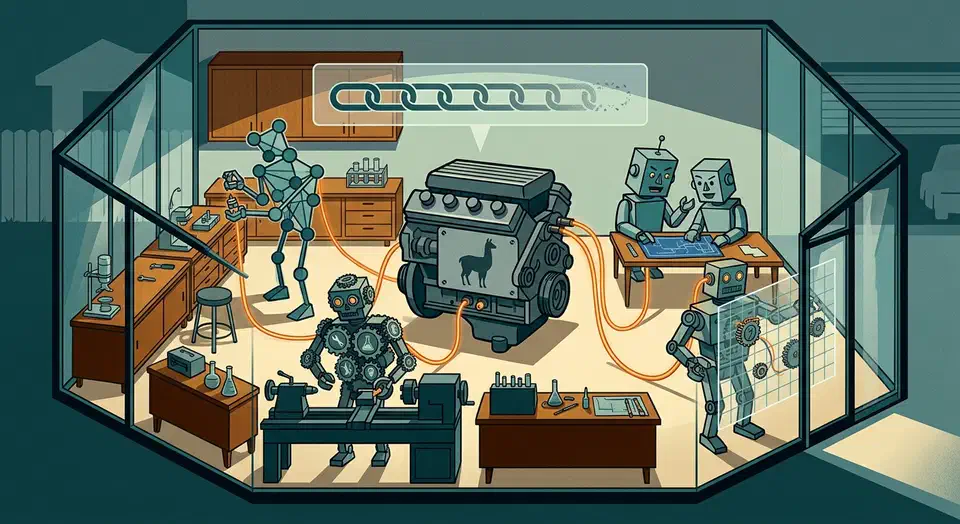
Four distinct robots in a sealed glass workshop, each cabled to one central llama-stamped engine, with an eight-link reliability gauge fading at the end.

Self-Hosted AI Agent Frameworks in 2026: Local-First Compared

A self-hosted AI agent needs to run entirely on your own Ollama or vLLM with no OpenAI key. All four major frameworks claim that support, but only LangGraph and CrewAI wire to a local model with zero workarounds. AutoGen needs a client swap, and Flowise needs one base-URL field. The model, not the framework, is the real reliability ceiling.

Key Takeaways

  • All four run on Ollama, but only LangGraph and CrewAI need zero workarounds.
  • The small local model, not the framework, is what breaks tool calling.
  • Flowise is the only true no-code pick; LangGraph is the most code-heavy.
  • Most framework docs still assume an OpenAI key, so budget setup time.
  • Use Qwen3 or larger for agents; smaller models drop tool calls under load.

Why Local-First Fitness Is the Axis That Counts

Most “best agent framework” roundups assume you have an OpenAI key and a credit card. The first code sample spins up a hosted client, and the “swap to local” path is a footnote if it shows up at all. Self-hosters ask a sharper question about whether any of these run on their own box with no cloud call.


Agentic RAG with LangGraph: 25% Better Accuracy, Fewer Calls

Agentic RAG with LangGraph: 25% Better Accuracy, Fewer Calls

Agentic RAG replaces the standard “retrieve-then-generate” pattern. The LLM gets tool-use powers to decide when to retrieve, which sources to query, how to rewrite queries, and whether the result is enough. Instead of fetching docs on every query, the model acts as an orchestrator. It runs targeted searches across vector stores, SQL databases, and web sources, then checks its own answers. This pattern lifts answer accuracy by 15-25% on multi-hop benchmarks and cuts wasted retrieval calls by about 35%.

Building Multi-Step AI Agents with LangGraph

Building Multi-Step AI Agents with LangGraph

AI agents built on LangGraph run as stateful graphs, not linear prompts. The graph can loop, branch on tool output, retry after a failure, and save its progress. That structure is what lets one agent handle long, multi-step tasks reliably.

Key Takeaways

  • LangGraph models an agent as a stateful graph, so it can loop, retry, and recover.
  • The state schema you design up front decides how stable the agent turns out.
  • Built-in checkpointing lets an agent crash, pause for approval, and resume without lost work.
  • Conditional edges turn failures into retries instead of dead ends.
  • One agent task can fire dozens of LLM calls, so plan for cost before you deploy.

Prerequisites

You should know Python 3.11+ and the LangChain basics: LLMs, tools, prompts. The code below uses these versions:

Most Popular

Gemma 4 vs Qwen 3.5 vs Llama 4: Which Open Model Should You Actually Use? (2026)

Gemma 4 vs Qwen 3.5 vs Llama 4: Which Open Model Should You Actually Use? (2026)

Gemma 4, Qwen 3.5, and Llama 4 compared on benchmarks, licensing, speed, and hardware so you can pick the right open model fast.

5 Open Source Repos That Make Claude Code Unstoppable

5 Open Source Repos That Make Claude Code Unstoppable

Five March 2026 repos extend Claude Code with autonomous ML, self-healing skills, GUI automation, multi-agent coordination, and Google Workspace access.

Cross-section of a translucent crystal brain threaded by red, gold, and teal attention ribbons resting on a doubly-stochastic matrix pedestal beside a guitar-tuning lab figure.

DeepSeek V4 Tech Report: 3 Tricks That Cut Compute 73%

DeepSeek V4 ships 1.6T parameters and 1M context using only 27% of V3.2's inference FLOPs. Inside the hybrid attention, mHC residuals, and Muon optimizer.

Cracked stone tablet engraved with a bulleted system prompt, four crossed-out goblin silhouettes repeated, a tiny goblin escaping with upvote-arrow sparks, a giant dollar-sign price tag, and figures refusing to step onto a glossier pedestal.

GPT 5.5 Reddit Reception: Goblins and the Cost Backlash

GPT-5.5 Reddit reception: viral goblin prompt leak, doubled pricing backlash, and 5.4 holdouts citing hallucination regressions in factual recall workflows.

What X and Reddit Users Are Saying about Claude Opus 4.7

What X and Reddit Users Are Saying about Claude Opus 4.7

How power users on X and Reddit reacted to Claude Opus 4.7: praise for agentic coding, token burn concerns, and teams' practical prompting habits.

Qwen3.6-35B-A3B: Alibaba's Open-Weight Coding MoE

Qwen3.6-35B-A3B: Alibaba's Open-Weight Coding MoE

Alibaba's sparse Mixture-of-Experts: 35B total parameters, 3B active per token. Q4 quantization runs on MacBook Pro M5, matches Claude Sonnet performance.

Alacritty vs. Kitty: Best High-Performance Linux Terminal

Alacritty vs. Kitty: Best High-Performance Linux Terminal

Alacritty vs Kitty in 2026: emoji and Unicode rendering, real benchmarks, latency, memory, maintainer reputation, and the right terminal for your workflow.

Like what you read?

Get new posts on Linux, AI, and self-hosting delivered to your inbox weekly.

Privacy Policy  ·  Terms of Service
2026 Botmonster