 Botmonster Tech
Awesome Claude Skills has 1,001 unmerged pull requests

The Awesome Claude Skills list is the best-known directory of agent skills, and its numbers don’t survive a count. The README promises 1000+ skills and links 164. Its pull request queue holds 1,001 open submissions against 38 ever merged, and the oldest has been waiting since December 2025.
Key Takeaways
- The list says 1000+ skills but links only 164 of them.
- Most linked entries point back into the maintainer’s own repository.
- All 78 of its app automation links are broken and return 404.
- 1,001 pull requests sit open, against 38 ever merged.
- The explainer at the top of the list is worth reading on its own.
What is on the Awesome Claude Skills list
The Awesome Claude Skills list is one long README kept by Composio . It sorts entries into ten categories covering document processing, code tools, security, productivity, and app automation.

The top of the list holds the skills most people already have. Anthropic’s docx, pdf, pptx, and xlsx entries open the document processing section. Development and code tools is the biggest community section at 32 entries, and it is the part most likely to show you something new.
The best thing in the repository sits above the list: an explainer that separates three ideas most coverage blurs together. MCP defines how an agent connects to outside systems. Tools are the functions an agent calls. Skills define the workflow once those connections and tools exist.
The explainer gets the loading model right too. At session start the agent reads only each skill’s name and description, about 100 tokens each. The full body loads later, and only if the agent decides the skill applies. That progressive loading is what lets one agent carry hundreds of skills without flooding its context window. Your source files deserve the same treatment, which is what a code graph served over MCP does for a repository.
The repository itself went up in October 2025. It shows an Apache 2.0 badge with no licence file behind it, so GitHub reports no licence at all.
The 1000+ number, counted
The README’s first line promises “1000+ production ready” Claude skills and plugins. The Skills section links 164 entries. Anyone can repeat that count by tallying the list items between the Skills heading and the next top-level heading.
Of those 164 entries, 101 point back into the maintainer’s own repository. Seventy-eight sit in one app automation section that routes through Composio’s product. Another 23 are in-repo folders scattered across the other categories. Only 60 entries link to an outside GitHub repository, plus three that point at company websites. Fewer than four entries in ten send you anywhere the maintainer does not control.
There is a plausible innocent story behind the headline figure. The repository really does hold a folder called composio-skills, and that folder contains 832 app automation skills. The skills exist, but the list does not link to them. The same README also sells Composio’s platform as a gateway to 1,000+ app integrations, and that figure shows up seven times in the file.
Every one of those 78 app automation links is broken. Each points at a root path like ./close-automation/, while the real folders sit under composio-skills/ with different names, so all 78 return a 404. The other 23 in-repo links resolve fine.
Rot has reached the community half as well. Of the 60 external GitHub links, 7 return a 404. Two of the 36 repositories behind those links have been deleted outright, and 8 more have not been touched since 2025.
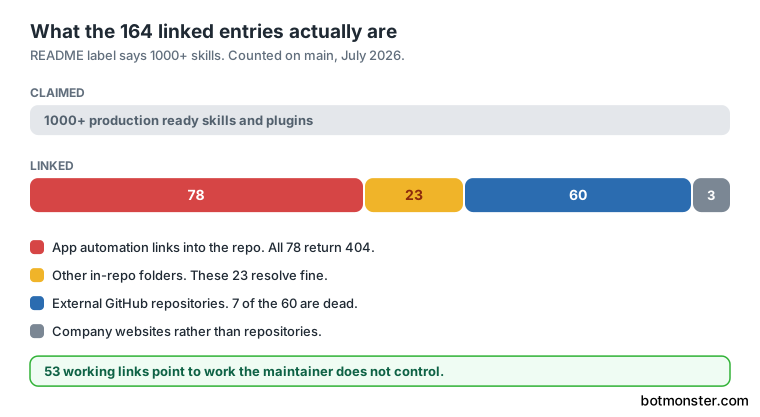
None of that makes the list dishonest. A vendor keeping a directory that features its own product is ordinary. The 832 folders are real work as well, each one carrying tool sequences, parameter guidance, and known pitfalls. The practical effect is just narrower than the label. Someone arriving for a thousand curated skills gets 53 working links to other people’s work. Good skills keep landing outside the list too, such as the one that strips AI writing patterns from a draft .
The pull request queue nobody is emptying
The queue holds 1,001 open pull requests against 38 ever merged, alongside 125 open issues.
The oldest is pull request 13 , opened on 13 December 2025 to add a Reveal.js presentation skill. It is still open. The most recent merges all cluster on 22 May 2026, and nothing has landed in the two months since.
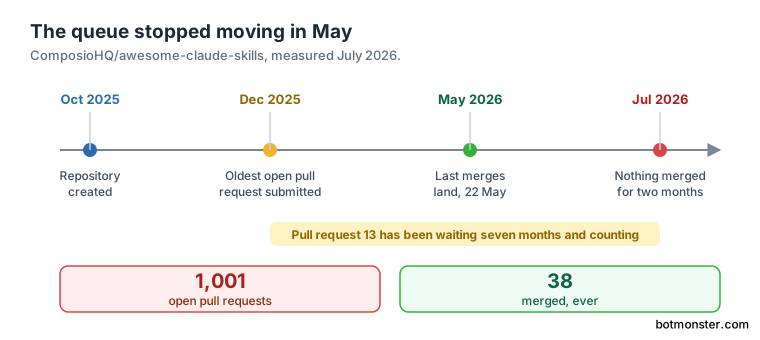
Behind that number are a thousand people who read “PRs welcome”, did the work, opened a pull request, and heard nothing back. The cost lands entirely on contributors, and none of it shows on the README.
The problem is bigger than one maintainer. Awesome lists were built for a time when curating took more effort than submitting. Skills flip that, because a skill is just a folder with a markdown file in it. An agent can write one in a minute, and a person can open the pull request in another. Submissions now arrive a hundred times faster than one reviewer can read them.
| List | Open pull requests | Merged |
|---|---|---|
| ComposioHQ/awesome-claude-skills | 1,001 | 38 |
| travisvn/awesome-claude-skills | 628 | 1 |
| hesreallyhim/awesome-claude-code | 0 | 214 |
The format can still work. One list runs an empty queue against 214 merges, so somebody is still doing the review.
Merging a thousand unreviewed links would make any list worse. A stalled queue is a communication failure, and the fix is a stated policy. A healthy version would publish a review cadence and a bar for inclusion, then close the submissions that miss it. An automated link check would catch the dead entries too.
A directory whose queue has not moved since May shows the field as it looked in spring, so check the dates yourself before you trust an entry.
Where to find agent skills instead
Go to the source for the official ones. Anthropic’s skills repository holds 17 skills, including the document, spreadsheet, and presentation ones. The Claude Cookbooks show how to call those same Excel, PowerPoint and PDF skills from code. The format itself is now an open standard with a published spec, so a skill written to that spec runs across several agents.
A GitHub code search works better than any directory for the rest. Query for SKILL.md files with the expected frontmatter and you turn up skills no list has indexed yet, including ones published this week. Whole field libraries surface that way too, such as a pack of 158 research skills
for biology and chemistry.
Commands like npx skills add <owner>/<repo> make a skill’s own repository its distribution channel, so you can browse a list for ideas and still install straight from the author.
Some of the most-used skills come from individual maintainers. They ship in their own repositories and announce them nowhere else, so following people pays off as much as following lists. A skill that generates 30 ideas and cuts 20 is the kind of thing you find that way, never through a directory.
Read before you install, every time. A skill is a set of instructions your agent will follow, which puts it closer to running a stranger’s script than to installing a linter. Check what the skill tells the agent to do and what scripts it bundles. Prefer small and readable over comprehensive. A skill you can read in five minutes is one you can audit, and auditing is the only safety net this format offers.
So use the list for its explainer and its development section. Treat the entry count as marketing. Then build your own short list of skills you have actually read.