 Botmonster Tech
DeepSeek V4-Pro runs 39x cheaper than Claude Opus 5

DeepSeek V4-Pro price and benchmarks put it about 39x cheaper per task than Claude Opus 5, at roughly $0.06 against Opus 5’s $2.34. It scores 53 on the Artificial Analysis Intelligence Index, about 10 points below Opus 5’s 63. So you trade one tier of raw intelligence for open weights and far lower cost.
Key Takeaways
- DeepSeek V4-Pro costs about $0.06 per task, versus $2.34 on Claude Opus 5.
- It scores 53 for intelligence, one tier below the Claude and GPT frontier.
- The weights are open, so teams can run it on their own hardware.
- Its base API rate is about $0.44 in and $0.87 out per million tokens.
- New peak and off-peak tiers can double the same call by time of day.
What does DeepSeek V4-Pro cost?
DeepSeek’s pricing page lists about $0.435 per million input tokens on a cache miss and $0.87 per million output tokens. When your prompt hits the cache, input drops roughly 120x cheaper, which rewards long system prompts and repeated context.
DeepSeek added peak and off-peak pricing, so the same call costs different amounts by time of day. As ghacks reported, off-peak sits near $0.66 in and $1.98 out, while peak roughly doubles that to $1.32 and $3.96 per million tokens. A workload pinned to peak hours can pay twice what the base sheet implies.
Independent trackers blend the number higher still. Artificial Analysis lists DeepSeek V4-Pro around $1.74 input and $3.48 output, likely because it weights the extra reasoning tokens the model spends before answering. The OpenRouter listing is another place to sanity-check the live rate. Whenever you quote a single price, name the tier it came from.
The context window is 1M tokens, with a max output of 384K, so a whole codebase fits in one call. The weights are also open, so a team can self-host and skip the API meter entirely.
How does DeepSeek V4-Pro score on benchmarks?
On the Artificial Analysis Intelligence Index, a composite of ten reasoning, coding, and knowledge tests, the 0813 GA build scores 53, the second-highest open-weights reasoning model at launch.
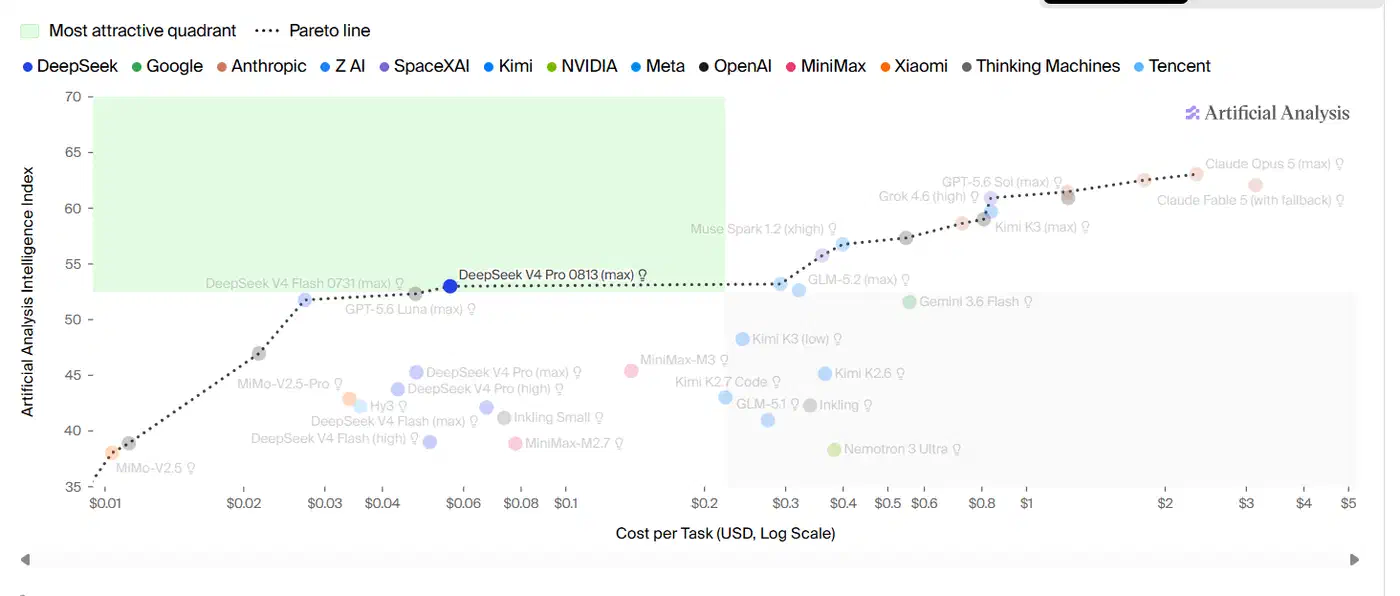
Independent testing puts GPQA Diamond at 93%, Terminal-Bench v2.1 at 79%, GDPval-AA v2 at 55%, and Humanity’s Last Exam at 39%, with output running about 79 tokens per second. As officechai noted, that 53 sits one point above the cheaper V4 Flash, a modest gain that the price story makes interesting.
Vendor numbers run hotter than the tests, so treat them with care. DeepSeek claims a Terminal-Bench 2.1 result of 87.9, well above the independent 79. Tech Times headlined that the GA benchmark claims still await outside proof. Some SEO blogs float even wilder figures, like SWE-bench swings between 80.6 and 96.4; those contradict themselves and are not worth trusting.
DeepSeek V4-Pro vs Claude Opus 5 and GPT-5.6 on cost per quality
| Model | Input $/M | Output $/M | Intelligence index | Cost per task |
|---|---|---|---|---|
| DeepSeek V4-Pro | 0.44 | 0.87 | 53 | ~$0.06 |
| Claude Opus 5 | 5 | 25 | 63 | ~$2.34 |
| GPT-5.6 Sol | 5 | 30 | 61 | - |
Artificial Analysis puts V4-Pro near $0.06 a task against Opus 5’s $2.34, about 39x cheaper for a 10-point intelligence gap. On output price alone, V4-Pro’s base rate undercuts Opus 5 by roughly 29x.
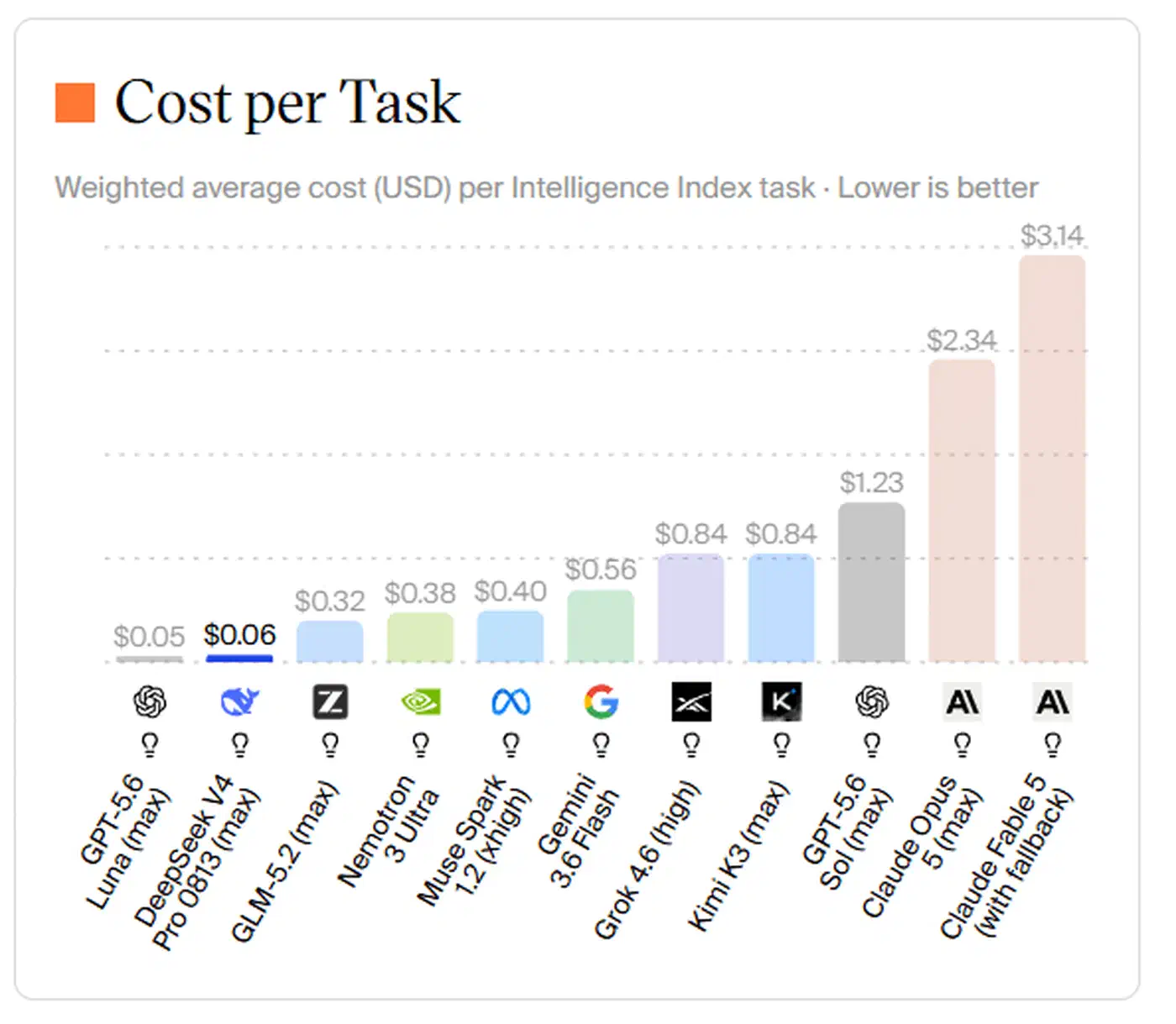
At scale the gap turns real. Say an agent generates 100 million output tokens a month. At base rates that runs about $87 on V4-Pro against roughly $2,500 on Opus 5. For high-volume, cost-sensitive work, that difference reshapes what you can afford to run.
Opus 5 still leads when you need the last few points of reasoning. When cost drives the decision, DeepSeek wins by a wide margin. A closed-weight rival plays a similar hand: Grok 4.6 undercuts Opus 5 by about 2.4x per task while landing just two points behind on intelligence. On the open-weight side, Qwen3.8-Max ties the previous Opus 4.8 on intelligence at $2/$6 per million tokens. When Anthropic shipped its next Opus, it cut pricing to $4 and $20, which narrows the DeepSeek gap without closing it.
What changed from DeepSeek V3 to V4-Pro?
This upgrade goes past a version bump. The architecture is a 1.6 trillion parameter mixture-of-experts model that activates about 49 billion parameters per token, so it runs faster than its total size suggests. The lighter V4 Flash sibling holds 284 billion total with 13 billion active.
At 1M tokens, V4-Pro carries 8x the window of V3.2’s 128K, enough to fit a full repository or a long agent trace in a single prompt.
Agentic work drove this release. DeepSeek tuned V4-Pro for tool use, code execution, and multi-step workflows, and it shipped the weights on Hugging Face under the MIT license. Alongside the model, qz covered the launch of DeepSeek Harness (dsh) v0.1, an open coding-agent tool aimed squarely at Claude Code.
Whether V4-Pro is multimodal or text-only is still contested across sources, and reviewers report a timeout rate on the hardest reasoning tasks, so long agentic loops are less predictable than the headline scores suggest.
When to skip DeepSeek V4-Pro
The cost case is strong, but it is not the right pick for every job. Reach for a frontier model instead when any of these hold.
- You need the highest raw intelligence. Claude Opus 5 at 63 and GPT-5.6 Sol at 61 sit 8 to 10 points above V4-Pro’s 53.
- You need one fixed price. Peak and off-peak tiers can make the same request cost up to 2x more at certain hours.
- You rely on long, stable agent loops. Reviewers report weaker long-loop stability and timeouts on the hardest tasks.
- You need vision or audio. The modality is contested, with some sources reporting text-only.
- You want day-one numbers you can trust. DeepSeek’s own benchmarks run well above independent tests and still await confirmation.