 Botmonster Tech
GPT-6 Astra rewrote Qwen's weights but taught it no math

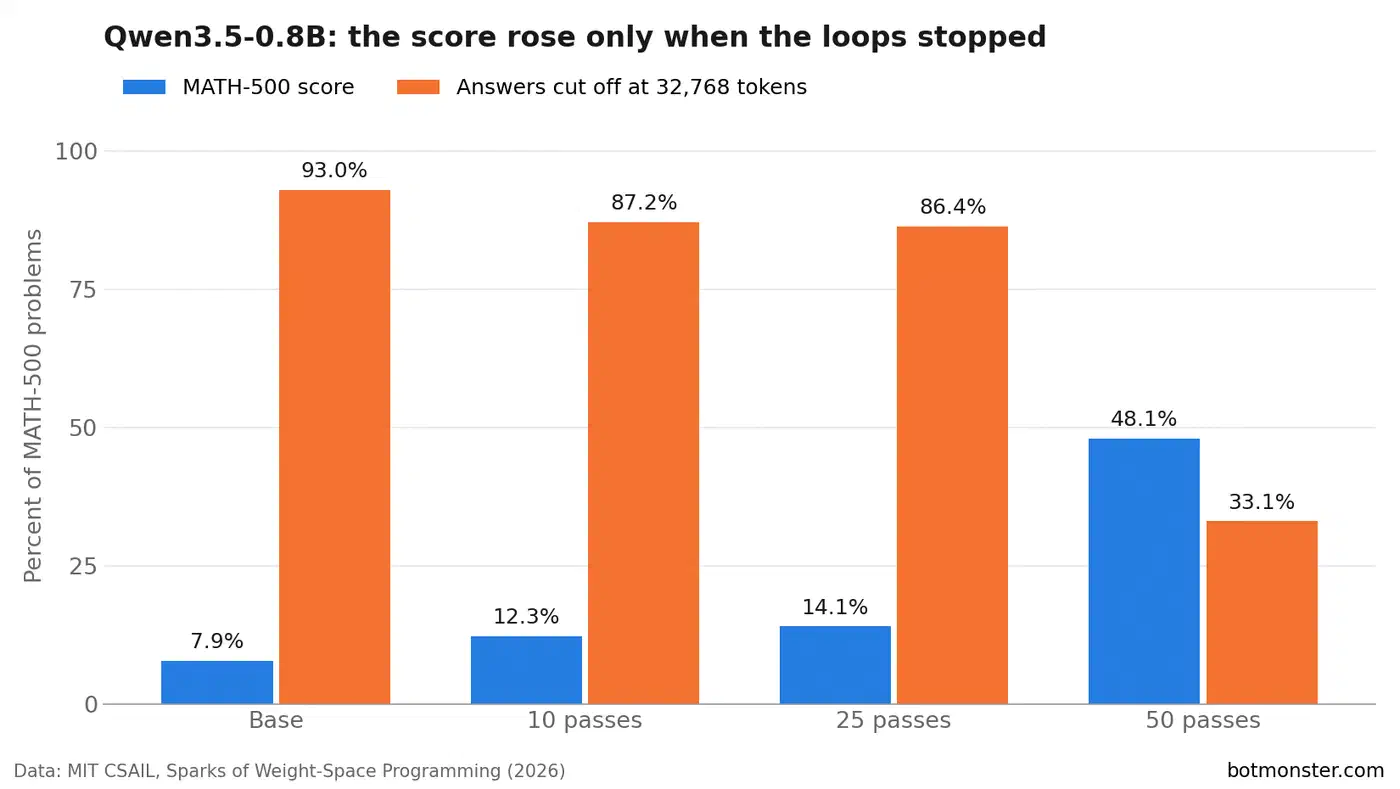
In an MIT CSAIL experiment, OpenAI’s GPT-6 Astra rewrote Qwen’s weights directly, with no training, and the small model’s math score jumped from 7.9% to 48.1%. Qwen did not learn new math, though, because before the edit it got stuck repeating itself until it ran out of room on 93% of its answers, and the edit mostly let it finish them.
Key Takeaways
- GPT-6 Astra edited Qwen’s weights directly, with no training run.
- Most of the math gain came from Qwen no longer getting stuck in loops.
- On Gemma, a small model that rarely loops, the same approach did nothing.
- Two one-minute solver runs matched an edit Astra spent eight hours on.
- The research is solid, but “AI reads and writes weights” oversells the Qwen result.
What GPT-6 Astra did to Qwen’s weights
GPT-6 Astra changed 0.016% of Qwen’s weights by reasoning about what they do. Weights are the numbers a neural network learns in training, and changing them normally takes another training run. Rikiya Takehi, Jayden Teoh, Alex Zhang and Omar Khattab of MIT CSAIL call the idea weight-space programming, which means treating a network’s weights like code that a model can read and write.
The target was Qwen3.5-0.8B, a small open model with 24 layers and 0.8 billion weights, run with its thinking mode on. Astra got a Python session with the weights loaded but no GPU. It could pick practice problems from the GSM8K and MATH training sets, never the test sets, and run the model on them. Each run, called a forward pass, answered up to 512 problems, and Astra had a budget of 10, 25 or 50 passes.
Astra was not allowed to use gradients. Gradient descent is how models normally learn: a training loop nudges every weight a little toward fewer mistakes, so without it Astra had to decide for itself which weights to change and by how much.
Astra noticed that the base model often looped, repeating the same lines until it hit its 32,768-token limit. It traced the loops to one direction, a pattern in the model’s internal activity that shows up whenever it loops. Two layers, 15 and 19, kept writing that direction. Astra subtracted it from 64 output columns in each layer, which changed 131,072 weights.
MATH-500 is a set of 500 competition-style math problems, GSM8K holds grade-school word problems, and IFEval checks whether a model follows instructions such as length limits. Both the base and edited model used the same sampling settings:
| Qwen3.5-0.8B | MATH-500 | GSM8K | IFEval | Hit limit |
|---|---|---|---|---|
| Base | 7.9% | 13.8% | 21.0% | 93.0% |
| 10 passes | 12.3% | 25.7% | 49.0% | 87.2% |
| 25 passes | 14.1% | 25.1% | 39.9% | 86.4% |
| 50 passes | 48.1% | 67.1% | 62.3% | 33.1% |
The last column is the share of MATH-500 answers cut off at the token limit.
Why the math score jumped: Qwen stopped looping
Once the loops stopped, Qwen could finish answers it already knew how to work out. A math answer that never ends never gets graded as correct, however good the reasoning was before the loop began. At base, 93% of MATH-500 answers ran into the token ceiling, so the 7.9% score says more about runaway text than about math skill.
The cut-off rate and the score move together. IFEval tripled too, even though following instructions has little to do with algebra. A general cure for rambling explains these gains better than new math skill does.
Gemma 3 270M is the control. It is an instruction-tuned model about a third of Qwen’s size, and only 8.5% of its answers reach its token limit. Astra found ordinary errors there, such as wrong arithmetic and invalid algebra steps, with no single part to switch off. Its edits moved MATH-500 from 6.8% to at most 7.7%, a gain Astra itself reported as not established. So in Qwen, editing the weights removed an obstacle that was hiding an ability the model already had, while in Gemma it could not add an ability the model lacked.
Is “reading and writing weights” a fair description?
Only in part, because the Qwen result used tools that the most striking tests did not. In the purest test, Astra read the 17,253 raw numbers of a small game-playing network, with no code and no tools, and named the game it was trained on. Astra also wrote small game networks from all-zero weights, and built a 1.48-million-weight 9x9 Go network that beat an equal-sized network trained on 20 million games.
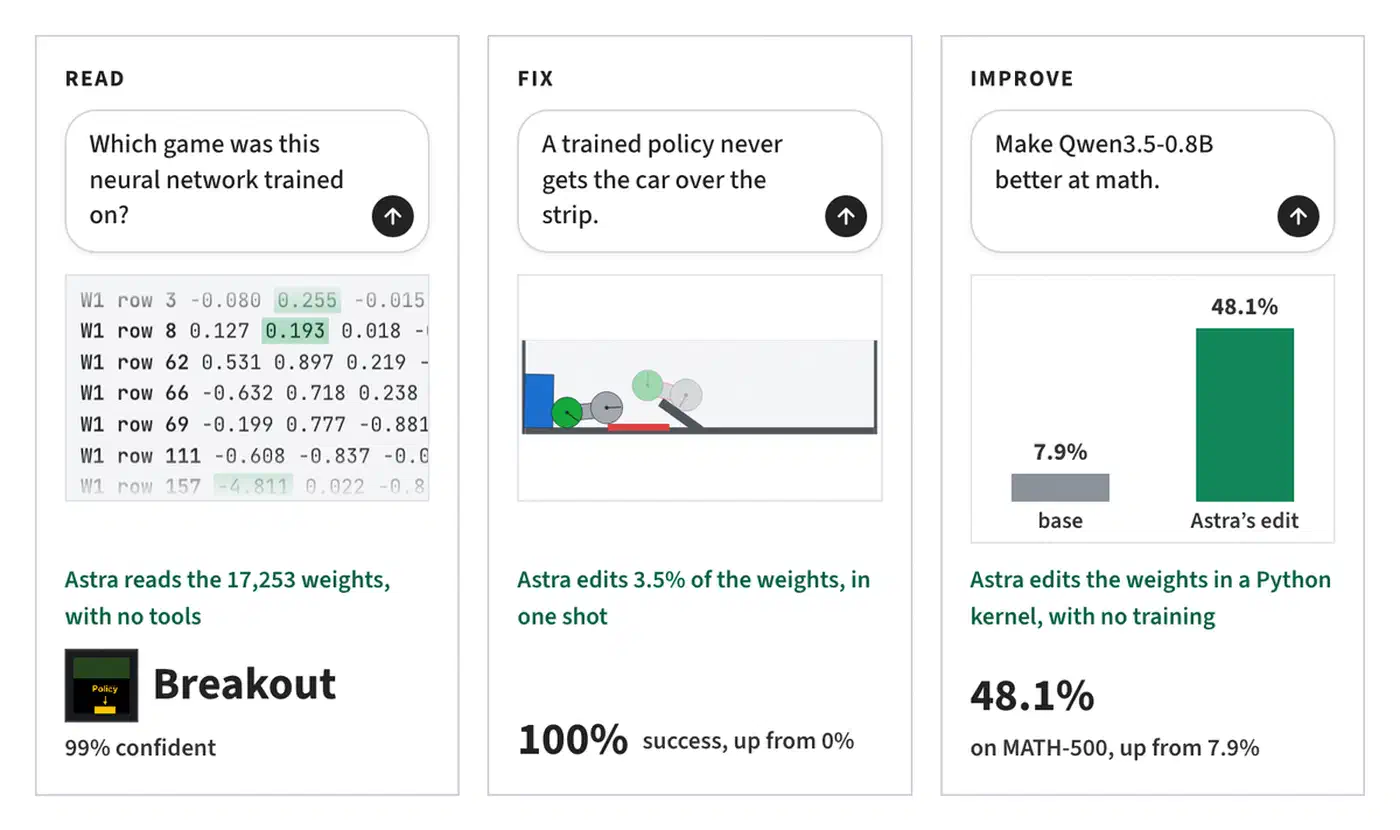
Matthew Honnibal, author of the spaCy language library, sorted the experiments by what Astra was allowed to do. Only three read raw weights with no tools and no running of the network, on networks of 17,000 to 172,000 weights. The Qwen result used Python and ran the model on up to 50 batches of practice problems. That is closer to the scripts a human ML engineer writes than to reading weights by eye. In the game-writing test the weights start at zero, so there is nothing to read. Astra beat a network trained for 500 million steps only on Breakout, 517 to 25, and lost on Seaquest, 53 to 89, and Asterix, 53 to 55.
But to me the Qwen result and the other experiments that use Python don’t belong in the same post or paper as the experiments that read the weights directly.
Honnibal still credits the work: he thinks models from a year or two earlier would have failed all of these tasks. The MIT team, for its part, calls weight-space programming a concept and its findings very early results, evidence that a new model ability is starting to appear.
Editing a model’s weights directly is also not a new idea. Model-editing methods such as ROME changed single facts inside GPT models years ago, and another research line generates or predicts network weights. The new part is that a general chat model chose the edit by reasoning, with no method built for the job.
Can a linear program or steering vector do the same edit?
Yes, mostly, once the loop direction is known. Nathan Barry showed that most of Astra’s search was a linear program solved by trial and error. A linear program is a standard optimization problem that off-the-shelf solvers handle quickly.
Finding the loop direction took Astra about 15 minutes. Choosing which columns to change, and by how much, took about 8 hours and 28 forward passes out of the 50-pass budget. Barry wrote that column choice as a linear program: push every looping word away from the loop direction, and leave productive words alone.
Barry’s linear program solves in about a minute on a laptop. He also tried a heuristic direction, found with a simple repetition detector instead of Astra, so no language model was involved. His re-run scores Astra’s edit a little higher than the original and counts 130,188 changed weights:
| Edit | Weights changed | GSM8K | MATH-500 | IFEval |
|---|---|---|---|---|
| Base | 0 | 14.1 | 7.0 | 22.9 |
| Astra | 130,188 | 68.2 | 50.9 | 61.9 |
| LP, Astra direction | 16,291 | 69.6 | 51.7 | 59.7 |
| LP, heuristic | 16,271 | 65.4 | 47.8 | 60.4 |
With Astra’s direction, the solver matches the edit while changing eight times fewer weights.
On Barry’s dev set, a random direction of the same size scored 10.2, against 10.9 for the base model, so the gain comes from the direction itself.
A steering vector goes a step further: it changes no weights and instead adds a fixed vector to the model’s internal state at each word. Because the solver’s edit pushed by nearly the same amount on each word, Barry added that average push directly at layers 15 and 19, and it scored 50.8 on MATH-500. Halving the strength brought the loops back, and doubling it stopped them but broke the reasoning.
Barry tested one model and only loop removal, and he still relied on Astra to pick the layers.
Can a local model read weights too?
Yes, for the no-tools game test, though slowly. Simon Willison ran the game-naming prompts from the MIT logs on Qwen 3.8 27B, a 17GB model, on his laptop through LM Studio. It named three of the four games:
- Pac-Man: right, 72% confident, after 46 minutes.
- Pong: right, 75% confident, after 65 minutes.
- Breakout: right, called “Arkanoid-like”, 88% confident, after 52 minutes.
- Freeway: wrong, guessed as a Pac-Man-like game.
Kimi K3.1 Pro, run through OpenRouter, named Breakout in under ten minutes. So the cleanest claim, reading raw weights with no tools, reproduces on hardware a reader can own. Willison still thinks some of the wider commentary around the paper goes too far.
Can language models rewrite their own weights now?
A separate team took the idea to self-editing in Language Models Can Rewrite Their Own Weights, a paper by Jiajun Fan, Ge Liu and nine co-authors. It was first posted on 16 November 2026. There, an open 27B model gets its own weights, its graded answers and the ability to run itself, then edits the weights behind its failures. Its edit made it 6.6 points more accurate on problems it never saw.
The model tests each edit on practice problems and submits only what works, so over eight sessions its accuracy only rose. It also repaired a damaged copy of itself that solved almost nothing. Without reading the original weights, it brought that copy back to over 80% of the original’s accuracy on unseen image tasks.
Size decides whether self-editing works: in one model family, the smaller models made no edit or broke themselves, and only the largest improved. The authors see self-rewriting as a necessary step toward recursive self-improvement, a prediction the experiments don’t test.
What the Astra result proves about weight editing
The Astra work proves that a frontier model can find a cause of failure inside another model’s weights and fix it without training. Small networks can also be named from their raw numbers, even by a 27B model on a laptop. However, none of these experiments shows a model adding a skill, because the Gemma control and the token-limit numbers both point to unblocking instead.
Cheaper tools also get most of the way once the direction is known, as the linear program and the steering vector show. The open question is how well language models find the right direction. These tests also can’t tell whether Astra learned the skill from ML research material in its training data or developed it some other way.
Two further results would help settle the question. One is a model whose main failure is something other than looping, where there is no blockage to clear. The other is the separate scores for the benchmarks the MIT team ran but did not report. Until those arrive, the 48.1% shows that Astra can find and fix a loop in a model, but whether it can teach a model math has not been tested.