 Botmonster Tech
Does the AIRI anime companion really play Minecraft?

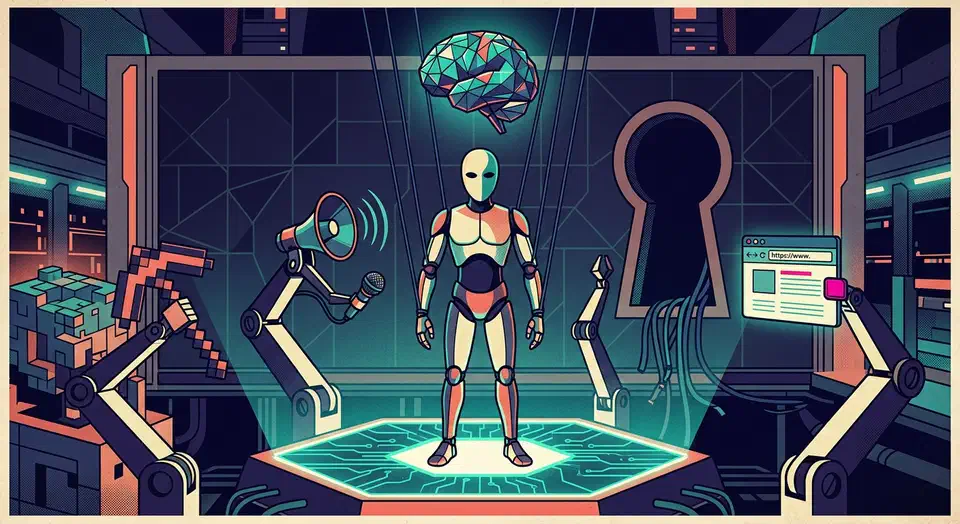
Yes, AIRI is a self hosted AI companion that joins a Minecraft server and plays alongside you. An animated anime body talks over the top. The project ticks Minecraft, Discord voice, and speech recognition as done. Long-term memory is still unticked, so it forgets you between sessions.
Key Takeaways
- AIRI gives an AI model a 3D anime body that blinks, looks around, and speaks.
- It really does play Minecraft, through a separate game-controlling agent.
- The whole thing runs in a browser, or as an app you install.
- You pick the model, so it can run locally or on a paid API.
- Memory is unfinished, so it does not remember you yet.
What a self hosted AI companion is, and where AIRI came from
The reference point is Neuro-sama , an AI streamer with a big audience. She plays games and banters with chat, and she is closed. AIRI is an open take on the same idea. You download it and run it yourself.
“Companion” here means four swappable parts: a body with a face, a voice, ears, and a model driving what it says.
The body is real 3D. Both VRM and Live2D models load, and you get auto blinking, look-at behaviour, and idle eye movement. The character keeps moving when nothing is happening.
The ears work through browser audio, Discord voice channels, and speech recognition in the client. A talking detector sits in front of that, so the character reacts to speech rather than to every noise in the room.
Speech output takes any voice provider. Point it at ElevenLabs, Microsoft Azure Speech, an OpenAI-compatible endpoint, Alibaba Cloud Model Studio, or a local Kokoro model. Model choice is just as open. Over thirty model providers are wired up, from Ollama and vLLM on your own hardware to OpenAI, Anthropic, DeepSeek, and Groq.
You can try the whole thing with nothing installed at airi.moeru.ai , which is the quickest way to see what it does.
The project has drawn a large following, and one widely shared post put the appeal plainly.
Someone just open sourced their own Neuro-sama. And it might be better than the original.
Yes, it plays Minecraft, through a separate bot
Minecraft is ticked as working. The character joins a server through Mineflayer , the library behind most Minecraft bots. The bot runs as its own service next to the character.
Inside that service sits a four-layer stack. Raw game events go in at the bottom, where a reflex layer handles fast reactions. Above it, a reasoning layer plans with one model and chats with another, and the top layer runs the plan. The planning model writes JavaScript, and the bot then runs it.
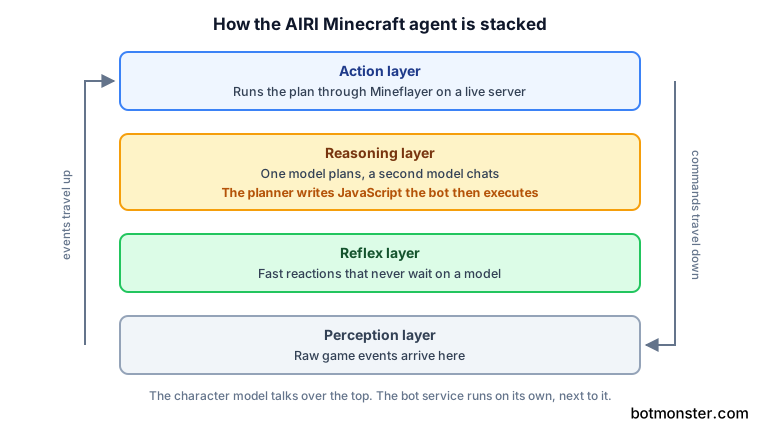
That last part comes with a warning from the maintainers. The generated scripts run in a sandbox. Still, they drive a real process that can reach your Minecraft session and your home network. Don’t point this bot at a public server you don’t trust. A throwaway box works better here, and a lightweight Minecraft server written in Rust will run one on a fraction of the memory Java wants.
Factorio works as a proof of concept. It is driven through a REST wrapper around the game’s own console, plus a mod-side automation library. Kerbal Space Program is listed as working, with the announcement still pending. Helldivers 2 co-play is in progress.
Every game follows the same pattern. One process holds the game connection, the character’s core tells it what to want, and each title gets its own agent in its own repository.
A bot plays the game while a character model talks over it, and no single agent learned to play anything. The result is still worth watching, and that is about all the streamer format it copies asks for.
One catch for anyone planning to build on this: the Mineflayer service is on a deprecation path. A Fabric mod runtime is meant to take over as the main Minecraft surface.
Running it in a browser, or on your own machine
The browser build carries most of the app. It leans on WebGPU, WebAudio, Web Workers, WebAssembly, and WebSockets. It installs on a phone as a web app. The database runs in the browser too, using DuckDB compiled to WebAssembly. That is how the character keeps state with no server behind it.
The desktop build is a real app. There are installers for Windows, for macOS on both Apple Silicon and Intel, and for Linux as deb, rpm, or flatpak. Windows users can install it through winget or Scoop. macOS users get a Homebrew cask. There is an Android APK too.
| Path | Runs on | Local model speed | Discord voice, Minecraft |
|---|---|---|---|
| Browser | Any WebGPU browser, phones included | Limited, in-browser inference unfinished | No |
| Desktop app | Windows, macOS, Linux | Native CUDA and Metal | Yes |
The desktop path reaches native NVIDIA CUDA and Apple Metal through Hugging Face’s candle library, so local model work is not stuck at browser speed. Anything needing a real network socket stays there as well, including Discord voice channels, Minecraft, and Factorio. The browser is left with the character, the voice, and the chat.
What is still missing
Memory is the gap. Browser storage works fine, but the memory system that would carry the character across days is still in progress. So the companion holds a conversation and then loses you.
Running the model inside the browser is also unticked, so the model still lives somewhere else, on your own machine or behind a paid API.
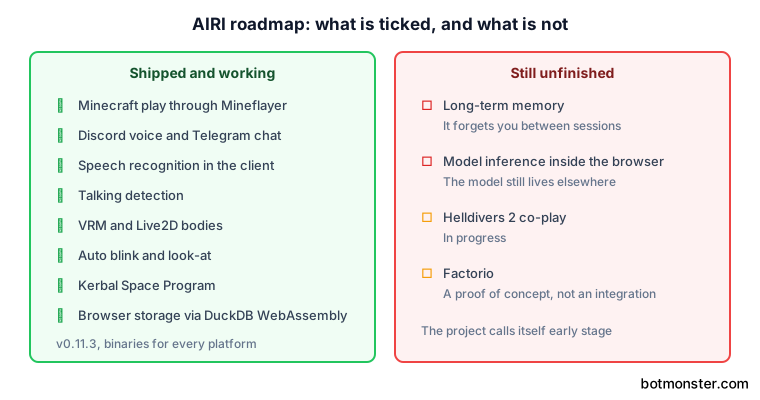
Version 0.11.3 shipped with a full set of platform binaries, and the public development logs run back to early 2025, which puts close to two years of work behind it. The tracker holds 93 open issues against 429 closed, so fixes are keeping ahead of reports.
The project calls itself early stage. It openly recruits artists, modellers, computer vision people, and speech contributors. That recruiting notice is a fair read on how finished it is. The self-hosted World Monitor news globe is just as blunt, calling itself a proof of concept in its own setup guide.
Who this is actually for
Streamers and hobbyists are the obvious audience. They get an on-screen character they own, instead of renting one from a service. Developers get one of the more ambitious WebGPU and WebAssembly apps in the open, worth reading for the browser tricks alone.
The speech parts ship as separate reusable projects, which helps anyone building voice interfaces. One is unspeech , a proxy that sits in front of any speech-to-text or text-to-speech endpoint.
It is not a work assistant. There is no calendar, email, or file access, and that omission is on purpose. It also won’t suit anyone who needs a companion that remembers last week. That waits on the memory work.
Anyone who already self-hosts knows the instinct: keep the thing on your own hardware, whether it holds a media library or a character.
The body, the voice, and the game-playing all work, and they are genuinely fun. The memory work that would turn the puppet into a companion is still being built.