 Botmonster Tech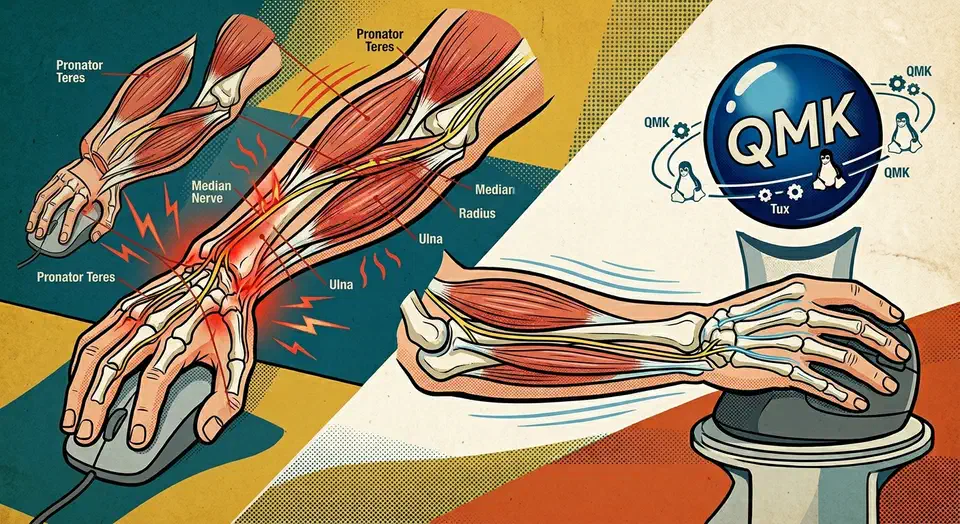
If you spend eight-plus hours a day in a terminal and an editor, the right pointing device counts as much as the right keyboard. The Logitech MX Vertical remains the default vertical pick. It has a 57-degree handshake angle, a 4000 DPI sensor, and solid Linux support via Solaar and logiops . For a thumb trackball, the Logitech MX Ergo S wins on tilt and 120-day battery life. The Kensington SlimBlade Pro leads the finger and palm trackball field with its 55mm billiard-grade ball and Bluetooth LE. For open-source fans, the Ploopy Classic 2 with QMK firmware ships as a fully user-fixable device. Linux sees it as a standard HID mouse with zero closed drivers.
Developer-Tools

Custom Mechanical Keyboards: Layout, Switches, Stabilizers, Build
Building a custom mechanical keyboard means assembling five core components: a PCB, a case, a plate, switches, and keycaps. The result is a board that types, sounds, and feels exactly the way you want. Budget $100 to $400 depending on materials, set aside three to six hours for a first build, and you’ll end up with a board no mass-produced model can match. This guide walks every decision from PCB choice to firmware flashing and final assembly.

AI Code Review in 2026: Why Human Review Skills Matter More Than Ever
AI writes about 41% of all committed code in 2026, and some teams report well above 50%. AI review tools have cut PR cycle times by as much as 59%. Yet when Sonar asked 1,149 developers for their 2026 State of Code report , 47% ranked “reviewing and validating AI-generated code for quality and security” the top skill in the AI era, above prompting at 42%. The paradox: the more code AI writes, the more vital human review becomes.
Zig 1.0 Tutorial: Build a Systems Programming Project Without C
Zig is a modern systems language built to replace C. It keeps manual memory management and zero hidden control flow: no garbage collector, no runtime, and one statically-linked binary that runs anywhere. Install Zig from ziglang.org/download
, scaffold a project with zig init, and you’ll have a working CLI tool in about 50 lines using comptime, error unions, and first-class C interop. The killer feature: zig build-exe -target x86_64-linux-musl cross-compiles to any target from any host with zero toolchain setup.
Best OLED Monitors for Coding 2026: WOLED Beats QD-OLED for Text
For coding in 2026, the LG UltraFine OLED 32GS95UE is the default pick: a 32-inch 4K WOLED panel at 140 PPI with five-year burn-in coverage and clean Linux support on Wayland under KDE Plasma 6.3 or later. WOLED beats QD-OLED on small monospace text, and 27-inch 1440p OLEDs should be avoided outright.
Key Takeaways
- The LG UltraFine OLED 32GS95UE is the default coder pick in 2026, with five-year burn-in coverage and clean Linux support.
- WOLED beats QD-OLED for small monospace text, and 140 PPI is the density where color fringing stops being visible.
- 27-inch 1440p OLEDs make code text look worse than a cheap IPS panel at the same price.
- KDE Plasma 6.3 on Wayland is the only mature Linux path for OLED HDR, brightness, and 10-bit color in early 2026.
- Use grayscale font antialiasing, dark themes, and auto-hidden system bars to keep burn-in risk near zero.
The Text Clarity Problem: WOLED vs QD-OLED Subpixel Layouts and Why They Matter for Code
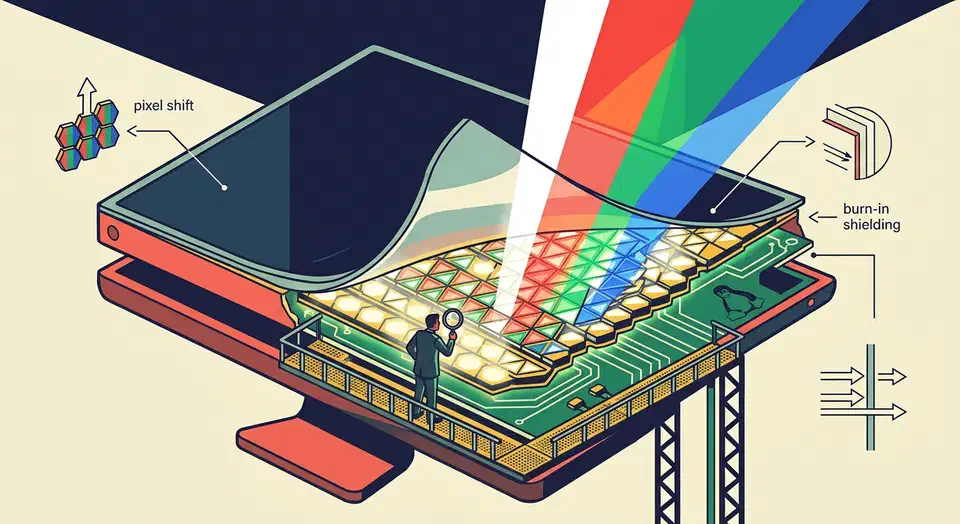
OLED panels do not use the standard horizontal RGB stripe that ClearType and freetype subpixel hinting were designed around. WOLED uses a WRGB quad (a white subpixel next to the three color subpixels), and QD-OLED uses a triangular RGB arrangement. Both produce visible color fringing on small black-on-white text unless you compensate with scaling, hinting tweaks, or raw pixel density. If your first few hours with a new OLED leave you thinking VS Code looks off, this is usually what your eyes are picking up.

Best Budget 4K Monitors for Linux Development in 2026
The best budget 4K monitors for Linux development in 2026 are the Dell S2722QC (around $330, USB-C with 65W power delivery, clean out-of-box scaling), the LG 27UL500-W (around $250, wide color gamut IPS with HDR10), and the ASUS ProArt PA279CRV (around $420, factory-calibrated with 96W USB-C PD). All three report correct EDID on major distributions, handle Wayland fractional scaling at 150% or 175% without driver workarounds on kernel 6.x, and deliver the pixel density you need for sharp text at 27 inches.