LogoBotmonster Tech
AI Smart Home Self-Hosting Coding Web Dev Hardware Bootpag Image2SVG Tags

Image-Generation

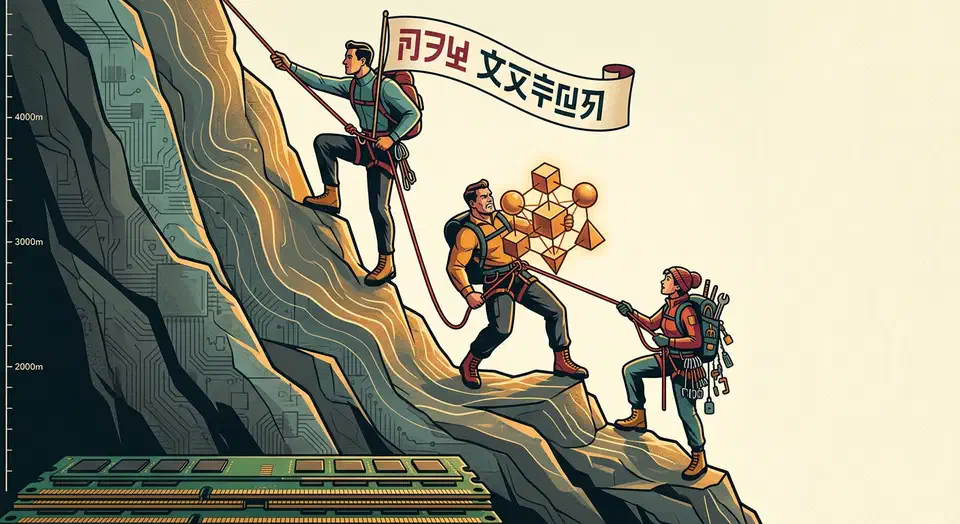
Three roped climbers ascend a cliff whose contour lines form a topographic curve over stacked memory chips at the base.

Local Image Models in 2026: Qwen vs FLUX vs SDXL on VRAM

No single local image model wins everything in 2026. After running one prompt set on a single 24 GB GPU, the picture is clear: Qwen-Image renders legible in-image text, FLUX leads prompt adherence, and SDXL keeps the deepest LoRA library on the lowest VRAM. The real frontier is quality-per-VRAM, not one champion.

Key Takeaways

  • No local model wins on everything; pick the one that fits your bottleneck.
  • Qwen-Image renders legible in-image text far better than its rivals.
  • FLUX.2 leads prompt adherence but is the heaviest on VRAM.
  • SDXL still has the biggest LoRA and ControlNet library by far.
  • Check the license: FLUX dev blocks selling output, Qwen and SDXL don’t.

How Do I Choose a Local Image Model in 2026?

Match the model to the one thing you can’t compromise on. That single rule beats chasing a mythical “best” pick, because each model sits in a different corner of the quality-per-VRAM map. The 2026 local field narrows to three serious families, and the rest are mostly noise.


RTX 5080 vs. RTX 5090: The Best GPU for Local AI Workloads in 2026

RTX 5080 vs. RTX 5090: The Best GPU for Local AI Workloads in 2026

For most local AI workloads in 2026, the RTX 5080 with 16 GB of GDDR7 is the better buy. It delivers 40-60 tokens per second on quantized 7B-13B parameter models at roughly half the price of the RTX 5090. The RTX 5090’s 32 GB of GDDR7 only justifies the premium if you regularly run 30B+ parameter models or full-precision fine-tuning jobs that cannot fit in 16 GB of VRAM. If either of those describes you, the 5090 earns its keep. If not, you are paying $1,000 extra for headroom you will not use.

Local AI Image Upscaling: Real-ESRGAN vs. Topaz vs. SUPIR

Local AI Image Upscaling: Real-ESRGAN vs. Topaz vs. SUPIR

For local AI image upscaling in 2026, Real-ESRGAN is the best free pick. It is fast and solid for most jobs. Topaz Photo AI gives the best overall quality with smart noise reduction and face recovery, but costs $199/year. SUPIR (Scaling Up to Excellence) makes the most detailed and lifelike output on badly degraded images. It needs 12+ GB of VRAM and runs 10-50x slower than the rest. The right pick depends on your workload: Real-ESRGAN for batch jobs and pipelines, Topaz for pro photo work, and SUPIR for one-off hero shots where time is not a factor.

ControlNet for Stable Diffusion: Sketch-to-Image, Depth Control

ControlNet for Stable Diffusion: Sketch-to-Image, Depth Control

ControlNet lets you steer Stable Diffusion with spatial inputs: hand-drawn sketches, Canny edge maps, depth images, or OpenPose skeletons. The output then follows your layout, not your prompt alone. You feed a control image next to your text prompt. The model builds artwork that matches the structure of your input. It then fills in texture, lighting, and detail from the prompt. You get pixel-level control that no prompt tweak can match.

SDXL 2.0 LoRA: 50-300 MB Adapters on 12 GB VRAM

SDXL 2.0 LoRA: 50-300 MB Adapters on 12 GB VRAM

The best way to fine-tune Stable Diffusion XL 2.0 is with Low-Rank Adaptation (LoRA) : a small adapter that injects your style or subject without touching the base weights. Instead of retraining the full model, LoRA trains a tiny side network next to the frozen base. The result is a 50 to 300 MB file you can load, swap, and stack at inference, trained on a 12 GB GPU in an afternoon.

Most Popular

Gemma 4 vs Qwen 3.5 vs Llama 4: Which Open Model Should You Actually Use? (2026)

Gemma 4 vs Qwen 3.5 vs Llama 4: Which Open Model Should You Actually Use? (2026)

Gemma 4, Qwen 3.5, and Llama 4 compared on benchmarks, licensing, speed, and hardware so you can pick the right open model fast.

5 Open Source Repos That Make Claude Code Unstoppable

5 Open Source Repos That Make Claude Code Unstoppable

Five March 2026 repos extend Claude Code with autonomous ML, self-healing skills, GUI automation, multi-agent coordination, and Google Workspace access.

Cross-section of a translucent crystal brain threaded by red, gold, and teal attention ribbons resting on a doubly-stochastic matrix pedestal beside a guitar-tuning lab figure.

DeepSeek V4 Tech Report: 3 Tricks That Cut Compute 73%

DeepSeek V4 ships 1.6T parameters and 1M context using only 27% of V3.2's inference FLOPs. Inside the hybrid attention, mHC residuals, and Muon optimizer.

Cracked stone tablet engraved with a bulleted system prompt, four crossed-out goblin silhouettes repeated, a tiny goblin escaping with upvote-arrow sparks, a giant dollar-sign price tag, and figures refusing to step onto a glossier pedestal.

GPT 5.5 Reddit Reception: Goblins and the Cost Backlash

GPT-5.5 Reddit reception: viral goblin prompt leak, doubled pricing backlash, and 5.4 holdouts citing hallucination regressions in factual recall workflows.

What X and Reddit Users Are Saying about Claude Opus 4.7

What X and Reddit Users Are Saying about Claude Opus 4.7

How power users on X and Reddit reacted to Claude Opus 4.7: praise for agentic coding, token burn concerns, and teams' practical prompting habits.

Qwen3.6-35B-A3B: Alibaba's Open-Weight Coding MoE

Qwen3.6-35B-A3B: Alibaba's Open-Weight Coding MoE

Alibaba's sparse Mixture-of-Experts: 35B total parameters, 3B active per token. Q4 quantization runs on MacBook Pro M5, matches Claude Sonnet performance.

Alacritty vs. Kitty: Best High-Performance Linux Terminal

Alacritty vs. Kitty: Best High-Performance Linux Terminal

Alacritty vs Kitty in 2026: emoji and Unicode rendering, real benchmarks, latency, memory, maintainer reputation, and the right terminal for your workflow.

Like what you read?

Get new posts on Linux, AI, and self-hosting delivered to your inbox weekly.

Privacy Policy  ·  Terms of Service
2026 Botmonster