 Botmonster Tech
TMR vs hall effect keyboards: which magnetic switch sensor is better?

TMR wins on paper and in ranked FPS tests. Tunnel Magnetoresistance sensors read key position to 0.01 mm. That is ten times finer than the 0.1 mm typical of Hall Effect boards, and it draws roughly 40x less power per sensor. In practice, you get tighter Rapid Trigger resets, less hysteresis, and wireless magnetic boards that finally last more than a weekend. If you play ranked shooters and want every edge, TMR is a real upgrade. If you type for a living or play single-player games, a good Hall Effect board is still plenty.
The magnetic keyboard market rode the Hall Effect wave through 2024 and 2025. Wooting , Keychron , and Gamakay all shipped tighter Rapid Trigger builds. By CES 2026, the talk shifted. Cherry XTRFY launched the first shipping TMR board. Akko ’s sub-brand MonsGeek showed off a 32K scan-rate TMR build, and Gamakay teased its own TMR model for Q2 2026. The sensor jump is real, and it landed faster than most fans expected.
How Hall Effect Keyboard Sensors Work (and Where They Fall Short)
The Hall Effect , found by Edwin Hall in 1879, makes a voltage across current flow when a conductor sits in a magnetic field. In a keyboard switch, a small neodymium magnet rides on the stem. A Hall sensor IC on the PCB reads how close the magnet is on each scan cycle, often at 4,000-8,000 Hz on gaming boards.
This design killed mechanical contact bounce. With no leaf contact to snap, a magnet-and-sensor switch is also quiet at the moment it registers, which is why Hall Effect designs feature in any roundup of the best silent keyboard switches. It also opened the door to set-your-own actuation points and Rapid Trigger. However, the Hall sensor has hard physical limits, and they show up fast once you push for sub-millimeter precision:
- Resolution tops out around 0.1 mm. Most Hall Effect boards from Wooting, Keychron, and Gamakay show about 40 steps across a 4.0 mm total travel. That is plenty for smooth Rapid Trigger at 0.2 mm reset distances. Still, firmware engineers must clamp the bottom 0.1-0.2 mm of travel to block phantom triggers from sensor noise.
- Hysteresis sits in the 0.05-0.15 mm range. The gap between the press-down and release sensing curves caps how tight you can set Rapid Trigger before double-taps creep in. Boards like the Wooting 80HE tame this with smart calibration, but cheaper Hall Effect models still trip up.
- Hall sensor output drifts with heat. Budget boards visibly re-tune after 20-30 minutes of warm-up. Tournament players sometimes report shaky actuation on long sessions.
- Power draw adds up. Every Hall IC on a 75-key board pulls standby current of about 4 mA per sensor. So most Hall Effect keyboards ship wired-only, or pair a wireless mode with so-so battery life. Running 75+ Hall sensors on battery drains a 4,000 mAh cell in about 120 hours with backlighting off.
None of these are deal-breakers for most users. The Wooting 80HE , Drunkdeer A75, and Keychron Q1 HE are all great keyboards. However, ranked players who want to set a 0.1 mm Rapid Trigger reset and trust it run into hard physics limits with Hall Effect.
How TMR Sensors Work - Tunnel Magnetoresistance Explained
A TMR sensor is built around a Magnetic Tunnel Junction (MTJ). It is two ferromagnetic layers split by a thin 1 nm barrier, often made of magnesium oxide (MgO). Electrons quantum-tunnel through that barrier. The junction’s resistance depends on how the two layers line up: low when parallel, high when anti-parallel.
Michel Julliere first saw the effect in 1975 with a modest 14% resistance shift. Modern MgO-based junctions clear 200% at room temperature, and researchers hit 604% in 2008 with CoFeB/MgO/CoFeB stacks. This big swing gives TMR sensors a signal-to-noise ratio roughly 10-40x higher than Hall sensors reading the same field.
None of this is exotic lab tech. TMR is the read head in every modern hard drive. It pushed out Giant Magnetoresistance (GMR) in the mid-2000s and drove the jump from gigabyte to terabyte drives. Everspin and Samsung ship MRAM (Magnetoresistive RAM) parts built on the same MTJ physics. The supply chain has run at scale for two decades, so TMR sensor dies cost pennies in keyboard volumes.
In a keyboard, a TMR die swaps in for the Hall IC under each key. The magnet on the stem stays the same. So existing magnetic switch housings from Gateron, Kailh, and TTC work with small PCB tweaks. The upshot: TMR sensors read magnet position to about 0.01 mm while drawing around 100 microamps per sensor, against 4 mA for Hall.
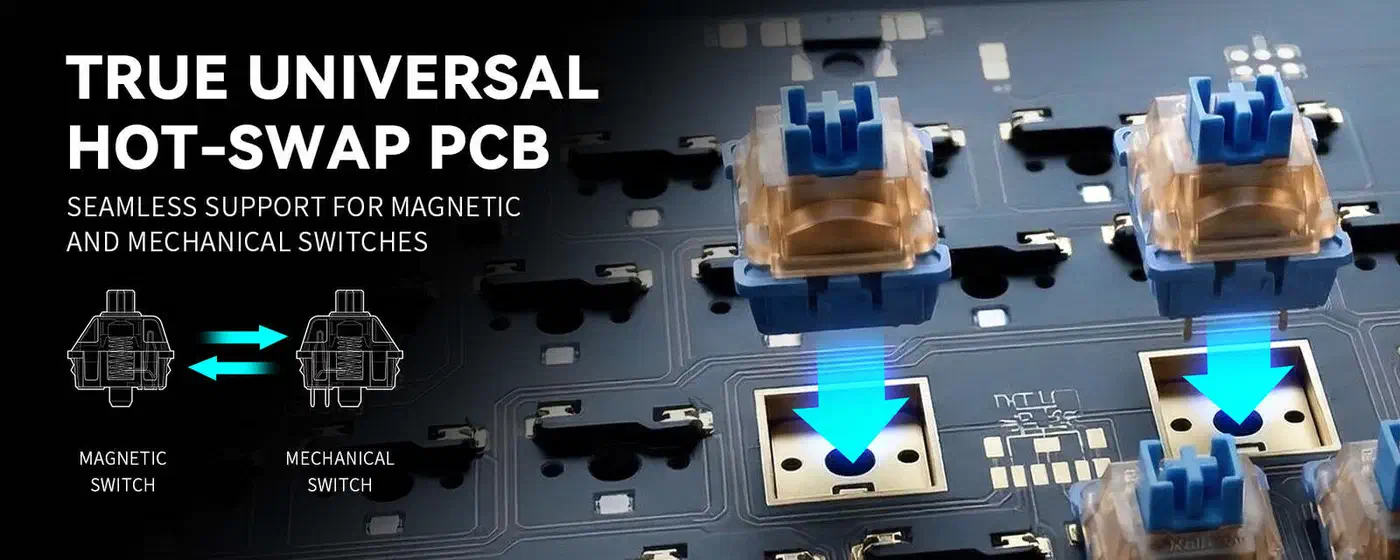
One perk caught the keyboard scene off guard. TMR sensors can read fields on more than one axis and shrug off off-center mounting. So TMR PCBs can use standard MX hot-swap sockets that accept both magnetic and mechanical switches on the same board. That socket compatibility stops at height, so low-profile Choc and KS-33 switches still need their own PCB. Hall Effect designs can’t pull this off, since they need tight single-axis lineup between magnet and sensor.
Gaming Performance: What TMR Actually Changes
The physics show up in real in-game gains, but only for some use cases.
Rapid Trigger Gets Tighter
Rapid Trigger drops the fixed reset point of old switches. It fires on any down move and releases on any up move past a set point. On Hall Effect boards, the practical floor is around 0.1 mm before sensor noise sets off false triggers. TMR pushes this down to 0.02 mm.
In Counter-Strike 2 and Valorant strafing, that gap is real. A tighter reset means faster turns. The keyboard logs the release and re-press a touch sooner. In casual reviewer tests, ranked FPS players could spot TMR from Hall Effect in strafing drills. The gap vanished in general typing and single-player play.
Hysteresis Drops Significantly
Hysteresis on early TMR boards lands in the 0.01-0.03 mm range, roughly 3-5x tighter than the best Hall Effect boards. Less hysteresis means the press and release curves track each other more closely. So your behavior stays steady when you set tight actuation points.
Analog Input Resolution Jumps
For analog use cases like racing game throttle, brake, flight sim controls, and controller emulation, the gap is huge. A Hall Effect board gives you about 40 steps across 4 mm of travel. A TMR board gives you closer to 400 steps over the same path. For players who map WASD to analog stick input, that is the line between rough and smooth.
Latency Is Mostly Unchanged
Polling rates stay at 8,000 Hz on wired USB. That is the protocol cap, not a sensor limit. However, TMR’s cleaner signal cuts the need for heavy firmware debouncing, which can shave roughly 1 ms off input lag. You can see it on a scope, but no human will feel it.
A badly tuned monitor costs you more than that millisecond. The Alienware AW3926QW , for one, looks oversaturated out of the box until you change its color preset.
Wireless Becomes Viable
The power gap between TMR and Hall Effect sensors is the biggest day-to-day win for many users. At 100 microamps per sensor versus 4 mA, a 75-key TMR board pulls a fraction of the sensing power. The MonsGeek FUN60 Ultra (TMR) and Epomaker HE75 Mag (Hall Effect) both pack 4,000 mAh batteries. Still, the TMR board runs up to 200 hours against 120 hours for the Hall Effect model with backlighting off. The full TMR power draw breakdown shows where those extra hours come from.
TMR Keyboards Shipping in 2026
The TMR keyboard market went from zero to several shipping models between January and April 2026. Here is what you can buy or pre-order today.
| Keyboard | Layout | Sensor | Polling Rate | Connectivity | Price |
|---|---|---|---|---|---|
| Cherry XTRFY MX 8.2 Pro TMR | TKL | TMR (Cherry MK Crystal) | 8,000 Hz | Wireless | $249.99 |
| Cherry XTRFY K5 Pro TMR | 65% | TMR (Cherry MK Crystal) | 8,000 Hz | Wired | $149.99 |
| Gamakay TK75 TMR | 75% | TMR | 8,000 Hz | Tri-mode | $109 (pre-sale) |
| MonsGeek M1 V5 TMR | 75% | TMR (32K scan) | 8,000 Hz | Tri-mode | ~$150 |
| MonsGeek FUN60 Ultra | 60% | TMR | 8,000 Hz | Tri-mode | $90-95 |
| Womier SK75 TMR | 75% | TMR | 8,000 Hz | Wired | ~$100 |
| Wooting 80HE (reference) | TKL | Hall Effect | 8,000 Hz | Wired | ~$175 |
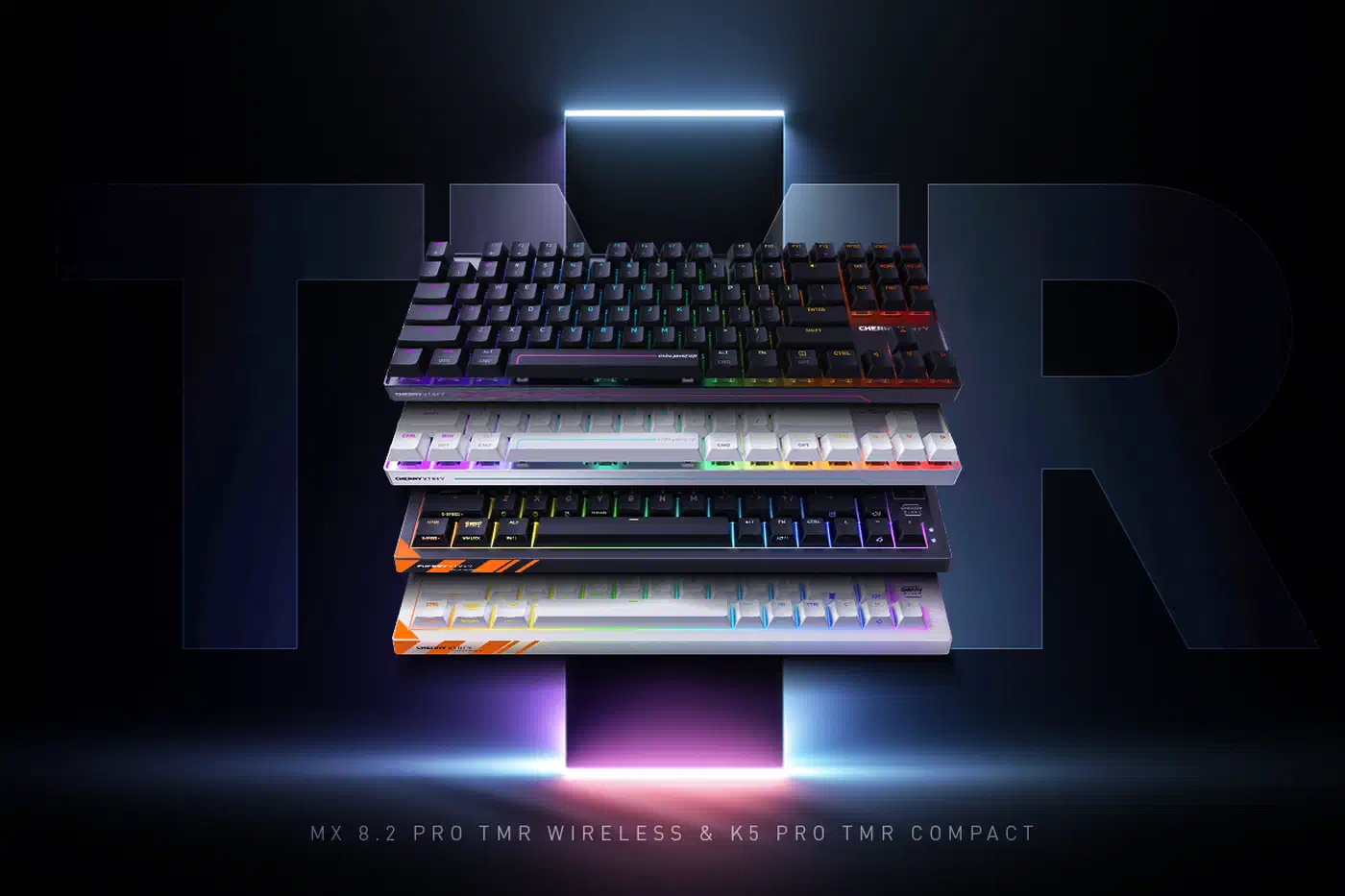
Cherry XTRFY shipped first with two models in January 2026. The MX 8.2 Pro TMR Wireless is the top pick at $249.99 with an aluminum frame, PBT keycaps, and wireless 8K polling. The K5 Pro TMR Compact is the wired option at $149.99 in a 65% layout. Both use Cherry’s MK Crystal Magnetic switches. Both also hot-swap between magnetic and mechanical switches.
Gamakay showed the TK75 TMR at CES 2026 with a Q2 2026 ship date and a $109 pre-sale price. That makes it the cheapest TMR board on the slate so far. It has 0.01-3 mm adjustable actuation, tri-mode pairing, and 8K polling on both wired and 2.4 GHz modes.
MonsGeek (Akko’s gaming sub-brand) went further with a 32K scan rate on the M1 V5 TMR, built around 15 extra logic ICs for fast read-out. The FUN60 Ultra at $90-95 is the cheapest TMR board you can buy now. It also has the best logged battery life.
Wooting has not shown a TMR product. Their 2026 plan centers on a new 65% Hall Effect layout with split space bars. Given Wooting’s careful firmware track record, they seem to be waiting for the TMR switch scene to settle before they jump in.
Drunkdeer is still on Hall Effect with the A75 Ultra. They use an AMR (Anisotropic Magnetoresistance) sensor rather than TMR. The current lineup has no TMR models.
Switch Compatibility
The TMR jump is easier than past sensor swaps because the magnet-on-stem layout stays the same. Switch vendors like Gateron, Kailh, and TTC ship TMR-ready magnetic switches that use standard MX-format stems and fit existing keycap sets.
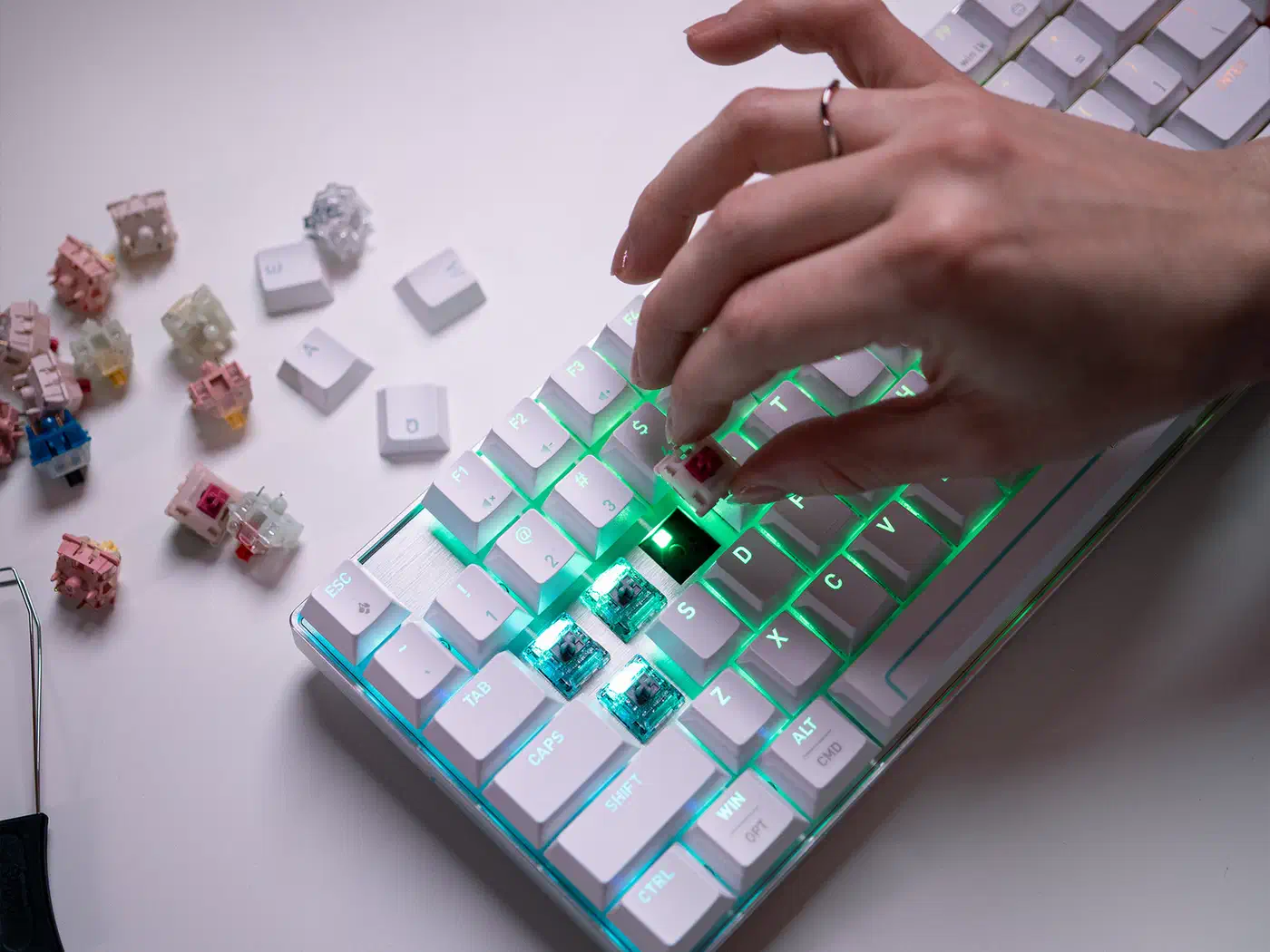
The hot-swap story has caveats. Cherry XTRFY and MonsGeek boards let you swap between magnetic and mechanical switches on the same PCB. TMR’s loose tolerance for off-axis mounting unlocks this. However, vendors run their own tuning code, and TMR sensor dies vary by maker. So swapping TMR switches across brands is not a sure thing. If you buy Gateron TMR switches for a Cherry XTRFY board, you may need to tune the calibration by hand.
Should You Buy a TMR Keyboard?
Buy TMR now if you play ranked FPS at a tough level and have already hit the limits of your current Hall Effect Rapid Trigger settings. It also makes sense if you want a wireless magnetic keyboard that lasts more than a few days between charges. Same if you are buying your first magnetic board in 2026 with no past spend on Hall Effect.
Wait for the second wave if you want a wireless TMR board with mature firmware. Most wireless TMR picks ship early code with known bugs. Same if you prefer Wooting’s ecosystem (still Hall Effect only) or want proven long-term reliability data. No TMR board has been on the market for more than four months yet.
Stay on Hall Effect if you mostly type or program and do not lean hard on Rapid Trigger. If you own a Wooting 80HE, 60HE+, or a peer premium Hall Effect board, the gap to TMR is real but small outside ranked FPS. If your budget is under $90, good Hall Effect picks exist at $40-60 while the cheapest TMR boards start around $90. For a wider view of where Hall Effect and mechanical switches sit in the market, see the best-selling keyboard switches of 2026 . If long coding days are your real concern, wrist posture beats the sensor debate, and an ergonomic split design does more for your hands than any switch upgrade.
The honest “blind test” answer: in reviewer trials, players reliably told TMR apart from Hall Effect during CS2 strafing drills, but not during normal typing or single-player play. The sensor upgrade pays off most at the ranked-FPS edge.
A Drunkdeer A75 (Hall Effect) runs about $130, while peer TMR boards from Gamakay and MonsGeek run $90-150. The TMR price gap has shrunk faster than expected. Early 2026 pricing sits only 15-25% above peer Hall Effect models. Budget picks like the MonsGeek FUN60 Ultra also undercut many Hall Effect rivals outright.
On lifespan, TMR sensors have no mechanical wear, same as Hall Effect. Switch vendors quote MTBF numbers in the same 100 million press range. Both tech types outlast every other part in the keyboard.
The Bottom Line
TMR is a real sensor upgrade over Hall Effect. The 10x boost in position resolution, tighter hysteresis, and far lower power draw are all measurable. They sit on physics that has been proven in hard drives and MRAM for over a decade.
That said, the real gap shows up mostly in ranked FPS strafing and wireless battery life. If those are your goals, TMR boards from Cherry XTRFY, MonsGeek, and Gamakay are already on sale at fair prices. If you like your current Hall Effect board and you don’t play at a sweaty ranked level, the next wave of TMR boards in late 2026 or 2027 will be cleaner, cheaper, and backed by mature firmware.