 Botmonster Tech
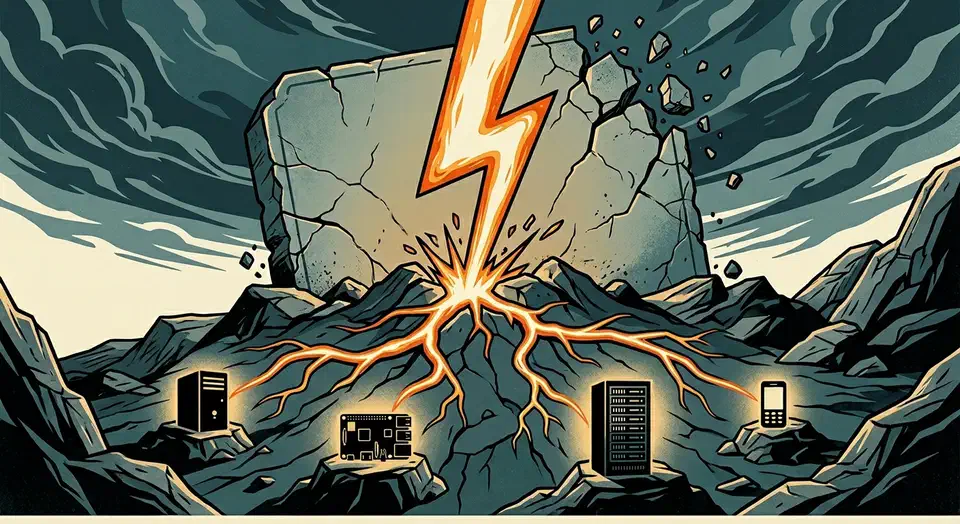
Zig is a modern systems language built to replace C. It keeps manual memory management and zero hidden control flow: no garbage collector, no runtime, and one statically-linked binary that runs anywhere. Install Zig from ziglang.org/download
, scaffold a project with zig init, and you’ll have a working CLI tool in about 50 lines using comptime, error unions, and first-class C interop. The killer feature: zig build-exe -target x86_64-linux-musl cross-compiles to any target from any host with zero toolchain setup.
Linux
Zig 1.0 Tutorial: Build a Systems Programming Project Without C

Deploy Ceph with cephadm: 3-node, 12 OSD storage cluster
Yes, you can build a self-healing, redundant distributed storage cluster using Ceph
across three Linux nodes. It’s less painful than its reputation suggests, thanks to the modern cephadm tool. You get block storage (RBD) for VMs, a shared POSIX filesystem (CephFS) for many clients, and S3-compatible object storage if you want it. Your data survives the loss of any node, rebalances on its own when hardware changes, and scales from a homelab to petabyte production by adding more disks.
Best OLED Monitors for Coding 2026: WOLED Beats QD-OLED for Text
For coding in 2026, the LG UltraFine OLED 32GS95UE is the default pick: a 32-inch 4K WOLED panel at 140 PPI with five-year burn-in coverage and clean Linux support on Wayland under KDE Plasma 6.3 or later. WOLED beats QD-OLED on small monospace text, and 27-inch 1440p OLEDs should be avoided outright.
Key Takeaways
- The LG UltraFine OLED 32GS95UE is the default coder pick in 2026, with five-year burn-in coverage and clean Linux support.
- WOLED beats QD-OLED for small monospace text, and 140 PPI is the density where color fringing stops being visible.
- 27-inch 1440p OLEDs make code text look worse than a cheap IPS panel at the same price.
- KDE Plasma 6.3 on Wayland is the only mature Linux path for OLED HDR, brightness, and 10-bit color in early 2026.
- Use grayscale font antialiasing, dark themes, and auto-hidden system bars to keep burn-in risk near zero.
The Text Clarity Problem: WOLED vs QD-OLED Subpixel Layouts and Why They Matter for Code
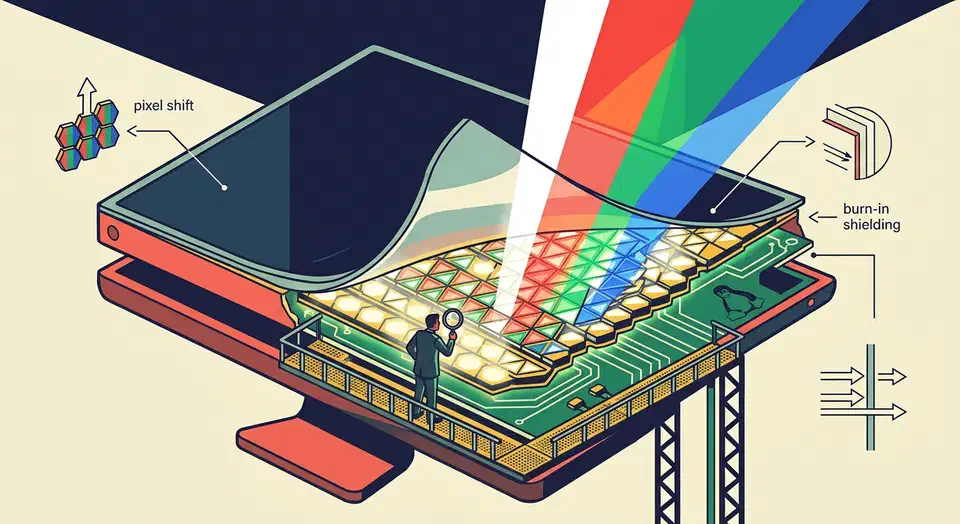
OLED panels do not use the standard horizontal RGB stripe that ClearType and freetype subpixel hinting were designed around. WOLED uses a WRGB quad (a white subpixel next to the three color subpixels), and QD-OLED uses a triangular RGB arrangement. Both produce visible color fringing on small black-on-white text unless you compensate with scaling, hinting tweaks, or raw pixel density. If your first few hours with a new OLED leave you thinking VS Code looks off, this is usually what your eyes are picking up.

Best Budget 4K Monitors for Linux Development in 2026
The best budget 4K monitors for Linux development in 2026 are the Dell S2722QC (around $330, USB-C with 65W power delivery, clean out-of-box scaling), the LG 27UL500-W (around $250, wide color gamut IPS with HDR10), and the ASUS ProArt PA279CRV (around $420, factory-calibrated with 96W USB-C PD). All three report correct EDID on major distributions, handle Wayland fractional scaling at 150% or 175% without driver workarounds on kernel 6.x, and deliver the pixel density you need for sharp text at 27 inches.

Linux Hardening in 30 Minutes: Lynis Score 55 to 84
You can shrink your Linux server’s attack surface in about 30 minutes. The recipe is simple. Harden SSH with Ed25519 keys, set up nftables with default-deny, turn on auto security updates, run auditd for kernel logs, and lock down accounts with faillock. A typical Lynis score jumps from 55-62 on a stock install to 75-84 after these changes.
Each section below takes 3-7 minutes. Work through it top to bottom on a fresh server. You will have a solid security baseline before your first app deploys, whether that is a database or a privacy-respecting analytics instance .

Custom Linux ISOs with Live Build or Cubic: Scripted or GUI
You can build a personalized Linux live USB image with your own packages, desktop, config files, and branding. Two tools cover this. Debian’s live-build
runs on the command line and builds repeatable ISOs from config files, so it fits CI pipelines well. Cubic
, the Custom Ubuntu ISO Creator, does the reverse: a GUI that opens an existing ISO, drops you into a chroot, then rebuilds it. Both make bootable ISOs you can flash with Ventoy
, dd, or Balena Etcher
.