 Botmonster Tech
Can Mistral Large 4 beat China's open models at coding?

Mistral Large 4 is a free-to-download AI model with a trillion parameters, and it is hard to run on a home PC because it needs far more memory than a normal PC has. Its smallest copy, a 233 GB file, needs about 256 GB of memory, so you need a server or a big Mac Studio to run it.
Key Takeaways
- Mistral Large 4 is a 1-trillion-parameter model you can download for free.
- Even the most squeezed copy needs about 256 GB of memory to run.
- It’s the strongest open model made outside China, but Chinese models still score higher.
- You can build products on it, but selling it as an API needs a deal with Mistral.
- Its coding-agent scores come closest to the top open models.
What is Mistral Large 4?
Mistral Large 4 is the flagship model of Mistral, the French AI lab, and its nickname is “Le Chonk”. Mistral pitches it as its best model for coding agents and defensive cybersecurity. It went into a paid API preview on 6 October 2026. Then, on 29 October 2026, Mistral put the weights on Hugging Face, taken from a better checkpoint that had about three more weeks of reinforcement learning.
The full name on the model card, Mistral-Large-4-1T-A52B, tells you how it’s built. It’s a mixture-of-experts model: a large pool of smaller sub-networks, of which only a few fire for each word. There are 128 routed experts, and 4 of them work on each token alongside 1 shared expert.
That split decides both speed and memory:
- Speed follows the active part, about 52B parameters per token (49B without the embedding and output layers).
- Memory follows the total, about 1T parameters, because every expert has to be loaded in case the router picks it. Mistral’s own spec lists 1,050B total.
It reads up to a million tokens of context and takes images as well as text. It also has three reasoning levels: low, medium and high, with high as the default.
Mistral trained it from scratch on 3,800 NVIDIA Grace Blackwell GPUs in European data centers. It speaks more than 160 languages, including all official EU languages, and supports function calling, JSON output and strict JSON schemas. Mistral recommends temperature 1.0 and top_p 0.95 at all three reasoning levels.
How much memory does Mistral Large 4 need to run locally?
Mistral Large 4 needs at least about 256 GB of memory to run, which rules out any consumer GPU or any one workstation card because none of them has that much memory. The 233 GB in the title is the 1-bit file, and running it takes about 256-270 GB once the context cache and the runtime are loaded.
Mistral publishes FP8 and NVFP4 itself, and the rest come from the Unsloth GGUF repo:
| Build | Bits | File size |
|---|---|---|
| BF16 GGUF | 16 | 2.1 TB |
| Q8_0 | 8 | 1.12 TB |
| FP8 (official) | 8 | 1,060.6 GB |
| UD-Q6_K_XL | 6 | 890 GB |
| UD-Q5_K_XL | 5 | 784 GB |
| NVFP4 (official) | 4 | 610 GB |
| UD-Q4_K_XL | 4 | 605 GB |
| UD-Q3_K_XL | 3 | 493 GB |
| UD-IQ3_XXS | 3 | 424 GB |
| UD-Q2_K_XL | 2 | 378 GB |
| UD-IQ2_XXS | 2 | 302 GB |
| UD-IQ1_M | 1 | 260 GB |
| UD-IQ1_S | 1 | 233 GB |
Each tier needs this much total memory, RAM plus VRAM:
| Tier | Total memory |
|---|---|
| 1-bit | 256-270 GB |
| 2-bit | 310-390 GB |
| 3-bit | 435-500 GB |
| 4-bit | 630 GB |
| 8-bit | 1.2 TB |
A 256 GB Mac Studio or two linked DGX Spark boxes fit the 1-bit build on paper, but no public source gives tokens per second on either. A 1-bit model also loses a lot of quality, so it gets the model running but says little about how good it is.
The biggest Apple machine doesn’t get you to 4-bit, because the M5 Ultra Mac Studio tops out at 512 GB of unified memory. That holds the 2-bit or 3-bit builds, with little room left for long context, while the 4-bit build needs about 630 GB. Four H200 cards fall short too: 4 x 141 GB adds up to 564 GB of GPU memory, below the 605 GB 4-bit file, so on paper they top out at the 3-bit build.
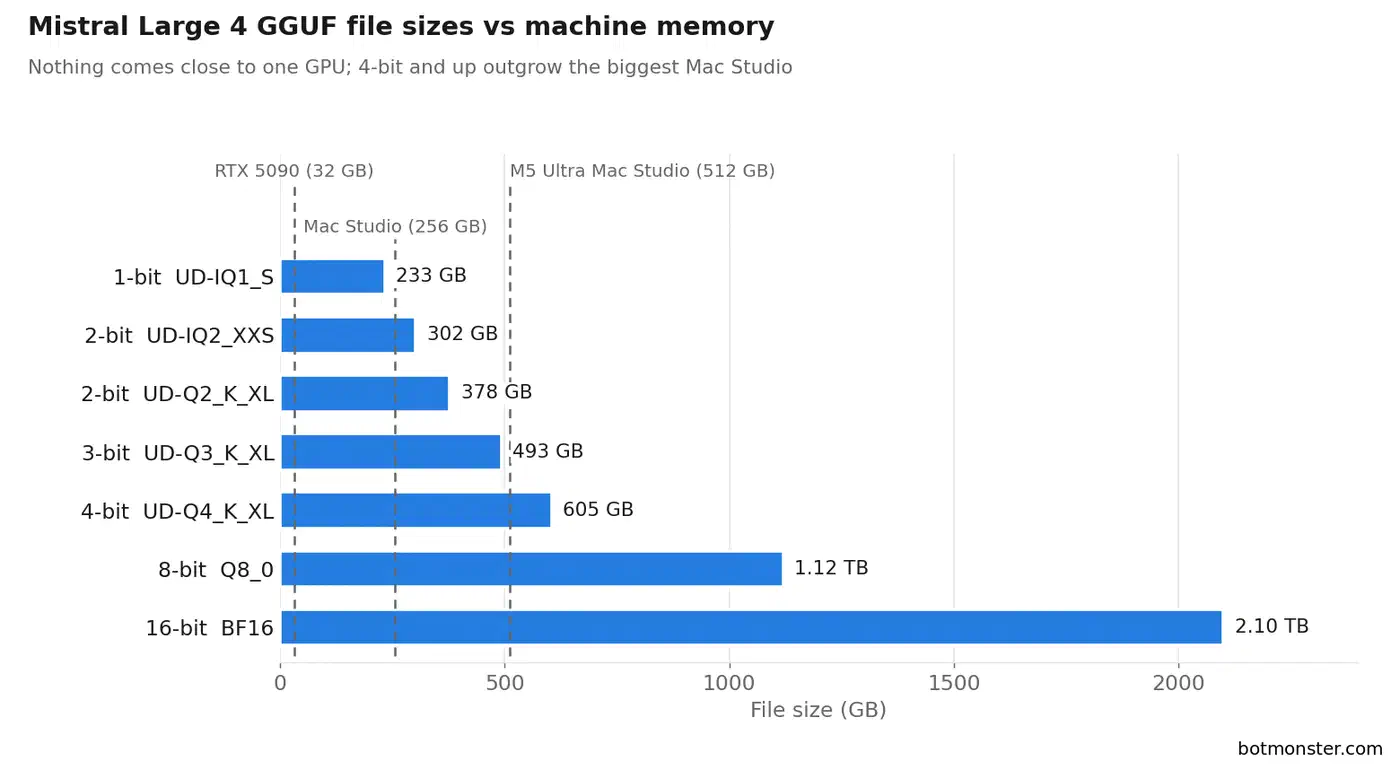
For a sense of scale, a 32 GB RTX 5090 holds about one-seventh of the smallest file. If you have one or two consumer cards, use the API or pick a smaller open-weight coding model that fits on ordinary hardware. For general use, Llama 4 Scout fits a 24 GB consumer GPU with a 1.78-bit GGUF and some layers offloaded to system RAM.
Mistral’s own deployment examples assume a data center. The vLLM and SGLang commands on the model card split the model across 8 GPUs, and the NVFP4 checkpoint targets NVIDIA’s Blackwell chips.
A small “DSpark” draft head, 2.25 GB at Q8_0, speeds things up by guessing the next few tokens so the big model can check them in one pass. Unsloth reports an average of about 2.5 accepted tokens per step and roughly twice the decode speed at batch size 1. Mistral claims up to 1.9x more throughput with identical outputs.
Running Mistral Large 4 with llama.cpp, Ollama or vLLM
Mistral Large 4 runs on llama.cpp from the Unsloth files and on vLLM or SGLang from the official weights. Ollama has no documented path yet, because no Ollama command appears in Unsloth’s material and each build is split into several GGUF files.
With llama.cpp, Unsloth’s guide serves the 2-bit build. Swap the tag for UD-Q4_K_XL if you have the memory:
./llama.cpp/build/bin/llama-server \
  -hf unsloth/Mistral-Large-4-1T-A52B-GGUF:UD-Q2_K_XL \
  --ctx-size 32768
The DSpark draft head and image input are extra flags. Vision needs the projector file mmproj-BF16.gguf, which is 3.44 GB:
-md dspark-Mistral-Large-4-1T-A52B-Q8_0.gguf \
  --spec-type draft-dspark --spec-draft-n-max 3 \
  --mmproj mmproj-BF16.gguf
For vLLM, Mistral ships the image vllm/vllm-openai:mistral-large-4. Tool calls and reasoning output need Mistral’s parsers on top of the 8-way split:
vllm serve mistralai/Mistral-Large-4-1T-A52B \
  --tensor-parallel-size 8 \
  --tool-call-parser mistral \
  --reasoning-parser mistral \
  --enable-auto-tool-choice
SGLang has its own image, lmsysorg/sglang:mistral-large-4, and turns on the draft head with --speculative-algorithm DSPARK. NVIDIA also offers a NIM container, a TensorRT-LLM branch and a hosted endpoint on build.nvidia.com. These engines trade off speed and setup the way they do for any big model in the local LLM runtimes comparison.
The license allows products but restricts resale
Mistral Large 4 ships under the Mistral Ecosystem Open-Weight License, which is MIT with one big exception. You can use, copy, modify, fine-tune and redistribute the model, and sell products built on it. The only attribution rule is to keep the copyright and permission notice.
The exception is the Model-as-a-Service clause in the LICENSE file. A MaaS business gives outside parties inference or post-training access with meaningful control over inputs, parameters or training data. If you or an affiliate run one, you need a separate commercial license from Mistral before any commercial use. There is no revenue or user threshold, so the activity alone triggers it.
Plenty of uses fall outside that clause:
- Internal use, where no third party gets access to the model.
- Mistral’s own products, such as its API and apps.
- End-user products where the model powers specific features or a fixed harness.
- Relaying requests to a copy of the model that someone else hosts.
The open rivals are looser, because each one below lets you sell hosted access for free up to a revenue line. That line counts the licensee’s and its affiliates’ total revenue over any 12 months, API or otherwise:
| Model | Total size | License | Free resale until |
|---|---|---|---|
| DeepSeek V4.1 Flash | ~763B | MIT | Unlimited |
| GLM-5.3 | ~753B | Custom | $10B revenue |
| Kimi K3 | ~2.8T | Custom | $20M revenue |
| Qwen3.8-2.4T-A95B | ~2.4T | Custom | $50M revenue |
| Mistral Large 4 | ~1T | Modified MIT | Deal needed |
Past their lines, GLM-5.3 asks for a Z.AI security review, Kimi K3 for a Moonshot agreement and Qwen for a separate license. Qwen’s terms also cover “AI Work Assistant” businesses.
Mistral Large 4 is open-weight, not open source, because the training data is not public, and the MaaS clause leads some developers to call it “weight-available”. Pierre Stock, Mistral’s VP of science, has argued that once weights are open, nobody can cut off access to them. That’s true for running the model, though the MaaS clause still limits reselling it as a hosted API.
Mistral Large 4 vs DeepSeek, GLM and Kimi on independent benchmarks
On independent tests, Mistral Large 4 is narrowly the best open model built outside China, and it trails the top Chinese open models overall. It comes closest to the leaders on coding agents. Mistral’s own choice of benchmarks makes it look stronger than the independent tests do.
On the Artificial Analysis Intelligence Index, Mistral Large 4 scores 26 at high reasoning and 23 at medium. A run of the index costs $2.06 per task, and output speed at high reasoning is 88 tokens per second. DeepSeek V4.1 Flash 1017 and GLM-5.3 lead the open field on the same index at 32.5 and 31.7. Several other Chinese models also rank above Mistral.
Its Coding Agent Index score has moved around:
- At launch (index v2), Mistral Large 4 scored 48.3 against GLM-5.3’s 48.9, second among open models. Mistral rounds this to “48%, effectively tied”, using 47% fewer tokens per task.
- Around 6 November, Artificial Analysis pulled that run, which left a 35.4 row, then restored it later with no public explanation.
- On index v2.1 (14 November), it scores 40.59. That puts it second behind Kimi K3.1 Pro at 48.64, and ahead of GLM-5.3 at 40.12 and DeepSeek V4.1 Flash 1017 at 36.83.
On the Cyber Index it scores 51, third among open models behind DeepSeek V4.1 Flash at 57 and MiMo-V2.6-Pro at 56.
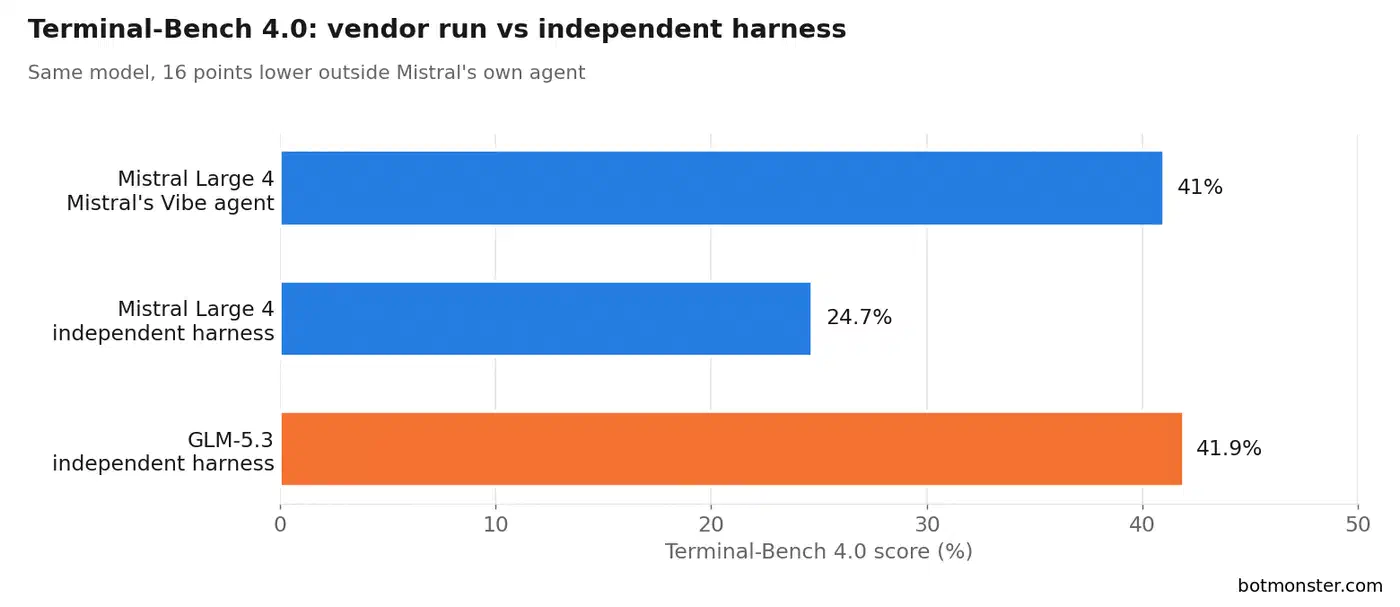
Terminal-Bench 4.0 shows the gap between vendor and independent numbers most clearly. Mistral reports 41% from runs in its own Vibe agent. In Artificial Analysis’s generic agent harness, the model scored 24.7%, while GLM-5.3 scored 41.9% in that same harness. The gap feeds an old doubt among developers, since earlier Mistral releases also fell short of their self-reported scores.
The rest of the headline numbers come only from Mistral and have no independent check:
| Benchmark | Mistral Large 4 | Claimed rank |
|---|---|---|
| FrontierCode 2.0 | 19.7% | 1st open |
| BrowseComp | 84.5% | |
| FinWorkBench | 73.3% | 2nd open |
Mistral also cites Surge’s blind code comparisons, where graders preferred its answers over GLM-5.3, Kimi K3 and DeepSeek V4.1 Flash, and only Claude Opus 5.5 beat it there. For the Chinese side of this race, see how DeepSeek V4 Pro compares on price and benchmarks and the Chinese open-weight coding stack.
Where Mistral Large 4 wins and where it loses
Where it wins:
- European origin. It’s trained in Europe from scratch, and EU companies online say they value a European provider for compliance, though your own duties under the EU AI Act rules depend on what you build, not on where the model comes from.
- Long context and images. A 1M-token window and image input are both built in.
- Token efficiency. It spends about 82K output tokens per index task, 39% fewer than the preview, while higher-scoring open models use 113K or more.
- Price. The API costs $0.70 per million input tokens, $0.07 cached and $2.10 output. That’s about half the preview price.
- Safety scores. Mistral reports a 96.6% refusal rate on malicious cyber requests and 97.1% resistance on the B3 attack benchmark. Developers have questioned the first figure, because Mistral gives no false-refusal rate next to it.
Where it loses:
- Overall intelligence, against DeepSeek V4.1 Flash and GLM-5.3.
- Licensing, because the MaaS clause is stricter than MIT rivals.
- Local use, because no build runs on a single GPU or a 128 GB machine.
Mistral also says the model shows “a potential for uplift” for attackers, and it is changing its guardrails in response. A cybersecurity variant is in restricted preview with Orange Cyberdefense.
Mistral Large 4 makes the most sense for teams that already run 8-GPU Blackwell nodes, and for EU organizations. It also suits anyone using it through Mistral Studio, OpenRouter, NVIDIA or Microsoft Foundry. For everyone else, the API is the simpler choice, because even the smallest download is 233 GB.