LogoBotmonster Tech
AI Smart Home Self-Hosting Coding Web Dev Hardware Bootpag Image2SVG Tags
Why Small Language Models (SLMs) are Better for Edge Devices

Why Small Language Models (SLMs) are Better for Edge Devices

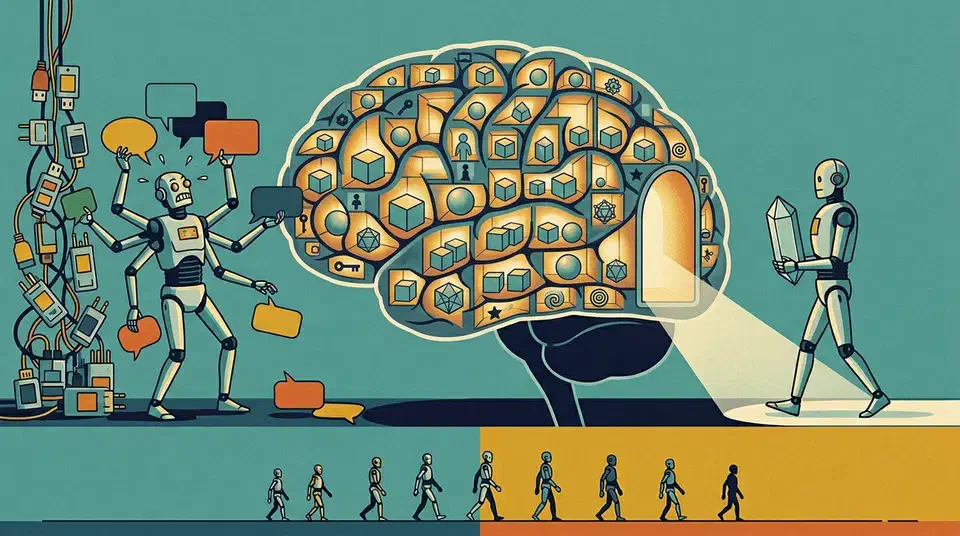
Small Language Models, sub-4B parameter models built to run on local hardware, now handle most of the edge AI work that used to need the cloud. Phi-4 , Gemma 3 , and Llama 3.2-1B run offline on Raspberry Pi boards, phones, and industrial PLCs. The economics, latency, and privacy story all point the same way: edge first.

What Counts as a Small Language Model

In 2023, “small” meant under 13B parameters. Today, three tiers matter for edge work.

SDXL 2.0 LoRA: 50-300 MB Adapters on 12 GB VRAM

SDXL 2.0 LoRA: 50-300 MB Adapters on 12 GB VRAM

The best way to fine-tune Stable Diffusion XL 2.0 is with Low-Rank Adaptation (LoRA) : a small adapter that injects your style or subject without touching the base weights. Instead of retraining the full model, LoRA trains a tiny side network next to the frozen base. The result is a 50 to 300 MB file you can load, swap, and stack at inference, trained on a 12 GB GPU in an afternoon.

Underground vault library with glowing holographic books arranged in vector space and a robot librarian retrieving relevant volumes

Setup a Private Local RAG Knowledge Base

To build a private Retrieval-Augmented Generation (RAG) system, pair a local vector database like Qdrant with an embedding model like BGE-M3 . Add a local LLM through Ollama , and you can index hundreds of documents and ask questions about them. Your data stays on your machine.

Why RAG? The Problem With Pure LLM Memory

Large language models sound smart, but they are poor knowledge stores. They learn from old training data and know nothing about files you created later or keep private. Ask about your own data, and the model will often guess. Even strong open weight models like Llama 4.0 can invent plausible but wrong answers about content they never saw. For a deeper breakdown of why LLM hallucinations happen and how to measure them, the issue goes beyond missing context.

Building Multi-Step AI Agents with LangGraph

Building Multi-Step AI Agents with LangGraph

AI agents built on LangGraph run as stateful graphs, not linear prompts. The graph can loop, branch on tool output, retry after a failure, and save its progress. That structure is what lets one agent handle long, multi-step tasks reliably.

Key Takeaways

  • LangGraph models an agent as a stateful graph, so it can loop, retry, and recover.
  • The state schema you design up front decides how stable the agent turns out.
  • Built-in checkpointing lets an agent crash, pause for approval, and resume without lost work.
  • Conditional edges turn failures into retries instead of dead ends.
  • One agent task can fire dozens of LLM calls, so plan for cost before you deploy.

Prerequisites

You should know Python 3.11+ and the LangChain basics: LLMs, tools, prompts. The code below uses these versions:

High-end gaming desktop with illuminated NVIDIA GPU visible through a glass side panel, surrounded by floating holographic neural network diagrams and data streams

Run Llama 4 Scout Locally: 24GB VRAM, GGUF, Real Speeds

You can run Llama 4 Scout on a 24 GB consumer GPU, but only with an aggressive quantization and some patience. Scout is a 109B-parameter Mixture-of-Experts model, and even its smallest Unsloth dynamic GGUF build is about 32 GB, so a 24 GB card runs it with CPU offload at roughly 20 tokens per second. This guide covers which Llama 4 model fits your hardware, the real VRAM math, and the fastest way to get it running.

  • ◀︎
  • 1
  • …
  • 12
  • 13
  • 14
  • ▶︎

Most Popular

What X and Reddit Users Are Saying about Claude Opus 4.7

What X and Reddit Users Are Saying about Claude Opus 4.7

How power users on X and Reddit reacted to Claude Opus 4.7: praise for agentic coding, token burn concerns, and teams' practical prompting habits.

Gemma 4 vs Qwen 3.5 vs Llama 4: Which Open Model Should You Actually Use? (2026)

Gemma 4 vs Qwen 3.5 vs Llama 4: Which Open Model Should You Actually Use? (2026)

Gemma 4, Qwen 3.5, and Llama 4 compared on benchmarks, licensing, speed, and hardware so you can pick the right open model fast.

Qwen3.6-35B-A3B: Alibaba's Open-Weight Coding MoE

Qwen3.6-35B-A3B: Alibaba's Open-Weight Coding MoE

Alibaba's sparse Mixture-of-Experts: 35B total parameters, 3B active per token. Q4 quantization runs on MacBook Pro M5, matches Claude Sonnet performance.

MiniMax M2.7: Model That Almost Matches Claude Opus 4.6

MiniMax M2.7: Model That Almost Matches Claude Opus 4.6

MiniMax M2.7 review: 230B Mixture-of-Experts reasoning model with strong benchmarks, self-hosting options, and a tenth the cost of Claude Opus 4.6.

Running Gemma 4 26B MoE on 8GB VRAM: Three Strategies That Work

Running Gemma 4 26B MoE on 8GB VRAM: Three Strategies That Work

Run Google Gemma 4 26B MoE with sparse activation on budget 8GB GPUs using aggressive quantization, GPU-CPU layer offloading, and tensor parallelism techniques.

AI Coding Agents Are Insider Threats: Prompt Injection, MCP Exploits, and Supply Chain Attacks

AI Coding Agents Are Insider Threats: Prompt Injection, MCP Exploits, and Supply Chain Attacks

Study of 78 coding agents including Claude Code, Copilot, Cursor: all vulnerable to prompt injection attacks succeeding 85% of the time with adaptive vectors.

Like what you read?

Get new posts on Linux, AI, and self-hosting delivered to your inbox weekly.

Privacy Policy  ·  Terms of Service
2026 Botmonster