 Botmonster Tech
SolidCraft is a Fusion 360 alternative AI wrote in 10 days
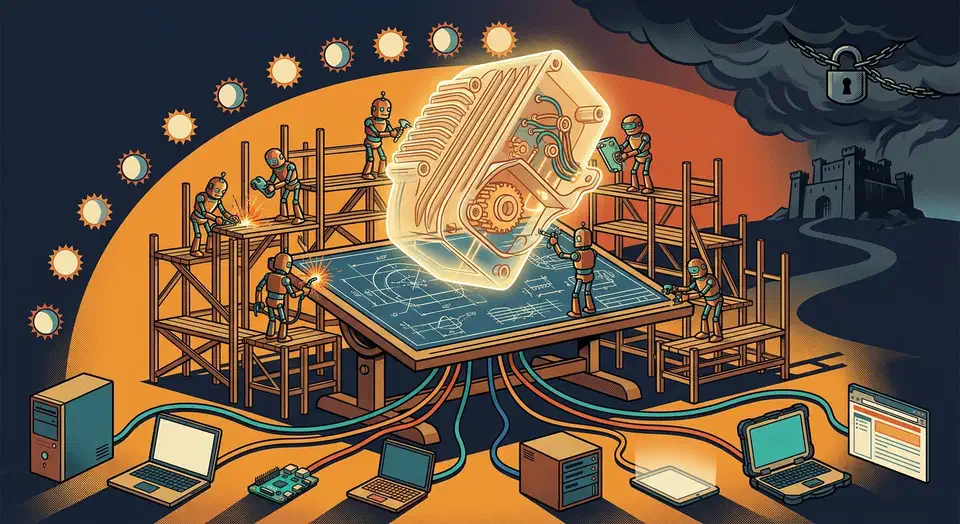
SolidCraft is a free Fusion 360 alternative that Claude coding agents built in ten days, and it already models simple parts. Its builds cover eight targets, from ARM Linux and FreeBSD to the browser, while Extrudo, another AI-built CAD app, ships four. Neither one replaces Fusion for paid production work yet.
Key Takeaways
- AI coding agents built SolidCraft, a working Fusion-style CAD app, in ten days.
- SolidCraft runs on Windows, Mac, Linux, FreeBSD, ARM chips and in a browser.
- Extrudo is also AI-built, but its desktop apps run on far fewer machines.
- Both handle simple 3D-printed parts and still fail on harder ones.
- Fusion still wins for CAM, PCB design and paid work, at $680 a year.
This is SolidCraft 0.14 running in a browser tab, with no install and no account. Anyone who has used Fusion will recognise the layout: the ribbon on top, the browser tree on the left and the feature timeline along the bottom.

Why people are looking for a Fusion 360 alternative
Price is the first complaint from people leaving Fusion. The Autodesk Fusion subscription FAQ lists $85 a month, $680 a year or $2,040 for three years, per user. There’s no perpetual licence to buy.
Fusion stores your designs in Autodesk’s cloud by default, so they’re only as safe as your account and Autodesk’s service. It also has no native Linux app. The browser client is the only route, and Autodesk’s web client page says personal-use and trial licences don’t include it. A Linux hobbyist therefore has no legitimate way to run Fusion at all.
Autodesk has also repeatedly cut its free tier and retired its maker tools, so hobbyists know a free licence can shrink at the next renewal.
FreeCAD is the mature open-source answer. Still, its learning curve is steep, and people who learned on Fusion often end up fighting it.
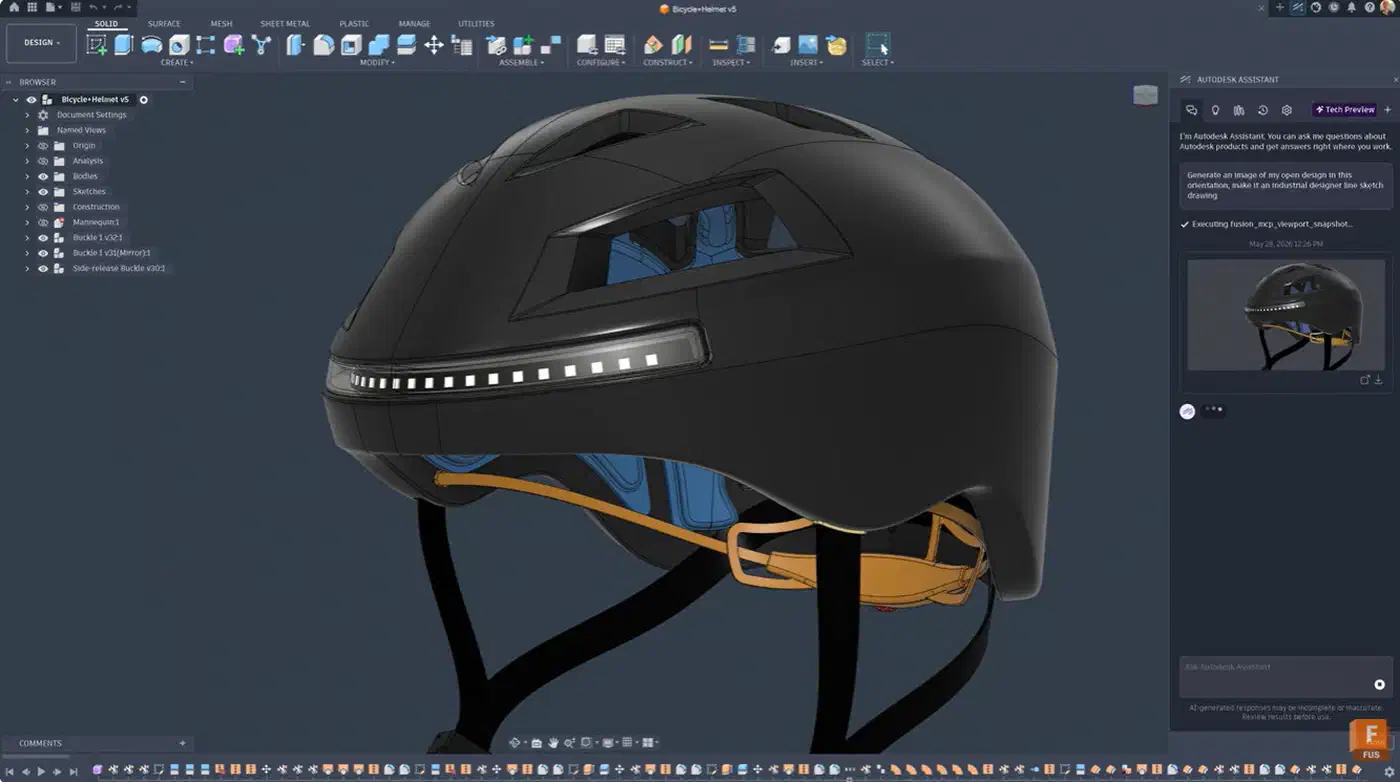
Image: Autodesk Fusion blog
How Autodesk kept shrinking the free Fusion licence
- 2017: EAGLE went subscription-only, ending perpetual licences.
- 2019: the free licence split into Personal, Startup and Commercial; free use became non-commercial only.
- 2020: EAGLE was folded into Fusion and no longer sold on its own.
- 2020: personal use was capped at 10 active documents, with fewer export formats, slower CAM and no simulation. STEP export, first removed, came back after the backlash.
- 2026: EAGLE was retired on June 7.
- Today: personal use means non-commercial work earning under $1,000 a year, without cloud rendering, simulation or extensions.
The free tier can change at any renewal. That, more than the $680 price, is the reason to keep an open alternative within reach.
What is SolidCraft?
SolidCraft is a free, open-source parametric CAD app. You sketch, add constraints, extrude, then edit a dimension and the model rebuilds. Its layout is a deliberate copy of Fusion’s Design workspace.
Version 0.14.0 shipped ten days after the first commit, with 1,412 commits, about 3,300 GitHub stars and 367 forks. Dozens of people have contributed, but the lead author, bherbruck, wrote 689 of those commits.
The evidence that AI wrote it is in the repo itself:
- The very first entry in the commit history, “M0: workspace, geometry foundation, sketch constraint solver, kernel boundary”, carries a
Co-Authored-By: Claude Opus 5.5line. - The ROADMAP measures remaining work in “agent hours”, with about 82 of them left before a useful alpha.
- The repo’s CLAUDE.md is an operating manual for agents. It sets out an autonomous operation protocol and a “never crash” rule that bans
unwrap()andpanic!in production code. It also has a clean-room rule: agents may not drive or copy Fusion, SolidWorks or Onshape.
According to the README, SolidCraft has its own sketch constraint solver plus extrude, revolve, sweep, loft, fillet, shell, holes, threads and patterns. It handles parameters and configurations, assemblies with joints and motion studies, and sheet metal with flat patterns. It exports STEP AP242, IGES, STL, 3MF and OBJ, and it imports FreeCAD .FCStd and Rhino .3dm files.
The project calls itself “early but usable for simple parts”. Its README says 75 of 76 public reference parts match analytic or FreeCAD-computed values, and the ROADMAP now claims 82 of 82. Those are the project’s own tests. They show the kernel gets volumes right, and they say nothing about matching Fusion feature for feature.
An unofficial community guide exists too, though it still points at the old repo address under bherbruck’s account. ArtCraft got a lot of attention for Rust rebuilds of Adobe-style apps, which its developer told Notebookcheck he wrote with Claude Opus 5.5.
Why pure Rust makes SolidCraft run almost anywhere
SolidCraft is about 97% Rust: 18.0 MB of its 18.5 MB of code, according to GitHub’s language count. The rest is build scripts and packaging.
Nearly every CAD app is built on a geometry kernel written in C++. FreeCAD and Extrudo use OpenCascade, SolidWorks uses Parasolid, and Fusion uses Autodesk’s own kernel. A C++ kernel has to be compiled and tested separately for every chip and operating system, which is slow, fiddly work.
SolidCraft skips that step. Its kernel layer wraps truck , a geometry library written in Rust. The code that turns surfaces into triangles runs on the GPU through wgpu, with a CPU fallback, and the interface is drawn with egui. Consequently, no C++ toolchain is needed to build any part of it.
Every pull request must pass a WebAssembly build, so the browser version can’t break unnoticed. The code also sets unsafe_code = "forbid" across its crates, with three documented exceptions where it talks to the operating system. In plain terms, the compiler rules out a whole class of memory crash bugs.
The result shows on the v0.14.0 release page:
| Target | Packages | Size |
|---|---|---|
| Windows x64, ARM64, 32-bit x86 | MSI, portable zip, exe | 41-98 MB |
| macOS (Apple silicon and Intel) | Universal DMG | 120 MB |
| Linux x86_64 and aarch64 | AppImage, deb, rpm, Flatpak, Snap, tar.gz | 33-64 MB |
| FreeBSD x86_64 | tar.gz | 60 MB |
| Browser | WebAssembly bundle (WebGPU, WebGL2 fallback) | 17 MB zip |
A Raspberry Pi 5, an ARM laptop running Linux, a FreeBSD workstation and a school Chromebook can all run the same CAD app. Fusion runs natively on none of them.
The Windows and macOS builds are unsigned, so expect SmartScreen and Gatekeeper warnings on first launch. The Flatpak sandbox also blocks 3D mouse support for now.

As in Fusion, the three user parameters drive the model’s d1, d2 and d3 dimensions.
Extrudo, the other AI-built CAD app, and why it travels less well
Extrudo bills itself as parametric CAD for 3D printing in your browser. It’s free, needs no account, and keeps your designs locally in the browser. It’s a solo project by zoltanf, with 359 commits, seven GitHub stars and version 0.7.0 three weeks after its first commit.
It’s AI-built as well. In the Extrudo repo , 69 of the latest 100 commits credit Claude Opus 5.5 or Sonnet 5.5 as co-author. Similarly, its roadmap splits work into tasks sized for one agent session.

For makers, Extrudo has tools SolidCraft lacks:
- overhang and wall-thickness checks, plus placing a part on the print bed
- filament weight and cost estimates, and 3MF export with colours
- send-to-slicer for PrusaSlicer, OrcaSlicer, Bambu Studio and Cura from the desktop app
- a Customizer with sliders, and OpenSCAD import in the browser
Its import menu also lists .f3d, Fusion’s own design format. That could be the most useful feature of all for someone leaving Fusion, though I didn’t test a real Fusion file.
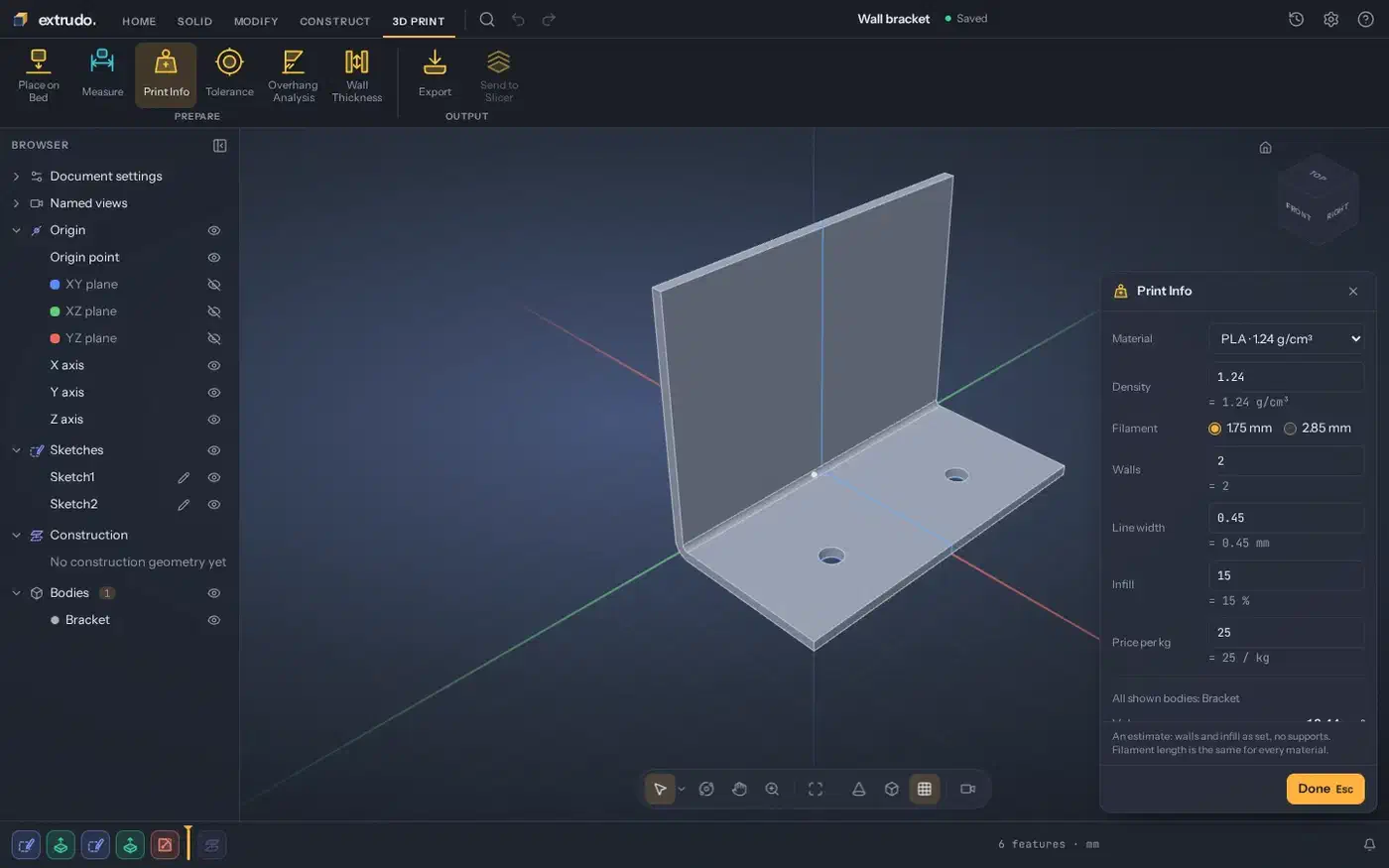
Image: Extrudo README screenshots
However, its stack is much heavier. GitHub counts about 93% of Extrudo’s code as TypeScript, and the app is built on React 19 and three.js. Underneath are OpenCascade and FreeCAD’s planegcs sketch solver, both compiled from C++ to WebAssembly. QuickJS runs scripts, and Electron wraps the desktop app. Each layer narrows where a native build can run.
The Extrudo 0.7.0 release shows the gap:
| SolidCraft 0.14.0 | Extrudo 0.7.0 | |
|---|---|---|
| Windows | x64, ARM64, x86 | x64 only |
| macOS | Apple silicon and Intel | Apple silicon only |
| Linux | x86_64 and aarch64, six package formats | x86_64 only (deb, AppImage) |
| FreeBSD | Yes | No |
| Browser | Yes | Yes |
| Smallest Linux download | 33 MB (aarch64 Flatpak) | 111 MB (deb) |
| Build from source | cargo only | Node 24, pnpm 12 and an OpenCascade WASM build (download, or about 15 minutes in Docker) |
To be fair, the Extrudo web app works in any current Chrome, Edge, Firefox or Safari, and it runs offline after the first visit. ARM Linux users can still use it in a browser.
Driving SolidCraft with an AI agent over MCP
SolidCraft ships a built-in MCP server, so an AI agent can use the app as a tool. One command connects it to Claude Code:
claude mcp add solidcraft -- solidcraft-cli mcpThe MCP docs list tools such as execute, batch, measure, screenshot, export and undo. The server runs headless or attached to the open desktop app. The same headless CLI also turns JSON recipes into STEP files and PNG renders. That makes parts scriptable and testable in CI:
solidcraft-cli run examples/bracket.json --out bracket.stepThe project’s showcase is the SELENE rover. Contributor 0xlillith built it entirely through the MCP server, and its timeline runs to 3,323 steps.

Image: SolidCraft repo screenshots
Fusion takes the opposite approach. Its Autodesk Assistant is a panel inside the app, marked Tech Preview, and you talk to it there. In SolidCraft, the app is a tool your own agent calls from any MCP client. Extrudo falls between the two: it has a TypeScript scripting sandbox, Record Macro, an @extrudo/api package and a headless CLI, but no MCP server.
What happened when I tried both web apps
I opened both browser builds in Chrome and ran a few basic operations. The SolidCraft web app loaded straight to a Home screen with six samples, from a Sample Plate to a Hinge Assembly and a Vent Plate. There was no account and no sign-in.
Pressing F opened the Fillet dialog, the same shortcut Fusion uses. But SolidCraft refused a 2 mm fillet on one edge of its own Plastic Enclosure sample, saying “the rounds would leave openings in the surface”. The dialog offered a Create Issue button that drafts a bug report, and it sends nothing on its own.

Extrudo went more smoothly on its own templates. The PCB enclosure template has a box, shell, cylinder, holes, a rectangular pattern and a mirror, nine features in all. Its status bar reported a full rebuild in 428 ms. Overhang Analysis at 45 degrees then found one overhanging face of 4,764 mm².

Extrudo’s home screen also warns that browser storage may be cleared. Browser storage is no place to keep designs, so export your work or link a local folder (Chrome and Edge only) before you trust it.
SolidCraft felt far closer to Fusion. Still, I’d hand Extrudo to a 3D-printing beginner. Its overhang check and slicer hand-off answer the first questions a new printer owner asks.
SolidCraft vs Extrudo vs Fusion 360: which one should you use?
| SolidCraft | Extrudo | Fusion | |
|---|---|---|---|
| Price | Free | Free | $680/year |
| Open source | Yes | Yes | No |
| Files | Local | Browser | Cloud |
| Linux | Yes | x86 only | No |
| FreeBSD | Yes | No | No |
| Browser | Yes | Yes | Paid only |
| AI | MCP server | Scripting | Assistant |
| CAM, PCB | No | No | Yes |
| 3D printing | Export | Built-in | Basic |
| Maturity | Early | Early | Mature |
Keep Fusion if you sell parts or need CAM, simulation or PCB design. The same goes if clients send you .f3d files.
Pick SolidCraft if you’re on Linux, ARM or FreeBSD, or you want your files on your own disk in an open format. It’s also the one to try if you want an AI agent to build parts for you over MCP. Expect rough edges on fillets and complex features.
Pick Extrudo if you mostly design 3D prints. Its overhang checks, wall-thickness analysis and slicer hand-off live in the same app as the modelling. For depth today, FreeCAD is still the mature open-source choice, if you can live with the learning curve.
The open question is who maintains SolidCraft and Extrudo a year from now, when the novelty is gone. So whichever one you pick, export your parts to STEP regularly, and you can walk away from either app without losing your work.