Professional Home Assistant
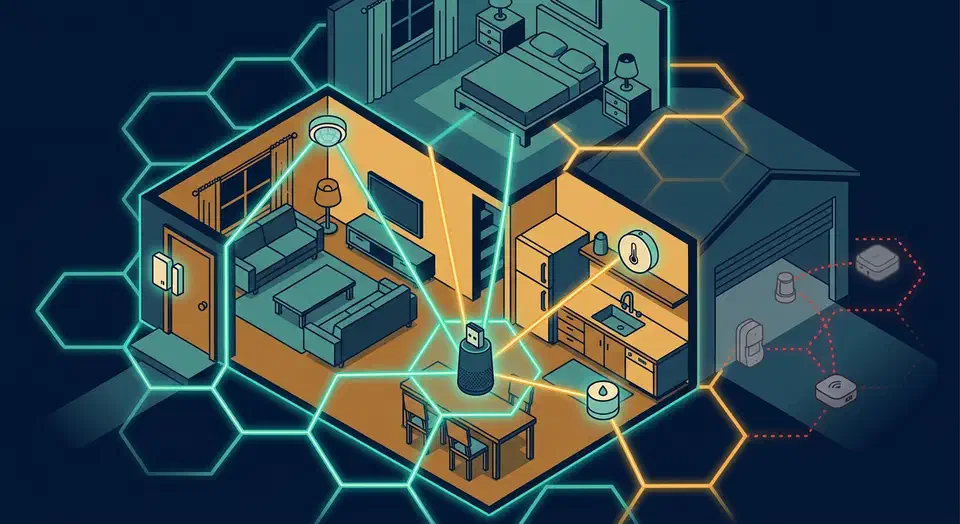
dashboards are achieved by using custom CSS Grid layouts and HACS cards like button-card to create responsive, mobile-first interfaces. Moving beyond the default grid allows you to design a “control center” that looks like a native high-end app rather than a scrolling list of toggles. This guide walks through every layer of that transformation - from understanding why the default UI falls short, to applying CSS Grid fundamentals, building a cohesive theme, structuring room-based navigation, and making everything work beautifully on the HA Companion App.
Designing a Professional Home Assistant Dashboard with CSS
CSS Container Queries: Build Truly Responsive Components
CSS container queries
(@container) style components based on the width of their parent container instead of the browser viewport. Add container-type: inline-size to a parent element, write @container (min-width: 400px) { ... } rules on the children, and those children automatically adapt their layout based on the space available to them - not the screen size. All major browsers have supported container queries since early 2023 (Chrome 105+, Firefox 110+, Safari 16+), and as of 2026 they sit at over 96% global support according to Can I Use
.
Production LLM Hallucinations: Taxonomy, Evals, and RAG Defenses
Fixing LLM hallucinations in production needs a layered defense. Use Chain-of-Verification at inference time. Ground the model in trusted data. Build eval suites that give you a hallucination rate you can track and gate in CI . No single trick fixes this. But pair prompt rules with retrieval-augmented grounding , self-checking, and validation layers, and you turn it into a problem you can measure and ship against.
What Is Hallucination? A Taxonomy for Developers
“Hallucination” has become an umbrella label for almost any unexpected LLM output. That fuzziness is dangerous in production. Each failure mode has a distinct cause and a distinct fix. Lump them together and you’ll apply the wrong remedy to the wrong problem. You’ll spend cycles on prompt tuning when the real issue is retrieval quality, or add RAG when the failure is instruction-following. Before you can fix hallucinations, you need a precise vocabulary for what you’re seeing.
Restore an Old MacBook Pro with Modern Linux (2026)
You can revive a 2012-2015 MacBook Pro by swapping the HDD for an SSD and installing a light Linux distro. A machine that felt slow and unsupported under macOS turns into a snappy computer for web, writing, and dev work. The swap keeps working hardware out of landfill and gives you a secure, up-to-date machine for years.
Which MacBook Models Are Worth Restoring in 2026?
Not all old MacBooks make good Linux candidates. The key factor is hardware upgradability. Apple’s shift from user-serviceable to sealed hardware draws a hard line.
Better Presence Detection with Bayesian Sensors in Home Assistant
Bayesian sensors in Home Assistant
give you one reliable presence signal by fusing weak ones: phone Wi-Fi, GPS zones, motion, power draw, and more. The bayesian platform doesn’t ask “is this one sensor on?” It asks “given everything I can see right now, how sure am I that someone is home?” The result is a presence system that tolerates dropouts, handles sleeping occupants, and stops the lights clicking off while you’re still on the couch.
Should You Move from Zigbee2MQTT to Matter in 2026?
Matter-over-Thread gives you one standard that works across Apple, Google, and Amazon. But Zigbee2MQTT still wins for power users who want deep local control over old hardware. In 2026, run both: Matter for new buys and energy gear, Zigbee for battery sensors and the long tail of devices that won’t ever get a Matter firmware update.
What Is Matter and Why Does It Exist?
For nearly a decade, the smart home was a patchwork of rival ecosystems. A Philips Hue bulb worked fine in Apple HomeKit, but pairing it with Google Home meant jumping through extra hoops. An Amazon-branded device wouldn’t talk to an Apple TV at all. Brands had to pick a platform alliance and live with it. Buyers paid the hidden cost every time they bought from a brand that didn’t play well with their hub of choice.
Botmonster Tech