 Botmonster Tech
AI generates roughly 41% of all committed code in 2026, with some teams reporting well above 50%. AI-powered review tools have slashed PR cycle times by as much as 59%. And yet, when Sonar surveyed 1,149 developers for their 2026 State of Code report , 47% ranked “reviewing and validating AI-generated code for quality and security” as the single most important skill in the AI era - above prompting ability at 42%. This is the AI code review paradox: the more code AI writes, the more critical human review becomes.

Ditching Claude Opus for GLM 5.1 in OpenClaw at $18/Mo
After Anthropic’s third-party tool restrictions priced agentic users off Claude Opus 4.6, the cheapest working OpenClaw stack is Z.ai’s $18/mo GLM 5 Turbo plan, with Ollama-cloud’s $20/mo GLM 5.1 and MiniMax’s $40/mo highspeed tier as the next two rungs. Kimi 2.6 stays API-only because local deployment needs roughly 750 GB of RAM.
Key Takeaways
- Z.ai’s $18/mo plan running GLM 5 Turbo is the cheapest OpenClaw backend that actually works.
- MiniMax highspeed at $40/mo handles heavier workloads without the four-figure surprise bills.
- Kimi 2.6 needs around 750 GB of RAM to self-host, so almost everyone runs it through the API.
- Keep Claude on the planner role; route scheduled jobs to the cheap backends.
- China-hosted models trade dollars for privacy on iMessage, contacts, and email skills.
Why $1,500/mo Opus Bills Pushed Users to GLM
The pressure here is simple. The moment Anthropic’s third-party tool restrictions kicked in, OpenClaw users who had been running on the Claude Pro CLI got nudged onto pay-per-token API access. At Opus 4.6 list pricing of $15 per million input tokens and $75 per million output tokens, agentic loops add up fast. The OP of the r/openclaw PSA thread tracked his own bill at roughly $1,500/mo before he switched. That figure is the reference point most cost-comparison threads on the sub now cite.

OpenClaw vs Hermes and Why Memory Kills Agent Loyalty
Hermes Agent , built by Nous Research, has taken roughly 30% of OpenClaw’s user base by solving one failure mode: memory. The Kilo.ai synthesis of 1,300+ r/openclaw comments confirms the figure. OpenClaw still wins on multi-agent breadth and 100+ skills, so the right answer depends on which failure mode hurts you more.
Key Takeaways
- About 30% of r/openclaw users have switched to Hermes Agent, mainly for memory reliability.
- Memory failures, not features, are the top reason people leave OpenClaw.
- Hermes ships with memory that works by default; OpenClaw needs heavy prompt-engineering to behave.
- OpenClaw still wins for multi-bot setups across Telegram, Slack, and Discord.
- A growing minority skip both and use OpenAI Codex business-tier instead.
Why r/openclaw Is Migrating to Hermes
The most-cited migration thread on the subreddit is the 167-comment OpenClaw vs Hermes thread , and the top-voted answer to “is Hermes worth a look” reads as a clean defection notice. The poster had run OpenClaw for weeks against the same workload and switched in an afternoon:
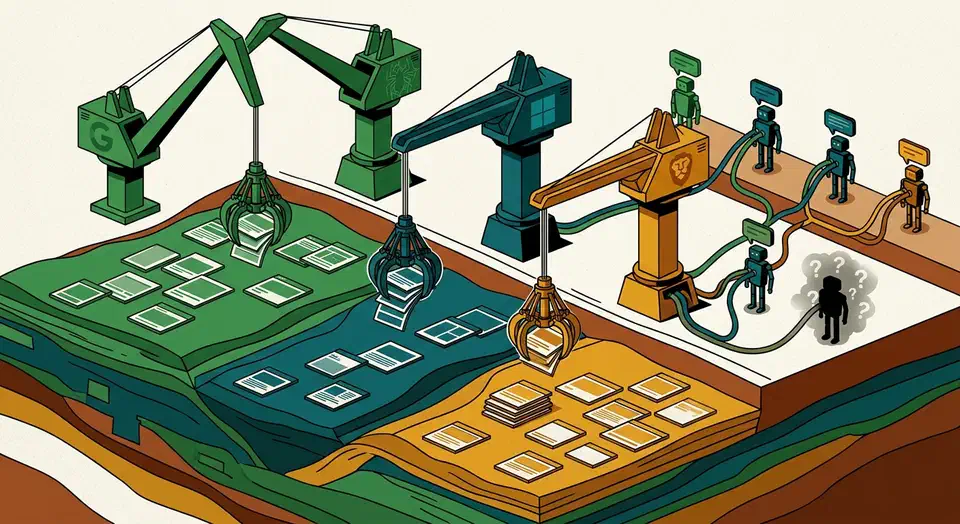
AI Web Search Backends: Who Owns, Who Rents
Only Google Gemini and Microsoft Copilot run on a search index their parent company crawls itself. Anthropic Claude rents Brave Search
, Mistral Le Chat rents Brave too, OpenAI ChatGPT rents Bing
plus its own crawler, and Meta AI rents both. The key clue: Claude’s web_search tool exposes a literal BraveSearchParams field, and citation overlap with Brave runs about 86.7%.
Key Takeaways
- Only Google and Microsoft own a web-scale search index.
- Claude and Mistral both reportedly run on the Brave Search API.
- ChatGPT uses Bing, OpenAI’s own crawler, and publisher deals.
- IndexNow helps Bing-backed AI products, not Brave or Google.
- Brave now acts as AI’s third search pole beside Google and Bing.
Only Five Companies Actually Crawl the Open Web
Before mapping each AI lab to its backend, the key constraint is simple: only five operators crawl the open web at scale. Everything else sold as a “search engine” resells one of those indexes. The five are Google, Microsoft Bing, Yandex, Baidu, and Brave Search, with Mojeek as a much smaller niche sixth.

Claude Code vs COBOL: The AI Migration Controversy That Crashed IBM's Stock 13%
On February 23, 2026, Anthropic published a blog post titled “How AI Helps Break the Cost Barrier to COBOL Modernization” . It shipped with a Code Modernization Playbook . By market close, IBM’s stock had fallen 13.2% to $223.35 per share. That was IBM’s worst single day since October 2000. More than $31 billion in market cap vanished. Accenture fell 6.5%. Cognizant dropped 6%. One blog post had shaken the whole legacy migration sector.

OpenClaw on Your $20 Claude Sub After Anthropic Banned It
OpenClaw’s bundled claude-cli backend is officially sanctioned by Anthropic, while OAuth-token extraction tools stay blocked. The carve-out works because shelling out to claude -p preserves prompt caching, so a $20 Pro or $200 Max sub routes through OpenClaw without four-figure API bills. The catch: a roughly 5-hour cap that cron jobs exhaust in minutes.
Key Takeaways
- OpenClaw’s CLI backend is allowed by Anthropic; the older OAuth-token tools are not.
- The reason it is allowed: it preserves Anthropic’s prompt caching exactly like Claude Code does.
- Pro and Max plans cap usage near 5 hours per window, so cron jobs need a cheaper backup.
- Use Claude for planning and chat, route automated tasks to GLM, MiniMax, or Codex.
- Setup is three commands and one config edit on any Mac or Linux host running Claude Code.
What Changed in Anthropic’s Third-Party Tool Policy?
Most users found out about the policy change when their Anthropic bill jumped, not from a press release. Heavy agentic workflows that previously billed against a flat Pro or Max subscription suddenly tracked toward $1,500 a month on Opus 4.6 once Anthropic forced third-party orchestrators onto the pay-per-token API. The original concern was narrower than the community read it as. Anthropic’s target was a specific class of tool that extracts the OAuth token from a local Claude Code install and calls the Anthropic API directly under that identity. That pattern bypasses Anthropic’s prompt caching and pushes load to the API tier without the caching benefit Anthropic gets when Claude Code itself runs the request.