 Botmonster Tech
I’ve run every Claude tier through my own workflow for months, and Claude Max 20x at $200/month is the best AI coding deal I’ve found for heavy users. It cuts the per-message cost in half versus Pro and gives me about 900 Opus 4.7 messages per 5-hour window on a 1M token context. I tracked one power user who burned 10 billion tokens in eight months for around $800 on Max; the same usage at API rates would top $15,000. Yet Anthropic’s own data shows the average Claude Code user runs about $6/day in API-equivalent spend, with 90% under $12/day. So I think Max 5x at $100/month is the sweet spot for most devs. Max 20x only pays off if you push past 225 messages per 5-hour window on a regular basis.
Llm

Gemini 3.5 Flash: 76% on Terminal-Bench, 4x Faster Output
Google released Gemini 3.5 Flash on May 19, 2026. The fast, lower-cost tier scored 76.2% on Terminal-Bench 2.1 and, by Google’s own measure, generates output about 4 times faster than other frontier models. Flash is available today across the Gemini app, Search, and the API. Gemini 3.5 Pro is confirmed for next month.
Key Takeaways
- Gemini 3.5 Flash launched on May 19, 2026 and is free to use in the Gemini app and Google Search.
- It scored 76.2% on Terminal-Bench 2.1, a test of finishing real terminal tasks end to end.
- Google says Flash produces output about 4 times faster than rival frontier models.
- The model is built for agents that run long, multi-step jobs and call tools.
- Gemini 3.5 Pro, the larger sibling, is confirmed for next month.
What is Gemini 3.5 Flash?
Gemini 3.5 Flash is Google’s new fast, lower-cost tier of the Gemini 3.5 family. It was announced and made generally available on May 19, 2026, according to the Google announcement post . The “Flash” name has always meant a model tuned for speed and price.

Cursor Composer 2.5 vs Composer 2: What Actually Changed
Cursor Composer 2.5 is an incremental upgrade over Composer 2, not a new model. Both run on Moonshot’s open-source Kimi K2.5 checkpoint, so the entire difference is training. Composer 2.5 learned from 25x more synthetic coding tasks plus targeted reinforcement learning. Standard pricing holds at $0.50 per million input tokens.
Key Takeaways
- Composer 2.5 and Composer 2 share the same open-source base model, so only the training changed.
- Cursor trained Composer 2.5 on 25 times more synthetic coding tasks than the older version.
- The standard model costs $0.50 per million input tokens and $2.50 per million output tokens.
- A faster variant exists for $3.00 input and $15.00 output per million tokens.
- Cursor is now building a much larger coding model from scratch with 10x more compute.
What is Cursor Composer 2.5?
Composer 2.5 is Cursor’s in-house coding model and the direct successor to Composer 2. It runs inside the Cursor editor, which slots into a crowded field of AI coding tools . The model is built for sustained work, not just quick one-shot answers.

Ditching Claude Opus for GLM 5.1 in OpenClaw at $18/Mo
Anthropic’s third-party tool rules priced agent users off Claude Opus 4.7. The cheapest working OpenClaw stack now is Z.ai’s $18/mo GLM 5 Turbo plan. Next rungs: Ollama-cloud’s $20/mo GLM 5.1, then MiniMax’s $40/mo highspeed tier. Kimi 2.6 stays API-only since local setup needs about 750 GB of RAM.
Key Takeaways
- Z.ai’s $18/mo plan running GLM 5 Turbo is the cheapest OpenClaw backend that actually works.
- MiniMax highspeed at $40/mo handles heavier workloads without the four-figure surprise bills.
- Kimi 2.6 needs around 750 GB of RAM to self-host, so almost everyone runs it through the API.
- Keep Claude on the planner role; route scheduled jobs to the cheap backends.
- China-hosted models trade dollars for privacy on iMessage, contacts, and email skills.
Why $1,500/mo Opus Bills Pushed Users to GLM
The pressure here is simple. Once Anthropic’s third-party tool rules kicked in, OpenClaw users on the Claude Pro CLI got nudged onto pay-per-token API access. At Opus 4.7 list pricing of $15 per million input tokens and $75 per million output tokens, agent loops add up fast. The OP of the r/openclaw PSA thread tracked his own bill at about $1,500/mo before he switched. That figure is the anchor most cost threads on the sub now cite. The pricing pain did not ease with the next model either: the community reception of Opus 4.7 leaned on token-burn complaints from power users hitting caps in minutes, which is exactly the pattern that turns an OpenClaw cron fleet into a four-figure surprise.
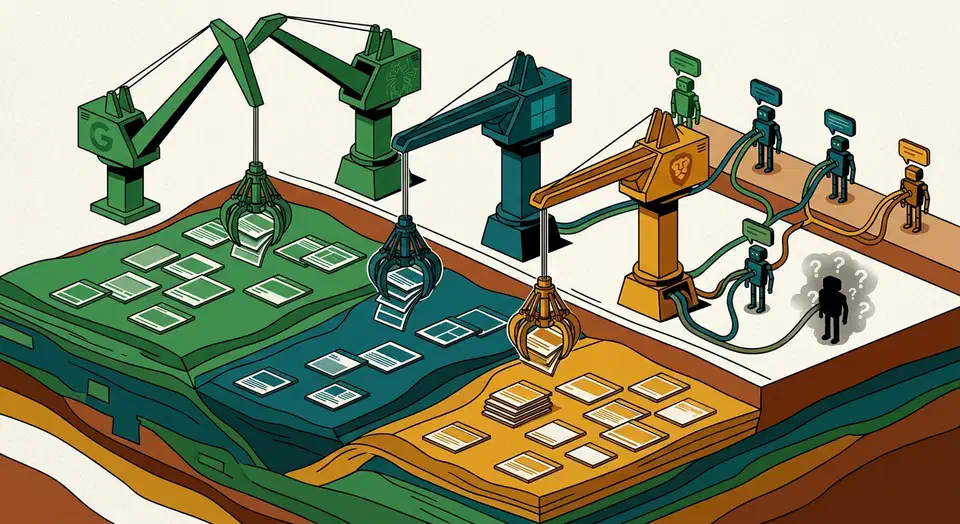
AI Web Search Backends: Who Owns, Who Rents
Only Google Gemini and Microsoft Copilot run on a search index their parent company crawls itself. Anthropic Claude rents Brave Search
, Mistral Le Chat rents Brave too, OpenAI ChatGPT rents Bing
plus its own crawler, and Meta AI rents both. The key clue: Claude’s web_search tool exposes a literal BraveSearchParams field, and citation overlap with Brave runs about 86.7%.
Key Takeaways
- Only Google and Microsoft own a web-scale search index.
- Claude and Mistral both reportedly run on the Brave Search API.
- ChatGPT uses Bing, OpenAI’s own crawler, and publisher deals.
- IndexNow helps Bing-backed AI products, not Brave or Google.
- Brave now acts as AI’s third search pole beside Google and Bing.
Only Five Companies Actually Crawl the Open Web
Before mapping each AI lab to its backend, the key constraint is simple: only five operators crawl the open web at scale. Everything else sold as a “search engine” resells one of those indexes. The five are Google, Microsoft Bing, Yandex, Baidu, and Brave Search, with Mojeek as a much smaller niche sixth.

Claude Code vs COBOL: The AI Migration Controversy That Crashed IBM's Stock 13%
On February 23, 2026, Anthropic published a blog post titled “How AI Helps Break the Cost Barrier to COBOL Modernization” . It shipped with a Code Modernization Playbook . By market close, IBM’s stock had fallen 13.2% to $223.35 per share. That was IBM’s worst single day since October 2000. More than $31 billion in market cap vanished. Accenture fell 6.5%. Cognizant dropped 6%. One blog post had shaken the whole legacy migration sector.