LogoBotmonster Tech
AI Smart Home Self-Hosting Coding Web Dev Hardware Bootpag Image2SVG Tags

Networking

  • ◀︎
  • 1
  • …
  • 3
  • 4
  • 5
  • ▶︎
DIY NAS Comparison: Raspberry Pi 5 vs. Intel N100

DIY NAS Comparison: Raspberry Pi 5 vs. Intel N100

The Intel N100 is the better DIY NAS choice in 2026 if you plan to run Plex or Jellyfin, want ZFS, or need more than two drives. The Raspberry Pi 5 still wins for low-power, always-on file storage where idle power cost is what counts. The right pick depends almost entirely on what you want the box to do.

Why Build a DIY NAS in 2026? The Case Against Synology

Synology and QNAP have spent the last few years getting harder to recommend. Newer Synology units reject non-Synology drives. Those rejected drives work just like the approved ones. The DSM operating system has changed too. It used to be a handy management layer. Now it’s a closed platform that pushes cloud services you didn’t ask for. A Synology DS423+ costs about $500 with no drives. A DIY N100 build with four SATA ports runs under $200.

Solving Slow WiFi on Linux: Moving Beyond the 2.4GHz Bottleneck

Solving Slow WiFi on Linux: Moving Beyond the 2.4GHz Bottleneck

It’s a common frustration. You have a high-end Linux laptop with a cutting-edge WiFi card , yet your speeds are stuck in the single digits. Even on a fast fiber connection, the experience feels sluggish. Web pages hang, and file transfers take ages. Many users blame the drivers. But the cause is often more basic: the radio band you are connected to.

Modern WiFi hardware is very capable. But old networking setups often hold it back. Most routers today broadcast on two main bands: 2.4GHz and 5GHz, and more and more on 6GHz. The 2.4GHz band has better range and gets through walls well. It is also very crowded. Every neighbor’s router, your Bluetooth mouse, and even your microwave use this same space. That congestion leads to packet loss and big speed drops, no matter how fast your internet plan is.

Setup a Private WireGuard VPN for Secure Remote Access

Setup a Private WireGuard VPN for Secure Remote Access

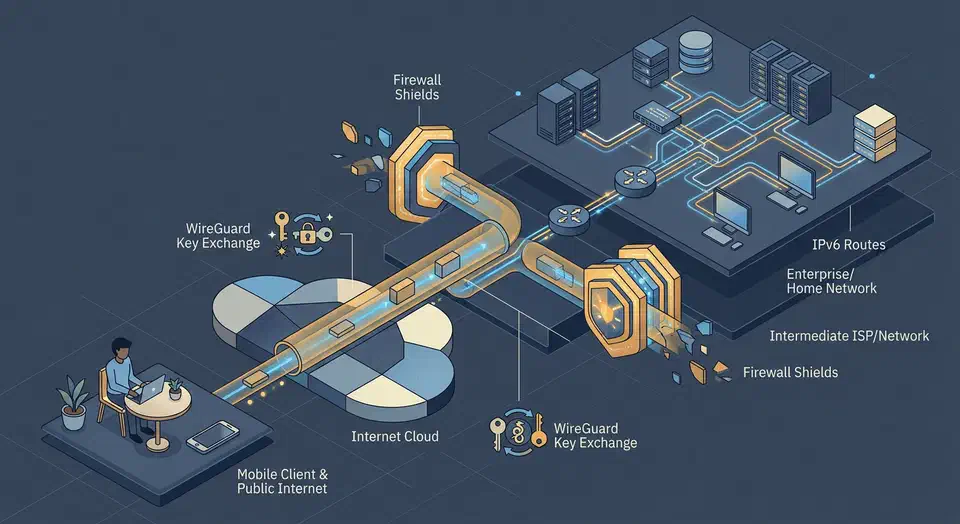
A private WireGuard VPN is the simplest way to reach your home lab, self-hosted apps, and dev machines from anywhere. You don’t expose services directly to the internet. Instead of opening many inbound ports, you publish one UDP endpoint and move trusted traffic through an encrypted tunnel. In 2026, that still gives you the best mix of speed, security, and simple upkeep.

This guide builds a setup from scratch on Ubuntu or Debian . Then it hardens that setup for the real world: home IPs that change, IPv6, mobile clients behind carrier NAT, and networks that try to block VPN traffic. You’ll also see a GUI path, wg-easy , for teams that would rather click than edit config files.

Upgrade Laptop to WiFi 7: M.2 2230 Card and Linux Driver Setup

Upgrade Laptop to WiFi 7: M.2 2230 Card and Linux Driver Setup

To upgrade your laptop to WiFi 7, swap the internal M.2 wireless card for a newer module like the Intel BE200 . The new card enables Multi-Link Operation (MLO), which brings higher throughput and lower latency on 6GHz networks. The physical swap takes about 15 minutes. The real hurdles are checking that your laptop can take a new card and picking one with solid Linux drivers.

Is Your Laptop Upgradeable? Checking Before You Buy

Not all laptops have a wireless card you can reach. Some makers solder the WiFi chip straight onto the motherboard. This is common in ultra-thin designs and many premium laptops built after 2020. Others give you an M.2 slot but bury it under thermal shielding or RAM sticks, so you have to take the whole thing apart to get at it.

ZFS Snapshots Guide: Protect Your Data from Ransomware

ZFS Snapshots Guide: Protect Your Data from Ransomware

Ransomware has shifted from a “big enterprise” worry to a routine risk for freelancers, homelab users, and small teams. In 2026, attacks are faster and quieter. They often start with plain credentials stolen from a browser, a password vault export, or an exposed SSH key. If you run Linux storage and your only safeguard is “we have backups somewhere,” your recovery window is too wide.

ZFS snapshots give you a way to shrink that window. A snapshot is a read-only marker of a dataset at a fixed point in time. ZFS is copy-on-write (CoW). Snapshots are cheap to make, fast to list, and safe to recover from. You just need to set up retention and permissions with care. This guide covers the full plan: setup, install paths, locked-down snapshot controls, jobs with sanoid and syncoid , recovery steps during a live hit, performance cost, and compliance notes.

  • ◀︎
  • 1
  • …
  • 3
  • 4
  • 5
  • ▶︎

Most Popular

Gemma 4 vs Qwen 3.5 vs Llama 4: Which Open Model Should You Actually Use? (2026)

Gemma 4 vs Qwen 3.5 vs Llama 4: Which Open Model Should You Actually Use? (2026)

Gemma 4, Qwen 3.5, and Llama 4 compared on benchmarks, licensing, speed, and hardware so you can pick the right open model fast.

5 Open Source Repos That Make Claude Code Unstoppable

5 Open Source Repos That Make Claude Code Unstoppable

Five March 2026 repos extend Claude Code with autonomous ML, self-healing skills, GUI automation, multi-agent coordination, and Google Workspace access.

Cross-section of a translucent crystal brain threaded by red, gold, and teal attention ribbons resting on a doubly-stochastic matrix pedestal beside a guitar-tuning lab figure.

DeepSeek V4 Tech Report: 3 Tricks That Cut Compute 73%

DeepSeek V4 ships 1.6T parameters and 1M context using only 27% of V3.2's inference FLOPs. Inside the hybrid attention, mHC residuals, and Muon optimizer.

Cracked stone tablet engraved with a bulleted system prompt, four crossed-out goblin silhouettes repeated, a tiny goblin escaping with upvote-arrow sparks, a giant dollar-sign price tag, and figures refusing to step onto a glossier pedestal.

GPT 5.5 Reddit Reception: Goblins and the Cost Backlash

GPT-5.5 Reddit reception: viral goblin prompt leak, doubled pricing backlash, and 5.4 holdouts citing hallucination regressions in factual recall workflows.

What X and Reddit Users Are Saying about Claude Opus 4.7

What X and Reddit Users Are Saying about Claude Opus 4.7

How power users on X and Reddit reacted to Claude Opus 4.7: praise for agentic coding, token burn concerns, and teams' practical prompting habits.

Qwen3.6-35B-A3B: Alibaba's Open-Weight Coding MoE

Qwen3.6-35B-A3B: Alibaba's Open-Weight Coding MoE

Alibaba's sparse Mixture-of-Experts: 35B total parameters, 3B active per token. Q4 quantization runs on MacBook Pro M5, matches Claude Sonnet performance.

Alacritty vs. Kitty: Best High-Performance Linux Terminal

Alacritty vs. Kitty: Best High-Performance Linux Terminal

Alacritty vs Kitty in 2026: emoji and Unicode rendering, real benchmarks, latency, memory, maintainer reputation, and the right terminal for your workflow.

Like what you read?

Get new posts on Linux, AI, and self-hosting delivered to your inbox weekly.

Privacy Policy  ·  Terms of Service
2026 Botmonster