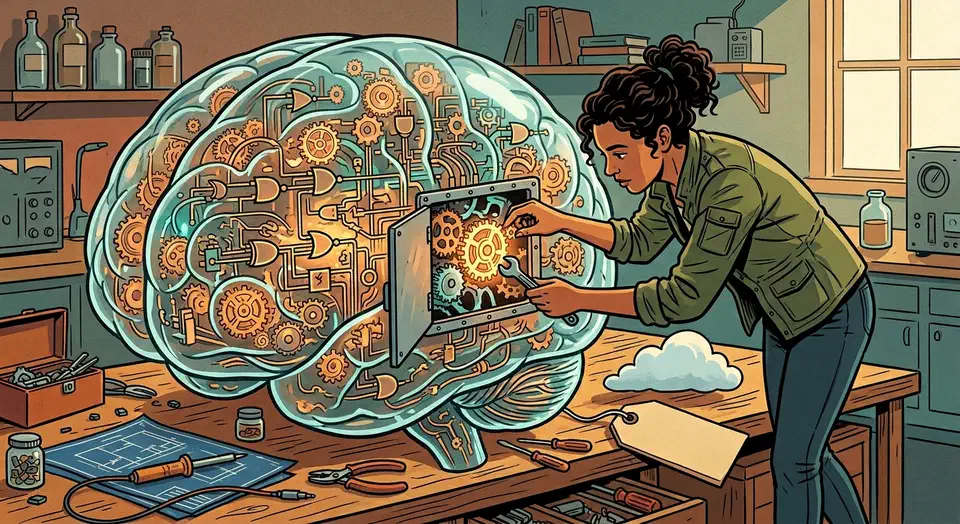
The best way to fine-tune Stable Diffusion XL 2.0 is with Low-Rank Adaptation (LoRA) : a small adapter that injects your style or subject without touching the base weights. Instead of retraining the full model, LoRA trains a tiny side network next to the frozen base. The result is a 50 to 300 MB file you can load, swap, and stack at inference, trained on a 12 GB GPU in an afternoon.
Latest
Hands-on experience with AI, self-hosting, Linux, and the developer tools I actually use
Setup a Private WireGuard VPN for Secure Remote Access
A private WireGuard VPN is the simplest way to reach your home lab, self-hosted apps, and dev machines from anywhere. You don’t expose services directly to the internet. Instead of opening many inbound ports, you publish one UDP endpoint and move trusted traffic through an encrypted tunnel. In 2026, that still gives you the best mix of speed, security, and simple upkeep.
This guide builds a setup from scratch on Ubuntu or Debian . Then it hardens that setup for the real world: home IPs that change, IPv6, mobile clients behind carrier NAT, and networks that try to block VPN traffic. You’ll also see a GUI path, wg-easy , for teams that would rather click than edit config files.
Core Web Vitals: Fix LCP, CLS, and INP
To pass all three Core Web Vitals, target three numbers. Get LCP under 2.5 seconds by preloading your hero image and cutting server response time. Get CLS under 0.1 by reserving explicit dimensions for all media. Get INP under 200ms by breaking long JavaScript tasks into smaller chunks. Diagnose all three with Chrome DevTools, Lighthouse, and the CrUX Dashboard for real-user field data.
Why Core Web Vitals Matter for SEO and User Experience
Google added Core Web Vitals to its ranking algorithm in 2021, and their weight has grown since. The March 2026 core update brought holistic CWV scoring. Google now aggregates performance data across your whole domain rather than judging it page by page. If 30% of your indexed pages fail LCP thresholds, that drags down the site-wide score even when your homepage is fast.
Web Components: Build Framework-Agnostic UI Elements
Web Components are native browser APIs: Custom Elements, Shadow DOM, and HTML Templates. They let you build reusable UI parts like <modal-dialog> or <accordion-panel> that work in React, Vue, Svelte, Angular, or plain HTML. No build tools, no framework lock-in. With 98% browser support in 2026, they’re the most portable component format around. Write it once, ship it anywhere.
The Three APIs That Make Up Web Components
Web Components is an umbrella term for three browser APIs that work together. You can use each one on its own. Custom Elements without Shadow DOM, Shadow DOM without Templates. But the combination is where they shine.
Setup a Private Local RAG Knowledge Base
To build a private Retrieval-Augmented Generation (RAG) system, pair a local vector database like Qdrant with an embedding model like BGE-M3 . Add a local LLM through Ollama , and you can index hundreds of documents and ask questions about them. Your data stays on your machine.
Why RAG? The Problem With Pure LLM Memory
Large language models sound smart, but they are poor knowledge stores. They learn from old training data and know nothing about files you created later or keep private. Ask about your own data, and the model will often guess. Even strong open weight models like Llama 4.0 can invent plausible but wrong answers about content they never saw. For a deeper breakdown of why LLM hallucinations happen and how to measure them, the issue goes beyond missing context.
Track Your Home's Energy Usage with Home Assistant
The average American household spends about $1,500 a year on electricity. Most of it walks out the door with no clear sense of where. Your utility’s smart meter reports yesterday’s total. It won’t tell you that an old game console pulls 30W while it sits “off,” or that your water heater runs right when grid prices peak. Home Assistant fixes that. Pair the right hardware with the built-in Energy Dashboard, and you get per-device, per-circuit visibility.