LogoBotmonster Tech
AI Smart Home Self-Hosting Coding Web Dev Hardware Bootpag Image2SVG Tags
Fix Zigbee Drops: Routers, Channels, and Placement

Fix Zigbee Drops: Routers, Channels, and Placement

The Short Answer

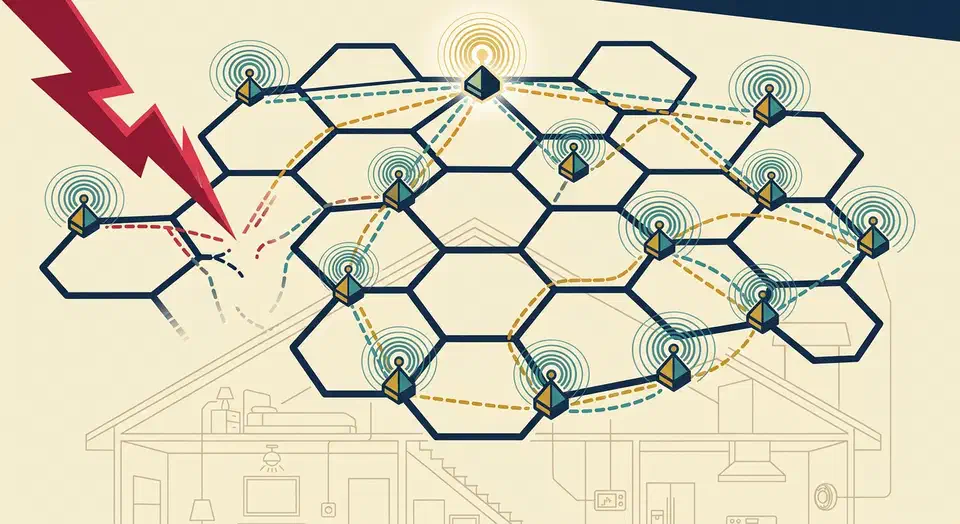
When Zigbee devices keep dropping, the culprit is almost always the mesh topology, not the sensors. Add mains-powered routers every 10 to 15 meters. Move the coordinator away from the WiFi router and any USB 3.0 port. Switch to Zigbee channel 15, 20, or 25 to dodge WiFi. Use the network map in Zigbee2MQTT or ZHA to spot weak links. Roughly 90% of complaints trace back to three things: too few routers, a coordinator in an RF hot zone, and a Zigbee channel that clashes with WiFi.

Monitor Linux Servers: Prometheus and Grafana

Monitor Linux Servers: Prometheus and Grafana

Deploy Prometheus to scrape metrics from node_exporter on each Linux server. Then chart it all in Grafana with CPU, memory, disk, network, and systemd service health. The full stack (Prometheus 3.x, node_exporter 1.10, Grafana 11.6) can watch a 10-server homelab on one Raspberry Pi 4 or a small VM with 1GB RAM. The community Node Exporter Full dashboard (Grafana ID 1860) gives you production-grade views in under 30 minutes.

Track Package Deliveries in Home Assistant with 17TRACK and Automations

Track Package Deliveries in Home Assistant with 17TRACK and Automations

Connect a free 17track.net account to Home Assistant and you can pull tracking data from 3,200+ carriers into one place. From there, automations ping your phone, fire the porch camera, and toggle outdoor lights as boxes move through the system. Below is a working blueprint for the whole flow, from setup to multi-user alert tuning.

Setting Up the 17TRACK Integration

17track.net is a tracking aggregator. It pulls status updates from USPS, UPS, FedEx, DHL, Royal Mail, China Post, YunExpress, and roughly 3,200 other carriers across 220 countries. Once you add tracking numbers to your 17track account (by hand, through the mobile app, or via email forwarding), the Home Assistant integration mirrors them as sensor entities. You can then display them and build automations on top.

Deploy Ceph with cephadm: 3-node, 12 OSD storage cluster

Deploy Ceph with cephadm: 3-node, 12 OSD storage cluster

Yes, you can build a self-healing, redundant distributed storage cluster using Ceph across three Linux nodes. It’s less painful than its reputation suggests, thanks to the modern cephadm tool. You get block storage (RBD) for VMs, a shared POSIX filesystem (CephFS) for many clients, and S3-compatible object storage if you want it. Your data survives the loss of any node, rebalances on its own when hardware changes, and scales from a homelab to petabyte production by adding more disks.

Home Assistant Energy Dashboard: 4 Flows, Solar, and Battery Tracking

Home Assistant Energy Dashboard: 4 Flows, Solar, and Battery Tracking

The Home Assistant Energy Dashboard shows you where your power comes from, where it goes, and what it costs. If you have solar panels and a battery, it’s the best way to track output, storage cycles, grid flow, and per-device use, all without your inverter maker’s cloud app.

Setup takes care, though. The dashboard wants specific sensor types with specific attributes. Get those wrong and you get blank graphs or wildly wrong numbers. Below: the sensor rules, how to wire up popular inverter and battery brands, the dashboard setup itself, and some custom sensors for deeper insight into your solar setup.

Is Systemd-Nspawn a Better Alternative to Docker for Linux Containers?

Is Systemd-Nspawn a Better Alternative to Docker for Linux Containers?

Yes. For many workloads, systemd-nspawn beats Docker on leanness, simplicity, and host integration. It shines on servers and homelabs where you want isolated environments without daemon overhead. You launch a container with one command, manage it with machinectl, and run it as a systemd service. All the tools already ship with every modern Linux system.

That said, Docker and nspawn solve slightly different problems. Knowing where each one wins makes the choice easy.

  • ◀︎
  • 1
  • 2
  • 3
  • ▶︎

Most Popular

Gemma 4 vs Qwen 3.5 vs Llama 4: Which Open Model Should You Actually Use? (2026)

Gemma 4 vs Qwen 3.5 vs Llama 4: Which Open Model Should You Actually Use? (2026)

Gemma 4, Qwen 3.5, and Llama 4 compared on benchmarks, licensing, speed, and hardware so you can pick the right open model fast.

5 Open Source Repos That Make Claude Code Unstoppable

5 Open Source Repos That Make Claude Code Unstoppable

Five March 2026 repos extend Claude Code with autonomous ML, self-healing skills, GUI automation, multi-agent coordination, and Google Workspace access.

Cross-section of a translucent crystal brain threaded by red, gold, and teal attention ribbons resting on a doubly-stochastic matrix pedestal beside a guitar-tuning lab figure.

DeepSeek V4 Tech Report: 3 Tricks That Cut Compute 73%

DeepSeek V4 ships 1.6T parameters and 1M context using only 27% of V3.2's inference FLOPs. Inside the hybrid attention, mHC residuals, and Muon optimizer.

Cracked stone tablet engraved with a bulleted system prompt, four crossed-out goblin silhouettes repeated, a tiny goblin escaping with upvote-arrow sparks, a giant dollar-sign price tag, and figures refusing to step onto a glossier pedestal.

GPT 5.5 Reddit Reception: Goblins and the Cost Backlash

GPT-5.5 Reddit reception: viral goblin prompt leak, doubled pricing backlash, and 5.4 holdouts citing hallucination regressions in factual recall workflows.

What X and Reddit Users Are Saying about Claude Opus 4.7

What X and Reddit Users Are Saying about Claude Opus 4.7

How power users on X and Reddit reacted to Claude Opus 4.7: praise for agentic coding, token burn concerns, and teams' practical prompting habits.

Qwen3.6-35B-A3B: Alibaba's Open-Weight Coding MoE

Qwen3.6-35B-A3B: Alibaba's Open-Weight Coding MoE

Alibaba's sparse Mixture-of-Experts: 35B total parameters, 3B active per token. Q4 quantization runs on MacBook Pro M5, matches Claude Sonnet performance.

Alacritty vs. Kitty: Best High-Performance Linux Terminal

Alacritty vs. Kitty: Best High-Performance Linux Terminal

Compare Alacritty and Kitty terminal emulators: performance benchmarks, latency, memory use, startup time, and which fits your Linux workflow best.

Like what you read?

Get new posts on Linux, AI, and self-hosting delivered to your inbox weekly.

Privacy Policy  ·  Terms of Service
2026 Botmonster