LogoBotmonster Tech
AI Smart Home Self-Hosting Coding Web Dev Hardware Bootpag Image2SVG Tags

Ai-Agents

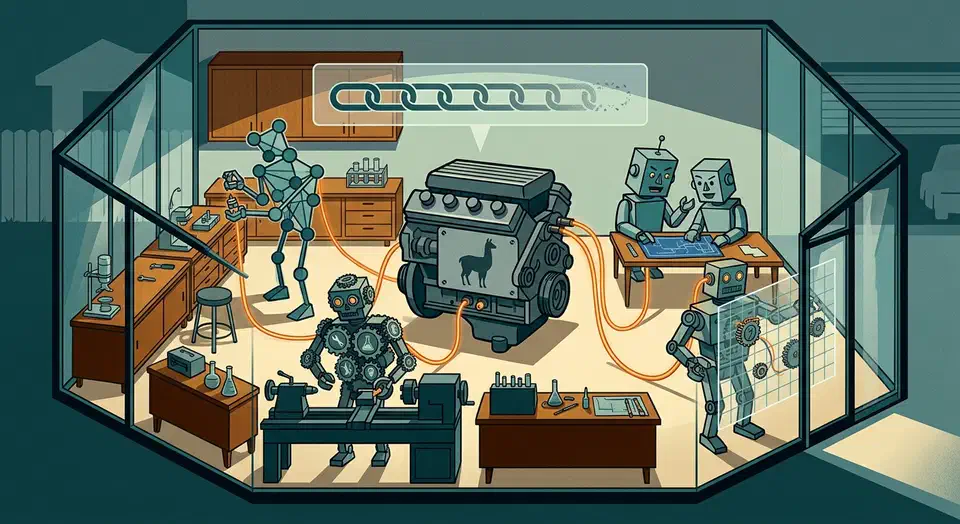
Four distinct robots in a sealed glass workshop, each cabled to one central llama-stamped engine, with an eight-link reliability gauge fading at the end.

Self-Hosted AI Agent Frameworks in 2026: Local-First Compared

A self-hosted AI agent needs to run entirely on your own Ollama or vLLM with no OpenAI key. All four major frameworks claim that support, but only LangGraph and CrewAI wire to a local model with zero workarounds. AutoGen needs a client swap, and Flowise needs one base-URL field. The model, not the framework, is the real reliability ceiling.

Key Takeaways

  • All four run on Ollama, but only LangGraph and CrewAI need zero workarounds.
  • The small local model, not the framework, is what breaks tool calling.
  • Flowise is the only true no-code pick; LangGraph is the most code-heavy.
  • Most framework docs still assume an OpenAI key, so budget setup time.
  • Use Qwen3 or larger for agents; smaller models drop tool calls under load.

Why Local-First Fitness Is the Axis That Counts

Most “best agent framework” roundups assume you have an OpenAI key and a credit card. The first code sample spins up a hosted client, and the “swap to local” path is a footnote if it shows up at all. Self-hosters ask a sharper question about whether any of these run on their own box with no cloud call.

Dark server room at night with racks of glowing servers and a terminal showing red terraform destroy text

When Claude Code Ran terraform destroy on Production - The DataTalks.Club Incident

On February 26, 2026, Claude Code ran terraform destroy against a stale state file. It wiped 2.5 years of DataTalks.Club production data: the RDS database, VPC, ECS cluster, load balancers, and every automated snapshot. Four cascading failures, each one preventable, took down a platform serving 100,000 learners.

Alexey Grigorev runs DataTalks.Club , a data engineering school with over 100,000 learners. He lost 1,943,200 rows of homework, project entries, and leaderboard scores when Claude Code ran the command against his whole production stack. The database, the VPC, the ECS cluster, load balancers, bastion host, and every automated snapshot were gone in seconds.

A lightning-bolt-shaped racing vehicle speeds across a landscape of terminal windows while small subagents fan out and a rocket waits on a launchpad.

Gemini 3.5 Flash: 76% on Terminal-Bench, 4x Faster Output

Google released Gemini 3.5 Flash on May 19, 2026. The fast, lower-cost tier scored 76.2% on Terminal-Bench 2.1 and, by Google’s own measure, generates output about 4 times faster than other frontier models. Flash is available today across the Gemini app, Search, and the API. Gemini 3.5 Pro is confirmed for next month.

Key Takeaways

  • Gemini 3.5 Flash launched on May 19, 2026 and is free to use in the Gemini app and Google Search.
  • It scored 76.2% on Terminal-Bench 2.1, a test of finishing real terminal tasks end to end.
  • Google says Flash produces output about 4 times faster than rival frontier models.
  • The model is built for agents that run long, multi-step jobs and call tools.
  • Gemini 3.5 Pro, the larger sibling, is confirmed for next month.

What is Gemini 3.5 Flash?

Gemini 3.5 Flash is Google’s new fast, lower-cost tier of the Gemini 3.5 family. It was announced and made generally available on May 19, 2026, according to the Google announcement post . The “Flash” name has always meant a model tuned for speed and price.

Claude Agent SDK: Build Custom AI Agents Without Reinventing the Orchestration Layer

Claude Agent SDK: Build Custom AI Agents Without Reinventing the Orchestration Layer

The Claude Agent SDK is the Claude Code engine stripped down to a library. Same agent loop, same built-in tools, same context handling, but you call it from your own Python or TypeScript code instead of the CLI. If you’ve used Claude Code to read files, run shell commands, search codebases, and edit code, the SDK points that same machinery at any problem you want. No human needs to sit in the loop.

Robotic claw extending from a laptop screen flinging a paper-airplane text message toward three small house silhouettes across colored permission zones

OpenClaw Texted My Ex and Why iMessage Access Is a Trap

The viral r/ChatGPT “my OpenClaw texted my ex” post reads like a joke, but the comments treat it as a warning sign. Keep OpenClaw’s iMessage, SMS, and contacts skills off your personal Mac. Wait until LTS ships and the founder’s “rough week” supply-chain fixes land. Scope write-access skills to a disposable VPS instead.

Key Takeaways

  • The viral “texted my ex” post is a leading indicator, not just a meme.
  • iMessage, SMS, and contacts are write-heavy skills that touch your real social graph.
  • Forgetful agents plus unsupervised cron jobs turn wrong-recipient sends into expected behavior.
  • Run write-heavy OpenClaw skills on a disposable VPS, not your personal Mac.
  • Wait for the LTS release before treating OpenClaw as personal-machine infrastructure.

The viral OpenClaw meme is not just a meme

A screenshot of OpenClaw happily reporting that it had texted the OP’s ex hit 4.8K upvotes and 176 comments on r/ChatGPT in about three weeks. The top replies are jokes (“Of all the things that didn’t happen, this happened the didn’test”). The serious comments point at a real safety category that is forming in real time.

Brass alchemist scales weighing a heavy pile of gold coins with a red 1500 price tag against a small pyramid of bronze coins and a teal dragon-circuit gem, with five colored arrows pointing to isometric server towers

Ditching Claude Opus for GLM 5.1 in OpenClaw at $18/Mo

Anthropic’s third-party tool rules priced agent users off Claude Opus 4.7. The cheapest working OpenClaw stack now is Z.ai’s $18/mo GLM 5 Turbo plan. Next rungs: Ollama-cloud’s $20/mo GLM 5.1, then MiniMax’s $40/mo highspeed tier. Kimi 2.6 stays API-only since local setup needs about 750 GB of RAM.

Key Takeaways

  • Z.ai’s $18/mo plan running GLM 5 Turbo is the cheapest OpenClaw backend that actually works.
  • MiniMax highspeed at $40/mo handles heavier workloads without the four-figure surprise bills.
  • Kimi 2.6 needs around 750 GB of RAM to self-host, so almost everyone runs it through the API.
  • Keep Claude on the planner role; route scheduled jobs to the cheap backends.
  • China-hosted models trade dollars for privacy on iMessage, contacts, and email skills.

Why $1,500/mo Opus Bills Pushed Users to GLM

The pressure here is simple. Once Anthropic’s third-party tool rules kicked in, OpenClaw users on the Claude Pro CLI got nudged onto pay-per-token API access. At Opus 4.7 list pricing of $15 per million input tokens and $75 per million output tokens, agent loops add up fast. The OP of the r/openclaw PSA thread tracked his own bill at about $1,500/mo before he switched. That figure is the anchor most cost threads on the sub now cite. The pricing pain did not ease with the next model either: the community reception of Opus 4.7 leaned on token-burn complaints from power users hitting caps in minutes, which is exactly the pattern that turns an OpenClaw cron fleet into a four-figure surprise.

  • ◀︎
  • 1
  • 2
  • 3
  • 4
  • ▶︎

Most Popular

Gemma 4 vs Qwen 3.5 vs Llama 4: Which Open Model Should You Actually Use? (2026)

Gemma 4 vs Qwen 3.5 vs Llama 4: Which Open Model Should You Actually Use? (2026)

Gemma 4, Qwen 3.5, and Llama 4 compared on benchmarks, licensing, speed, and hardware so you can pick the right open model fast.

5 Open Source Repos That Make Claude Code Unstoppable

5 Open Source Repos That Make Claude Code Unstoppable

Five March 2026 repos extend Claude Code with autonomous ML, self-healing skills, GUI automation, multi-agent coordination, and Google Workspace access.

Cross-section of a translucent crystal brain threaded by red, gold, and teal attention ribbons resting on a doubly-stochastic matrix pedestal beside a guitar-tuning lab figure.

DeepSeek V4 Tech Report: 3 Tricks That Cut Compute 73%

DeepSeek V4 ships 1.6T parameters and 1M context using only 27% of V3.2's inference FLOPs. Inside the hybrid attention, mHC residuals, and Muon optimizer.

Cracked stone tablet engraved with a bulleted system prompt, four crossed-out goblin silhouettes repeated, a tiny goblin escaping with upvote-arrow sparks, a giant dollar-sign price tag, and figures refusing to step onto a glossier pedestal.

GPT 5.5 Reddit Reception: Goblins and the Cost Backlash

GPT-5.5 Reddit reception: viral goblin prompt leak, doubled pricing backlash, and 5.4 holdouts citing hallucination regressions in factual recall workflows.

What X and Reddit Users Are Saying about Claude Opus 4.7

What X and Reddit Users Are Saying about Claude Opus 4.7

How power users on X and Reddit reacted to Claude Opus 4.7: praise for agentic coding, token burn concerns, and teams' practical prompting habits.

Qwen3.6-35B-A3B: Alibaba's Open-Weight Coding MoE

Qwen3.6-35B-A3B: Alibaba's Open-Weight Coding MoE

Alibaba's sparse Mixture-of-Experts: 35B total parameters, 3B active per token. Q4 quantization runs on MacBook Pro M5, matches Claude Sonnet performance.

Alacritty vs. Kitty: Best High-Performance Linux Terminal

Alacritty vs. Kitty: Best High-Performance Linux Terminal

Alacritty vs Kitty in 2026: emoji and Unicode rendering, real benchmarks, latency, memory, maintainer reputation, and the right terminal for your workflow.

Like what you read?

Get new posts on Linux, AI, and self-hosting delivered to your inbox weekly.

Privacy Policy  ·  Terms of Service
2026 Botmonster