LogoBotmonster Tech
AI Smart Home Self-Hosting Coding Web Dev Hardware Bootpag Image2SVG Tags

Local-Ai

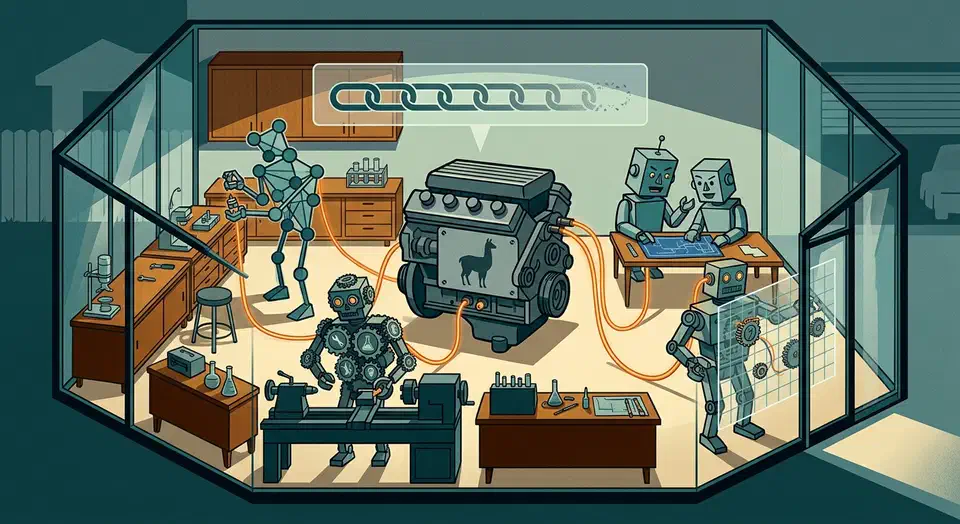
Four distinct robots in a sealed glass workshop, each cabled to one central llama-stamped engine, with an eight-link reliability gauge fading at the end.

Self-Hosted AI Agent Frameworks in 2026: Local-First Compared

A self-hosted AI agent needs to run entirely on your own Ollama or vLLM with no OpenAI key. All four major frameworks claim that support, but only LangGraph and CrewAI wire to a local model with zero workarounds. AutoGen needs a client swap, and Flowise needs one base-URL field. The model, not the framework, is the real reliability ceiling.

Key Takeaways

  • All four run on Ollama, but only LangGraph and CrewAI need zero workarounds.
  • The small local model, not the framework, is what breaks tool calling.
  • Flowise is the only true no-code pick; LangGraph is the most code-heavy.
  • Most framework docs still assume an OpenAI key, so budget setup time.
  • Use Qwen3 or larger for agents; smaller models drop tool calls under load.

Why Local-First Fitness Is the Axis That Counts

Most “best agent framework” roundups assume you have an OpenAI key and a credit card. The first code sample spins up a hosted client, and the “swap to local” path is a footnote if it shows up at all. Self-hosters ask a sharper question about whether any of these run on their own box with no cloud call.

A glowing crystalline token-core wrapped in translucent shells, with light streams splitting into one lazy beam and many fast parallel beams

Best Local LLM Runtimes in 2026: Speed vs Setup Tradeoff

The best local LLM runtime in 2026 depends on what runs under the hood. Ollama , LM Studio, and Jan are all just llama.cpp rebranded with a friendlier interface, so you pay a measurable abstraction tax for the convenience. By default llama.cpp and Ollama leave 30 to 50% of VRAM stranded by inefficient KV cache allocation, while vLLM ’s PagedAttention keeps that overhead under 4%.

Key Takeaways

  • Ollama, LM Studio, and Jan are all just llama.cpp rebranded with a friendlier interface.
  • vLLM is the only one built for many users at once, beating Ollama 16 to 20x under load.
  • Ollama and LM Studio are the easiest way to get a model running today.
  • llama.cpp loses 30 to 50% of VRAM to KV cache fragmentation by default; vLLM’s PagedAttention keeps it under 4%.
  • On a Mac, the MLX engine runs about 3x faster than the llama.cpp Metal path.

What are the best local LLM runtimes in 2026?

Five runtimes lead the field this year: Ollama , LM Studio , llama.cpp , vLLM , and Jan . They split into two real categories. Only two are genuine inference engines (llama.cpp and vLLM). The other three, Ollama, LM Studio, and Jan, are just llama.cpp rebranded behind a friendlier interface.

Different-sized glowing AI brains on a weighing scale balanced against stacks of memory chips, the smallest sitting on a 24 GB pedestal

Open-Weight Coding Models Ranked by Capability Per GB (2026)

The best open-weight coding model you can run on a 24 GB GPU in 2026 is Qwen3.6-27B at Q4. It scores 77.2 on SWE-bench Verified while fitting in about 17 GB, the highest coding skill per gigabyte you can actually load at home. DeepSeek V4 wins the leaderboard, but no consumer card can hold it.

Key Takeaways

  • Qwen3.6-27B at Q4 gives the most coding skill per GB on a 24 GB card.
  • DeepSeek V4 tops the leaderboard, but no home GPU can run it.
  • GLM-4.7-Flash fits 24 GB and still clears 59 percent on SWE-bench.
  • Qwen and Devstral ship Apache 2.0; the big models lean on MIT.
  • Pick by the GPU you own, not by the top of the leaderboard.

Why Capability Per GB Beats the Leaderboard

Most 2026 roundups rank coding models by the score of a flagship variant that needs a multi-GPU server. For anyone running models at home, that number is a fantasy. The only figure that counts is how much coding skill fits in the VRAM you actually own.

Cross-section of a translucent crystal brain threaded by red, gold, and teal attention ribbons resting on a doubly-stochastic matrix pedestal beside a guitar-tuning lab figure.

DeepSeek V4 Tech Report: 3 Tricks That Cut Compute 73%

DeepSeek V4 is a 1.6 trillion parameter open-weight Mixture-of-Experts model. It reads 1M tokens at once. It uses 27% of V3.2’s inference FLOPs and 10% of its KV cache. The DeepSeek V4 tech report credits three moves: hybrid CSA plus HCA attention, Manifold-Constrained Hyper-Connections, and the Muon optimizer in place of AdamW.

Key Takeaways

  • DeepSeek V4 is a free, open-weight AI that goes toe-to-toe with the top closed models from OpenAI, Anthropic, and Google.
  • It reads 1 million tokens in one prompt, enough for several full books or a long agent run without losing track.
  • It runs on roughly a quarter of the compute its previous version needed, making long-context AI affordable to operate.
  • A smaller team built it without access to top NVIDIA chips, proving clever engineering can rival raw GPU spend.
  • It scored a perfect 120 out of 120 on the 2025 Putnam math competition and beats Google’s Gemini 3.1 Pro at 1M-token recall.

DeepSeek V4 at a Glance

The official launch announcement on April 24, 2026 framed the release as “the era of cost-effective 1M context length.” It shipped two checkpoints under the MIT license. DeepSeek-V4-Pro runs at 1.6T total and 49B active parameters. DeepSeek-V4-Flash runs at 284B total and 13B active. Both models read 1M tokens at once. Both ship as open weights on Hugging Face . The routed expert weights use FP4 math, and most other weights use FP8.

Run DeepSeek R1 Locally: Reasoning Models on Consumer Hardware

Run DeepSeek R1 Locally: Reasoning Models on Consumer Hardware

You can run DeepSeek R1 ’s distilled reasoning models on an RTX 5080 with 16 GB of VRAM. Use Ollama or llama.cpp with 4-bit quantization. The 14B distilled variant (Q4_K_M) fits in about 10 GB of VRAM. It shows visible <think> reasoning traces that rival cloud quality on math, coding, and logic. The full 671B model needs multi-GPU rigs, but the distilled models give you 80-90% of the quality for far less hardware.

Build an AI-Powered Terminal Assistant with Ollama and Shell Scripts

Build an AI-Powered Terminal Assistant with Ollama and Shell Scripts

You can build a practical AI terminal assistant by wiring Ollama’s local API into shell functions that explain errors, suggest commands, and summarize man pages - all from your .bashrc or .zshrc. No Python dependencies, no cloud API keys, no persistent daemon consuming RAM when you’re not using it. The whole thing fits in under 120 lines of shell script and responds in under a second on modest hardware with a model already loaded.

  • ◀︎
  • 1
  • 2
  • 3
  • …
  • 5
  • ▶︎

Most Popular

Gemma 4 vs Qwen 3.5 vs Llama 4: Which Open Model Should You Actually Use? (2026)

Gemma 4 vs Qwen 3.5 vs Llama 4: Which Open Model Should You Actually Use? (2026)

Gemma 4, Qwen 3.5, and Llama 4 compared on benchmarks, licensing, speed, and hardware so you can pick the right open model fast.

5 Open Source Repos That Make Claude Code Unstoppable

5 Open Source Repos That Make Claude Code Unstoppable

Five March 2026 repos extend Claude Code with autonomous ML, self-healing skills, GUI automation, multi-agent coordination, and Google Workspace access.

Cross-section of a translucent crystal brain threaded by red, gold, and teal attention ribbons resting on a doubly-stochastic matrix pedestal beside a guitar-tuning lab figure.

DeepSeek V4 Tech Report: 3 Tricks That Cut Compute 73%

DeepSeek V4 ships 1.6T parameters and 1M context using only 27% of V3.2's inference FLOPs. Inside the hybrid attention, mHC residuals, and Muon optimizer.

Cracked stone tablet engraved with a bulleted system prompt, four crossed-out goblin silhouettes repeated, a tiny goblin escaping with upvote-arrow sparks, a giant dollar-sign price tag, and figures refusing to step onto a glossier pedestal.

GPT 5.5 Reddit Reception: Goblins and the Cost Backlash

GPT-5.5 Reddit reception: viral goblin prompt leak, doubled pricing backlash, and 5.4 holdouts citing hallucination regressions in factual recall workflows.

What X and Reddit Users Are Saying about Claude Opus 4.7

What X and Reddit Users Are Saying about Claude Opus 4.7

How power users on X and Reddit reacted to Claude Opus 4.7: praise for agentic coding, token burn concerns, and teams' practical prompting habits.

Qwen3.6-35B-A3B: Alibaba's Open-Weight Coding MoE

Qwen3.6-35B-A3B: Alibaba's Open-Weight Coding MoE

Alibaba's sparse Mixture-of-Experts: 35B total parameters, 3B active per token. Q4 quantization runs on MacBook Pro M5, matches Claude Sonnet performance.

Alacritty vs. Kitty: Best High-Performance Linux Terminal

Alacritty vs. Kitty: Best High-Performance Linux Terminal

Alacritty vs Kitty in 2026: emoji and Unicode rendering, real benchmarks, latency, memory, maintainer reputation, and the right terminal for your workflow.

Like what you read?

Get new posts on Linux, AI, and self-hosting delivered to your inbox weekly.

Privacy Policy  ·  Terms of Service
2026 Botmonster